
Power Your Software Testing with AI Agents and Cloud
The Native AI-Agentic Cloud Platform to Supercharge Quality Engineering. Test Intelligently and Ship Faster.

- TestMu AI (Formerly LambdaTest)
- /
- Blog
- /
- Autonomous Test Orchestration: How Agents Decide What Runs
Autonomous Test Orchestration: How Agents Decide What Runs
Autonomous test orchestration lets an agent decide what runs, where, and what broke. See the four decisions, a working config, and which calls to keep gated.
Published on:
A pull request lands at four in the afternoon. An agent reads the diff, picks a subset of the regression suite, spreads it across parallel lanes, watches two checks fail, retries one on a timeout signature, and files the other as a genuine regression before anyone opens the tab. Nobody chose that subset.
That loop is autonomous test orchestration. The pipeline still executes the tests; the agent decides what belongs in the run, where it goes, and what its failures mean.
The pressure to keep handing over that judgment is real, because the delegation pays: in the 2025 Stack Overflow Developer Survey, among developers who have used AI agents at work, 69% agree they have experienced an increase in productivity. The open question is which of those decisions anyone is still checking.
TL;DR
Autonomous test orchestration is test orchestration where an agent produces the plan instead of executing one you wrote in advance. It decides which tests a change needs, how they spread across infrastructure, what gets retried or aborted mid-run, and what each failure means. The execution substrate does not change; the source of the decisions does.
What Does an Autonomous Orchestrator Decide?
- Scope: An autonomous orchestrator picks which tests a given diff needs, the one decision in the loop with no deterministic answer. Safe to delegate above a fixed floor of always-run tests: yes.
- Placement: An autonomous orchestrator decides how the selected tests spread across parallel lanes. In a measured run of six identical checks on TestMu AI cloud, six lanes finished in 13,963 ms against 94,905 ms in a single lane.
- Execution control: An autonomous orchestrator adjusts a run already in flight, retrying on matched error patterns, aborting a uniformly broken build, and reordering previously failing tests first. Safe to delegate when retries are scoped by regex: yes.
- Triage: An autonomous orchestrator classifies each failure as an application bug, a script bug, or the environment. TestMu AI runs triage as a pipeline from smart tags through flaky-test detection and failure categorization into root cause analysis.
What Should Stay Under Human Control?
No agent should be able to make a failure disappear. Muting a repeatedly failing test stays an admin-owned dashboard setting, and the release gate stays with a person who can be asked why a build shipped. Agent approves the release on its own: no.
What Is Autonomous Test Orchestration?
Autonomous test orchestration is test orchestration in which an agent chooses the plan rather than executing one a team encoded ahead of time. It selects the tests a change needs, places them on infrastructure, adapts the run while it is in flight, and classifies what failed.
The distinction matters because two neighbouring terms already have meanings. Conventional test orchestration coordinates sequencing, environments, dependencies, and reporting according to rules somebody wrote down. Autonomous testing describes tests that generate, heal, and interpret themselves.
Autonomous orchestration sits between them and inherits the risk of both. The pipeline machinery stays exactly where it was, and the decisions move upstream into a model whose reasoning you cannot read from a YAML file.
This is why the useful question is which specific decisions to hand over. A team that delegates test selection and keeps the release gate has a different risk profile from one that lets an agent mute failing tests, even though both would describe themselves as running autonomous orchestration.
How an Autonomous Orchestration Loop Runs
Each decision in the loop carries a different blast radius. Walking them in order shows where the agent's judgment is genuinely useful and where the platform should stay deterministic.
Deciding Which Tests Run
Selection is the decision with no deterministic answer, which is exactly why it suits an agent. A dependency graph tells you which tests import the changed module; it cannot tell you that a checkout regression usually follows a change to the currency formatter three files away.
Be precise about which system provides this capability, because the marketing category invites a wrong assumption. HyperExecute does not ship risk-based test prioritization or test-impact analysis. What it documents is manual job priority labels of high, medium, or low, plus automatic reordering that surfaces previously failing tests first.
That split is the honest architecture of autonomous orchestration today. The agent supplies the selection, the platform supplies the distribution, and the boundary between them is the thing you can audit. Agentic regression testing covers how to bound that selection so a narrowed run still protects the release.
- Floor the selection - define a set of tests that always run regardless of what the agent concludes, so a confident wrong answer cannot reduce the suite to nothing.
- Record the reasoning - store which tests were skipped and why, because a skipped test that later fails in production is the only feedback the selector will ever get.
- Widen on signal - treat a production incident or a merged hotfix as a trigger to run the full suite rather than the narrowed one.
Placing the Run on Infrastructure
Once the agent has a list, something has to turn it into parallel work. This is where TestMu AI's HyperExecute orchestration cloud does the deterministic half of the job, running suites up to 70% faster than traditional grids by keeping the test script and its execution components in one isolated environment instead of round-tripping between a hub and remote nodes.
Three distribution strategies exist, and picking between them is the agent's second decision. Matrix builds a Cartesian product of declared dimensions and runs one task per combination. Auto-Split discovers test entities and spreads them across a pool of virtual machines you size with a concurrency key.
Auto-Split is the right default when the parallelism comes from splitting test files rather than from environment dimensions, which is the usual shape of an agent-selected subset:
version: 0.1
runson: linux
autosplit: true
concurrency: 10

pre:
  - mvn dependency:resolve

testDiscovery:
  type: raw
  mode: remote
  command: grep -nri 'public class' src/test/java/**/*.java | awk '{print $3}'

testRunnerCommand: mvn test -Dtest=$test

report: true
partialReports:
  location: target/surefire-reports
  type: html
  frameworkName: testng
Three keys carry the whole strategy. The autosplit flag activates it, concurrency declares how many machines the suite spreads across, and testRunnerCommand must contain the $test placeholder so each discovered entity runs in isolation. Every key is documented in the HyperExecute YAML parameters reference.
Controlling Execution Mid-Run
A run that has started is still a decision surface. Blanket retries are where most teams accidentally break their own signal, because retrying everything converts a real assertion failure into a pass on the second attempt.
Scoping the retry to a matched error signature is the fix. Infrastructure signatures get another attempt; assertion failures fail immediately:
retryOnFailure: true
maxRetries: 3
retryOptions:
  errorRegexps: ["org.openqa.selenium.NoSuchElementException"]

failFast:
  maxNumberOfTests: 2
  level: scenario
Two behaviours here surprise people. Retries fire only when the test runner command itself exits non-zero, so a Maven build configured with testFailureIgnore set to true reports success and never retries at all. The fail-fast counter also resets on a pass, which means it aborts a uniformly broken build rather than an intermittently flaky one.
Test muting deliberately sits outside all of this. It is an organization setting under product preferences with a default threshold of five consecutive failures, owned by an admin rather than exposed as a YAML key an agent could write.
Triaging What Failed
A run that returns 40 failures has not finished its job. TestMu AI structures triage as a pipeline rather than a feature list: execution feeds smart tags, which feed flaky-test detection, which feeds failure categorization, which feeds root cause analysis with a recommended fix.
The governance layer is the part that matters for autonomy. Automatic root cause analysis is scoped by an admin to one of three analysis scopes, and the definitions are precise enough to reason about:
- All failures - every failing test is analysed, which is the widest and most expensive scope.
- New failures - a test that failed after passing at least 10 consecutive times, which isolates genuine regressions from long-standing breakage.
- Consistent failures - a test that failed in all of the previous 5 runs, which surfaces the breakage everyone has learned to ignore.
Regex include and exclude rules narrow it further across test names, build names, tags, and job labels, and admins can define their own classification categories so the model uses the buckets the organization actually argues in. Manual analysis returns in a documented 20 to 30 seconds. The same signals surface in TestMu AI's test intelligence dashboards.
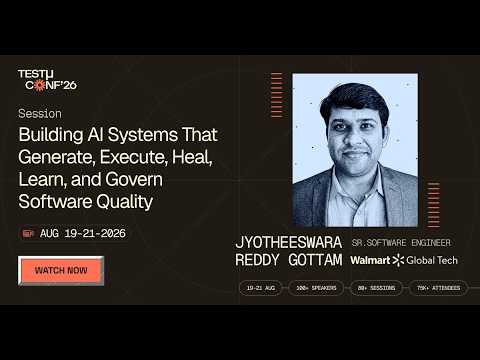
The part this loop does not cover is what the system learns from its own decisions and how it governs them. In this TestMu Conf 2026 session, Jyotheeswara Reddy Gottam presents Autonomous Quality Engineering: Building AI Systems That Generate, Execute, Heal, Learn, and Govern Software Quality, a proposed framework that combines generative AI, LLMs, AI agents, machine learning models, and observability feedback to cover LLM-based test generation, self-healing automation, output quality scoring, predictive defect analytics, and intelligent release decisions.

Note: Run an agent-selected subset across parallel lanes on TestMu AI and see the wall-clock difference on your own suite. Start free
A Measured Run on TestMu AI Cloud
Placement is the decision teams argue about with the least evidence, so I measured it. Six identical Selenium checks ran against the TestMu AI Selenium Playground form demo on Chrome and Windows 11, first serially in one lane and then all six at once, under build 103188023 on the TestMu AI automation dashboard.
Each case typed its own marker value and asserted that the page echoed that exact value back, so a case could not silently pass on a neighbour's result. This is the verbatim console output, with the adapter connection lines trimmed:
PHASE A - serial placement (1 lane, 6 checks back to back)
  [serial] alpha    PASS     9573 ms
  [serial] bravo    FAIL    41473 ms  Wait timed out after 30019ms
  [serial] charlie  PASS    12106 ms
  [serial] delta    PASS     9159 ms
  [serial] echo     PASS    10414 ms
  [serial] foxtrot  PASS     9985 ms
  PHASE A total wall clock: 94905 ms

PHASE B - parallel placement (6 lanes, 6 checks at once)
  [parallel] bravo    PASS   10586 ms
  [parallel] foxtrot  PASS   11939 ms
  [parallel] alpha    PASS   12014 ms
  [parallel] echo     PASS   12338 ms
  [parallel] delta    PASS   12465 ms
  [parallel] charlie  PASS   13533 ms
  PHASE B total wall clock: 13963 ms
Three findings came out of it, and only the first is the one people expect.
- Wall clock collapsed - 94,905 ms serial against 13,963 ms parallel, a ratio of 6.8x. That ratio flatters parallelism, because one serial case flaked. Had it passed at the serial median, six healthy serial cases would land near 61,000 ms, which is a ratio closer to 4.4x against a theoretical ceiling of 6x for six lanes.
- Per-case latency got worse - the median case took 9,985 ms serially and 12,176 ms in parallel, roughly 22% slower. An orchestrator tuned to minimise per-test duration would read this as a regression and reduce concurrency, which is the wrong call.
- One flake cost more than the parallelism saved - the failing case burned 41,473 ms, about 44% of the entire serial phase, on a 30-second wait timeout. Retry and fail-fast policy is not a tuning detail at this scale; it is the dominant term.
The caveat is real: this is one run of six short checks on one browser and operating system, not a benchmark of a production suite. It is enough to establish direction and to make the second finding concrete, which is that suite completion time and per-test latency move in opposite directions under parallelism.
That opposition is the reason an autonomous orchestrator needs its objective stated explicitly. Optimize suite completion time and it adds lanes; optimize average test duration and it removes them.
Delegation Boundaries for an Autonomous Orchestrator
Every decision in the loop can be delegated. Not every decision should be, and the dividing line is simple to state: an agent may decide how work gets done, and may not decide whether a failure counts.
| Decision | Delegate to the agent? | Failure mode if left ungated |
|---|---|---|
| Which tests run for a diff | Yes, above a fixed floor of always-run tests | The agent narrows confidently and wrongly, and a regression ships in a path nobody exercised |
| How the suite splits across lanes | Yes, within a concurrency cap | Unbounded lanes drain shared concurrency and stall every other team's merge queue |
| Retrying a failed test | Yes, only on matched error patterns | Blanket retries turn a genuine assertion failure into a green run on the second attempt |
| Aborting a broken build | Yes | A uniformly broken build burns the full suite's compute before anyone reads the first failure |
| Muting a repeatedly failing test | No, admin-owned | A real regression leaves the report instead of blocking the release, and nothing records that it did |
| Classifying a failure as flaky | Recommend only, human confirms | The one failure that mattered gets reclassified as noise and stops being investigated |
| Approving the release gate | No | Nobody owns the ship decision, so nobody can be asked why it shipped |
| Widening run scope or credentials | No | Cost and blast radius stop being bounded by anything the team agreed to in advance |
Cost bounding deserves a mechanism rather than a policy document. The TestMu AI root cause analysis API caps each identifier array at 100 entries and rejects any request whose scope resolves to more than 10,000 failed tests, and its trigger response returns an estimated credit count before the work runs.
An agent that has to read an estimate before it spends is an agent whose spending you can cap. That is a more durable control than asking a model to be frugal.
Wiring an Agent to the Orchestrator
The connection between an agent and the orchestration platform is a Model Context Protocol server. TestMu AI hosts one server with five tool clusters covering HyperExecute, Automation, SmartUI, Accessibility, and Test Manager, included with every account and consuming only the test-execution minutes a team already pays for.
Authentication is the detail worth pausing on. The server accepts OAuth 2.1 bearer tokens only, through a browser consent flow on first connect. Username and access-key authentication was removed in November 2025, which means an autonomous agent is no longer handed a long-lived static credential:
claude mcp add --transport http mcp-lambdatest https://mcp.lambdatest.com/mcpFour HyperExecute tools become available once it connects, and they map onto the loop above rather than onto a feature list:
- generateHyperExecuteYAML - analyses the codebase and writes the configuration file, which is the placement decision expressed as YAML.
- answerHyperExecuteQuery - answers documentation questions through agentic retrieval, so the agent resolves a config question without a human relaying docs.
- getHyperExecuteJobInfo - returns job-level detail for a run, which is how the agent observes the outcome of its own plan.
- getHyperExecuteJobSessions - fetches the session detail behind a job, which is the evidence layer under any triage claim the agent makes.
Setup that used to be a YAML-authoring exercise becomes a request in the editor, and the HyperExecute MCP server walkthrough covers the client configurations in detail. Note that Antigravity enforces a global limit of roughly 100 active MCP tools across all servers, which matters once several servers are connected at once.

Failure Modes in Autonomous Orchestration
The failures worth planning for are the quiet ones, where the pipeline stays green and the signal degrades. Four recur often enough to design against.
- Healing that hides a defect - auto-healing regenerates a locator from surrounding attributes and hierarchy, and TestMu AI's own documentation warns that aggressive healing can mask a real bug where an element genuinely disappeared. Healed locators are inspectable through a band-aid icon in the dashboard and through an API returning the original and healed locator per command, so the mitigation is to review them rather than to disable healing.
- Retries silently disabled - a Maven configuration with testFailureIgnore set to true exits zero, so the platform sees a pass and never retries, even with retries switched on. The run looks configured and is not.
- Muting as a slow leak - the default auto-mute threshold is five consecutive failures, which is exactly the pattern a genuine regression produces. Muting removes the noise and the alarm together, which is why it stays an admin decision.
- Optimizing the wrong metric - per-case latency rose 22% under parallelism in the run above while total time fell by 85%. An orchestrator handed the wrong objective will confidently undo the gain.
A fifth failure mode belongs to the agent layer rather than the test layer. When several agents coordinate, the coordination itself becomes a source of faults, which agentic AI orchestration covers in depth, and agent automation testing covers how to debug a single agent's run.
The First Decision to Delegate
Delegate placement first. It is the decision with the largest measured payoff, the clearest rollback, and no ability to make a failure disappear: convert one suite to an Auto-Split configuration, set a concurrency cap, and compare wall clock against your current serial pipeline before touching selection.
Then write the boundary down. The table above is a starting draft, and the rows that say no matter more than the rows that say yes, because those are the ones an eager agent will cross without announcing it.
What you are choosing underneath the agent is a test orchestration cloud. TestMu AI's AI-native test orchestration platform runs that deterministic half of the loop: Auto-Split distribution, retries scoped to matched error patterns, and root cause analysis an admin can govern. Start with the HyperExecute getting started guide, then point your agent at the MCP server once the first suite runs clean.
Author

Anmol Gupta
Blogs: 9

Anmol Gupta is Vice President of Product Management at TestMu AI, driving HyperExecute, the test orchestration cloud that runs and accelerates automated test execution. He led the development of the Unified Test Execution Cloud Platform and now leads a 30-member cross-functional product organization across product lines contributing $7M+ in revenue. He brings over nine years of experience and previously co-founded the SaaS company Timble as CTO, where he grew the team from 5 to 40 and launched an AI KYC platform that processed 600K+ applications in five months while cutting verification time from 12 minutes to under 30 seconds. Anmol holds an MTech and BTech from IIT Delhi.
Reviewer

Samyak Goyal
Reviewer
Samyak Goyal is a Senior Member of Technical Staff at TestMu AI engineering Kane CLI, the command-line tool that runs browser automation from the terminal, where a flow described in natural language executes in a real Chrome browser and returns pass or fail with shareable proof. He is a backend engineer with 4+ years of experience, previously an SDE at Innovaccer, where he built APIs, introduced Kafka, and cut deployment from weeks to hours. Samyak also builds multi-agent systems, skill-orchestration frameworks, and a personal copilot that indexes 200+ microservice repositories.


Autonomous Test Orchestration FAQs
Did you find this page helpful?
More Related Blogs

TestMu AI forEnterprise
Get access to solutions built on Enterprise
grade security, privacy, & compliance
- Advanced access controls
- Advanced data retention rules
- Advanced Local Testing
- Premium Support options
- Early access to beta features
- Private Slack Channel
- Unlimited Manual Accessibility DevTools Tests