
Power Your Software Testing with AI Agents and Cloud
The Native AI-Agentic Cloud Platform to Supercharge Quality Engineering. Test Intelligently and Ship Faster.

- TestMu AI (Formerly LambdaTest)
- /
- Blog
- /
- Ask Me Anything: AI Agents, Skills, Career and Growth [Testμ 2026]
Ask Me Anything: AI Agents, Skills, Career and Growth [Testμ 2026]
Rahul Shetty on what QA engineers should learn first in the AI era, how to prove real agent experience to recruiters, and whether the SDET role is shrinking.
Last Updated on:
Rahul Shetty’s AI courses passed 100,000 enrolments in their first year. Keeping them accurate means revising 50 to 60 percent of the material every month, against the four years his Selenium course sat largely untouched.
That pace is the backdrop to this AMA from Testμ Conf 2026, where Rahul Shetty, QA Instructor and Founder at Rahul Shetty Academy, took live audience questions on AI agents, skills, and careers.
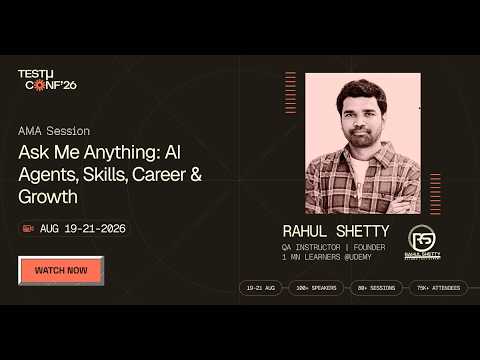
If you couldn’t catch all the sessions live, you can access the recordings at your convenience by visiting the TestMu AI YouTube Channel.
TL;DR
For a QA career in the era of AI agents, master testing fundamentals first: browser automation with Playwright or Selenium, API testing, and one programming language. Layer agent skills on top, including MCP servers, skill files, and context engineering. The SDET role changes shape rather than disappearing.
- Should you learn Playwright or AI agents first? - Testing and automation fundamentals come first, and that sequence holds two or three years out. Playwright is the recommended starting point because it covers browser automation and API automation in a single tool.
- Which programming language should a beginner pick? - JavaScript and TypeScript are the recommended languages for anyone starting from scratch. Engineers with existing Java experience should carry Java over rather than restart, because language fluency matters more than the tool choice.
- How do you prove real AI experience in an interview? - Enterprise LLM hosting is the scenario that separates project experience from tool familiarity. With the code base barred from third-party models, the convincing answer is self-hosted enterprise models with routine work routed to open-source ones.
- DIY stack vs enterprise platform - DIY agentic adoption requires self-hosted infrastructure (yes), paid model subscriptions (yes), and custom token routing (yes). An enterprise agentic platform such as TestMu AI supplies cloud hosting, models, and tokens by subscription instead.
- Is the SDET role going away? - No. SDET headcount may fall roughly 20 to 30 percent, so a team of ten becomes six or seven, but that work reappears as testing AI agents and chatbots. QA sits in a safer position than developers or business analysts.
- Which testing certification matters for AI? - ISTQB is the one credential a hiring manager reliably recognises, and its AI testing syllabus was recently revised. ISTQB will not decide an outcome alone but may give an edge. Playwright, Selenium, and API testing have no official certifications.
- Which AI evaluation frameworks are growing? - DeepEval and Ragas are the named growth area for the next six to seven months, as frameworks for testing AI systems rather than for using AI in testing.
Sparsh opened with questions the community had submitted ahead of the session, before moving to the live Q&A tab.
Playwright or Agents First?
A community member asked what to learn first when starting today, given Playwright adoption has climbed over the past year or two while agents move in on the same work.
Rahul said his answer would be identical if the question were asked in two or three years. Fundamentals of testing and fundamentals of automation come first, and agents follow.
His reasoning is about validation rather than nostalgia. AI produces output, and you need enough knowledge to judge it, because the same problem can be solved several valid ways and only some of them match how your organisation actually works.
He also framed Playwright as one technical tool inside a wider testing ecosystem rather than the destination. The target is to be a full-stack functional test engineer, comfortable with browser automation in either Selenium or Playwright and with back-end API testing.

He added a practical reason the sequence holds. Hiring still tests human skills, so the basics decide whether you get the job, while AI knowledge decides whether you stay effective once you are in it.
The Manual to Automation Path
Another question came from someone moving out of a support role into QA, asking whether the manual-to-automation pipeline still exists.
Rahul said that until a year or two ago it was the mandatory route: build the testing mindset and the curiosity to probe a product first, then add automation. That chain is no longer sufficient on its own.
What has changed is that AI fundamentals now sit in the same package rather than in an optional follow-up stage:
- Talking to AI - knowing how to frame work for a model rather than treating it as a search box.
- Creating AI agents - assembling an agent for a task rather than only consuming someone else’s.
- Building skill files - encoding repeatable procedure so an agent performs a task the way your team expects.
- Evaluating responses - judging output quality systematically instead of eyeballing it.
- MCP servers - understanding what they are and where they fit in the toolchain.
Previously the learning chain stopped at one automation tool. Now, in his framing, those AI fundamentals are part of what it takes to move at all.
Tune into this session on AMA: AI Agents, Skills, Career, where Rahul Shetty shares how Support professionals can move into QA by building automation expertise and AI skills, including creating SKILL.md files. pic.twitter.com/cbUkLGc50n
— TestMu AI (@testmuai) August 19, 2026
Your First Six Months
Asked what to study in a first six months from scratch, Rahul named Playwright, on the practical grounds that it covers browser automation and API automation in one tool.
He was quick to say the tool choice is the easy part. The harder decision is the programming language, and that depends on where you are coming from.
- Existing experience - if you already work in a language such as Java, carry it over rather than restarting.
- Starting from scratch - his strong suggestion is JavaScript and TypeScript.
The six-month goal is the full automation ecosystem: browser automation, API testing, and how to build frameworks. Agents come after that, and performance and mobile testing come later still.
Proving Real AI Experience
One question captured a common frustration: every job description now asks for AI or agent experience, and courses and side projects do not read as experience to a recruiter.
Rahul’s answer was that interviewers find this easy to test. Everyone knows how ChatGPT, Copilot, and Claude work at a surface level, so naming them proves nothing.
What separates candidates is the scenario question. He gave an example: your company forbids uploading its code base to a third-party model, so what do you do?
An answer grounded in real work explains enterprise models hosted on your own cloud servers so data does not leak, and how that infrastructure was actually set up. A follow-up on token consumption tests it further.
The convincing version of that answer is that routine work runs on open-source models and complex tasks get routed to the paid enterprise model hosted internally. In his words, there should be a story.
With traditional testing you can point at a website and describe what you did. With LLMs, the equivalent proof is being able to discuss AI security, AI governance, data, and privacy as they were handled on your project. On the governance side, an AI governance framework is the set of owners, system inventory, risk tiers, controls and evidence an organization uses to run AI.

Note: Testing AI agents needs its own evaluation surface. TestMu AI Agent Testing scores chat, voice, and phone agents on hallucination, bias, completeness, and context awareness. Try it free!
Going Agentic in a Legacy QA Org
The question that drew the longest answer came from a 40-person QA organisation in a regulated industry, with legacy audited test suites and leadership that has decided the team is going agentic this year.
Rahul split the decision into two tracks before any tooling choice gets made.
| Track | What it involves |
|---|---|
| Do it yourself | Paid model subscriptions, infrastructure sized for the model you pick so data stays inside your systems, a framework that routes questions between open-source and paid models by complexity, and RAG over your existing company documents. |
| Enterprise agentic platform | A subscription to a quality engineering platform that already handles the cloud, models, and tokens, so the team works with the capability rather than assembling it. |
He was direct that the DIY route is not a free one. Despite the name, it requires infrastructure, paid models, subscriptions, and token spend, and the model has to be hosted in your own environment because the data cannot go to a vendor’s servers.
He named TestMu AI as an example of the platform track, where the cloud, tokens, and models are already equipped so a team can subscribe rather than build.
His advice was to settle the track and the affordable cost first, then do the due diligence on where AI genuinely helps, and only then decide how to move from legacy to agentic.
Three AI Learning Paths
Asked how someone inside a legacy system builds hands-on agentic experience, Rahul shared his screen and walked through a three-path structure, while telling the audience to use whatever learning resource suits them.
- Using AI to boost QA productivity - split into a DIY strand covering models, agent building, MCP servers, and custom agents, and a platform strand where the tool does the heavy lifting and you work by stating goals.
- Testing AI systems - how to test AI agents, chatbots, RAG applications, and models, including the ISTQB AI certified tester certification. For AI agents, a Testμ keynote on evaluating agents against what they are actually supposed to do argues for testing each against its written behavior spec, not generic benchmarks.
- Architect essentials - designing your own LLM framework, using LangChain to build agents with MCP integration and model rerouting, and building your own MCP servers rather than relying on third-party ones.
He described the maintenance burden candidly. His AI courses crossed 100,000 enrolments in a year, and every month roughly half the material needs updating or removing.
The contrast he drew was with Selenium, where he could leave a course alone for four years because the migration from Selenium 3 to 4 took that long to land.
2M+ Devs and QAs Rely on TestMu AI for Web & App Testing Across 3000 Real Devices
 Sign up with google
Will the SDET Role Shrink?
A question from the live chat asked whether the SDET role will shrink or change shape. Rahul treated the churn as routine rather than exceptional, pointing out that the way testers work turns over every five years or so.
He traced it from waterfall projects driven by vendor tools and VBScript around 2010, to Selenium and open-source frameworks with Java from 2016, to Playwright by 2020, and now to agents.
Underneath each shift the goal held steady. A quality assurance engineer assures quality, whether the instrument is a legacy vendor tool, Selenium, Playwright, or an agent.
What changes is the shape of the day. The tester moves toward orchestration:
- Design skill files - encode how work should be done so the agent follows your team’s approach.
- Set agent goals - define what the agent is aiming at rather than scripting each step.
- Build testing agents - stand up the agents that carry out the testing work. Another session at the same conference, on eval-first QA agents, shows how Fox keeps the testing agents it builds behind an eval suite written first.
- Keep a human in the loop - correct the agent mid-flight, keep it pointed in the right direction, and validate its output rather than sitting back once it starts.
- Design the scenarios - write the scenarios and work back from requirements and acceptance criteria so the agent has something real to generate against.
Writing click, XPath, and CSS selectors by hand is the part he expects to fall away. On headcount he was straightforward: the role will not disappear, but a team of ten SDETs might settle at six or seven, a reduction of roughly 20 to 30 percent.
He then argued those positions reappear elsewhere, absorbed by the work of testing AI agents and chatbots. In his read, QA sits in a relatively safer zone than developers or business analysts facing the same pressure.
Q & A Session
The closing stretch of the AMA took the remaining audience questions on certifications and staying relevant.
- Are AI certifications worth it?
Rahul: ISTQB is the certification body that has held its position for more than a decade and a half, and its recently revised AI testing syllabus tracks current trends. Setting AI aside, the Certified Tester Foundation Level syllabus is also strong. A certification will not decide an outcome on its own, but as a manager reviewing a resume he recognises ISTQB where he would not recognise most others, so it will not harm you and may give an edge. There are no official certifications from Playwright, Selenium, or the API testing tools.
- How should someone plan the next year of upskilling?
Rahul: Filtering the noise is itself the challenge, with many thin wrappers presented as tools. One encouraging sign from the last quarter is that no genuinely new terminology has appeared; the models are simply getting better. Keep browser automation, API testing, and programming fundamentals as the base, then add agent literacy on top: what AI agents and MCP servers are, what skill files do, why tokens matter, and what context engineering means. All of this is about a year old, so anyone who has not caught up within six months will sound outdated.
- Where is the growth in testing over the next year?
Rahul: Testing AI itself, as distinct from using AI in testing. Every company and product is now shipping chatbots, AI applications, and agents, and somebody has to test them. Evaluation frameworks such as DeepEval and Ragas are the area he expects to develop most over the next six to seven months. The learning curve is real, and it now runs in both directions: knowing how to use AI in testing, and knowing how to test AI.
The guide to Ragas metrics covers every current metric in Ragas, the second framework Rahul named, including which ones need an LLM to score.
Sparsh noted that TestMu AI offers a free AI certified tester credential on the TestMu AI certifications page, and confirmed that the questions left in the chat would be answered on the community channels after the session.
Rahul closed by inviting attendees to continue the discussion by tagging him on LinkedIn.
This AMA was part of Testμ Conf 2026, which ran across three days of sessions on agentic engineering and quality. Registrations for the next edition are already open on the Testμ Conference 2027 page.
For a first-hand account, see Productize Yourself: AI Proof Yourself from Testμ 2026.
Author

TestMu AI
Blogs: 290


TestMu AI is World's First Full Stack AI Agentic Quality Engineering platform that empowers teams to test intelligently, smarter, and ship faster. Built for scale, it offers a full-stack testing cloud with 10K+ real devices and 3,000+ browsers. With AI-native test management, MCP servers, and agent-based automation, TestMu AI supports Selenium, Appium, Playwright, and all major frameworks. AI Agents like HyperExecute and KaneAI bring the power of AI and cloud into your software testing workflow, enabling seamless automation testing with 120+ integrations. TestMu AI Agents accelerate your testing throughout the entire SDLC, from test planning and authoring to automation, infrastructure, execution, RCA, and reporting.


Did you find this page helpful?
More Related Blogs

TestMu AI forEnterprise
Get access to solutions built on Enterprise
grade security, privacy, & compliance
- Advanced access controls
- Advanced data retention rules
- Advanced Local Testing
- Premium Support options
- Early access to beta features
- Private Slack Channel
- Unlimited Manual Accessibility DevTools Tests