
Power Your Software Testing with AI Agents and Cloud
The Native AI-Agentic Cloud Platform to Supercharge Quality Engineering. Test Intelligently and Ship Faster.

- TestMu AI (Formerly LambdaTest)
- /
- Blog
- /
- Productize Yourself: AI Proof Yourself [Testμ 2026]
Productize Yourself: AI Proof Yourself [Testμ 2026]
Rahul Parwal on moving from execution to insights, publishing what you learn the same day, and why who knows you matters more than who you know.
Published on:
Testing work sits on four levels, and the bottom one is the level AI came for. Execution work, meaning test cases, reports, data mocks and API work, is the level you cannot compete on.
At Testμ Conf 2026, Rahul Parwal, Specialist at IFM Engineering, named the three levels above it as thinking, systems and insights, and his instruction was to climb. His broader argument is that skills on their own do not convert into money, so they have to be packaged before anyone pays for them.
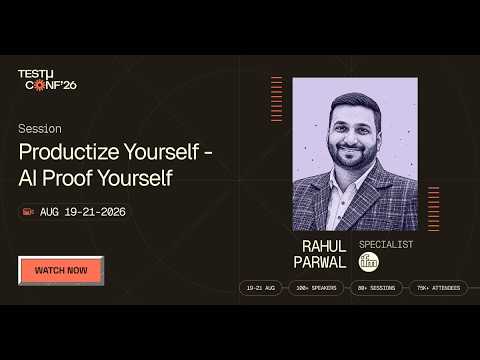
If you couldn’t catch all the sessions live, you can access the recordings at your convenience by visiting the TestMu AI YouTube Channel.
TL;DR
Productizing yourself means turning your expertise and skills into something sellable and scalable rather than leaving them as a list of things you can do. Rahul Parwal argues it has become necessary because skills alone do not convert into business value, and because execution work is the first thing AI takes.
- What does it mean to productize yourself as a tester? - Rahul Parwal defines productizing as turning your expertise and skills into a sellable, scalable product, a concept he credits to The Almanack of Naval Ravikant. His reasoning is that skills alone do not convert into business value, so they have to be packaged before the market can pay for them.
- Can testers compete with AI on execution work? - No. Rahul Parwal’s position is that execution work is exactly what AI came to take, and that you cannot compete with it there. The durable ground he names is thinking and systems work, because the agentic world needs systems that are not stable yet.
- What are the four levels of testing work? - Execution covers test cases, reports, data mocks and API work. Thinking covers risk analysis, test design, strategy, exploratory testing, persona analysis and requirements engineering. Systems covers tools, AI hubs, skills and MCP libraries, hooks, agents, processes and checklists. Insights covers root cause analysis, case studies, research and reviews.
- Are resumes still a useful hiring signal? - No, in Rahul Parwal’s view. He says most resumes now look the same because candidates generate ATS-friendly versions with AI tools, so a resume no longer shows who actually has which skills, and the chance of differentiating yourself with one is very low.
- What should a tester ask before changing career direction? - Rahul Parwal runs a chain of self-audit questions testers usually dodge, covering whether the job is good for your future, whether your employer keeps people in bad times, whether their business model is future-proof, and whether people actually stay ten years where you plan to. A single no anywhere is his signal to start.
- How do you stop learning from evaporating? - Apply it the same day, at any size. Rahul Parwal says scrolling, bookmarking and forwarding fade away and stall progress, and that learning has no value until it is applied, because the future never arrives free of new problems.
- What belongs in a tester’s portfolio? - Rahul Parwal lists open-source contributions, crowdsourcing work, GitHub repositories with published code, agent skills, prompts and agents, conference and meetup talks, blogs, and published study notes. He started with the last of those himself while learning Git, GitHub and NUnit.
- Is networking more useful than being known? - No, and Rahul Parwal calls this the reversal he had to learn personally. Knowing ten excellent testers is worth little if none of them knows your work, because people cannot recommend what they have not seen.
- How do you build a personal brand as a tester? - Through consistency and authenticity, on whichever platform suits you. Rahul Parwal says branding does not happen overnight and cannot be built by copying others, and he deliberately refuses to prescribe a format, naming LinkedIn, Twitter, Instagram and YouTube as options.
- Do you need certifications to prove AI capability? - No, according to Rahul Parwal, who says he holds none at all and that his portfolio and his name are his certificate. He argues the right portfolio, examples and repositories demonstrate capability without anyone’s permission.
- Should QA engineers learn automation tools or AI agents? - Both, in sequence. Rahul Parwal says if you know no automation tool, learn one, and it can be as simple as an API testing tool just to understand how automation works, then also learn AI and agents because the orchestration layer has moved above.
- Does the session include an action plan? - No. Rahul Parwal announced a three-part talk whose third part was an action plan, then ran short of time and rushed the closing stretch. No action plan, checklist or step-by-step framework appears in the recording, despite the chapter list and the host’s closing summary implying otherwise.
The Self-Audit Questions
He opens with a chain of questions he says testers dodge in team discussions, office discussions and community meetups, and tells the audience not to answer in chat because the point is self-analysis.
The first pair is foundational: do you want to work in corporate technology at all going forward, and is your current job satisfying and good for your future?
The next pair turns on the employer. Does your company keep people in bad times and will it secure you when things get tough, naming the market, AI and factors outside anyone’s control. And can you keep working there emotionally, all the way to retirement?
Then the ten-year pair, where he pushes hardest on the second half. You may want to work somewhere for ten years, but do people actually stay there for ten years? Look around and count how many stick and how many dropped off along the way.
The last pair widens out. Is your employer’s business model future-proof, on the reasoning that an employer without one cannot keep anyone employed. And does the work you actually do day to day prepare you for a secure future?
His exit condition runs in both directions. A single no anywhere in the chain is the signal to start productizing yourself. If every answer was yes, he tells the audience this talk is not for them and that now would be the right moment to leave, joking that he has already wasted five minutes of their time.
The Market Already Evolved
His central reality check is a tense correction. Saying the tech market is evolving is an old framing, because the market has already evolved.
His supporting claim is that the industry has put trillions of dollars, people, resources, energy and data centres into that evolution and is now in a new world. No source, report or origin accompanies the figure, so it reads as rhetoric rather than data.
The behavioural instruction that follows is the useful part. Stop living in a world where the change is still happening and you will adapt alongside it, because the change has happened.
He warns the audience before this block that the points are hard, and frames the section as a set of reality checks.
His metaphor for productizing is a video game character catching the items that are hidden and hard, which ordinary players do not see, and clearing the level. Everyone, in his framing, has to go one level up.
Four Broken Hiring Rules
The first is that resumes have stopped working as a signal. He gets constant referral requests on social media, and says most resumes now look the same because people generate ATS-friendly versions with AI tools, so a resume no longer reveals who has which skills without putting candidates through tests.
His conclusion is that if you are counting on a very good resume to differentiate you in your next job search, the chances are very low.
The second is that layoffs have become routine rather than news. There was a time when tech layoffs made headlines, and now they arrive weekly with new companies and new numbers. No figures or sources are cited.
The third is that junior hiring has slowed, and he attaches a specific unsourced claim to it: that this trend has reversed for the first time in twenty-five years, where the market for new entrants had always been good. No study, dataset or region is named.
The fourth is that AI is competing with people without announcing it, positioning itself as a cheaper alternative. He names one coding agent as an example and refers to it being challenged publicly, though that clause is damaged in the captions and is not reproduced here. His broader point survives it: more companies and more tools are competing subtly for the same work.
He then draws a distinction worth preserving. What matters is the difference between the real substance of these tools and the perception they create for future employers, which are two different things.

Note: Publish what you learned today, not next month. Try TestMu AI now!
The Keeping-Up Treadmill
He uses one model vendor’s release cadence as his illustration, noting it is only an example and that the point is the weekly arrival of new updates.
The churn hits the enthusiasts too. Even people who are strongly pro-AI face the problem of keeping up with everything shipping.
He names the rotating vocabulary to make it concrete: loop engineering today, harness engineering tomorrow, context engineering the day after, and onward.
His verdict is that standing out in this market is genuinely difficult unless you learn to productize yourself.
The differentiator he proposes is perception and pattern-spotting rather than tool count, capturing the points that are hidden and hard and that most people do not see.
The Definition
His definition is compact: productizing means turning your expertise and your skills into a sellable, scalable product.
He credits the concept to The Almanack of Naval Ravikant, shown on screen, and says the book changed his life. He also told the audience it is available free and displayed a QR code, saying he would hold the slide for five seconds. That availability claim is unsourced and the target is not verifiable from the recording.
He is explicit about the limits of his own talk, calling it just an introduction to productizing and saying the book contains the real thing.
The economic argument underneath everything is that skills in themselves do not convert into business value or money, and that some productizing is required to make money out of them.
He describes productizing as multi-dimensional, naming offering, learnings, branding presence, portfolio and AI proofing among others, then says he will cover only four of those dimensions very quickly and briefly. The published description drops that caveat and presents four pillars as the framework.
AI is changing the way we work. But are you changing with it?
— TestMu AI (@testmuai) August 21, 2026
Right now at #TestMuConf, Rahul Parwal is breaking down what it means to Productize Yourself and build a career that stays valuable in an AI-first world.
From a reality check to productizing your expertise to… pic.twitter.com/TAUp1sPPrT
Productize Your Offering
Most testers describe their offering in execution terms, he says: test cases, reports, data mocks, API work. All of it is execution-level work.

The second level is thinking work, where he says people are genuinely good: risk analysis, test design, strategy, exploratory testing, persona analysis, requirements engineering, and reasoning about real risk, business domain and context.
The third is systems work, covering utilities, tools, AI tool hubs, skills libraries, MCP libraries, hooks, agents, processes and checklists. His justification is that the agentic world needs its own systems, that they are not stabilised yet, and that every company is trying to build them so the work can scale.
The fourth is insights: root cause analysis, AI-testing case studies, research, reviews and quality engineering.
The instruction is to move from execution to thinking, thinking to systems, and systems to insights, because that is where most of the value lies. He notes he started at execution himself. The published description compresses these four rungs into moving from execution to systems thinking, a phrase he never uses, which fuses two levels and drops the one the same sentence claims the market pays for.
As his worked example of a productized offering he points the audience at TestMu AI’s own solutions and case-study pages, saying reading them shows what offerings the market is looking for. He discloses in the same breath that the company sells tools, products and case studies. Those are the conference organiser’s marketing pages rather than independent market evidence.
Productize Your Learnings
His diagnosis of how learning evaporates is familiar and specific. People read or watch something, forget it, keep scrolling social media, forward the good bits, and the whole thing fades.
Bookmarking gets its own treatment. The plan to bookmark today, read next week and apply next month is how things fade away and stall your progress.
His rule is same-day application at any size. Do it today even if the application is small, because the future never comes, and when it does it arrives with newer challenges and newer problems to solve.
The conversion formula is that learning in itself has no value unless you apply it, and the moment you apply it, it becomes value.
His own loop is the worked example: learn a new concept, then write a course, give a talk, write an article, create a free resource. He showed a screenshot of his site listing classes on agents, context engineering, foundations and bug advocacy. The payoff he claims is that anyone checking the web tomorrow can see he knows the subject.
He then recommends TestMu AI’s free certifications, repositories, community, webinars and blog as places to productize learning, prefaced with his disclosed affiliation and a superlative about never getting such people for free.
Productize Your Portfolio
He picks up an observation from the chat: everybody is talking about AI in the office, and the real problem is that nobody is building with it. He qualifies that within twenty seconds, noting there are plenty of people who have built things with AI and published them, so the line is emphasis rather than a finding.
His differentiator is that the moment you start building with AI you separate yourself from the people who only talk about it.
He named public portfolio examples on screen, including James Bach’s site and his own. A third address in the same breath is too garbled in the captions to print.
He showed a trend chart claiming a sharp spike in portfolio interest over the last two to three years since AI arrived, with developers far ahead and testers far behind. No source, axis, date range or number was spoken, so the chart is described here rather than reproduced as a statistic.
The consequence he draws is straightforward. If testers do not create portfolios or make their skills public, nobody can find those skills, and that is a missed opportunity.
The surfaces he lists are open-source work, crowdsourcing, repositories with published code, agent skills, prompts and agents, conference and meetup talks, blogging, and published study notes. He started with the last one himself while learning Git, GitHub and NUnit. He also made two offers to the live audience, inviting people to send him their portfolio sites to be featured and to message him for a portfolio-ideas mind map he had prepared.
Productize Your Branding
He presents that as a reversal he had to learn personally, having believed that knowing the right people was how you levelled up a career.
His argument for it is practical. You may know ten excellent testers, and if they do not know you, you cannot ask them for help and they will never recommend you.
The experiment he sets the audience is to open an anonymous chat and ask an AI who they are. He displayed a screenshot of an assistant’s answer about himself, said most of it was correct, and attributed the sources to his public work. That was a static slide rather than a live query, the model and date are unknown, and the accuracy assessment is his own.
His forward-looking claim is that AI is becoming the interface for finding information, so someone looking him up years from now would still find him through it.
He sets two conditions on branding. Consistency, because it does not happen overnight and you have to stay in the game for the long run. And authenticity, because you cannot build a brand by copying others.
He refuses to prescribe a format or platform, saying there is no right or wrong format and you have to choose what suits you, naming LinkedIn, Twitter, Instagram and YouTube. His proof that branding pays is personal: he never applied to give this talk, and was approached because of his public work.
Platforms And Communities
For paid offerings and mentoring he named Topmate and Mentoring Club, with the caveat that the right platform depends on region and that those two are popular in India.
For people who want their own site without being technical, he named WordPress, Medium and Substack.
He adds a newer route, which is prompting an AI agent or harness to build something for you.
On in-person community he says every popular tech city now has testing meetups worth attending, and tells the audience they can apply to speak at the organiser’s meetups, which is another vendor-adjacent call to action from a speaker with a disclosed affiliation.
He frames all of it as the practical answer to a question he gets often, which is where someone should build a website.
His closing recap is the four dimensions he covered: level up your offerings, your learnings, your portfolio, and your branding. He closed on his own timer, saying he had used the twenty-five minutes allocated to him, and thanked his mentors, his reviewers and the conference team.
Q & A Session
Three audience questions were submitted to the Q&A box and read out by the host.
- What is the hardest but most necessary first step towards productizing yourself?
Rahul Parwal: Two words: put yourself out. If you have learned something at this conference, share it. Post a summary of what you learned and what you liked, tag the speaker and tag the organiser, and start a discussion. That is step one. He stops there, without addressing what makes it hard, which was half the question.
- Should QA engineers learn new automation tools or learn around AI agents?
Rahul Parwal: This is a personal view, and it is not either-or. If you know no automation tool, learn one. It can be anything, even an API testing tool, just to understand how automation works. Then also learn AI and agents, because the orchestration layer has moved above and you should know that layer too. Learn at least one tool. He hedges the framing rather than picking a side, and names no specific tool or framework.
- How can someone demonstrate real AI capability beyond certifications?
Rahul Parwal: I hold no certifications and have never done them. My portfolio is my certificate, and my name is my certificate. Build a name, plus the right portfolio, the right examples and the right repository, and that is the demonstration. Everything is democratised now, so you can do things without permission.
This session was part of Testμ Conf 2026, which ran across three days of sessions on agentic engineering and quality. Registrations for the next edition are already open on the Testμ Conference 2027 page. Another Testμ 2026 session explains why agents need custom evals and how to create them.
Author

TestMu AI
Blogs: 292


TestMu AI is World's First Full Stack AI Agentic Quality Engineering platform that empowers teams to test intelligently, smarter, and ship faster. Built for scale, it offers a full-stack testing cloud with 10K+ real devices and 3,000+ browsers. With AI-native test management, MCP servers, and agent-based automation, TestMu AI supports Selenium, Appium, Playwright, and all major frameworks. AI Agents like HyperExecute and KaneAI bring the power of AI and cloud into your software testing workflow, enabling seamless automation testing with 120+ integrations. TestMu AI Agents accelerate your testing throughout the entire SDLC, from test planning and authoring to automation, infrastructure, execution, RCA, and reporting.


Did you find this page helpful?
More Related Blogs

TestMu AI forEnterprise
Get access to solutions built on Enterprise
grade security, privacy, & compliance
- Advanced access controls
- Advanced data retention rules
- Advanced Local Testing
- Premium Support options
- Early access to beta features
- Private Slack Channel
- Unlimited Manual Accessibility DevTools Tests