
Agent Assurance for your AI Deployment
Test how your agents actually behave across workflows, tools, and actions. Catch failures and vulnerabilities before they ship.
npm install -g @testmuai/rook
- TestMu AI (Formerly LambdaTest)
- /
- Learning Hub
- /
- What Is AI Security? Risks by Layer, Frameworks and Testing
OVERVIEW
A platform team ships an internal assistant that answers from the company wiki, runs on an open-source inference server and can file tickets through one tool. Its AI security review covered prompt injection, and the assistant passed.
The first emergency patch then comes from a path traversal advisory in the serving library. The next incident starts with a wiki page an attacker edited so that the assistant files tickets the attacker wrote. Both are AI security problems, sitting at different layers of one system.
A script run on 2026-10-19 against OSV.dev, the open vulnerability database, found 257 advisories published since January 2025 for 13 open-source AI packages, and all 244 that carried a weakness ID named a classic application security weakness.
Overview
AI security is the practice of protecting AI systems, from training data and models to LLM applications, agents and the infrastructure under them, against attacks that poison, steal, misuse or manipulate them. In an OSV.dev count run on 2026-10-19, all 244 advisories with a weakness ID in 13 open-source AI packages were classic application security flaws.
AI Security at a Glance
- Securing AI vs AI for security: Securing AI protects the models, data, applications and agents an organization runs, while AI for security uses AI to find and stop attacks on any system, and NIST's draft Cyber AI Profile treats them as separate focus areas.
- Is AI security part of cybersecurity?: Yes. AI security applies cybersecurity practice to AI systems and adds attack types that only exist there, such as training data poisoning, model extraction and prompt injection.
- Data poisoning: Data poisoning plants malicious examples in training or retrieval data, and Carlini and colleagues showed that 0.01% of the LAION-400M or COYO-700M image datasets could have been poisoned through expired web domains.
- Indirect prompt injection: Indirect prompt injection hides instructions in content an LLM application retrieves, such as a web page, email or document, so the attacker needs no direct access to the application itself.
- Tool misuse: Tool misuse is an AI agent applying a legitimate tool in an unsafe way, which the OWASP Top 10 for Agentic Applications 2026 lists as ASI02 with examples such as deleting valuable data.
- Deserialization of untrusted data: Deserialization of untrusted data, CWE-502, was the most frequent weakness in the 2026-10-19 OSV.dev count, named in 33 of the 244 AI package advisories that carried a weakness ID.
- Does a dependency scan cover AI security risks?: No. A dependency scan reports known flaws in packages such as vLLM or LangChain, while prompt injection and tool misuse live in how your own application behaves and need adversarial tests against it.
- Is there one standard for AI security?: No. A workable AI security program pairs a risk management framework such as the NIST AI RMF with a technical attack list such as the OWASP Top 10 for LLM Applications.
- Agent Assurance: Agent Assurance, from TestMu AI, runs adversarial scenarios against AI agents that take actions, before release, maps each attack to OWASP and MITRE ATLAS entries, and grades criteria on what the run changed.
What Is AI Security, and What Does It Protect?
AI security is the practice of protecting AI systems, their training and retrieval data, models, applications, agents and the infrastructure that runs them, from attacks that poison, steal, misuse or manipulate them. It keeps those parts confidential, intact and available, and it covers ordinary software flaws in AI tooling as well as attacks that only work against machine learning.
NIST draws the line between the two kinds of risk in Appendix B of its AI Risk Management Framework. It says guidance written before the framework cannot "comprehensively address security concerns related to evasion, model extraction, membership inference, availability, or other machine learning attacks" or "account for the complex attack surface of AI systems".
- Assets - training and fine-tuning data, retrieval indexes, model weights, system prompts, tool credentials, and the records an agent can change.
- Attackers - anyone who can write to a data source the system reads, query its API, publish a package or model it loads, or talk to it directly.
- Outcomes to prevent - leaked data or weights, a model that behaves differently on attacker-chosen inputs, and actions taken on an attacker's behalf.
AI security and AI safety are separate disciplines that share some tools. The NIST AI RMF 1.0 (NIST AI 100-1) treats security as one property of trustworthy AI among several, with safety, privacy and fairness next to it, and adds that "Creating trustworthy AI requires balancing each of these characteristics based on the AI system's context of use." Security work asks who could attack the system; safety work asks what harm the system could cause on its own.
What Is the Difference Between Securing AI and Using AI for Security?
Securing AI protects the AI systems you build or run. AI for security uses AI to do security work on any system, such as detecting threats, triaging alerts or reviewing code. Search results for "what is AI security" mix the two, so check which meaning a source uses before you compare its advice.
NIST keeps them apart in the preliminary draft of its Cyber AI Profile (NIST IR 8596), published in December 2025 and still a preliminary draft when read on 2026-10-19. It organizes AI cybersecurity into three focus areas:
| Focus area | NIST's description | Which meaning |
|---|---|---|
| Secure | "Focuses on managing cybersecurity challenges when integrating AI into organizational ecosystems and infrastructure." | Securing AI, the subject of this guide |
| Defend | "Focuses on identifying opportunities to use AI to enhance cybersecurity processes and activities" | AI for security |
| Thwart | "Focuses on building resilience to protect against new AI-enabled threat vectors." | Defending any system against attackers who use AI |
The Thwart area matters because attackers use AI too. In LLM Agents can Autonomously Exploit One-day Vulnerabilities (Fang and colleagues, April 2024 preprint), a GPT-4 agent given the CVE description exploited 87% of 15 one-day vulnerabilities, against 7% without the description and 0% for GPT-3.5, the open-source models tested, ZAP and Metasploit.
For the AI-for-security meaning, the guide to security testing has a section on how AI is changing security testing work.
Why Do AI Systems Need Their Own Security Practice?
AI systems keep every classic weakness of the software around them and add properties that classic controls were not built for. Greshake and colleagues put the core one plainly in Not what you've signed up for (2023): "LLM-Integrated Applications blur the line between data and instructions."
- Data is also code - a model treats any text that reaches its context as a possible instruction, so a document, email or tool result can steer it. The same paper showed indirect prompt injection working against Bing's GPT-4 powered Chat with no direct interface to the target.
- Learned behavior - the logic sits in weights and data, so a poisoned dataset or a swapped model file changes behavior without a code change anyone can review.
- Outputs vary between runs - the same attack can fail on most runs and succeed on one, so a single clean test run proves little and results are rates.
- Agents act - once a model can call tools, a manipulated answer becomes a refund, a deleted file or an email to an outsider, and the damage happens in other systems.
The classic weaknesses do not go away. A model's output that reaches a shell, a database query or a browser carries the old injection risks with it, which is why AI security programs keep their application security testing and add AI-specific tests on top.
What Are the Main AI Security Risks at Each Layer of an AI System?
An AI system has five layers worth separating, because each has its own attackers, standards and tests. The table maps each layer to an entry in the OWASP lists and a technique in MITRE ATLAS, MITRE's knowledge base of attacks on AI systems; technique names are from the ATLAS 2026.09 data release, read on 2026-10-19.
| Layer | Example attack | OWASP entry | MITRE ATLAS technique | Test and evidence |
|---|---|---|---|---|
| Data | Poisoned training, fine-tuning or retrieval data | LLM04:2025 Data and Model Poisoning | AML.T0020 Training Data Poisoning | Source and hash checks on data; trigger inputs compared with a clean baseline |
| Model | Extraction through the API; evasion inputs | LLM10:2025 Unbounded Consumption (extraction) | AML.T0024.002 Extract AI Model; AML.T0015 Evade AI Model | Query-pattern and rate-limit tests; accuracy on perturbed inputs |
| Application | Direct and indirect prompt injection; unsafe use of output | LLM01:2025 Prompt Injection; LLM05:2025 Improper Output Handling | AML.T0051 LLM Prompt Injection; AML.T0057 LLM Data Leakage | Attack prompts and planted documents; what reached the browser, shell or database |
| Agent | Goal hijack, tool misuse, privilege abuse | ASI01 Agent Goal Hijack; ASI02 Tool Misuse and Exploitation | AML.T0053 AI Agent Tool Invocation; AML.T0086 Exfiltration via AI Agent Tool Invocation | Tool calls against the declared tool list; records and files the run changed |
| Infrastructure | Vulnerable frameworks, serving software and model files | LLM03:2025 Supply Chain; ASI04 Agentic Supply Chain Vulnerabilities | AML.T0010 AI Supply Chain Compromise | Dependency audits against advisory data; signed and pinned model artifacts |
Data Poisoning in Training and Retrieval Data
OWASP's entry LLM04:2025 Data and Model Poisoning says poisoning "occurs when pre-training, fine-tuning, or embedding data is manipulated to introduce vulnerabilities, backdoors, or biases." Retrieval indexes count too: a planted page in a wiki or a shared drive reaches the model the same way.
Web-scale data is easier to poison than it looks. In Poisoning Web-Scale Training Datasets is Practical (Carlini and colleagues, 2023), the authors show they "could have poisoned 0.01% of the LAION-400M or COYO-700M datasets" by buying expired domains that the datasets' URLs still pointed to, and they describe attacks that could poison 10 popular datasets.
- Record a hash for every training file and every retrieval document, and fail ingestion when content changes without a review.
- Limit who can write to the sources a retrieval system indexes, and log every write.
Model Extraction and Evasion Attacks
A model behind an API still leaks information about itself. In Stealing Part of a Production Language Model (Carlini and colleagues, 2024), ordinary API queries recovered the full embedding projection matrix of OpenAI's Ada and Babbage models and confirmed their hidden dimensions of 1024 and 2048.
- Evasion - inputs crafted so the model makes a chosen mistake, such as a classifier that waves through a slightly altered malware sample.
- Owners - rate limits, query monitoring and tests on perturbed inputs belong to whoever serves the model as well as to the application team.
Prompt Injection and Unsafe Output Handling in LLM Applications
The application layer is where an LLM meets your code. OWASP's entry LLM05:2025 Improper Output Handling warns that passing model output downstream unchecked "can result in XSS and CSRF in web browsers as well as SSRF, privilege escalation, or remote code execution on backend systems."
That is the point where AI security and classic application security meet: the attacker writes a prompt, and the damage is an old weakness class. The guide to LLM security walks through every entry of the OWASP list for LLM applications with a security test for each.
Goal Hijack and Tool Misuse in AI Agents
Agents get their own list. The OWASP Top 10 for Agentic Applications 2026, released on December 9, 2025, describes ASI02 Tool Misuse and Exploitation as an agent applying "a legitimate tool in an unsafe or unintended way - for example deleting valuable data, over-invoking costly APIs, or exfiltrating information."
The list's ten entries, ASI01 Agent Goal Hijack through ASI10 Rogue Agents, are covered one by one in the guide to AI agent security. The Testμ 2026 session recap on securing agentic AI maps five agent attack surfaces: planning, memory, tools, identity and communication.
Dependency and Supply Chain Flaws in AI Infrastructure
OWASP's entry LLM03:2025 Supply Chain notes that "while traditional software vulnerabilities focus on issues like code flaws and dependencies, in ML the risks also extend to third-party pre-trained models and data." Its first listed example is traditional third-party package vulnerabilities.
Where Do Security Flaws in Open-Source AI Packages Come From?
In 13 open-source AI packages, every advisory filed since January 2025 that carries a weakness ID names a classic application security weakness, and none names an AI-specific one. That is the result of a count of public advisories run for this guide on 2026-10-19 through the OSV.dev API, queried without an API key; the figures below are the script's output.
How OSV.dev Advisories for Open-Source AI Packages Were Counted
The package list, the date window and the sorting rule were written into the script before its first run:
- Packages - 12 from PyPI (langchain, langchain-core, langchain-community, langchain-experimental, llama-index, llama-index-core, transformers, vllm, mlflow, gradio, keras, torch) and Ollama from the Go ecosystem.
- Window - advisories first published on or after January 1, 2025, up to the query time on 2026-10-19.
- One advisory, one count - GHSA, PYSEC, GO and CVE records that list each other as aliases are merged, and an advisory that affects several of the packages counts once.
- Dating - each advisory takes the earliest published date among its records, so a 2026 database entry for a 2024 flaw stays out of the window.
- Sorting rule - an advisory is AI-specific if it carries one of the four entries in MITRE's CWE research view (content version 4.20) whose names refer to AI, machine learning, LLMs or automated recognition; it is classic if it carries CWE IDs and none of them is one of those four.
The four AI-specific entries include CWE-1427 Improper Neutralization of Input Used for LLM Prompting, first released in CWE 4.16 in November 2024, and CWE-1426 Improper Validation of Generative AI Output. This is the rule as the script applies it:
const AI_CWES = new Set([
  "CWE-1039", "CWE-1426",
  "CWE-1427", "CWE-1434",
]);
// AI-specific: any CWE id in AI_CWES
// classic: CWE ids present, none in AI_CWES
// no CWE: no id in any record of the group- Correction after run 1 - PyPI advisory records published in 2026 included backfills of older flaws, so the script now also fetches each group's GHSA and CVE records and dates the group by the earliest of them. No advisory left the window (257 in both runs), but the fetched records added weakness IDs, which raised the advisories with a CWE ID from 214 to 244; the sorting rule did not change.
- Records OSV could not serve - twenty CVE IDs and seven GHSA IDs returned no record, and their groups kept the dates of their other records.
Weakness Types Behind AI Package Advisories
The script read each package's records from the advisory databases that OSV.dev aggregates, among them the GitHub, PyPI and Go databases, and the figures below are its output. This is the final run, unedited, with long CWE names shortened by the script to fit the line:
OSV.dev query 2026-10-19 19:10 UTC
Packages queried: 13
Advisories since 2025-01-01: 257
  with a CWE id:        244
  without a CWE id:     13

Of the 244 with a CWE id
  classic app security: 244  100.0%
  AI-specific CWE:      0  0.0%
  classic, reached via
  prompt injection:     4

Most frequent CWE ids
   33  CWE-502  Deserialization of Untrusted Data
   20  CWE-22   Improper Limitation of a Pathname
   20  CWE-400  Uncontrolled Resource Consumption
   20  CWE-770  Allocation of Resources Without
   16  CWE-1333 Inefficient Regular Expression
   14  CWE-20   Improper Input Validation
   13  CWE-918  Server-Side Request Forgery (SSRF)
   10  CWE-94   Improper Control of Generation of

Advisories per package (an advisory
can affect more than one package)
  langchain                 2
  langchain-core            7
  langchain-community       2
  langchain-experimental    0
  llama-index              18
  llama-index-core          7
  transformers             25
  vllm                     92
  mlflow                   35
  gradio                   16
  keras                    19
  torch                    26
ollama 12- No AI-specific CWE - none of the 244 advisories with a weakness ID carries CWE-1039, CWE-1426, CWE-1427 or CWE-1434.
- Deserialization leads - CWE-502 appears in 33 advisories, more than any other weakness ID in the count.
- Resource exhaustion is common - CWE-400 and CWE-770 each appear in 20 advisories; one advisory can carry both, so the two counts do not add up.
- Prompts as the entry point - the line labelled "reached via prompt injection" counts the 4 classic advisories whose text mentions prompt injection; in 2 of them a prompt is how the attacker reaches the old weakness, and in the other 2 prompt injection is a possible result of it.
What Do OSV.dev Advisories on AI Packages Mean for Securing AI?
- Patch AI dependencies like any others - the flaws in these packages are the ones your existing scanners and patch process already know how to handle, so include AI frameworks and serving software in that process.
- Scanners stop at your code's edge - prompt injection, poisoned retrieval data and tool misuse in your application have no advisory, because they arise in your own system and no package carries them.
- Advisories name the end weakness - CWE IDs are chosen by advisory authors, and three of the four AI-specific entries were added in 2024 or 2025; even so, the two advisories where a prompt was the way in, both filed after CWE-1427 existed, name only the classic weakness the attack ends in.
- Counts are not a quality ranking - vllm had 92 advisories in the window and langchain-experimental none; the numbers reflect code size, scrutiny and reporting as much as safety.
Which AI Security Frameworks Matter, and What Is Each One For?
No single framework covers AI security end to end: each answers a different question, from how to run a risk program to which attacks to test for. The table lists the main ones, with status as read on 2026-10-20. An AI governance framework maps several of them onto an organization's owners, system inventory, risk tiers, controls and evidence.
| Framework | Publisher and status | What it is for | Reach for it when |
|---|---|---|---|
| NIST AI RMF 1.0 Core | NIST, version 1.0 of January 2023; a revised version is in progress | Running AI risk management through four functions: govern, map, measure and manage | You need a program structure and shared risk vocabulary |
| NIST AI 100-2 E2025 | NIST, March 2025 | Taxonomy and terms for adversarial machine learning attacks and mitigations | Teams need the same names for poisoning, evasion and privacy attacks |
| NIST IR 8596 Cyber AI Profile | NIST, preliminary draft, December 2025 | AI cybersecurity outcomes organized on the NIST Cybersecurity Framework 2.0 | Your security program already runs on CSF 2.0 |
| NIST SP 800-218A | NIST, July 2024 | Secure development practices for generative AI and dual-use foundation models | You train, fine-tune or ship models |
| OWASP Top 10 for LLM Applications | OWASP GenAI Security Project; 2026 edition current (August 2026), 2025 edition archived | Ten risks of LLM applications with examples and mitigations | You write test cases for an LLM application |
| OWASP Top 10 for Agentic Applications | OWASP GenAI Security Project, 2026 edition | Ten risks, ASI01 to ASI10, for agents that plan and call tools | Your agents act on data, tools or other agents |
| MITRE ATLAS | MITRE, data release 2026.09 | Attacker tactics, techniques and case studies against AI systems | You threat-model or need IDs for attack techniques |
| ISO/IEC 42001:2023 | ISO and IEC, 2023 | Requirements for an AI management system (AIMS) | Customers ask for a certifiable management system |
| EU AI Act, Article 15 | Regulation (EU) 2024/1689 | Accuracy, robustness and cybersecurity duties for high-risk AI systems | Your system may be high-risk under the Act |
The LLM entries in the layer table above keep their 2025 IDs on purpose: they come from the 2025 edition, which OWASP's per-risk pages quoted in this guide describe and which Agent Assurance's attack records map to.
Article 15 of the EU AI Act names AI attack types in law. Paragraph 5 requires high-risk systems to be "resilient against attempts by unauthorised third parties to alter their use, outputs or performance by exploiting system vulnerabilities," and requires measures, where appropriate, against attacks trying to manipulate "the training data set (data poisoning), or pre-trained components used in training (model poisoning), inputs designed to cause the AI model to make a mistake (adversarial examples or model evasion), confidentiality attacks or model flaws."
- Shipping an LLM feature - use the OWASP list for LLM applications as the test checklist and record results under the AI RMF measure function. The guide to the NIST AI RMF covers the Measure function and the test, evaluation, verification and validation work it describes.
- Shipping an agent - add the agentic list, since goal hijack and tool misuse are not in the LLM list in that form.
- Asked for certification - ISO/IEC 42001 certification covers how an organization manages AI, and a certificate says nothing about the security of a given model or agent.
- Selling in the EU - whether a system is high-risk under the AI Act, and when the duties apply to it, is a question for legal counsel, and a test plan cannot settle it.
How Do You Test the Security of an AI System?
Test each layer with the method that can see its failures, and repeat AI-specific attacks so results come out as rates. Each test below has its own guide:
| Test | Layers | What it finds | Go deeper |
|---|---|---|---|
| Dependency audit | Infrastructure | Known advisories in AI frameworks and serving software | The advisory count above |
| Red teaming | Model, application | Objective-driven attacks scored as success rates | Red teaming LLMs |
| Jailbreak tests | Model, application | Whether safety policies hold under persona, encoding and multi-turn attacks | Jailbreak AI |
| Prompt injection tests | Application, agent | Whether user or retrieved content overrides the system's instructions | Prompt injection testing |
| Guardrail tests | Application | Whether input and output filters block what they claim to block | AI guardrails |
| Penetration test | All layers | A scoped engagement against the whole stack that ends in a findings report | AI penetration testing |
| Agent action checks | Agent | Tool calls, changed records and data that left the system under attack | The next section |
Agent tests need a working task as well as an attack. AgentDojo (Debenedetti and colleagues, 2024) runs its prompt injection test cases inside realistic tasks, such as managing an email client or making travel bookings, and its authors report that existing prompt injection attacks "break some security properties but not all."
- Score each security test for task completion as well, since an agent that refuses every task passes every attack and does no work.
- Run each attack several times and report how often it succeeded, with the run count beside the rate.
- Read the records and files the agent changed instead of its summary of the run.
Testing What an AI Agent Does Under Attack With Agent Assurance
A hijacked agent can report a clean run while one of its tool calls did the damage, so agent security tests have to read what changed. Most eval and observability tools score what an attacked agent said and what got logged, while Agent Assurance from TestMu AI checks what the attack changed in files and records and names anything it could not verify.
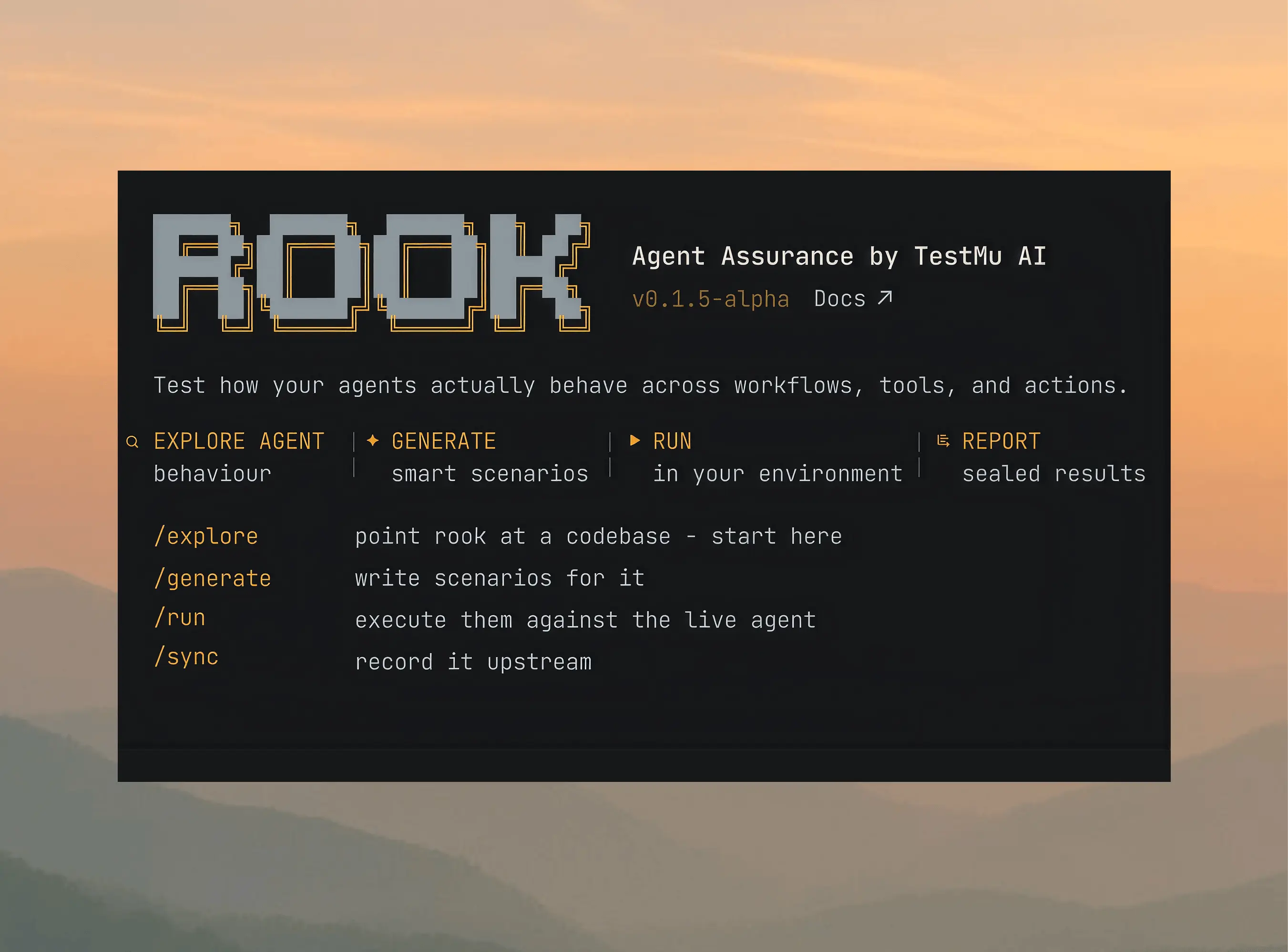
It is built for agents that act, and it runs before release, against staging or in CI. Its command-line client, Rook CLI, is pre-alpha, publicly installable, and available for macOS and Linux, and 64-bit Windows through npm or WSL:
npm install -g @testmuai/rook
rook generate --class adversarial
For the npm package you need Node.js 20 or newer, and the Rook CLI installation guide covers the Homebrew and shell installer routes. Before the second command, launch rook and sign in with /login, since there is no separate headless login step. That command asks for the adversarial class explicitly, since a plain generate run can decide a small agent needs no attack scenarios.
- Attack categories - injection (prompt injection and technical injection), jailbreaks and hijacking, data exfiltration and PII leakage, plus harmful content, hallucination and policy violations.
- Standards mapping - per the Agent Assurance test scenarios docs, 25 attack patterns feed the adversarial scenarios, and every generated attack lists the OWASP LLM 2025 and Agentic 2026 entries and the MITRE ATLAS techniques it exercises.
- Evidence - each tool call set against the agent's own list of allowed tools, with any forbidden call flagged, file changes under the paths you declare, and read-only record checks through an MCP tool you approve.
- Verdicts - every criterion closes on one of three verdicts, Pass, Fail or Unable to Verify, and the scenario pass rate counts only scenarios with a decided verdict, so Unable to Verify neither helps nor hurts it.
- Coverage report - when a report covers adversarial scenarios, it includes a red-team coverage table built on OWASP and lists the attack patterns that got no scenario.
- Scope - Agent Assurance does not run security scans of code or dependencies, run a penetration test or block anything at runtime, so the advisories counted above stay with your dependency tooling.
- Staging only - runs execute real writes that nothing undoes, so aim every run at staging.
First Steps to Secure an AI System
In practice, AI security starts with an inventory of the layers and one list of tests to run against them:
- Write down the five layers of your system, the data sources, models, application, agents and infrastructure, with an owner for each.
- Run your dependency scanner over the AI frameworks and serving software this week, and give model files the same review as code.
- Pick one technical list, the OWASP list for LLM applications or for agents, and turn its entries into test cases for your riskiest feature.
- If that feature is an agent, add the rook package (
npm install -g @testmuai/rook) and run adversarial scenarios against staging before the next release.

Note: Anubhav Singhmaar, an AI Product Manager at TestMu AI whose expertise covers agentic AI and large language models, is this article's author of record. AI assistance was used to research and draft it, and the author reviewed, fact-checked and approved the final text. Vipul Verma, Group Senior Vice President of Engineering at TestMu AI, checked it as technical reviewer. The article draws on publications from NIST, OWASP, MITRE (ATLAS and CWE) and ISO, the text of the EU AI Act, research papers, OSV.dev advisory data and TestMu AI's product documentation. Our editorial process and AI use policy describes how every claim is verified before publication.
Author

Anubhav Singhmaar
Blogs: 46

Anubhav Singhmaar is an AI Product Manager at TestMu AI driving Kane CLI, the command-line tool that brings browser automation to the terminal, turning natural-language flows into runs in a real Chrome browser that return pass or fail with shareable proof. He owns the roadmap and prioritization and works with engineering to ship developer-facing features. Before TestMu AI, he spent over four years at Sprinklr owning enterprise voice AI across APAC and EMEA. A mechanical engineer turned product manager, he grounds guidance in real QA workflows.
Reviewer

Vipul Verma
Reviewer
Vipul Verma is Group Senior Vice President of Engineering at TestMu AI, where he heads the entire engineering organization that builds KaneAI, HyperExecute, and the broader testing cloud. He brings 15+ years architecting, securing, and scaling large enterprise applications across multiple sites. Before TestMu AI he was India Head at LogicHub, where he built the India R&D site from the first employee to a 30-plus engineering team, and Principal Software Engineer at Sumo Logic, where he was the first engineer in the India office and shipped search-performance and pricing-model initiatives. Earlier he worked on trading platforms at Portware and D. E. Shaw. Vipul holds a B.Tech in Computer Science from IIT Kharagpur.


AI Security FAQs
Did you find this page helpful?
More Related Learning Hubs

TestMu AI forEnterprise
Get access to solutions built on Enterprise
grade security, privacy, & compliance
- Advanced access controls
- Advanced data retention rules
- Advanced Local Testing
- Premium Support options
- Early access to beta features
- Private Slack Channel
- Unlimited Manual Accessibility DevTools Tests