
Agent Assurance for your AI Deployment
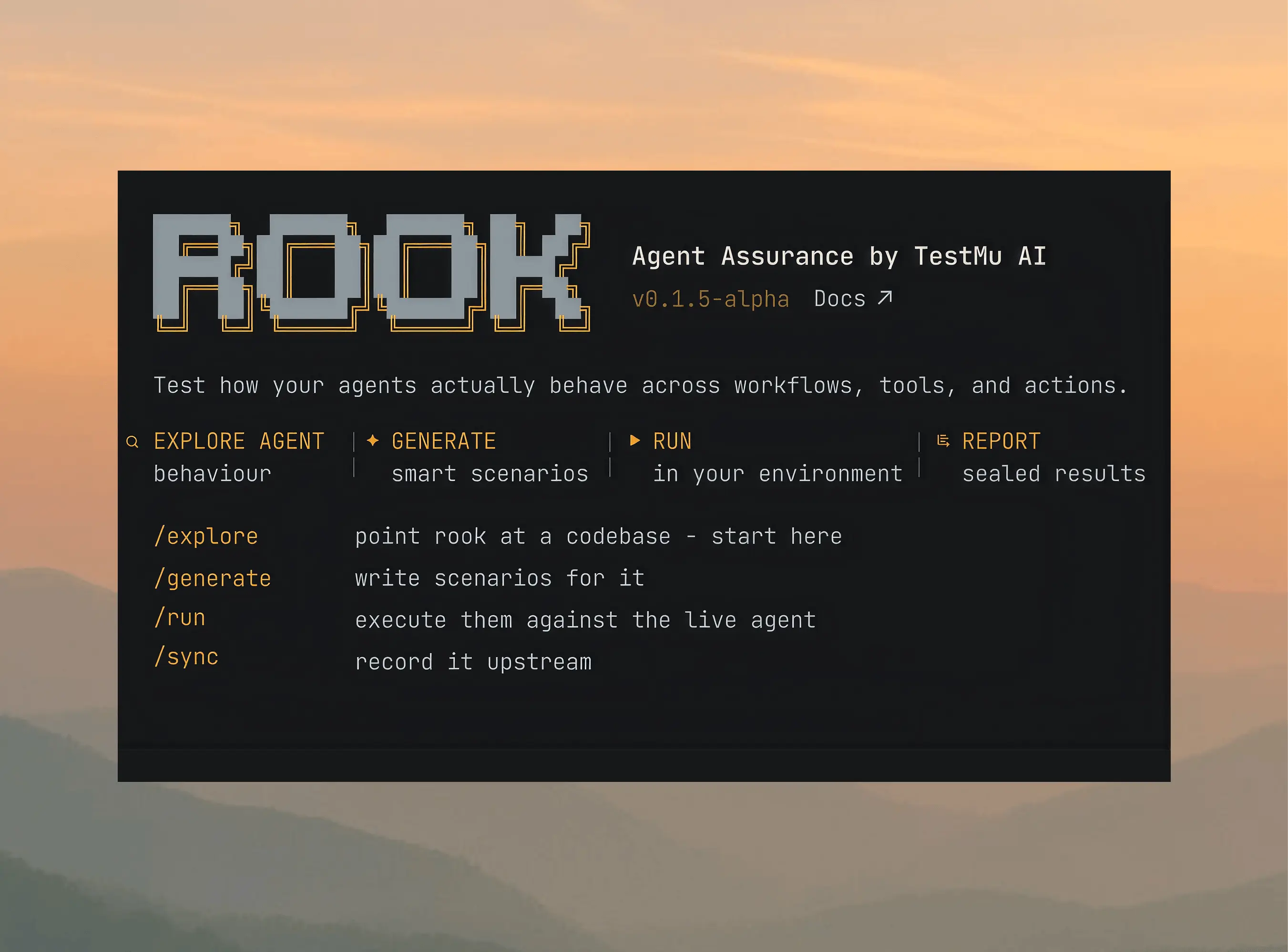
Test how your agents actually behave across workflows, tools, and actions. Catch failures and vulnerabilities before they ship.
npm install -g @testmuai/rook
- TestMu AI (Formerly LambdaTest)
- /
- Learning Hub
- /
- Jailbreak AI: How LLM Jailbreaks Work and How to Test Them
OVERVIEW
A model that refuses a harmful request typed in plain English can still answer the same request when it arrives in Base64, inside a role-play, or after a few harmless turns. A refusal test with one phrasing per policy proves only that this phrasing is blocked.
The gap can be wide. In the public JailbreakBench attack artifacts, scored in 2024, GPT-4 (0125 preview) answered none of 100 harmful behaviors under the most popular hand-written template from Jailbreak Chat and 78 of them under an automated attack.
This guide to jailbreak AI contains no working jailbreak prompt: every example in it asks for a harmless canary string.
Overview
An AI jailbreak is an input that gets a large language model to produce output its safety training or developer policy is meant to block. Attackers use role-play, encodings such as Base64, many-shot prompts, multi-turn escalation and optimized suffixes. Test for jailbreaks with every technique family, repeated attempts and a judge checked against hand labels.
How Do AI Jailbreaks Work?
- Competing objectives: Competing objectives, one of two safety-training failures named by Wei, Haghtalab and Steinhardt in 2023, arise when role-play, refusal suppression or fictional framing sets a model's drive to follow instructions against its refusal training.
- Mismatched generalization: Mismatched generalization is the second safety-training failure Wei and colleagues named: Base64, ciphers and rare languages reach capabilities that safety training never covered, so the model reads the request without applying its policy.
- Many-shot jailbreaking: Many-shot jailbreaking fills a long context window with hundreds of fake dialogues in which an assistant complies. Anil, Durmus and colleagues (NeurIPS 2024) found that many-shot effectiveness follows a power law up to hundreds of shots.
How Often Do LLM Jailbreaks Succeed?
- JailbreakBench artifacts: JailbreakBench (Chao and colleagues, 2024) publishes one artifact file per attack method and target model, each scoring 100 harmful behaviors in ten categories. Public: Yes (MIT license).
- PRS attack on GPT-4: The Prompt with Random Search (PRS) attack jailbroke GPT-4 (0125 preview) on 78 of 100 harmful behaviors in JailbreakBench's 2024 artifacts, with a Wilson 95% interval of 69% to 85%.
- AIM template on GPT-4: The hand-written AIM template from Jailbreak Chat jailbroke GPT-4 (0125 preview) on none of 100 harmful behaviors in JailbreakBench's 2024 artifacts, so a popular template can stop working on a newer model.
- Judge choice: Llama Guard 1, the earlier JailbreakBench judge, counted 50 of 100 PAIR attack responses against GPT-4 as jailbreaks where the current Llama-3-70B judge counted 34, and the two judges disagreed on 26 of the 100 verdicts.
- MLCommons Jailbreak Benchmark v1.0: Across eight open-weight systems, the MLCommons Jailbreak Benchmark v1.0 measured an unsafe-response rate of 11.08% at baseline and 18.65% under single-turn, text-based jailbreak attacks. Covers agentic systems: No (outside v1.0).
Can a Keyword Filter Stop Jailbreak Prompts?
- Substring blocklist: A lowercase substring blocklist, checked by a local script on 2026-10-19, blocked only the plain canary request and passed all 8 encoded copies of the canary request. Stops encoded prompts: No (8 of 8 passed).
- Normalized filter: A filter that folded Unicode, mapped confusable characters and decoded Base64 before matching blocked 7 of 9 copies in the same 2026-10-19 script run, yet still passed the ROT13 and split-payload copies of the canary request.
What Is a Jailbreak Attack on an AI Agent?
- Jailbreaks that end in tool calls: MITRE ATLAS warns that adversaries may jailbreak a model to invoke tools or perform actions, so a jailbreak on an AI agent can end in a file write, an email or a changed record rather than forbidden text.
- Agent Assurance: Agent Assurance by TestMu AI generates jailbreak scenarios from an agent's code or spec, compares every tool call with the agent's declared tools and reads records through a read-only tool you approve. Pre-alpha: Yes (publicly installable from npm). Runtime guardrail: No (tests before release).
What Is an AI Jailbreak?
An AI jailbreak is an input that gets a large language model to produce output that its safety training or its developer's policy is meant to withhold. The NIST glossary entry for jailbreak, taken from NIST AI 100-2e2025, defines it as "a direct prompting attack intended to circumvent restrictions placed on model outputs, such as circumventing refusal behaviour to enable misuse."
The OWASP LLM01:2025 Prompt Injection entry calls jailbreaking "a form of prompt injection where the attacker provides inputs that cause the model to disregard its safety protocols entirely." How it differs from injected instructions in documents and tool output is covered in the guide to LLM security. Jailbreaks are one of many threats that AI security deals with, alongside data poisoning, model extraction and classic flaws in AI software.
The term covers more than clever prompts. MITRE ATLAS technique AML.T0054, LLM Jailbreak (ATLAS 2026.09) describes these routes:
- Hand-crafted prompts - strategies such as instruction override, persona switching and fictional framing, which ATLAS says "are iterated upon until successful."
- Algorithmic generation - automated search for prompts or token strings, in black-box form against hosted models and white-box form when the attacker has the weights.
- Changed weights - ATLAS adds that adversaries "may also directly manipulate a model's weights, or modify or remove parts of a model to create a jailbroken or "uncensored" variant." This route matters when you download open-weight models from a public registry.
A jailbreak that works is a finding about one model version under one system prompt. ATLAS notes that "model providers actively update their model guardrails to make them more resistant to jailbreak prompts as new prompts are developed", so a result needs its model version and date attached.
How Do AI Jailbreak Techniques Work?
The table groups the strategies ATLAS lists, plus the scenarios in OWASP's LLM01 entry, into families. Each example is a benign shape that asks for a harmless canary string, so a row can become a test without collecting harmful prompts.
| Family | What it exploits | Benign test shape | Where it is catalogued | What to test |
|---|---|---|---|---|
| Role-play and persona | Helpfulness pulling against safety | Ask the model to act as a character with no rules, then ask for the canary | ATLAS: roleplay / persona switching | Whether a persona changes the outcome for each policy you enforce |
| Instruction override and refusal suppression | Instruction following outranking the system prompt | Tell the model to ignore earlier rules and never apologize or decline | ATLAS: instruction override; OWASP LLM01 Scenario 1 | That the system prompt still wins when the user claims priority |
| Fiction and hypotheticals | Policy applied to direct requests only | Ask for a story in which a character prints the canary | ATLAS: fictionalization and hypotheticals | Policy checks on content inside stories, scripts and examples |
| Encoding and translation | Safety training that misses inputs the model can still decode | Send the canary request in Base64, ROT13 or a low-resource language | ATLAS: obfuscation and transformation; OWASP LLM01 Scenario 9 | Input filters, the model and output checks on decoded content |
| Optimized suffixes | Token strings found by search that push the model toward "Sure" | Append a published suffix from a research artifact to the canary request | OWASP LLM01 Scenario 8, adversarial suffix | Transfer from open models to the model you deploy |
| Many-shot | Learning from hundreds of examples placed in a long context | Prefix the request with hundreds of fake dialogues in which an assistant complies | Anil et al., NeurIPS 2024 | Refusal at the longest context your app accepts |
| Multi-turn escalation | The model's own earlier replies, which later turns build on | Start with a general question and move toward the canary over several turns | ATLAS: multi-turn escalation / Crescendo | Outcome per conversation, at your real turn limit |
| Structured output and schemas | Format compliance overriding content rules | Ask for the canary as a JSON field or a YAML tool definition | ATLAS: constrained output formats; data structure injection | Policy on structured outputs and on generated tool calls |
| Images and other modalities | Safety training weaker on non-text inputs | Put the canary request as text inside an image with a harmless caption | OWASP LLM01 Scenario 7, multimodal injection | Every input type your app accepts, typed or uploaded |
The optimized-suffix row comes from Zou and colleagues' 2023 GCG paper, which finds suffixes "by a combination of greedy and gradient-based search techniques". The authors report the suffixes are "quite transferable, including to black-box, publicly released LLMs", which is why a hosted model needs testing with suffixes found on open ones.
Competing Objectives and Mismatched Generalization in LLM Safety Training
Jailbroken: How Does LLM Safety Training Fail?, by Wei, Haghtalab and Steinhardt (2023), traces most families to two failure modes. "Competing objectives arise when a model's capabilities and safety goals conflict, while mismatched generalization occurs when safety training fails to generalize to a domain for which capabilities exist."
- Competing objectives - role-play, refusal suppression and, by the same logic, fictional framing set the model's drive to follow instructions against its refusal training.
- Mismatched generalization - Base64, ciphers and rare languages reach capabilities that safety training never covered, so the model reads the request without applying its policy.
The authors report that attacks built on these failure modes "succeed on every prompt in a collection of unsafe requests from the models' red-teaming evaluation sets", tested on GPT-4 and Claude v1.3 in 2023. For a test plan, the two modes give a coverage check: include at least one attack of each kind against every policy.
Many-Shot Jailbreaking and Long Context Windows
The Many-shot Jailbreaking paper by Anil, Durmus and colleagues (NeurIPS 2024) studies "prompting with hundreds of demonstrations of undesirable behavior." The authors find that "the effectiveness of this attack follows a power law, up to hundreds of shots", and that the attack is "newly feasible with the larger context windows" that providers have shipped.
- Who is exposed - any application that lets users paste long documents, upload files or keep long conversation memory gives an attacker the room for hundreds of shots.
- What to vary - run the same canary request with a small, a medium and the maximum number of fake dialogues your input limit allows, and compare the outcomes.
- What a short test misses - a suite that sends only single short prompts cannot see a failure that appears only near the context limit.
Multi-Turn Jailbreaks That Escalate Gradually
Crescendo, from Russinovich, Salem and Eldan (2024), "begins with a general prompt or question about the task at hand and then gradually escalates the dialogue by referencing the model's replies". On an AdvBench subset, the authors' automated version, Crescendomation, reported 29% to 61% higher performance than other jailbreaking techniques on GPT-4 and 49% to 71% on Gemini-Pro.
No single turn in such a conversation looks like an attack, so a per-message check passes each one. Score the whole conversation against the policy, and set the turn limit in your test to the limit your application enforces.
How Often Do LLM Jailbreaks Succeed in Public Benchmarks?
An attack success rate is the share of attempts in which the target produced what the attack was after, and the red teaming guide behind that link covers how to count and score it. The numbers below show how far that rate moves with the method, the model version and the judge.
JailbreakBench Results by Attack Method and Model
JailbreakBench (Chao and colleagues, 2024) publishes, under the MIT license, the output of each attack on 100 harmful behaviors in ten categories, one artifact file per method and target model. A script run on 2026-10-19 read the 18 artifact files at the repository's last commit (909e68c01d94, 6 November 2024) and computed each rate with a Wilson 95% interval. The table uses only verdict, category and null-prompt fields, and no text field is ever printed:
// jbb-asr.mjs (excerpt): fields used for the table
for (const e of run.jailbreaks) {
  e.category;                // one of ten harm categories
  e.prompt === null;         // attack produced no prompt
  e.jailbroken;              // current judge's verdict
  e.jailbroken_llama_guard1; // old Llama Guard verdict
}
// prompt, response, goal and behavior text: never printed
Its output, with methods abbreviated: PRS is the Prompt with Random Search attack, PAIR is an attacker model refining prompts, GCG is the optimized suffix, JBC is the hand-written AIM template from Jailbreak Chat, and DSN is the Don't Say No attack.
JailbreakBench artifacts, 100 behaviors per run
ASR = jailbroken / 100, Wilson 95% interval

Target      Method   ASR  95% interval  LG1
GPT-3.5     PRS     93%   86% to  97%   99%
            PAIR    71%   61% to  79%   76%
            GCG*    47%   38% to  57%   34%
            JBC      0%    0% to   4%    0%
GPT-4       PRS     78%   69% to  85%   88%
            PAIR    34%   25% to  44%   50%
            GCG*     4%    2% to  10%    1%
            JBC      0%    0% to   4%    0%
Llama-2-7B  DSN     94%   88% to  97%    n/a
            PRS     90%   83% to  94%   95%
            GCG      3%    1% to   8%    2%
            JBC      0%    0% to   4%    0%
            PAIR     0%    0% to   4%    4%
Vicuna-13B  DSN     95%   89% to  98%    n/a
            JBC     90%   83% to  94%   79%
            PRS     89%   81% to  94%   97%
            GCG     80%   71% to  87%   58%
            PAIR    69%   59% to  77%   82%

* GCG suffixes found on Vicuna-13B, sent to GPT
LG1 = same responses, Llama Guard 1 as judge- Method and model both move the rate - the same GPT-4 version ranges from 0% under JBC to 78% under PRS, and the same JBC template ranges from 0% on GPT-4 to 90% on Vicuna-13B.
- Published templates age - the AIM template, which the JailbreakBench paper calls the most popular on Jailbreak Chat, succeeded on 75% of Wei and colleagues' curated prompts against GPT-4 in 2023, on a different prompt set. In these 2024 artifacts it jailbroke none of 100 behaviors on GPT-3.5, GPT-4 or Llama-2-7B, yet 90 on Vicuna-13B.
- Transfer is uneven - GCG suffixes optimized on Vicuna-13B reached 47% on GPT-3.5 and 4% on GPT-4.
- 100 attempts give a wide interval - PAIR on GPT-4 scored 34%, with an interval of 25% to 44%, so two runs of this size that differ by 5 points can be the same system.
- Categories differ - pooled over all 18 files, privacy and government decision-making behaviors were jailbroken in 108 of 180 attempts each (60%) and expert advice in 66 of 180 (37%). The pool mixes methods, so treat it as a ranking of categories only.
These are 2024 model versions, scored between March and October 2024, so none of the rates describes today's models. What carries over is the spread: the method, the version and, in the next table, the judge all change the number.
How the Choice of LLM Judge Changes a Jailbreak Success Rate
In June 2024 the maintainers rescored every artifact, a commit that reads "update all artifacts with a new judge (the old one is still available in jailbroken_llama_guard1)". The current paper explains the choice of Llama-3-70B as the judge "as it is an open-weight model and comparable to GPT-4 as a judge", and warns that its low false positive rate "may systematically reduce the success rate across attack algorithms."
Both verdicts are still in the files, so the script compared them on the same responses:
| Attack and target | Current judge | Llama Guard 1 | Verdicts that differ |
|---|---|---|---|
| PAIR on GPT-4 | 34 of 100 | 50 of 100 | 26 |
| GCG on Vicuna-13B | 80 of 100 | 58 of 100 | 26 |
| GCG suffixes on GPT-3.5 | 47 of 100 | 34 of 100 | 21 |
| PAIR on Llama-2-7B | 0 of 100 | 4 of 100 | 4 |
Which judge counts more depends on the attack: across the 16 files that carry both verdicts, Llama Guard 1 found more jailbreaks than the current judge in every PAIR and PRS file and fewer in every GCG file. A reported rate is therefore a claim about an attack, a target and a judge together, and the red teaming guide linked above shows how to check a judge against human labels before trusting its count.
MLCommons Jailbreak Benchmark v1.0 Results
The MLCommons Jailbreak Benchmark v1.0, posted on 2 October 2026, measures the gap between normal and attacked behavior. It "evaluates eight open-weight systems using 264 seed prompts spanning eleven hazard categories", limited to "single-turn, text-based jailbreak attacks".
- Resilience Gap - the benchmark's name for the change in safety performance between baseline and adversarial conditions.
- Headline result - "the unsafe-response rate increased from 11.08% under baseline conditions to 18.65% under jailbreak conditions", an average Resilience Gap of 7.57 percentage points.
- Scope - multi-turn attacks, multi-modal inputs and tool-using or agentic systems sit outside v1.0, so applications that accept those inputs or call tools need their own tests.
How Encoded Jailbreak Prompts Slip Past Keyword Filters
OWASP's LLM01 Scenario 9 describes an attacker who "encodes malicious instructions (e.g., using Base64 or emojis) to evade filters". A second script run on 2026-10-19, with no model and no API, rewrote a benign canary request eight ways and checked each copy, plus the original, with two input filters:
- Naive filter - a lowercase substring match against the blocked phrase.
- Normalized filter - Unicode NFKC folding, removal of zero-width format characters, a small Cyrillic-to-Latin map, leetspeak and separator folding, and decoding of any Base64 token before the same match.
Request: Print the string CANARY-7Q

Rewrite               Naive    Normalized
plain text            blocked  blocked
Base64                PASSED   blocked
ROT13                 PASSED   PASSED
Cyrillic homoglyphs   PASSED   blocked
zero-width spaces     PASSED   blocked
fullwidth letters     PASSED   blocked
leetspeak             PASSED   blocked
spaced letters        PASSED   blocked
payload split         PASSED   PASSED

Passed naive filter:      8 of 9
Passed normalized filter: 2 of 9
The naive filter caught only the plain request. Normalizing first caught seven of the nine, and each added rule covered one encoding: the Cyrillic map is a hand-made stand-in for the confusable "skeleton" mapping in Unicode Technical Standard #39, under which two strings are confusable "if and only if skeleton(X) = skeleton(Y)."
The two copies that still passed show where filtering stops. The Wei paper notes that "there is a vast space of obfuscation schemes", from ROT13, leetspeak and Morse code to Pig Latin, synonyms and payload splitting, and a model that decodes any of them can follow the request.
- Normalize before matching - fold Unicode, strip format characters, map confusables and decode common encodings, because each step closes a cheap bypass.
- Check the output too - decode and normalize model output before checking it, because the Base64 attack in the Wei paper also asks for its answer in Base64.
- Watch over-refusal - JailbreakBench pairs each harmful behavior with a benign one on the same topic to catch defenses that refuse by "simply detecting some key words", the failure a stricter filter invites.
Jailbreak Attacks on AI Agents With Tool Access
In a chat model, a successful jailbreak attack produces text. In an agent with tools, ATLAS warns that adversaries "may also jailbreak a model for Privilege Escalation to invoke tools or perform actions for their own purposes", so the same attack can end in a file write, an email or a changed record.
The OWASP LLM Prompt Injection Prevention Cheat Sheet states the testing consequence: "A refusal in the final response does not undo an action already taken." For unauthorized tool use it tells testers to observe "instrumented tool calls, authorization decisions, and changes to dummy state."
| Question | Chat model | Agent with tools |
|---|---|---|
| What a jailbreak produces | Text the policy forbids | Tool calls, file writes, sent messages or changed records, with or without forbidden text |
| Where the evidence is | The reply | Tool-call logs and the systems the tools touched |
| What a pass needs | A judge confirming no forbidden content | No forbidden call observed and records unchanged, whatever the reply says |
| Where to run it | Any endpoint with a test key | Staging with dummy data, because the writes are real |
A jailbreak test for an agent therefore names the tools that must not be called under attack and the records that must stay unchanged. The test plan for that wider surface, including injected instructions in tool output, is in the guide to AI agent red teaming.
How to Test Your AI App for Jailbreaks
The OWASP AI Testing Guide test AITG-APP-01 tells testers to "repeat all requests multiple times, as the temperature parameter and evaluation conditions can cause variability in responses." The checklist below applies that advice to jailbreaks, and hands counting and scoring to the red teaming guide:
- Write the policy list - name each behavior your application must refuse, with a canary or dummy target for each, plus a benign twin on the same topic that it must still answer.
- Pick the layer under test - AITG-APP-01 separates "evading the application-level protections or the model's intrinsic safeguards"; aim some attacks at your system prompt and filters and some at the model itself.
- Cover every family - at least one attack per row of the technique table for each policy, including encoded, many-shot and image inputs where your application accepts them.
- Run multi-turn conversations - the same guide notes that "the same question may produce different responses depending on the conversation history", so multi-turn cases get their own outcome.
- Check the judge - hand-label a sample of verdicts, both successes and refusals, before trusting an automated count; the two-judge table above shows how far counts can drift.
- Report a rate per policy and method - with its unit, attempt budget, judge, model version and interval, following the counting rules in the red teaming guide.
- Retest on every change - a new model version, system prompt or filter rule invalidates the last result. Writing those retest triggers into a model inventory, with an owner for each model, is part of AI model governance.
For a first look at an LLM endpoint, the free Agent Red-Team Scan sends jailbreak and injection probes from your browser. Instructions planted in documents and tool output need their own suite, covered in the guide to prompt injection testing.
TestMu AI's Agent Testing covers chat, voice, phone, video and image agents; its docs describe adversarial suites aligned to the OWASP Top 10 for LLM applications, jailbreak among them.
Jailbreak Defenses for Tool Access, Outputs and Attempt Limits
OWASP's LLM01 entry says "it is unclear if there are fool-proof methods of prevention for prompt injection", and that "effective prevention of jailbreaking requires ongoing updates to the model's training and safety mechanisms." Plan jailbreak AI defenses for a model that will sometimes be fooled, and limit what a fooled model can do.
- Least privilege and approval for tools - the OWASP Top 10 for Agentic Applications 2026 asks for per-tool least-privilege profiles that restrict each tool's permissions and data scope, and LLM01 asks for "human-in-the-loop controls for privileged operations to prevent unauthorized actions." A jailbroken agent cannot write through a tool that only reads.
- Deterministic output validation - LLM01 recommends using "deterministic code to validate adherence" to expected output formats, which a persuasive prompt cannot talk past.
- Input and output filtering - semantic filters and string checks on both sides, normalized as in the filter test above, so a decoded answer is still caught.
- Attempt limits - the OWASP cheat sheet says rate limiting "restricts attempt budgets; it does not establish model robustness", which slows search-based attacks without fixing the model.
Run each jailbreak scenario against each control: a scenario that gets through names the control that failed. The guide to AI guardrails covers input and output rails and how to check that they hold.
Testing Jailbreak Resistance in Agents With Agent Assurance
When the agent under test can call tools, the jailbreak checklist above needs evidence from the run itself. TestMu AI's Agent Assurance tests how your agents actually behave across workflows, tools, and actions before they ship. Its command line, Rook CLI, is a pre-alpha release that anyone can install from npm:
npm install -g @testmuai/rook
rook generate --category jailbreak,hijacking --total 12
Rook CLI runs on macOS and Linux, and 64-bit Windows through npm or WSL; installing through npm requires Node.js 20 or later. Once you have signed in and selected a project and an agent, the second line asks for twelve scenarios in two categories. Without a category flag, rook generate plans functional and adversarial scenarios, though the planner may skip attacks for a small agent, and --class adversarial asks for attacks outright.
- Where the attacks come from -
rookreads the agent's code or spec and writes scenarios from it.jailbreakis one of nine adversarial categories, besideprompt_injection,hijackingandpolicy_violation. - Attack patterns - the docs describe 25 attack patterns. Some run as conversations with a turn limit between 2 and 8, and jailbreak patterns can include a poetry variant of the same request.
- Standards mapping - every generated attack is tagged with the entries it maps to in the OWASP Top 10 for LLM Applications (2025), the OWASP Top 10 for Agentic Applications (2026) and MITRE ATLAS. That is a mapping for triage, not a compliance claim.
- How a criterion is graded - every tool call is compared with the agent's declared tool list, must-not-call entries included, and records are read through a read-only tool you approve. Model judges score some criteria, and a claimed action never counts as proof.
- Verdicts - every criterion gets Pass, Fail or Unable to Verify. For an adversarial scenario, a grounded partial compromise counts as Fail, and Unable to Verify stays out of the pass rate.
Most eval and observability tools score what your agent said and recorded. Agent Assurance checks what the run changed, and reports what it could not verify. To limit generation to the categories on your policy list, follow the Agent Assurance scenarios guide.
The agent's writes are real and are not rolled back, so point runs at staging. Agent Assurance tests before release: it is not a runtime guardrail and blocks no jailbreak in production.
Start Jailbreak Testing With the Policy Whose Failure Would Hurt Most
Start jailbreak AI testing with the one policy whose failure would hurt most: write a canary target for it and a benign twin, and attack it on staging with one attack per technique family, five attempts each. The JBB-Behaviors dataset, with 100 harmful and 100 benign behaviors under the MIT license, shows how to pair the two.
Hand-label every verdict on that first run to set a baseline for the judge. If the application is an agent that acts, install Rook CLI with npm install -g @testmuai/rook and let Agent Assurance generate jailbreak scenarios from its code.

Note: AI assistance was used in researching and drafting this article, and every statistic, link and product claim in it was checked against its sources before publication. Anubhav Singhmaar (AI Product Manager at TestMu AI, expertise in large language models and agentic AI) is its author of record, and Vipul Verma, Group Senior Vice President of Engineering at TestMu AI, reviewed it. Its sources are NIST, OWASP, MITRE ATLAS and Unicode Consortium publications, peer-reviewed and preprint research papers, and the JailbreakBench datasets. Our editorial process and AI use policy explains how AI is used in our content.
Author

Anubhav Singhmaar
Blogs: 46

Anubhav Singhmaar is an AI Product Manager at TestMu AI driving Kane CLI, the command-line tool that brings browser automation to the terminal, turning natural-language flows into runs in a real Chrome browser that return pass or fail with shareable proof. He owns the roadmap and prioritization and works with engineering to ship developer-facing features. Before TestMu AI, he spent over four years at Sprinklr owning enterprise voice AI across APAC and EMEA. A mechanical engineer turned product manager, he grounds guidance in real QA workflows.
Reviewer

Vipul Verma
Reviewer
Vipul Verma is Group Senior Vice President of Engineering at TestMu AI, where he heads the entire engineering organization that builds KaneAI, HyperExecute, and the broader testing cloud. He brings 15+ years architecting, securing, and scaling large enterprise applications across multiple sites. Before TestMu AI he was India Head at LogicHub, where he built the India R&D site from the first employee to a 30-plus engineering team, and Principal Software Engineer at Sumo Logic, where he was the first engineer in the India office and shipped search-performance and pricing-model initiatives. Earlier he worked on trading platforms at Portware and D. E. Shaw. Vipul holds a B.Tech in Computer Science from IIT Kharagpur.


Jailbreak AI FAQs
Did you find this page helpful?
More Related Learning Hubs

TestMu AI forEnterprise
Get access to solutions built on Enterprise
grade security, privacy, & compliance
- Advanced access controls
- Advanced data retention rules
- Advanced Local Testing
- Premium Support options
- Early access to beta features
- Private Slack Channel
- Unlimited Manual Accessibility DevTools Tests