

Power Your Software Testing with AI Agents and Cloud
The Native AI-Agentic Cloud Platform to Supercharge Quality Engineering. Test Intelligently and Ship Faster.


- TestMu AI (Formerly LambdaTest)
- /
- Learning Hub
- /
- What Is Test Observability: With Examples And Best Practices
What Is Test Observability: With Examples And Best Practices
Test observability explains why tests fail using logs, traces, and metrics. Learn its principles, components, tools, examples, and how to implement it.
Last Updated on:
On This Page
- What Is Test Observability?
- What Is the Difference Between Test Observability and Testability?
- How Does Test Observability Differ From Test Reporting, Monitoring, and Management?
- What Are the 4 Core Capabilities of Test Observability Platforms?
- What Is the Difference Between Test Observability and Controllability?
- How Does Test Observability Work in DevOps?
- Why Does Test Observability Matter?
- What Are the Key Advantages of Test Observability?
- What Problems Does Test Observability Solve?
- What Are the Key Components of Test Observability?
- What Are Examples of Test Observability in Action?
- What Are the Principles of Test Observability?
- How Do You Implement Observability in the Software Testing Process?
- How Long Will It Take to Implement Test Observability in an Organization?
- Which Test Observability Tools Should You Know?
- What Are the Challenges of Test Observability?
- What Are the Best Practices for Implementing Test Observability?
- What Is the Future of Test Observability?
- How Is AI Changing Test Observability?
- Why Should Teams Invest in Test Observability?
Test observability refers to gaining complete insights into the execution of tests. It involves collecting and analyzing telemetry data about the testing process, enabling testers to understand, monitor, and optimize the behavior and performance of software under different conditions. These insights help improve the effectiveness and efficiency of the testing process by identifying issues, bottlenecks, and areas for improvement.
With the increasing complexity of software applications, ensuring that these applications function ideally and safely is crucial. Achieving this assurance requires comprehensive and genuine testing approaches. As software applications become more complex, the quality of the testing process must also evolve. This evolution necessitates the adoption of new and improved test approaches and methodologies.
One such effective measure is test observability, which involves gaining deep insights into testing approaches through thorough examination, data analysis, and efficiency measurement.
This guide will teach us about test observability, its importance, key components, tools, and best practices. We will better understand every component and segment associated with test observability. Additionally, we will explore the challenges and tools involved in ensuring the ideal testing of software applications.
Overview
To achieve test observability and diagnose unexpected test failures, use TestMu AI test intelligence to automatically ingest telemetry data. This platform provides deep insights by combining logs, metrics, and traces, allowing teams to resolve unknown failure modes without manual tracing setup.
How Is Observability Different From Reporting and Monitoring?
- Best for diagnosing unknown failures: Test observability - This practice combines logs, metrics, and traces to let teams ask arbitrary questions after a test run, helping diagnose unanticipated failure modes.
- Best for quick status snapshots: Test reporting - This process provides a basic post-run snapshot that identifies which specific tests failed, stopping at the pass or fail boundary.
- Best for tracking predefined metrics: Test monitoring - This approach tracks known metrics like pass rates and average test duration over time to detect when predefined thresholds are crossed.
What Can a Test Observability Platform Do?
- Best for predicting deployment safety: Release-risk scoring - This capability combines test metrics, flakiness, and failure trends into a data-backed signal to determine if a build is safe to ship.
- Best for reducing triage time: Failure clustering - This capability groups similar errors together, often using AI, so teams can investigate a single root cause instead of multiple individual tickets.
How Do You Get It Without Building It?
- Best for automated telemetry collection: TestMu AI - This platform ingests test run results to automatically detect flaky tests, cluster similar failures, and analyze trends without requiring teams to manually configure tracing.
What Is Test Observability?
Test observability refers to obtaining comprehensive insights into the execution of software tests. It encompasses gathering and analyzing data about the testing procedure to grasp, supervise, and enhance the functionality and efficiency of software across diverse scenarios. Such insights are invaluable for improving testing procedures' overall efficacy and productivity by pinpointing concerns, obstacles, and areas for improvement. Test observability ensures software reliability and quality by providing valuable information for informed decision-making during testing.
Both software engineering and DevOps consider test observability a crucial process, as it provides developers and testers with a simplified view of complex systems. Observability involves externally monitoring the entire system through data analysis without delving into its internal complexities.
Test observability facilitates more straightforward test and verification processes and provides access to a wealth of historical data on the software's responses. This historical data helps developers identify efficiency threats and stability issues, enhancing the testing approach.
Let us better understand test observability and how different it is from testability. In the following section, we will look into the differences based on various test observability and testability features.
What Is the Difference Between Test Observability and Testability?
Test observability and testability are interconnected concepts in software testing, although they emphasize distinct aspects of the testing process.
| Features | Test Observability | Testability |
|---|---|---|
| Definition | Involves gaining insights into a system's internal state and behavior during testing through monitoring, logging, and data collection. | Measures how easily a system or application supports and facilitates testing activities. |
| Objective | Enhance understanding of the system’s dynamics during testing, aiding in debugging, performance analysis, and issue resolution. | Streamline testing activities, making them more efficient and reducing the effort required for validation and verification. |
| Timing | It is implemented during testing to provide real-time insights into the system’s behavior under different test conditions. | It is addressed during the development phase to ensure the software is designed with testing considerations in mind. |
How Does Test Observability Differ From Test Reporting, Monitoring, and Management?
Four terms get used interchangeably, and the imprecision is exactly why teams buy the wrong tool. Each answers a different question:
- Test reporting tells you what happened: the suite ran, 12 tests failed, here is the list. It is a snapshot after the fact, and it stops at the pass/fail boundary.
- Test monitoring tracks known metrics over time: pass rate, flaky rate, average duration. It answers "is a metric I already decided to watch trending the wrong way?" but only for questions you defined in advance.
- Test observability lets you ask arbitrary questions after the fact to understand why something failed. By collecting logs, metrics, and traces together, it can answer a question you did not anticipate when the test ran, which is the whole point: unknown failures are the ones that hurt.
- Test management is different in kind: it is the planning layer (organizing test cases, plans, cycles, and requirement traceability). It governs what you test; the other three concern what you learn after running.
The clean mental model: reporting is a photo, monitoring is a dashboard of gauges you chose, and observability is the ability to open the hood and investigate anything, including a failure nobody predicted.
What Are the 4 Core Capabilities of Test Observability Platforms?
Modern test observability platforms converge on four capabilities. If a tool is missing one, you will feel the gap fast.
- Flaky-test detection: Automatically identify non-deterministic tests that pass and fail on the same code. Flaky tests erode trust in the whole suite, so surfacing and quarantining them is the highest-value first capability.
- Failure clustering: Group similar failures together, often using AI, so a single root cause showing up across 40 tests appears as one cluster to investigate rather than 40 separate tickets. This is the difference between triaging a wall of red and reading a short list of real problems.
- Trend analysis: Track metrics (pass rate, duration, flakiness) over time so slow degradation is visible before it becomes an incident. A suite that is 3% slower every week is invisible day to day and obvious on a trend line.
- Release-risk scoring: Combine the above into a signal that predicts how safe a given build is to ship, so the go/no-go call is backed by data rather than a gut feel about whether "the tests looked okay."
What Is the Difference Between Test Observability and Controllability?
The two terms come from control theory, and they are a pair. Understanding both explains why some systems are hard to test even when observability tooling is in place.
- Controllability is the ability to steer the system into a desired state so you can run a test. If you cannot force the system into the exact condition a test needs (a specific cache state, a mid-transaction failure), the system is poorly controllable and that scenario is hard to test at all.
- Observability is the ability to reconstruct the internal state from external outputs (the telemetry). If you cannot tell what the system was doing internally from its logs, metrics, and traces, it is poorly observable and failures are hard to diagnose.
You need both. Controllability gets the system into the state you want to test; observability tells you what actually happened once it is there. A system strong in one and weak in the other is still hard to test: you can set up the scenario but cannot see the result, or you can see everything but cannot reproduce the condition.
How Does Test Observability Work in DevOps?
Test observability in DevOps collects logs, metrics, and traces from every pipeline test run, so teams can see why a test failed without rerunning it locally.
Observability in DevOps encompasses dynamic tools and techniques that enable proactive system debugging. It focuses on uncovering unforeseen patterns and attributes rather than predefined ones to foster a comprehensive understanding of compelling operational insights.
Users of observability are 2.1 times more likely to detect issues, and there is a reported 69% improvement in the Mean Time To Repair (MTTR), indicating how quickly an organization can respond to unplanned breakdowns and repair them.
Observability is valuable as it allows us to observe what happens in a test rather than wait for the final output. With the shift to the cloud, there is increased dynamism and change, making it challenging to deal with unknowns. Observability is a lifesaver in this regard, enabling us to tackle complexity.
Observability is critical to effective testing, DevSecOps, and software development. Teams can use this data to build better, more secure, and more resilient applications.
To learn more about DevSecOps and its benefits, follow this guide on the benefits of test observability for DevSecOps and get valuable insights.

Note: To harness the power of observability in your DevOps practice and gain comprehensive insights into your testing processes,Try TestMu AI Now!
In the following section, let's get deeper insights into why test observability matters in testing.
Why Does Test Observability Matter?
To accelerate feature delivery and mitigate customer impact, it's crucial to implement a robust observability strategy. Observability reduces development time by enabling swift issue diagnosis. This leads to increased test coverage, fewer defects escaping to production, and higher software quality. Improved software quality results in happier customers and positive business outcomes, as observability-focused organizations gain a competitive edge.
Observability also aids in diagnosing issues during testing, enabling easier understanding and resolution of fixes. With observability, pinpointing the cause of failures becomes easier, speeding up the software development process.
The absence of observability poses significant risks. For instance, troubleshooting becomes arduous during a production issue, often taking three times longer to identify the root cause, if possible. This can damage brand reputation, frustrate developers, and leave product issues unresolved.

Concretely, that value shows up in five ways:
- Timely error capture: It has a vast database to compare, and through thorough monitoring, issues and bugs can be detected in the initial stages of software development. This way, the errors don’t have to be hunted out of the complicated application code at the ultimate stages, which saves a lot of time and money.
- Smooth troubleshooting: It provides a more effortless debugging experience, as the vast ocean of observability data makes it easier to filter out the root cause of the issue and tackle it successfully.
- Enhanced functioning: It permits real-time and direct study of the application's performance and operation. Through this, the developers can directly identify the ways to performance boost and pinpoint the facets related to it.
- Streamline strategies: The process of test observability coupled with the plenty of information achieved through it acts as suggestions to the inaccuracy or improvement scopes for software developers in a somewhat systematic way. Developers get an idea to mold the application and the testing approaches concerning the history and response patterns.
- Relevant quality assurance: Its prime objective is customer satisfaction. Engineers can compare the application's responses with general user expectations through test observability and make changes accordingly.
What Are the Key Advantages of Test Observability?
Test observability cuts operational costs, boosts reliability and confidence, improves visibility and workflow, reduces downtime, and leads to a better user experience.
Although test observability is an obvious approach to increasing efficiency and precision in the testing process, many other applications exist for implementing this intricate concept within test suites. Some of these include.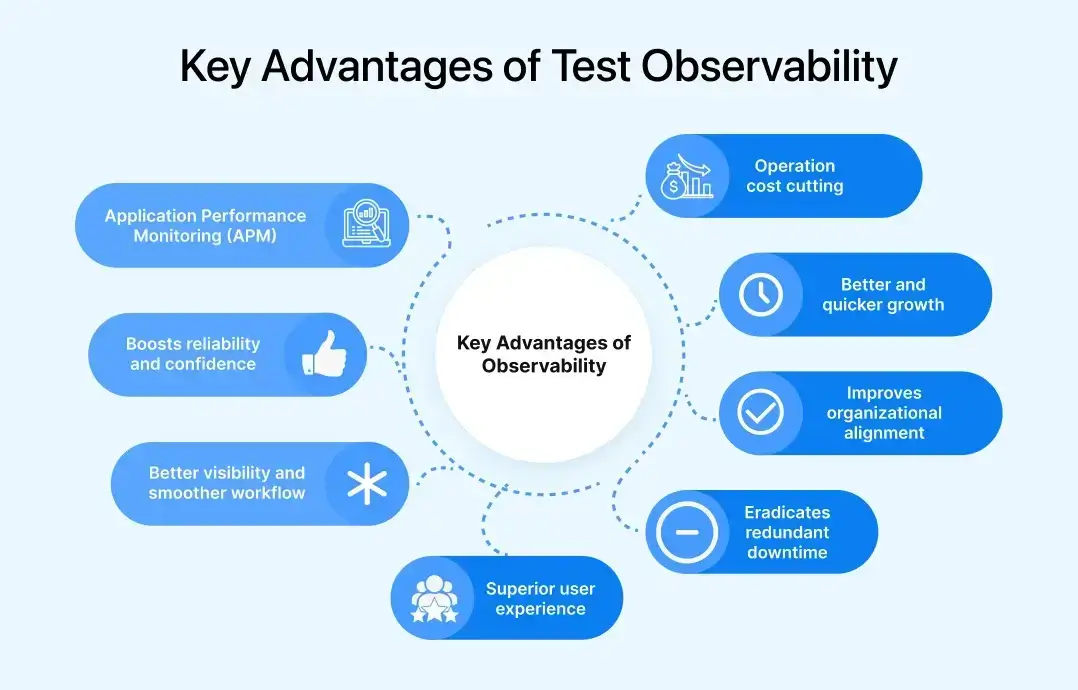
- Application Performance Monitoring (APM): APM is an observability strategy that provides high monitoring abilities with insights into the operational anomalies of the system. Bugs sourced from microservice architectures and cloud-native environments can also be tracked through APM.
- Operation cost cutting: Time is money in almost every developmental field. With precise tracing of issues and historical data at fingertips, observability allows quick and impactful handling of issues. It saves time and capital. Moreover, with continuous data monitoring and analysis, redundancy is reduced significantly. It smoothens the process of bug fixing and performance boosting and, in turn, cuts off operation costs.
- Boosts reliability and confidence: Broadly, the process of test observability stands on two concepts: firstly, through continuous monitoring, it examines the seamlessness of the system’s performance, and secondly, through the rich data collection, consistent assessment channels and history of responses, it analyzes and pre-determines critical issues and errors.
- Better and quicker growth: With components like tracing and metrics, observability also brings customer satisfaction. For recurring errors in the user interface, which act as a hassle in the consumer experience, observability concepts can track down the issues quickly and provide relevant measures and data for the solution.
- Better visibility and smoother workflow: Visibility becomes a major obstacle, especially in complex and distributed software systems. Developers often need clarification concerning the flow of queries across the application. In such cases, observability connects them with the natural flow of information and simplifies bug fixation.
- Improves organizational alignment: With the help of test observability, the organization gets a broader overview of its IT setup. The technology helps companies advance the alignment of information security teams, developers, and ITOs.
- Eradicates redundant downtime: As discussed in the context of operational costs, unwanted and elongated downtime is significantly reduced with the help of test observability. The bugs and errors evolving out of the systems are detected early and resolved accordingly, thus reducing the MTTR or MTTD to a great extent and improving productivity for the organization.
- Superior user experience: Better tracking of customer usage in distributed system pathways and rich metrics and logs associated with observability allow the developers to improve user satisfaction significantly. Moreover, early detection and resolution of issues prevent critical downtimes and impart seamlessness in the usage of the applications.
Thus, for complex cloud native environments where visibility becomes one of the major factors, observability plays a protagonistic role. Observability boosts the stakeholder’s confidence by offering reliability for complex structures where manual wisdom starts surrendering.
It brings about a sudden optimization in the Mean Time to Detection (MTTD). Statistical research from renowned authorities like Forbes suggested considerable improvement in the efficiency of 3/4th of the organizations that incorporated test observability in their systems.
In addition, with the combination of the visualized quantitative data, logs, and tracing of user pathways, observability gives an idea regarding the general interest of the user interest. It thus presents data and references for further upgrades and improvements in distributed software applications.
Now that we have learned its key advantages let's explore the specific problems that test observability helps solve.
What Problems Does Test Observability Solve?
Test observability solves problems in software testing by giving real-time information about how tests are running. This helps teams find and fix problems quickly and better understand their software's behavior and performance under different conditions. As a result, testing efficiency and software quality are improved.
- Differentiating genuine defects from background noise: Test failures can be noisy, making it challenging to discern between genuine issues that impact application reliability and insignificant anomalies.
- Mitigating the impact of flaky tests on defect detection: Inconsistent results from flaky tests can mask real defects, undermining the credibility of the testing process and potentially allowing critical issues to go unnoticed.
- Efficient debugging of unique errors: Effectively debugging unique errors that occur in test failures is essential. Teams need efficient and best debugging tools to avoid spending excessive time troubleshooting issues.
- Analyzing causes without local reproduction: Reproducing errors locally in complex distributed systems can be time-consuming. Waiting for the local manifestation of errors can delay problem resolution.
- Understanding key challenges in test automation: Gaining insights into the overarching challenges of test automation is crucial for making meaningful improvements. With clear insights, teams can address recurring issues effectively.

What Are the Key Components of Test Observability?
The key components of test observability are logging, tracing, metrics, distributed context propagation, and continuous examination with prompt alerting.
A robust framework is essential for the better performance of almost every process, and test observability is no exception. It incorporates plenty of components and performs various functions. The components have varying characteristics and, therefore, execute different functions. Below is a detailed description of each prominent test observability element.
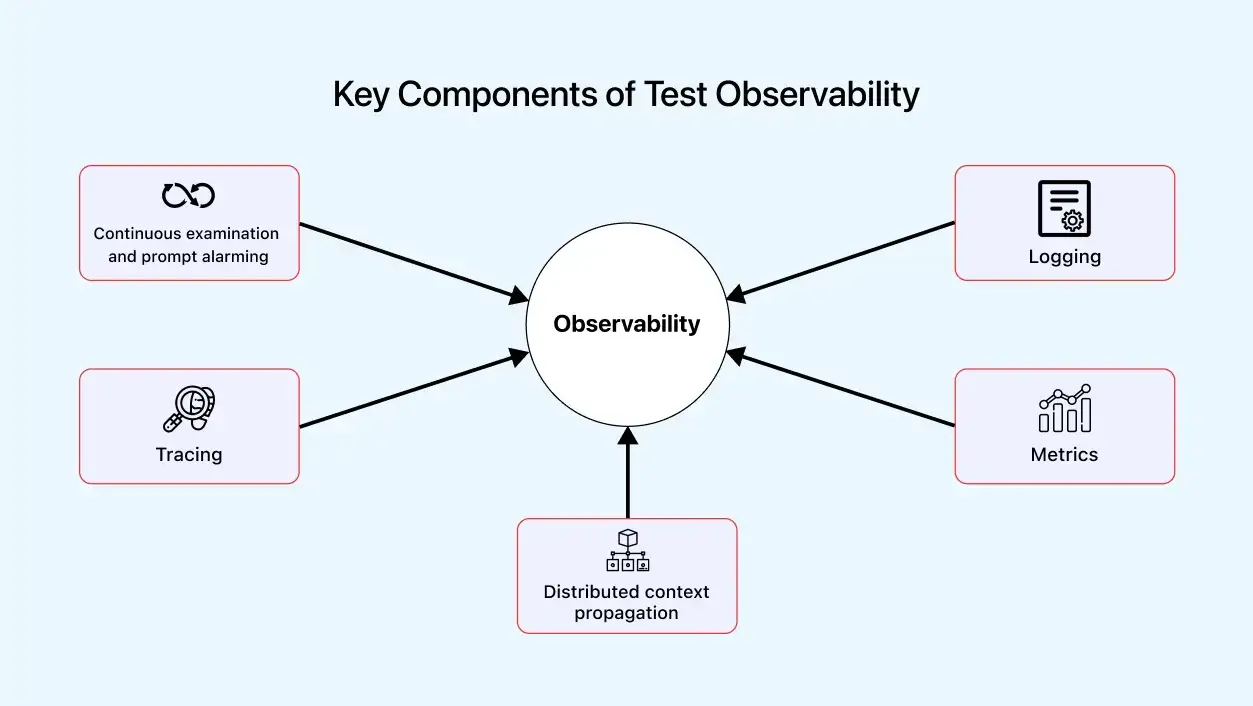
- Continuous examination and prompt alarming: It is essential to perform a continuous examination through test observability. It involves analyzing metrics and parameters like resource and capacity utilization, response rate, error frequency, anomaly chances, and volume acceptance efficiently. The data collected during this process helps handle these aspects and accurately highlights the data points, saving time.
- Logging: It involves the maintenance of continuous logs, including a chronological series of events such as inputs and responses, error occurrences, and actions taken.
- Tracing: It involves transporting and tracking the prompts input to the software through different code facets of the software application. This extensive monitoring provides a detailed analysis of the time taken at every point and identifies inefficiencies, pinpointing spots with scope for improvement.
- Metrics: It measures and represents the quantitative data collected throughout test observability, considering the extent of data acquired. Metrics collect CPU load, storage utilized, response rate, etc. These data types provide a statistical report for improving and maintaining the system and its operations.
- Distributed context propagation: In more complex systems, it is essential to have a comprehensive understanding of the flow of transactions or input through the various components of the system. Distributed Context Propagation, or DCP, traces the pathways of these queries and assesses their functionality across each stage of the code. This process helps gain a thorough understanding of the behavior and path of requests, even through inter-modular programs.
Moreover, continuous monitoring ensures deviations from the system's expected behavior lead to quick and accurate alerts. It helps resolve bugs before they reach a critical stage, as testing engineers and developers are notified promptly and can take suitable measures to fix the issues.
It's crucial to use continuous monitoring, logging, tracing, metrics collection, and distributed context propagation to monitor the performance of software testing processes, especially in complex cloud-native environments. These practices provide deep insights into test execution. Relying on a cloud-based platform like TestMu AI can significantly ease the work of developers and testers, ensuring smoother testing processes and higher-quality software.
TestMu AI is an AI-Native test orchestration and execution platform that lets you run manual and automated tests at scale across 10,000+ real devices and 3,000+ browser and OS combinations. You might wonder why TestMu AI can be used to enhance the core components of test observability. Well, some of the reasons are.
- This platform can quickly scale resources up or down based on your testing needs, ensuring optimal performance and cost-effectiveness.
- This platform allows testers and developers to access testing environments from anywhere, anytime, making collaboration more accessible and efficient.
- This cost-effective platform allows you to pay only for the resources you use, saving costs compared to maintaining on-premises infrastructure.
- This platform offers robust security measures and high availability, ensuring your testing processes are reliable and secure.
- This platform provides continuous monitoring, logging, tracing, and metrics collection, providing deep insights into test executions and helping to identify and resolve issues quickly.
To get started with the platform and learn how to leverage its functionality and manage complex cloud-native environments, watch this video tutorial and get valuable insights.

With all the detailed information on test observability, let's enhance our understanding with a few examples.
What Are Examples of Test Observability in Action?
To get a broader understanding of test observability in action, the following are relevant and rigorously describing examples of the process occurring in real-time.
Example 1: Monitoring Software Functionality
Assume an online application that undergoes a sudden increase in traffic due to the launch of products and services. In such cases, test observability allows the developers to examine the application’s behavior in real-time and detect the sources of inefficiencies.
Logs and metrics, for instance, response time, error handling, error frequency, load handling, resource utilization, etc., help the test engineers take suitable actions quickly and effectively. Not only does this process resolve the obstacle in smooth code flow, but it also distributes and optimizes resources properly.
Example 2: Detecting and Handling Bugs
Consider a web application that faces a user issue report while executing a sensitive and crucial transaction. Now, conventionally, detecting the source of the issue would require an extensive re-analysis of the back-end application. However, the process of test observability comes in handy in such cases.
Not only does it recognize the areas of improvement through continuous monitoring, but it also alerts the engineers about the possible sources of risks and deviations beforehand. In addition, tracing allows the tracking of transaction requests across various aspects of the system and provides precise evidence of exceptions.
Example 3: Optimizing Queries
Take the example of an eCommerce application about to launch its biggest sales event of the year. The extent of the increase in traffic anticipated during the sale would be multiple times the usual capacity handled by the software.
Developers and engineers can monitor metrics and logs through test observability, including response time, page load rate, resource utilization, server load handling, data collecting rate, error rates, and much more. Suppose the error rate surpasses a certain predetermined value.
The testers and stakeholders would then be notified and alarmed to take immediate action before the issue reached a critical stage. Tracing would thus allow proper identification of the source and cause of the problem and would save the most vital factor in such crucial situations, time. A typical issue arising in such conditions is the mismanagement of the sale timer with the time taken in page and transaction operations. Such problems can be managed better if bugs are dealt with beforehand.
Example 4: Tracing the Interface Usage
Consider a mobile application solely for user satisfaction. The process of test observability, tracing, and logging, in particular, would allow the most frequent journey taken by users in general.
The data may also include their time on every facet of the system and the different issues faced. It would allow the developers to make relevant and customer-oriented updates to the application and, in turn, increase traffic.
Example 5: Analyzing Edge Cases
The more multi-functional an application becomes, say, a social media application used for messaging, calling, media uploading, marketing, and much more, the higher the number and type of its edge cases.
Logging and metrics provide detailed analyses of the system’s responses and behavior to the extreme inputs and exhibit details surrounding the efficiency enhancement scopes, if any. Test observability imparts higher reliability to the application in diverse operations.
Example 6: Login Debugging Resolution
Take a widespread bug example of an error occurring while the user is trying to log into the online application. The observability instruments would detect the surge in the frequency of errors occurring on the login page and alert the engineers to the issue in time.
Meanwhile, they will also trace the issue through the code and pinpoint the bug precisely for quicker and better handling. The problems may vary from user input acceptance, error text, or unprecedented server responses. The data gathered throughout the process would also aid in finding the root cause and source of the error.
With a better understanding of the significance of test observability in the testing process, let us learn the principle of test observability in the following section below.
What Are the Principles of Test Observability?
Going by its name, test observability is a comprehensive and meticulous study of the internal and external components involved in the development and testing procedure. The scope of these observations ranges from troubleshooting ease to efficacy enhancement, as discussed above.
- Harmonizing: It is vital to equip the process with instruments encompassing data collection functions and logs and metrics generation for enhanced observation, harmonizing the process.
- Gathering: It generates a broad spectrum of data from various sources. This data may be quantitative, like net capacity utilization, response rate, etc., tabular, like records and efficiency, or traces that include data flow concerning the defined system. Understanding the variety of data makes it fruitful for handling errors and ensuring productivity.
- Storing: It is vital to systematically aggregate the expanding variety of data collected through various operations. This data can be secured in the form of a chronological database, tracing interface, etc., which can be used to conduct the historical analysis of the system.
- Presenting: It showcases the acquired data in a somewhat understandable and visually appealing format, which can be crucial to efficiency. Various tools and interfaces for better visual manifest convert the data into charts, graphs, and other formats. It allows easier comparison, analysis, and anomaly detection.
- Alarming: Its mechanisms can be used to spot errors or surpass security thresholds. This way, crucial and urgent issues are prioritized and responded to quickly.
- Relating: Its dashboard and data visualization, coupled with comprehensive historical analysis, allows a more straightforward and more prominent correlation with past applications or prototypes that, in turn, leads to premature error handling and more suitable planning.
- Detecting: It allows a smoother detection of bugs and errors in the software. This process increases accuracy in spotting these bugs and automates the anomaly detection process, thus reducing time and increasing productivity.
- Mapping: Its mapping process correlates the functionality and dependency of one application over another. It boosts the root cause analysis process while predicting and mapping down a well-defined course of failure impacts and improvement scopes.
- Developing: It consistently analyzes and updates the tools, information-gathering process, and inspection plans per the application requirement.
- Maintaining Privacy: It maintains privacy by ensuring that data involved in many applications is protected and secure. Test observability needs to be incorporated with specific data protection guidelines to secure sensitive information from leaking.
On the one hand, it considers the historical data and checks previous mistakes and exceptions for future strategies. On the other hand, it reviews the efficiency of the ongoing processes in real-time and develops a new course of action for improvements.
We have learned key components, advantages, examples, and principles. Let us further learn how to root cauimplement test observability to enhance software qualityse analysis.
How Do You Implement Observability in the Software Testing Process?
Incorporating observability into the software testing process can be complex and requires a systematic action plan for simplification. Test observability should be implemented during both the development and pre-production stages and environments of the system to ensure consistency and quality in performance. The following is a methodological description of how to smoothly and effectively apply observability in the testing procedure:
Pre-Production Environment
Below are the steps to consider when implementing observability in a pre-production/development environment.
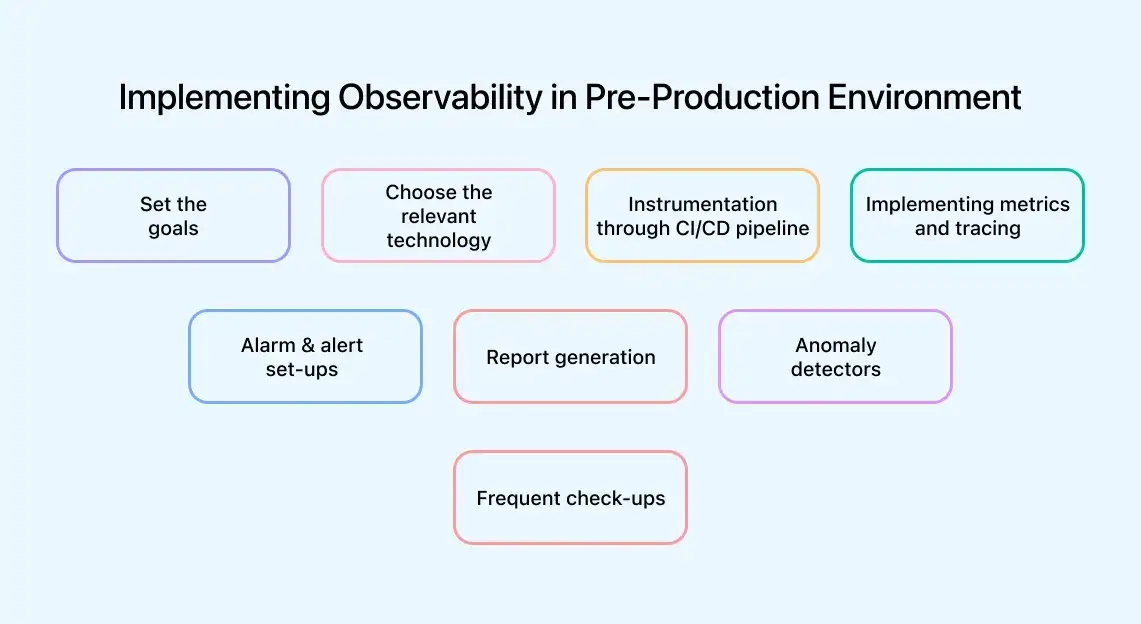
- Set the goals: First and foremost, understand the exact need and objective of test observability in the system during the pre-production phase. This helps prioritize data and spot and resolve issues early, ensuring a smoother and more effective testing process.
- Choose the relevant technology: The appropriate technology is crucial for test observability in the pre-production environment. It involves choosing from various tools and instruments based on available capital and their relevance to the components in the system. Making the right choices at this stage ensures the testing process is effective and efficient.
- Instrumentation through CI/CD pipeline: Continuous Integration (CI)/ Continuous Deployment (CD) pipelines integrate observability within the system effectively and ensure automation in consistently examining the test suites during generation and execution.
- Implementing metrics and tracing: Test suites are essential for continuously evaluating data. These instruments help monitor metrics such as response rate, error frequency, and efficiency measurement, providing valuable insights into the system's performance.
- Alarm & alert set-ups: Metrics and traces are incorporated into the system, and logging is implemented. Establishing alerts, including their limits and thresholds, is vital for early error detection and easy resolution. It is also essential to correlate limit breaches with notifications to engineers for timely action.
- Report generation: Detailed and precise reports are generated after every test run, whether it brings a positive or negative outcome. If positive, the scope for improvements is determined accordingly, while the fields of errors are spotted in case of failures.
- Anomaly detectors: Error-catching tools and algorithms detect anomalies without interrupting manual involvement while executing the tests.
- Frequent check-ups: Regular updates in the codes and test suites require the observability setups to be examined and upgraded accordingly. Feedback from users and other engineers from the team plays a vital role in making the essential changes.
Production Environment
Below are the steps to consider when implementing observability in a production environment.
- APM utilization: APM, or Application Performance Monitoring, is a set of tools that seamlessly monitors the functionality and efficacy of the production environment. They provide a broad understanding of how the software behaves with users in real time.
- RUM deployment: RUM, or Real User Monitoring, traces user requests and transactions, gathering data for further analysis. It helps pinpoint potential issues, sources of inefficiencies, and errors effectively.
- Analyzing logs: Using tools like the ELK Stack is crucial for effective log monitoring and analysis. These tools help determine areas for improvement and enhance error handling in the system.
- Microservices distributed tracing: It is essential for gaining an end-to-end understanding of request flows across system components. It helps detect bottlenecks and sources of inefficiency, enabling more effective optimization and troubleshooting.
- Incorporating heartbeat monitoring: Heartbeat monitoring is deployed to ensure consistent operation of the entire system. In addition, periodic health checks are conducted to eradicate the possibility of any deviation from the expected working of the application.
- Incident response and escalation strategy: A predefined and detailed incident response and escalation strategy is crucial for systems lacking manual intervention. This plan should clearly define roles and duties, ensuring quick and effective handling of exceptions.
- Deploy security tools: Deploying security tools is crucial for protecting sensitive data from security threats. Using precise security-assuring tools and plans helps ensure the security of the system.

How Long Will It Take to Implement Test Observability in an Organization?
Every organization takes a different amount of time to implement test observability, depending on what parameters it meets in the current scenario. Some include the size and complexity of the organization, the existing testing and monitoring infrastructure, the level of expertise within the team, and the specific goals and requirements for implementing test observability. Organizations with a higher resource availability have more leverage than their scarce counterparts. Therefore, they can implement test observability quicker than others and vice versa.
Below are some test observability tools that can help you achieve better efficiency in test observability. These tools offer features that enable developers and testers to make informed decisions.
Which Test Observability Tools Should You Know?
Observability tools are crucial for monitoring software tests and applications. They assist developers and testers in identifying problems, enhancing performance, and ensuring software reliability by providing vital information about behavior and performance. These tools are essential for ensuring the stability and effectiveness of software systems.
How to Choose a Test Observability Tool
Before comparing individual tools, judge every candidate against four criteria that separate a real observability platform from a dashboard:
- CI/CD integration: It has to plug into your existing pipeline (Jenkins, GitHub Actions, and the like) with minimal glue. A tool that lives outside the pipeline gets ignored.
- Open-standard support (OpenTelemetry): Support for OpenTelemetry, the vendor-neutral standard for traces, metrics, and logs, protects you from lock-in and lets the tool ingest telemetry you already emit.
- AI-driven root cause analysis: Failure clustering and automated root cause analysis are what turn a wall of red into an actionable short list. Without them you are back to reading logs by hand. To see what an automated analysis of one failure contains, read how to use AI to find the root cause of a failed test.
- Minimal execution overhead: Collecting telemetry should not materially slow the suite. If observability doubles run time, teams turn it off exactly when they need it most.
TestMu AI Test Observability Platform
It is an AI-native centralized platform designed to streamline the gathering and analysis of test execution data from multiple sources. Its test observability platform offers a single dashboard where users can access real-time insights, enabling them to make informed decisions about their testing processes. This platform helps improve efficiency and effectiveness in testing by providing a comprehensive view of testing data.
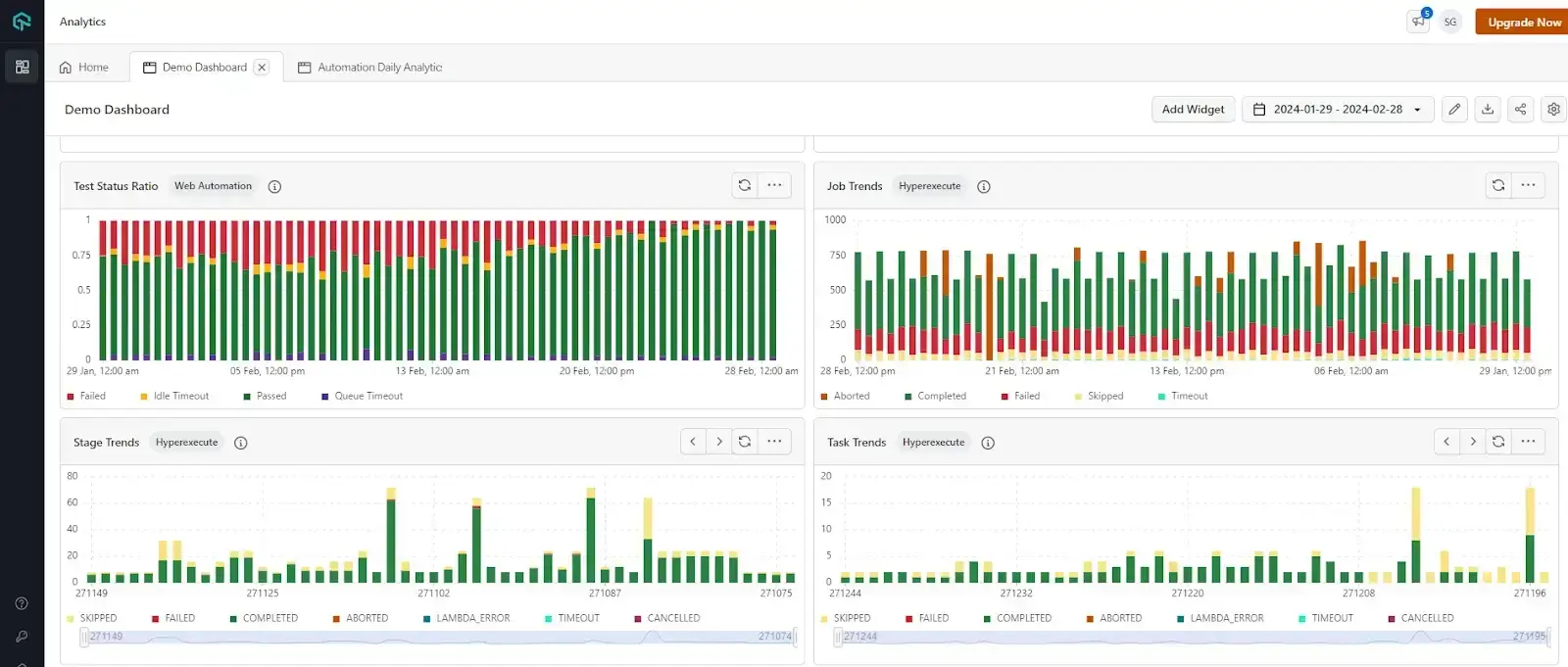
Features of TestMu AI Test Observability Platform:
- Test Analytics: Unifies test execution data from various TestMu AI products for real-time insights. It offers the following insights:
- It provides a test case health summary that helps focus on inconsistencies in test execution, helping identify tests that sometimes pass and sometimes fail, indicating potential issues in their design or execution.
- It provides an overall test summary to view the number of tests executed, categorized by status (e.g., pass, fail, skip).
- It enables users to track the performance of tests over time, helping identify trends in pass/fail rates and potential improvements needed in the testing process.
- It provides detailed information about errors encountered during testing.
- It offers insights into how your team is using TestMu AI resources.
- It helps testers pinpoint the nature and distribution of errors across different test categories. This enables focused debugging efforts and quicker resolution of issues impacting your software.
- It analyzes data specific to the HyperExecute platform (cloud-based test execution).
Prometheus
It is the standard for monitoring, focusing on metrics gathering and enabling alerts. It utilizes a robust time-series database for storing high-resolution metrics data and offers multiple visualization modes for analyzing data from backend services.
Features of Prometheus:
- It stores long-term metrics data for historical analysis using an efficient time-series database with scaling functionality through sharding and federation.
- It creates powerful alerts using PromQL, a flexible query language that maintains dimensional information.
- It pushes metrics and alerts to other tools in your observability infrastructure using open-source client libraries and integrations.
- It is primarily a metrics collection and alerting tool; it does not directly assist backend developers with testing their services.
Jaeger
It is an open-source end-to-end tracing tool that helps developers monitor and troubleshoot transactions in distributed environments. Its primary goal is simplifying the debugging process for developers working with distributed services, which is inherently more complex than working with monolithic systems.
Features of Jaeger:
- It monitors transactions between distributed services to understand infrastructure health and performance.
- It performs root cause analysis by examining individual transactions that may cause user-facing issues.
- It optimizes performance and latency by identifying services that respond slowest to requests.
- It is designed explicitly for end-to-end tracing and does not include tools for developing tests for backend services.
Grafana Tempo
It is an open-source, high-scale distributed tracing back-end designed to collect and store trace data. Released under the AGPLv3 license, Grafana Tempo is developed and maintained by Grafana Labs, known for other open-source projects like Loki for logs, Grafana for metrics visualization and alerting, and Mimir for metrics storage.
Features of Grafana Tempo:
- It consumes trace data from popular open-source tracing protocols such as OpenTelemetry, Jaeger, and Zipkin.
- It provides affordable long-term storage for trace data, enabling historical trends and analysis.
- It facilitates tracing implementation in backend services; it does not offer tools for writing or executing tests.
SigNoz
It is an open-source alternative to enterprise-level observability platforms such as Datadog and New Relic. Unlike some generalist tools, SigNoz specializes in Application Performance Monitoring (APM), focusing on measuring performance from the end-user experience perspective to help developers address issues proactively.
Features of SigNoz:
- It supports OpenTelemetry for instrumentation and generating application trace data.
- It offers a unified UI for metrics, traces, and logs, reducing the need to switch between tools like Prometheus and Jaeger to debug and troubleshoot issues.
- It provides flame graphs and individual request traces to identify the root cause of performance issues.
- It allows for building dashboards and alerts based on log attributes.
- It enables visualization of the slowest endpoints in an application.
OpenSearch
It is an open-source database for inserting, searching, visualizing, and analyzing data. It is built on Apache Lucene, a FOSS library for indexing and search, which enables OpenSearch to offer advanced analytics capabilities such as anomaly detection, machine learning, and full-text search.
Features of OpenSearch:
- It Ingests trace data from OpenTelemetry or Jaeger for visualization and performance problem identification.
- It uses community plugins to gather observability data from Prometheus and customize the output with rich visualizations.
- It filters, transforms, normalizes, and aggregates data to simplify analytics and visualizations.
- It collects metrics, traces, and logs that can be used for validating tests; it does not offer features to help developers create, deploy, or manage tests. Developers will need to use a separate tool and connect its outputs to OpenSearch for testing purposes.
Testers and developers still encounter challenges when implementing test observability despite the tools and techniques available. In the following sections, we will explore some of these challenges developers and testers face.
What Are the Challenges of Test Observability?
The main challenges of test observability are complex system interactions, data overload, legacy system integration, security and compliance, and resource intensiveness.
Observability is a mechanism for better decision-making and optimal system performance, enhancing software quality and reliability throughout every testing phase. However, there are challenges related to test observability. These challenges include:
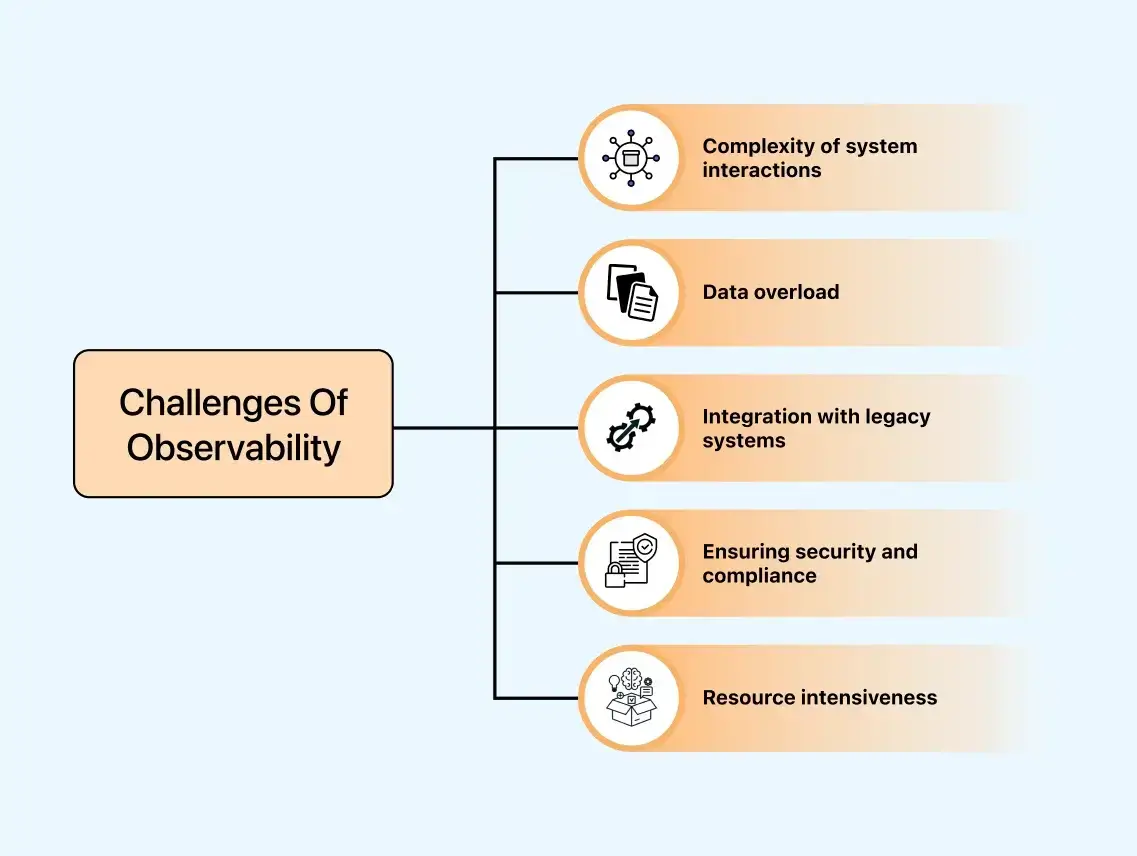
- Complexity of system interactions: Complex systems present challenges for test observability due to the complex interactions among numerous components. Tracing the flow of transactions and understanding dependencies becomes complex, often requiring advanced tools and techniques.
- Data overload: In testing, the large volume of generated data can lead to information overload, making it crucial to distinguish essential signals from noise. Insufficient filtering techniques can reduce the effectiveness of observability.
- Integration with legacy systems: Integrating observability into legacy systems can be challenging due to potential compatibility issues. Older systems may lack the necessary instrumentation for comprehensive observability, requiring additional efforts for rebuilding.
- Ensuring security and compliance: Collecting and analyzing sensitive data is integral to observability. Maintaining data integrity and preventing privacy breaches requires adherence to security and observability protocols, especially in regulated industries.
- Resource intensiveness: Implementing observability procedures may require significant resources. Balancing the need for sufficient data for insightful analysis with resource constraints can be challenging, particularly in environments with limited resources.
What Are the Best Practices for Implementing Test Observability?
Achieving optimal results with test observability requires strategic and effective implementation. Adhering to best practices ensures that test observability becomes an integral part of your testing approach, enhancing software quality and the overall development and testing process. Let's delve into these best practices in detail.
- Know your platform: Knowing your platform is essential for effective observability practices. Different systems and platforms require unique monitoring and observability approaches. Understanding your platform's unique characteristics helps optimize observability practices for better results.
- You don’t have to monitor everything: These platforms generate vast amounts of data, and every bit isn’t practical. You should design observability systems to filter out the data at different levels to cut through clutter. As a result, your real-time data analysis will get a lot faster.
- Enable Alerts for Critical Errors: As suggested earlier, you can always use automation or a self-healing infrastructure for resolution without intervening manually. You can enable alerts for issues and errors that are difficult or impossible to solve through automation testing. Such a practice will allow DevOps teams to concentrate on more essential matters instead of being preoccupied with insignificant ones.
- Create a Standardized Data Logging Format: Using a multi-cloud environment to conduct data logging for observability is essential, as it leads to better insights into various systems and potential bottlenecks.
- Monitor Beyond Logs and Traces: Besides traces and logs, it is also essential to consider front-end application data feeds. In other words, it tells how your system performs in the real world for end users. Such information can be highly critical if we discuss an outside-in perspective.
- Leverage Integrations: Utilizing integrations is crucial for effective observability practices. Integrating automation with observability systems creates a continuous ecosystem that monitors for any issues. Choose a tool that offers seamless third-party integrations, allowing you to quickly push bugs to your project management tools with just a single click. This integration helps incorporate automation more seamlessly into observability, recognizing insights as patterns that ultimately improve the efficiency of an application.
- Ensure Aggregation and Centralization of Data: Aggregate logs from different stages of the delivery pipeline for centralized logging into one place. It offers IT engineers and developers end-to-end clarity and visibility. They can leverage to consistently and continuously deliver software. By centralizing the data, you can collect logs from testing and development environments in the same place and turn them into production logs. It, in turn, makes it easier for everyone to view data and correlate it.
- Availability of Effective Feedback Loops: Feedback loops offer a detailed internal review of how users, systems, and teams function. It's not necessarily in the observability context but also from a DevOps context. They're crucial because feedback loops help improve development quality while ensuring timely deliverables.
Nevertheless, data logs can be ineffective because of too much or too little logging that doesn't serve the purpose. Hence, creating a standardized format for data logging is one of the most promising observability best practices. As a result, you can easily avoid extraneous data and log only critical stuff.
Consequently, it eliminates potential blind spots and improves other business outcomes.
Sometimes, a single modification in one unit can create a change in another, which can eventually impact the system. But when you continually perform required corrections, it makes the organization highly agile. Creating a consistent information flow and collecting data with the help of a feedback loop leads to enhanced observability in the DevOps context.
What Is the Future of Test Observability?
With technological advancements, we expect software testing tools to become more integrated, promoting collaboration and offering flexible tooling options. This evolution will streamline testing processes, making software development cycles more efficient and cost-effective.
- Tool consolidation: Currently, many companies need to use multiple tools to meet their observability requirements. Consolidating these tools into one will save time, increase efficiency, and reduce costs.
- Culture of collaboration: Observability fosters collaboration on code within the developer environment. It enhances the team collaboration and feedback loop, leading to better monitoring and fewer defects escaping to production.
- On-demand tooling: Modern observability tools are shifting away from subscription structures to usage-based models. It allows organizations to pay only for what they use, providing more flexibility and cost-effectiveness.
How Is AI Changing Test Observability?
AI is changing test observability by grouping similar failures, classifying them as product bugs, flaky tests, or environment issues, and suggesting likely root causes from logs and traces.
As test suites grow into thousands of runs a day, no one can read every log. AI summaries surface the few failures that matter, and trend models flag tests whose flakiness or duration is creeping up before they block releases.
AI classifications still need checking, because a failure labeled flaky can hide a real race condition. Confirm the cause in the run data, such as video, logs, and network traces, before closing the issue.
Why Should Teams Invest in Test Observability?
Teams should invest in test observability because it turns failing test runs into clear causes, cutting the time spent rerunning, debugging, and guessing.
All in all, test observability is one of the most powerful tools that enhances software quality. It also raises the standard of the entire development process. Test observability has risen as a crucial aspect of current-day software development by offering priceless insights into the behavior and performance of software during testing. When you employ components such as logging, monitoring, tracing, and metrics, QA teams can conduct effective monitoring and analysis, improving software quality, robustness, and reliability.
Author

Veethee Dixit
Blogs: 9


Veethee Dixit is a seasoned content strategist and freelance technical writer specializing in SaaS platforms and AI-driven testing technologies. She has over 8 years of hands-on experience writing SEO focused technical content, simplifying complex topics in software testing, and collaborating with product marketing teams to develop high converting blogs, documentation, whitepapers, and tutorials. She holds a Bachelor of Engineering in Computer Science and has authored 50+ learning hub articles in the software testing domain. Her work has been featured in leading software testing newsletters and cited by top technology publications. Veethee has played a key role in translating complex testing workflows into actionable guides, helping audiences implement automation strategies with clarity and confidence.
Reviewer

Rajas Nawar
Reviewer
Rajas Nawar is a Community Contributor at TestMu AI (formerly LambdaTest), where he authors software-testing content for QA engineers and testers. His articles cover black box testing, state transition testing, CI/CD test case templates, and software-testing interview questions, giving testing teams practical guides and ready-to-use templates for their quality assurance work.


Test Observability FAQs
Did you find this page helpful?
More Related Learning Hubs
TestMu AI forEnterprise
Get access to solutions built on Enterprise
grade security, privacy, & compliance
- Advanced access controls
- Advanced data retention rules
- Advanced Local Testing
- Premium Support options
- Early access to beta features
- Private Slack Channel
- Unlimited Manual Accessibility DevTools Tests