

Power Your Software Testing with AI Agents and Cloud
The Native AI-Agentic Cloud Platform to Supercharge Quality Engineering. Test Intelligently and Ship Faster.


- TestMu AI (Formerly LambdaTest)
- /
- Learning Hub
- /
- A/B Testing Tutorial: Complete Guide With Best Practices
Thought Leadership
A/B Testing Tutorial: Complete Guide With Best Practices
A/B testing compares two versions of a page or feature with real users. Learn A/B testing types, metrics, statistics, steps, tools, and best practices.
Last Updated on:
On This Page
- What Is A/B Testing?
- Why Should You Perform A/B Testing?
- What Are the Types of A/B Testing?
- How Does Client-Side A/B Testing Differ From Server-Side A/B Testing?
- What Are A/A Testing and Multi-Armed Bandit Testing?
- What Skills Does A/B Testing Require?
- QA Testing vs. A/B Testing: What Is the Difference?
- What Are Real-World Examples of A/B Testing?
- What Are the Benefits of A/B Testing?
- What Are the Drawbacks of A/B Testing?
- Which Statistical Approaches Are Used for A/B Testing?
- How Do You Perform A/B Testing?
- How Do You Set Primary and Guardrail Metrics for A/B Testing?
- What Mistakes Should You Avoid During A/B Testing?
- What Are the Challenges of A/B Testing?
- Is A/B Price Testing Legal?
- Which Tools Are Used for A/B Testing?
- How Do You Perform A/B Testing Using TestMu AI?
- How Do You Analyze A/B Testing Results?
- How Is AI Changing A/B Testing?
- What Are the Best Practices for A/B Testing?
OVERVIEW
A/B testing involves comparing two versions of a website or app against each other to determine which performs best. In this experiment, two or more variants of the same page are shown randomly to users, and statistical analysis determines which variation performs best.
There are a lot of businesses today that are unhappy with the unqualified leads they get per month. E-Commerce stores are struggling with a high cart abandonment rate. The media and publishing houses are also dealing with low customer engagement. Conversion metrics have impacted the overall business growth of different industries.
This is where you need A/B testing that helps improve the overall growth metrics and end-user engagement and experience.
What Is A/B Testing?
A/B testing is a basic way to perform an experimentation process to compare two or more versions to determine which version leaves the maximum impact and drives business metrics. Two or more versions of a webpage, page element, etc., are shown to the website visitors simultaneously so they can choose the best.
In A/B, ‘A’ represents the original version of the element, whereas ‘B’ refers to the variation or a new version of the original testing variable. A/B testing helps to eliminate all the guesswork from the equation and enables experienced optimizers to make data-backed decisions in a product and marketing strategy.
It means that you can make business decisions backed by comprehensive data analysis. Whether you are a designer, business analyst, or developer, you can always rely on the A/B testing results and become more data-driven in your working approach.
It started in the 1920s when the statistician and biologist Ronald Fisher discovered some key principles behind A/B testing. Still, it was in the 1990s that this concept came into existence.
Here are some scenarios where you can run A/B tests.
- Call to action button
- Website performance
- Page headlines
- Position of different elements on the web page
- Product descriptions
- Email marketing
A/B testing involves three key elements.
- Campaign: This can be an ad, landing page, or any medium already used.
- Elements: The elements that need to be tested.
- Defined goals: The goals that you tend to achieve in the long run.
Additionally, A/B tests lets you know what words, phrases, images, or design elements work best. Even the smallest of changes can impact metrics and growth. You can execute changes that are relatively inexpensive to implement. You can test 2 to 3 elements and get the desired answer. Also, it can help you easily decide whether to implement that change. You can always revert to the older version if the testing results are incorrect.
Why Should You Perform A/B Testing?
B2B businesses always face challenges with all the unqualified leads, and eCommerce stores struggle with a high cart abandonment rate. This impacts their business metrics in the long run.
Here are some of the top reasons you should prefer A/B tests for your growth strategies.
- Solve user's pain points: Users visit your website because they have a specific goal they need to accomplish. It may be related to understanding a specific product or service, buying a particular product, or simply browsing the product catalog. Whatever the visitor’s goal, they may face some pain points in achieving their desired goal.
- Get a better ROI from the existing traffic: It is always a challenging task when trying to acquire quality traffic on your website. This is when you can rely on A/B test that helps improve conversions without spending additional money on acquiring new traffic. It provides high ROI helping you to improve your business growth.
- Making minor modifications to the software application: A/B test allows you to make minor and incremental changes to your web page rather than drastically improving the page design and layout. This ensures that your current conversion rate remains intact. You can perform A/B tests to gauge user behavior when minor modifications are performed.
- Achieve improvements in the long run: Since A/B tests is a data-driven approach where you do not have to rely on guesswork or instincts, and that is why you can quickly determine the right version based on different predefined metrics. This allows you to bring improvements that are great for your business’s growth in the long run.
It could be due to the CTA button not being visible or maybe in a confusing place for the user to click. When they cannot achieve your desired goals, the end user experience is impacted. You can gather data using heatmaps and Google Analytics to solve your visitor’s pain points.
Let’s consider the two versions of a landing page you need to test for an e-commerce website. The traffic is split randomly so that one group of the website audience views version A, and the other group sees version B of the landing page.
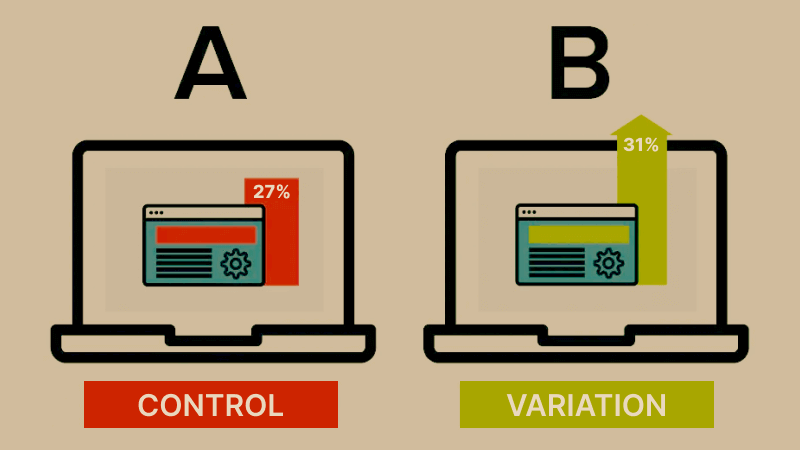
Different metrics, such as time spent during each session, conversions, etc., are calculated and tracked to gauge which version works the best for the website users. This is how you can effectively use A/B tests to determine which version helps you to achieve desired business growth in the long run.
What Are the Types of A/B Testing?
There are three types of A/B tests you should know about, plus A/A testing, which validates your setup rather than a variant.
- Split testing: In split testing, you can test a completely new version of an existing web page to see which version performs better. It is a great way to test an existing page's design and copy without changing anything else.
- Multivariate testing: This type of A/B testing involves simultaneously testing variations of multiple variables on a page to determine which combination performs best. Since this method involves creating many variant pages, it ideally suits advanced marketers, product developers, and designers.
- Multi-page testing: It involves testing changes to particular elements, such as the CTA button, across multiple web pages.
- A/A testing: A control test where both variants are identical. You are not looking for a winner. You are checking that your testing setup is trustworthy. If a test between two identical pages reports a significant difference, something in your tool, traffic split, or tracking is wrong. This is covered in more depth below.
How Does Client-Side A/B Testing Differ From Server-Side A/B Testing?
Beyond what you test, there is the question of where the variant is applied. This is the single most consequential technical decision in an A/B testing setup, and it determines what you are able to test at all.
Client-side testing runs in the browser. The original page loads, then JavaScript from your testing tool modifies the DOM to apply the variant: swapping a headline, changing a button colour, hiding a section. Because it needs no deployment, marketing teams can build and ship tests through a visual editor without involving engineers, which is why most A/B testing tools started here.
The cost is the flicker effect, also called the flash of original content. The browser paints the original page before the testing script has rewritten it, so real users briefly see version A before it snaps to version B. It looks broken, and worse, it contaminates your data, because users who saw the flicker are reacting to something neither variant intended. Client-side tests also add a blocking script to the page, which hurts load time, and ad blockers or strict content security policies can prevent the test from running at all.
Server-side testing decides the variant on the server and delivers the finished HTML to the browser. There is no flicker, because the browser only ever receives one version. There is no extra client script, so no page-speed penalty, and no ad blocker can interfere. More importantly, it lifts the ceiling on what you can test: server-side experiments can cover pricing logic, search ranking and recommendation algorithms, checkout flows, API responses, and native mobile apps, none of which a DOM-rewriting script can reach. The trade-off is that every test needs engineering involvement and a deployment.
| Parameters | Client-side testing | Server-side testing |
|---|---|---|
| Where the variant is applied | In the browser, via JavaScript on the DOM | On the server, before the HTML is sent |
| Who builds the test | Marketers, via a visual editor | Engineers, in the application code |
| Flicker effect | Yes, a known risk | None |
| Page speed impact | Adds a blocking script | Negligible |
| Blocked by ad blockers | Possible | No |
| What you can test | Visual and front-end changes | Pricing, algorithms, APIs, mobile apps, full flows |
| Speed to launch | Fast, no deployment | Slower, needs a release |
Use client-side for fast, visual, front-end experiments where the marketing team owns the hypothesis and speed matters more than depth. Use server-side when the change touches business logic, when the flicker effect would distort the result, or when you are testing anything beyond the web page itself.
Most mature programs end up running a hybrid approach: server-side for pricing, algorithms, and anything in the product, and client-side for quick copy and layout tests on marketing pages. The important part of a hybrid setup is that both paths write to the same experiment assignment and the same analytics pipeline. If your client-side and server-side tests bucket users independently, a user can end up in variant A of one test and variant B of another overlapping test, and neither result will be trustworthy.
What Are A/A Testing and Multi-Armed Bandit Testing?
Two approaches sit either side of a standard A/B test. One checks that your setup can be trusted before you run anything. The other changes how traffic is allocated while the test is running.
A/A Testing
An A/A test splits traffic between two identical variants. Since there is no difference between them, the correct outcome is no significant difference, and that is the whole point. An A/A test does not evaluate a change, it evaluates your testing setup.
If an A/A test declares a winner, you have found a real problem before it cost you a bad decision. The usual causes are a broken randomization or traffic split, a sample ratio mismatch where the 50/50 split is not actually 50/50, duplicate or missing tracking events, caching that pins users to one variant, or simply peeking at results until noise crosses the significance threshold. Any of these would have silently corrupted every A/B test you ran afterwards.
A/A testing is worth running when you adopt a new testing tool, after you change your analytics or tracking implementation, or when a result looks too good to be believed. It also gives you a feel for the natural variance in your own traffic, which is a useful reality check on how large a lift needs to be before it means anything. The cost is real, though: an A/A test consumes traffic and time and produces no business insight, so it is a periodic validation exercise rather than something to run constantly.
Multi-Armed Bandit Testing
A classic A/B test holds the traffic split fixed at 50/50 for the whole run, and you decide at the end. That means you knowingly keep sending half your traffic to the losing variant while the test completes. A multi-armed bandit test uses machine learning to reallocate traffic continuously instead, shifting more visitors toward whichever variant is performing best while the test is still running.
The name comes from the problem of a gambler facing several slot machines, each with unknown payout, who must balance exploring the machines to learn which pays best against exploiting the one that seems best so far. A bandit algorithm makes that trade-off automatically on every request.
Bandits suit situations where the cost of showing the losing variant is high and the window is short, such as a holiday campaign, a news headline, or a limited promotion. They start capturing the benefit immediately rather than at the end. The trade-off is statistical cleanliness. Because the traffic split changes over time, it becomes harder to attribute a difference cleanly or to quantify exactly how much lift the winner delivered. If your goal is to maximize conversions during a campaign, use a bandit. If your goal is to learn something reliable about your users that will inform decisions later, run a standard A/B test and accept the cost of the fixed split.
What Skills Does A/B Testing Require?
A/B testing can be challenging if you do not have the right resources to implement it. That is why you need exceptional testing professionals or specialists that can derive valuable insights and make required design corrections to your website or webpage.
Some key skills required for it.
- Expertise in testing multiple platforms and systems.
- Understanding the different data requirements and performing detailed analysis.
- Knowledge related to user experience design where you understand different design elements and how they interact within the system.
- Social media marketing and campaigns.
- User interviews to derive valuable insights from your users who are using the product.
Roles That Perform A/B Testing
A/B testing allows teams and organizations to change their user experiences while collecting data from the testing results. It is focused on improving the growth metrics, which are specific to the company’s goals and objectives.
It can be performed by either of the following teams that are aware of the end-to-end functionality flows:
- UX team
- QA team
The respective teams can try A/B tests changes to the form fields, headline, call to action, and overall page layout. In some companies, the UX and QA teams can collaborate closely to perform it.
That is why it becomes important talking to your customers so that you can easily identify the specific aspects that need improvement. The right approach is to make small design changes and observe customer behavior.
QA Testing vs. A/B Testing: What Is the Difference?
Because the QA team is often involved in both, the two get conflated. They answer completely different questions. QA testing asks “does this work correctly?” A/B testing asks “do users prefer this?”
QA testing verifies that software behaves as specified and is free of defects, and it happens before release. It is deterministic: a test either passes or fails, there is a correct answer, and a bug is unambiguously something to fix. A/B testing is an experiment run on live traffic with real users, measuring behavior and business metrics. It is statistical rather than deterministic: there is no “correct” answer to discover, only evidence that one variant performs better than another, with some probability of being wrong.
| Parameters | QA testing | A/B testing |
|---|---|---|
| Question it answers | Does the software work correctly? | Which version do users respond to better? |
| When it runs | Before release | After release, on live traffic |
| What it measures | Correctness, defects, regressions | User behavior and business metrics |
| Nature of the result | Deterministic pass or fail | Statistical, with a confidence level |
| Who runs it | QA engineers and developers | Product, growth, UX, with QA support |
| Definition of success | No bugs found | A variant wins on the primary metric |
The two are sequential, not competing. Every variant in an A/B test still has to be QA tested first, across browsers, devices, and screen sizes, before it is exposed to real users. A variant that loses because it is broken on Safari is not a user preference finding, it is a QA failure that wasted a live experiment and some of your traffic. Running your variants through cross-browser testing before the experiment goes live is what keeps an A/B test measuring what you think it is measuring.
What Are Real-World Examples of A/B Testing?
Well-known A/B testing examples come from Netflix testing streaming experiences, Amazon testing its buying flow, and Booking.com testing changes to raise bookings.
Here is how tech giants like Netflix, Amazon, and Booking.com use A/B tests to achieve desired business goals and customer growth.
Netflix is well known for providing its users with the best-in-class streaming experience. But everyone is unaware that it relies heavily on A/B tests. Even today when it sees a dip in customer engagement and retention. Every change done on the Netflix website goes through an A/B test process. One such example of it is the personalization feature which is shown on the home page. Based on every user profile, the user personalization experience is defined. This is applicable in the case of media as well.
When we talk about the eCommerce industry, no other brand like Amazon provides an amazing end-user experience. This is evident in the buying functionality as well. Amazon used A/B tests to define the call-to-action button for improving the overall shopping experience since it has a huge business impact on the sales and revenue of the company.
A/B tests is also a useful option in the travel domain, especially when planning to increase the existing bookings or improve the existing revenue. Booking.com quickly realized the true value of it. The users of this organization were executing tests based on the finalized ideas.
What Are the Benefits of A/B Testing?
With A/B test, you can directly test your hypothesis on a target audience segment. This will ensure that any changes you make to your website are based on strong evidence. Some of its advantages are.
- Improve your website's visitor experience and conversion rate continuously.
- Ensure your visitors have an exceptional user experience to keep them around your brand.
- Understand the needs and expectations of your visitors by analyzing how your pages are structured.
- It helps you make better decisions by testing your assumptions and reducing risk factors.
- When making decisions, avoid subjective assessment. Instead, test your hypotheses and reduce risks by collecting reliable facts and statistics.
What Are the Drawbacks of A/B Testing?
Here are some of the disadvantages of using A/B tests.
- Involves a lot of time and resources. There is a significant amount of time spent setting up the process, even though you can use third-party services. There can be endless meetings before you conclude. A/B tests can take weeks or even months for low-traffic sites.
- If you already have usability issues with your website, then you cannot expect that the A/B tests can help you achieve the desired results.
- It cannot help you to determine why people perform a certain set of actions. You are not observing the users or their thought processes but relying on statistics to arrive at the results.
- It is not a comprehensive UX method such as usability testing, where you can identify potential issues in the overall system design. It works on the data elements that are being tested.
Which Statistical Approaches Are Used for A/B Testing?
To perform A/B tests successfully and draw the right business conclusions, you must understand which statistical approach to use. Most A/B/n testers use Frequentist or Bayesian statistical approaches.
Let's understand these two approaches.
- Frequentist approach: You can determine the reliability of your results by checking the confidence level. If it is above 95%, you have a 95% chance of being accurate. However, this method comes with a drawback. Due to its "fixed horizon", the confidence level does not have any value until the test ends.
- Bayesian approach: With this approach, you know what is likely to happen at the beginning of the test, so you can identify trends and interpret the data immediately. However, this method has its challenges. You need to understand how to interpret confidence intervals. As the number of conversions increases, the probability of a reliable winning variant increases.
Whichever approach you use, every A/B test can be wrong in exactly two ways, and the whole discipline of test design is about managing the balance between them.
- Type I error (false positive): You conclude a variant won when there was actually no real difference. You shipped a change based on noise. Your significance level, usually written as alpha and conventionally set at 5%, is your tolerance for this: a 95% confidence level means you accept a 1 in 20 chance of a false positive. This is why peeking at a test and stopping the moment it crosses significance is so damaging: check often enough and random noise will eventually cross the line on its own.
- Type II error (false negative): You conclude there was no difference when a real one existed. You threw away a genuine improvement. This is the quieter failure, because nothing looks broken: the test simply reported nothing, and the idea gets dropped.
- Statistical power: Your protection against a Type II error, and the number most teams ignore. Power is the probability that your test detects a real effect when there is one, conventionally targeted at 80%. Power is driven by your sample size and the size of the effect you are trying to detect, which is why underpowered tests on low-traffic pages are mostly a waste of time: they cannot detect anything short of an enormous lift, so they report “no difference” regardless of the truth.
The two errors trade off against each other. Demanding a higher confidence level reduces false positives but makes real effects harder to detect, and the only way to reduce both at once is a larger sample. Calculate the sample size you need before you start, based on the smallest lift that would actually be worth shipping, and let the test run to that number.
How Do You Perform A/B Testing?
This section will discuss the steps to run an A/B test in sequential order.
- In-depth research and collect data requirements: You need to be intelligent and proactive about your testing requirements. The best way to do it is to do an in-depth analysis and study your current analytics trend.
- How is the site performing?
- How are we meeting our business goals and objectives?
- What are the key performance metrics, and how are they tracked?
- How can we bring overall improvements in site traffic and user growth?
- Finalize a goal: Once the research phase is over, it is about finalizing your goal and ensuring you achieve it. You can set goals based on the organization’s growth prospects. The goals can vary, but they should be clearly defined and measured. Some goals that can be accomplished are:
- Improve business growth
- Increase customer engagement
- Increase the existing website traffic
- Create a hypothesis: With the final goal, it is time to invest your time and effort toward creating a hypothesis for your A/B tests. This is required to perform the right testing on the required elements to get the desired outcomes. You can opt for multiple hypotheses but can pick and choose which ones to take up first based on the priorities.
- Estimate different factors related to A/B tests: You can estimate key factors related to your tests, including the sample size where you evaluate the total number of visitors that need to pick up for the experiments. You can also calculate the total number of days it will take to conduct A/B tests.
- Determine the target audience for A/B tests: It is important to determine the target audience on which the A/B tests need to be performed.
- Create variations: You can create different variations of the element once you are aware of the testing scope and the target audience that are part of this testing process.
- Run tests: Now you are ready to run the required tests after creating different variations on which the tests need to be performed.
- Result analysis: This is one of the key phases. It is about evaluating the test results to see which aspects are doing well and which ones need improvement in the long run. It is about taking constructive actions based on the result analysis.
You need to answer some common questions:
You can then define the A/B tests once you get clarity on the overall business trends and growth metrics. You can observe the trends related to top-performing pages and how you can bring much-needed improvements to the pages that need to meet the desired expectations. Once the research is done and you have collected the required data points, it is time to finalize a goal.
In the absence of a goal, there is no point in starting A/B tests. Once the goal is finalized, it is about creating a hypothesis to take it forward.
Apart from performing the above sequential for A/B tests, you can also perform the following key things to ensure that your business growth improves shortly.
- Keep the landing page simple, where the page load time is within seconds.
- You can connect personally with your customers and end users by introducing videos that add value.
- You can talk to new customers and ask them what made them sign up with valuable features that add value.
- You can change the heading style and content to see how it impacts the subscribers.
- You can change the pricing model to see the customer’s response.
- Make the sign-up form super short by removing extra details.
A test that measures only the thing it was designed to improve will tell you it worked. That is not the same as it having been a good idea. A complete A/B testing workflow defines two kinds of metrics before the test launches, not after the results are in.
The primary metric
Your primary metric is the single conversion goal the test is designed to move, and the number that decides whether you ship. Pick exactly one, and commit to it before you launch. The reason for the discipline is straightforward: if you track eight metrics and allow any of them to declare victory, you have quietly made a false positive near-certain, because with enough metrics something always crosses significance by chance. Choosing afterwards is how teams talk themselves into shipping a losing variant.
A good primary metric is close enough to the change to actually move within the test window, and close enough to the business to be worth moving. “Checkout completion rate” is a workable primary metric for a checkout test. “Annual revenue” is not: the signal is too far downstream and too noisy to attribute to a button.
Guardrail metrics
Guardrail metrics are the metrics you monitor to make sure the variant is not doing damage somewhere you were not looking. They are not there to improve. They are there to stay flat, and a variant that wins on the primary metric while breaking a guardrail is not a win.
Typical guardrails include:
- Page load speed: A variant carrying a heavier image or extra script may convert better in the test while degrading performance for everyone.
- Error and crash rates: JavaScript errors, failed requests, and app crashes introduced by the variant.
- App uninstalls: An aggressive prompt can lift opt-ins and lose you users permanently.
- Refunds, cancellations, and returns: The classic signal that a variant is winning by overselling.
- Unsubscribes and complaints: Especially for anything that increases messaging frequency.
- Support ticket volume: A cheap proxy for confusion the variant introduced.
Consider a signup form variant that lifts completions by 8%. It looks like a clear win, until the guardrails show it added 400ms to page load and doubled the client-side error rate on older Android devices. The extra signups are real, and so is the slower experience you just shipped to every visitor. Without the guardrails, you would only have seen the 8%.
Decide the rule in advance: the variant ships if the primary metric wins and no guardrail degrades beyond an agreed threshold. Writing that down before launch is what stops the argument after the results arrive, when everyone is already attached to the outcome.
What Mistakes Should You Avoid During A/B Testing?
These are some common mistakes you can avoid so that it does not hurt your business growth.
- A/B tests should never be performed on predefined assumptions.
- It is important to formulate a hypothesis before conducting A/B tests. All subsequent steps are based on hypothesis, which is why creating the wrong hypothesis can prove costly with inaccurate results.
- It is not recommended to consider someone else's test results for your website or webpage.
- You are not required to run too many tests simultaneously. Testing too many elements too quickly is not a good practice because you will not be able to evaluate the performance of every element that impacts success or failure.
- It should be performed with the right traffic to get desired results.
- Running a test for a too-long or too-short period can result in the test failing or producing insignificant results. The duration to run the tests is decided on various factors such as existing traffic, current conversion rate, etc.
- Performing it with faulty tools can impact the performance of your website. It is important to pick and choose the right tools.
- A/B tests is an iterative process; you need to derive key insights from the last tests when planning your next test.
What Are the Challenges of A/B Testing?
Here are some of the major challenges that are faced during A/B testing.
- You must decide on the testing scope because it is all about choosing the right elements. Since there are so many website elements to choose from, you might find yourself unable to decide which elements to be given the top priority during testing so that it helps to improve the growth metrics. You can identify the most visited websites or web pages because this is where you will get the maximum benefit when you are performing your testing activity.
- Finalizing the sample size, which should be decided based on website traffic. It is important to finalize a sample size that covers a large set of users so that effective results can be obtained from A/B testing.
- Maintaining an iterative testing environment where you keep improving and getting better. That is why you need to maintain an environment that can help you achieve the desired outcomes.
- It is not a good practice to frequently bring changes to your A/B testing. This will impact the final results, but the teams won’t be motivated enough to perform this activity in the near future as it takes up a significant amount of time and effort.
Is A/B Price Testing Legal?
Testing a headline is uncontroversial. Testing a price is where A/B testing runs into ethics, and in some cases into law. Broadly, showing different prices to different visitors is legal in most markets: businesses change prices constantly, and running a promotion is a form of price variation nobody objects to. But the boundaries are real, and the reputational risk usually arrives long before the legal one.
Three things move price testing from routine into dangerous territory:
- Price discrimination against protected groups: This is the bright line. If your dynamic pricing varies by a protected characteristic such as race, gender, religion, disability, or national origin, you are exposed to anti-discrimination law regardless of intent. Intent is the trap: a model that prices by postcode, device type, or browsing history can proxy for a protected characteristic without anyone choosing that, and the outcome is what gets scrutinized, not the input you thought you were using.
- Sector-specific rules: Some jurisdictions and industries regulate pricing directly. In the US, the Robinson-Patman Act addresses price discrimination between business purchasers of like goods; insurance, credit, and housing carry their own pricing rules. In the EU, consumer protection rules require disclosure when a price has been personalized through automated decision-making, and using personal data to set prices engages GDPR.
- Customer backlash: The most likely consequence, and the one no legal review catches. Amazon ran a price test in 2000 in which customers saw different prices for the same DVDs. Customers compared notes, the story broke widely, and Amazon ended up refunding the difference and publicly abandoning the practice. The test was not illegal. It was still a serious mistake, because being seen to charge people different amounts for the same thing reads as exploitation, whatever the intent behind it.
Safer alternatives to testing the price itself
You can learn most of what price testing promises without showing two people two prices for the same product at the same moment:
- Test the presentation, not the number: Framing, anchoring, how the discount is expressed, monthly against annual, which plan is highlighted as recommended: all measurable, and none of it charges anyone a different price.
- Test bundles and packaging: Different combinations at different price points are different products, which is ordinary commerce rather than differential pricing.
- Test sequentially in time: Run price A this month and price B next month. You lose some statistical cleanliness to seasonality, but nobody is charged differently than their neighbour on the same day.
- Test on new customers only: Changing pricing for new signups while existing customers keep their rate is standard practice and widely accepted.
- Use public, explainable promotions: A published discount code or a launch offer is a price variation everyone can see and qualify for.
- Honour the lowest price: If you do test prices, charge every participant the lowest one at checkout. You still get your data, and no customer is worse off for having been in your experiment.
A useful test before you launch a pricing experiment: would you be comfortable explaining this test, in plain language, to the customer who paid more? If the answer is no, the problem is not your legal exposure, it is the experiment.
This is general guidance and not legal advice. Pricing law varies significantly by jurisdiction and industry, so run any pricing experiment past your legal team before it reaches real customers.
Which Tools Are Used for A/B Testing?
There are two different tools that you can use for A/B testing:
- Quantitative A/B testing tools.
- Qualitative A/B testing tools.
Let us discuss both of these categories in more detail.
Quantitative A/B testing tools
These tools rely on the data requirements and user insights during the A/B test. These types of tools help gather required data points numerically.
The following quantitative tools are used for A/B testing.
- Google Optimize
- VWO
- Omniconvert
Qualitative A/B testing tools
These tools rely on user experience, product experience insights, and user patterns, where you explain the user behavior while performing specific actions. These tools are useful when you need to achieve advanced insights from A/B testing.
The following qualitative tools are used for A/B testing.
- Hotjar
- Usersnap
- CrazyEgg
Performing A/B tests outside the production environment is impossible as they can only be successful with real users. It provides valuable feedback for developers, testers, and other stakeholders when performed effectively. Production environments should be real devices and browsers. Emulators or Simulators cannot replicate real user conditions and should not be considered a viable option for testing.
This is where cloud-based testing platforms like TestMu AI help you with A/B testing.
TestMu AI is a continuous quality cloud platform that lets you perform web and mobile app testing on over 3000 real browsers, devices, and OS, accessible from anywhere and anytime. It enables you to make manual and automation testing requirements seamless by utilizing cloud capabilities. When you test different features and functionalities on the cloud, you tend to manage testing requirements much better. You can attain better browser coverage with the variety of options supported by this platform.
It also provides a real device cloud to help you test web and mobile applications in real-user conditions and get accurate test results.

Subscribe to the TestMu AI YouTube channel for test automation tutorials around Selenium, Playwright, Appium, and more.
How Do You Perform A/B Testing Using TestMu AI?
TestMu AI helps you perform A/B testing of your websites and mobile apps on a real device cloud. Using this platform, you can perform real-time or automated testing for your testing needs across different browsers and OS combinations.
Apart from manual and automated testing, there are various features that the TestMu AI cloud platform offers, like visual regression testing, responsive testing, screenshot testing, and more.
For now, we will discuss real-time testing and automation testing.
Real-time testing
TestMu AI gives you the power to perform live-interactive testing that will help you deliver error-free software applications as you perform tests to check the intended functionality of features on your website as an end user in real time.
Below are the steps to perform real-time testing on TestMu AI.
- Sign up for free and login to your TestMu AI account.
- From the left sidebar menu, go to Real Time Testing > Browser Testing.
- Enter the website’s URL, and select a desktop or mobile device. If you want to test on a desktop, choose the RESOLUTION, OS, and VERSION of the browser. Then, click START.
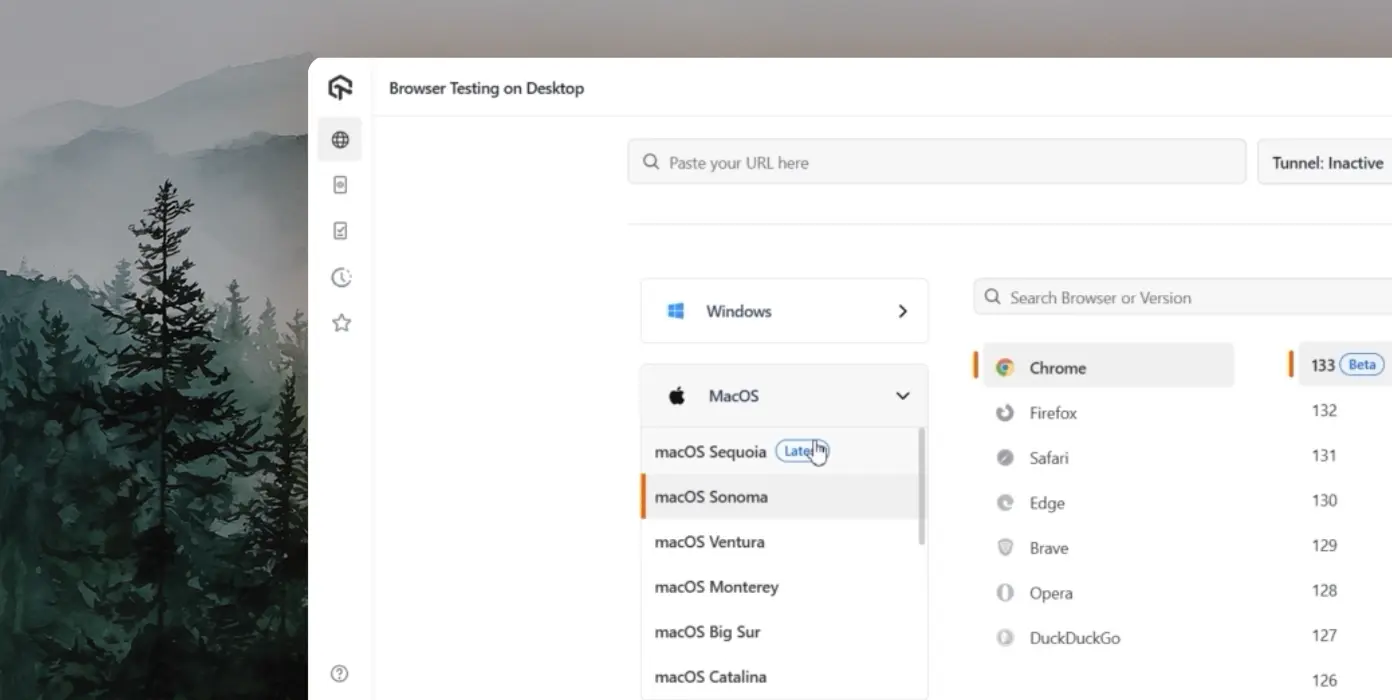
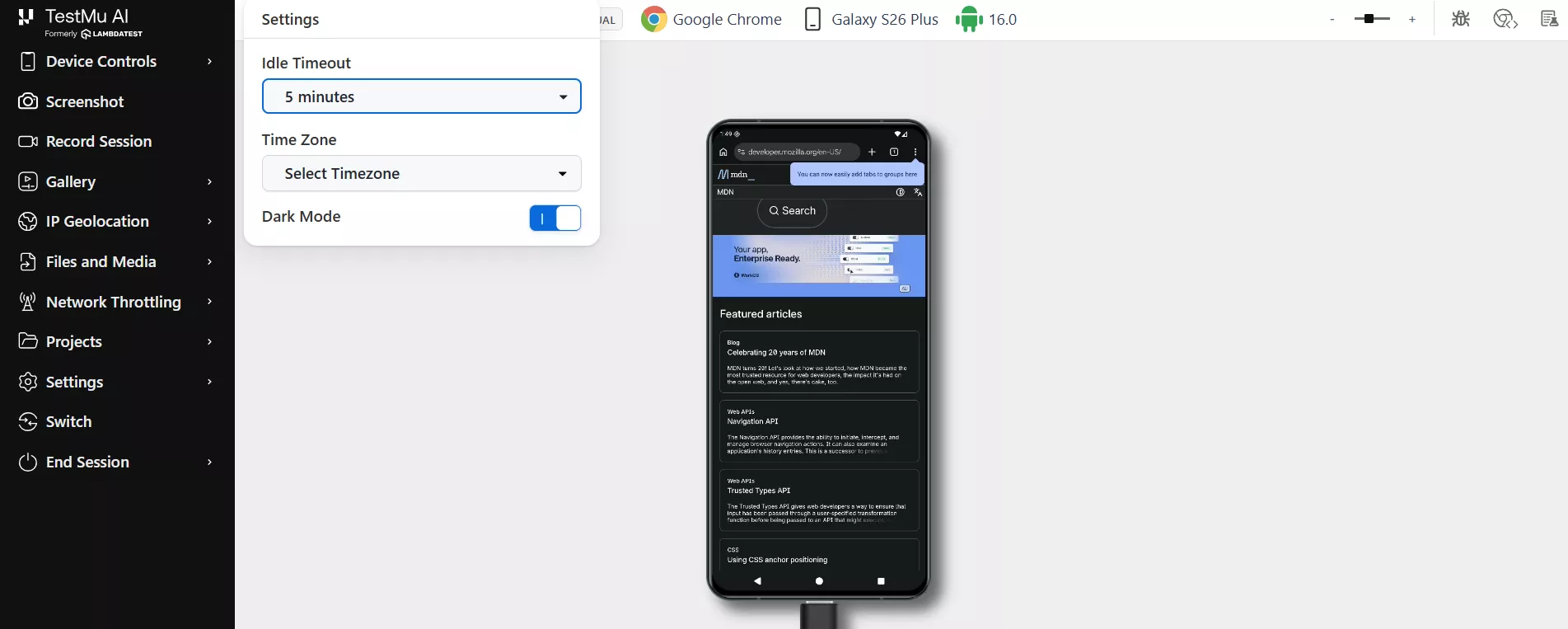
A cloud-based real operating system will spin up where you can run A/B tests of your web or mobile apps.
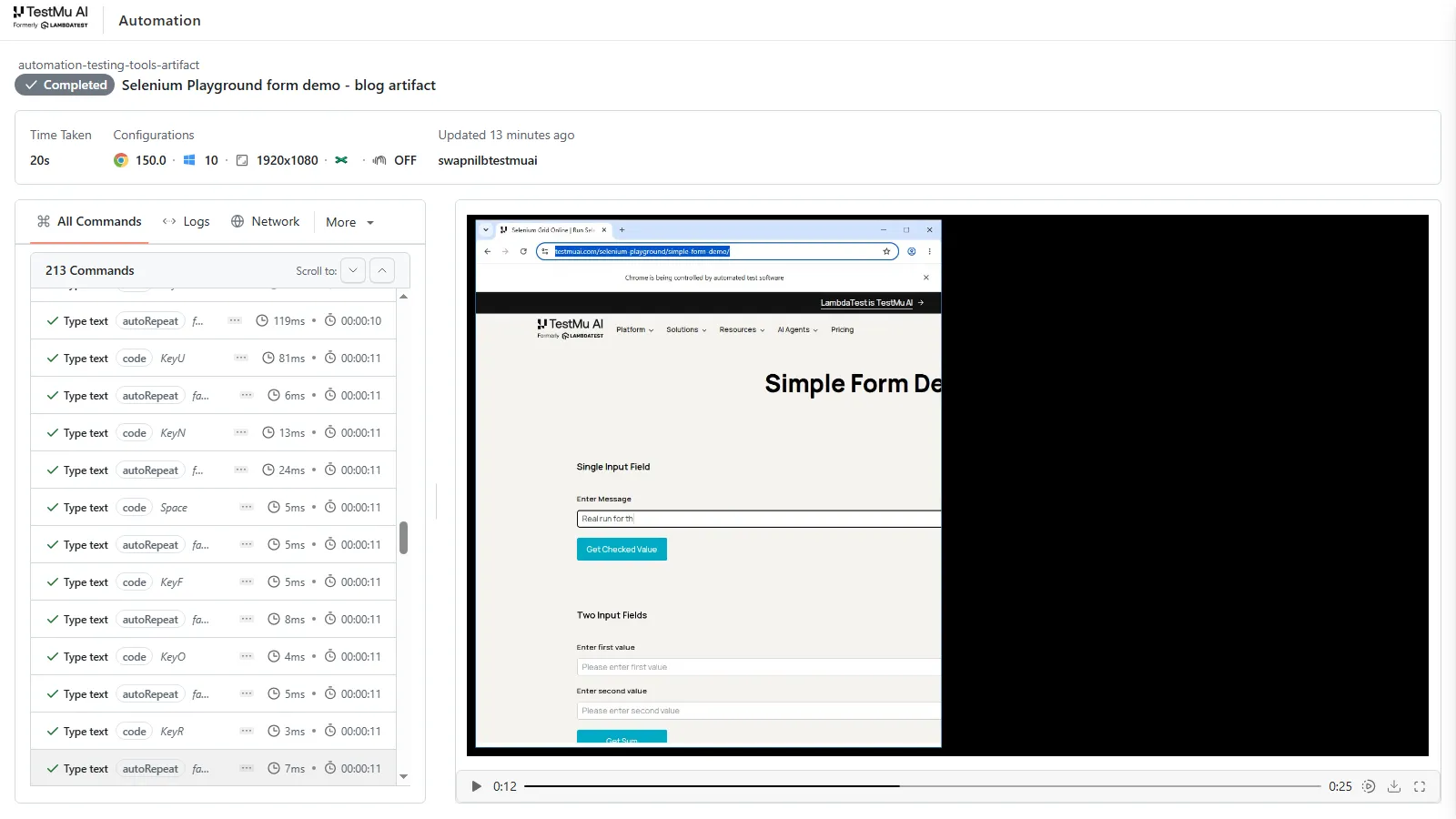
Automation testing
Besides real-time testing, you can perform automation testing for your websites or mobile apps. You can run automated tests using Selenium, Cypress, Playwright, Appium, and more.
Check out the steps to perform automated A/B testing using the TestMu AI platform.
- Login to your TestMu AI account.
- From the left sidebar menu, go to Automation > Builds.
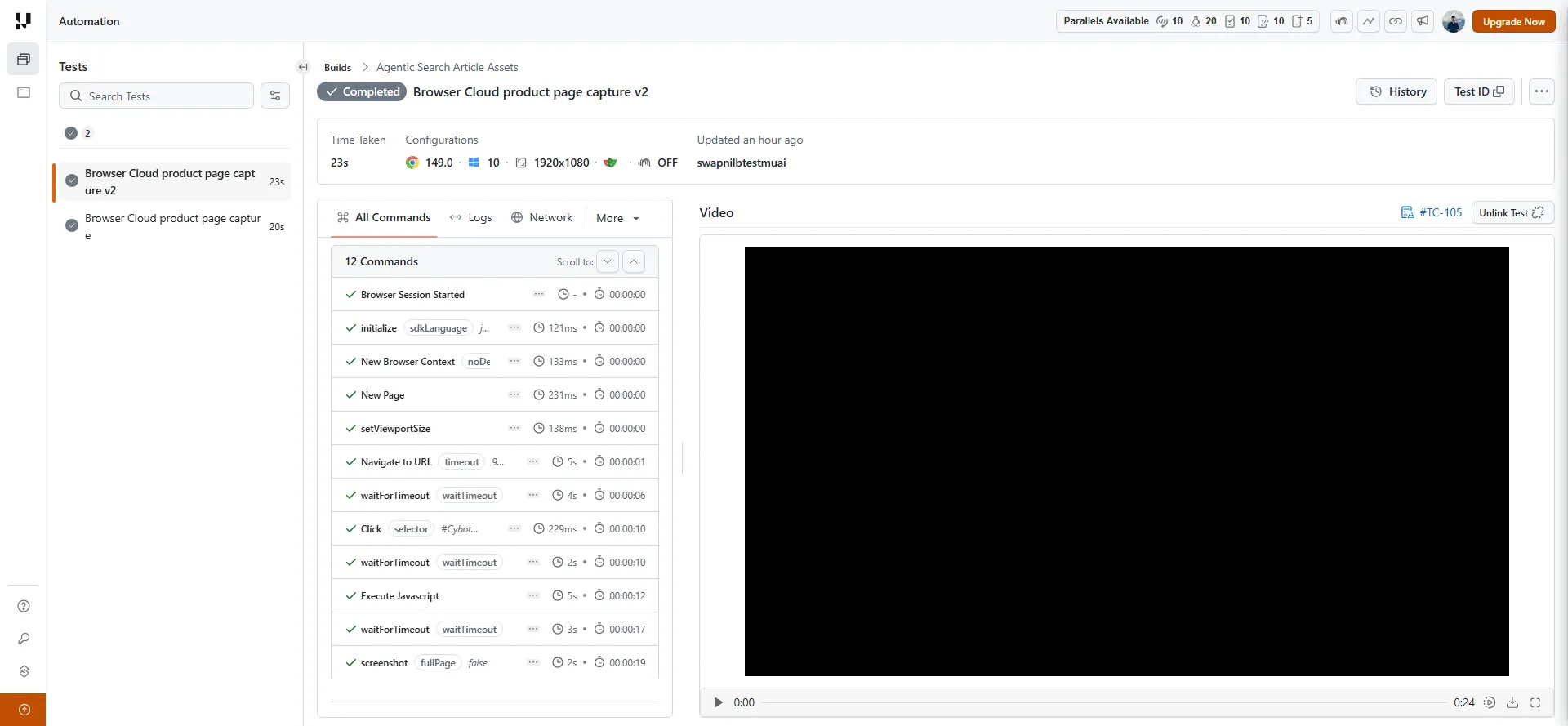
- Choose your favorite programming language and testing frameworks and start automating your repetitive A/B test cases.
How Do You Analyze A/B Testing Results?
We can have structured processes to perform A/B testing, but the important aspect is to analyze the A/B Testing results. It is more complex than you could imagine. You can follow the below pointers:
- Basic analysis: Check the A/B test results to identify the clear winner. You can perform basic analysis using Google Analytics, which helps you make better decisions based on data trends and more informed decisions.
- Analysis of secondary metrics: While the winner is evaluated based on the primary metrics, you can also measure the performance using secondary metrics as well. You can analyze secondary metrics if the initial analysis does not provide exact results.
- Audience breakdown analysis: You can break your results based on the audience.
- Evaluate past data: You can archive or revisit the past data from A/B tests to analyze testing results.
How Is AI Changing A/B Testing?
AI is changing A/B testing by generating variant copy and designs, predicting which variants are likely to win, and shifting traffic toward better performers automatically during the test.
Adaptive methods such as multi-armed bandits, often driven by machine learning, reach decisions with less wasted traffic than fixed 50/50 splits. AI analysis tools also segment results automatically, surfacing which user groups responded differently.
Keep statistical discipline even with AI: define the primary metric and guardrails before launch, and be wary of AI-picked winners from small samples. Our roundup of ai testing tools covers tools that support experimentation.
What Are the Best Practices for A/B Testing?
Here are some of the best practices you can follow when doing A/B testing.
- The testing results tend to suffer if you do not define the sample size right from the beginning. If you do not perform tests for enough people, you won’t get reliable results.
- You can choose the required A/B testing tools based on the variables that need to be tested.
- It is always a good practice to preserve your test results in a centralized location so that different teams in the future can refer them.
- Test the right items that make a difference to your business and growth metrics.
- Make sure that your data set is reliable and authentic.
- Get your hypothesis right from the start.
- Schedule your test results correctly.
- Finalize the test duration, as it plays an important role in determining the reliability of the test results.
- Do not try to introduce mid-test changes.
- Test one element at a time.
- Keep variations under control.
- Pay close attention to the data.
Summing up
After reading the detailed guide on A/B testing, you should now be fully equipped to plan your A/B testing requirement considering the challenges and blockers. It is important to understand the true value of improving your website’s existing traffic and growth; cloud testing platforms like TestMu AI allow you to simplify A/B testing, where all the infrastructure and test configurations are handled seamlessly on the cloud.
There is no denying that if you implement A/B testing with complete knowledge and dedication, you will observe your existing design elements improving and have the most optimized version of your website.
Author

Irshad Ahamed
Blogs: 11


Irshad Ahamed is a Technical Writer and Information Architect with over 4 years of experience working across notable companies like Amazon, IBM, and Symantec. He specializes in crafting high-quality documentation, technical writing, and content strategies for software development, APIs, and process documentation. Irshad’s expertise spans across product documentation, creating instructional content, and collaborating with cross-functional teams to ensure clear, concise, and easily understandable outputs. His certifications include PMI-ACP and Camtasia 2019 Essentials.
Reviewer

Saurabh Prakash
Reviewer
Saurabh Prakash is an Engineering Manager at TestMu AI (formerly LambdaTest), where he leads engineering on agentic AI development and scalable system architecture for the quality engineering platform. He has also contributed to Test at Scale, the company's open-source test intelligence platform. He brings over 9 years of experience across Node.js, Java, Spring, MVC, data structures, algorithms, and scalable system design, with earlier roles as SDE 2 at Zomato, Senior Software Engineer at LogicHub, and Software Development Engineer at Directi. Saurabh holds a B.Tech in Computer Science and Engineering from Delhi Technological University.


A/B Testing FAQs
Did you find this page helpful?
More Related Learning Hubs
TestMu AI forEnterprise
Get access to solutions built on Enterprise
grade security, privacy, & compliance
- Advanced access controls
- Advanced data retention rules
- Advanced Local Testing
- Premium Support options
- Early access to beta features
- Private Slack Channel
- Unlimited Manual Accessibility DevTools Tests