
Kane CLI vs Cursor: Testing What Cursor Ships
Cursor's agent tests its own work and Bugbot reviews the diff. Kane CLI gives an independent pass or fail with evidence in a real browser.
or read the documentation
Why teams pair Kane CLI with Cursor
Cursor is where many developers write code now: tab completions, the in-editor agent, cloud agents that run in their own VMs, and Bugbot reviewing every pull request. Its agent can open a browser and check its own work.
The catch is who grades the work. The agent checks its work in the run that wrote it, against the task it was given, and Bugbot reads the diff rather than running the app. Nothing saves that check for the next change.
Kane CLI adds the independent check. You give it the journey the change touches, it drives a real browser, asserts the result and hands back a verdict with evidence, from Cursor's agent and in your CI.
Want the setup steps? The Cursor app testing page shows how Cursor runs Kane CLI before you merge, and the Cursor browser automation guide covers the browser tools Cursor's agent uses.
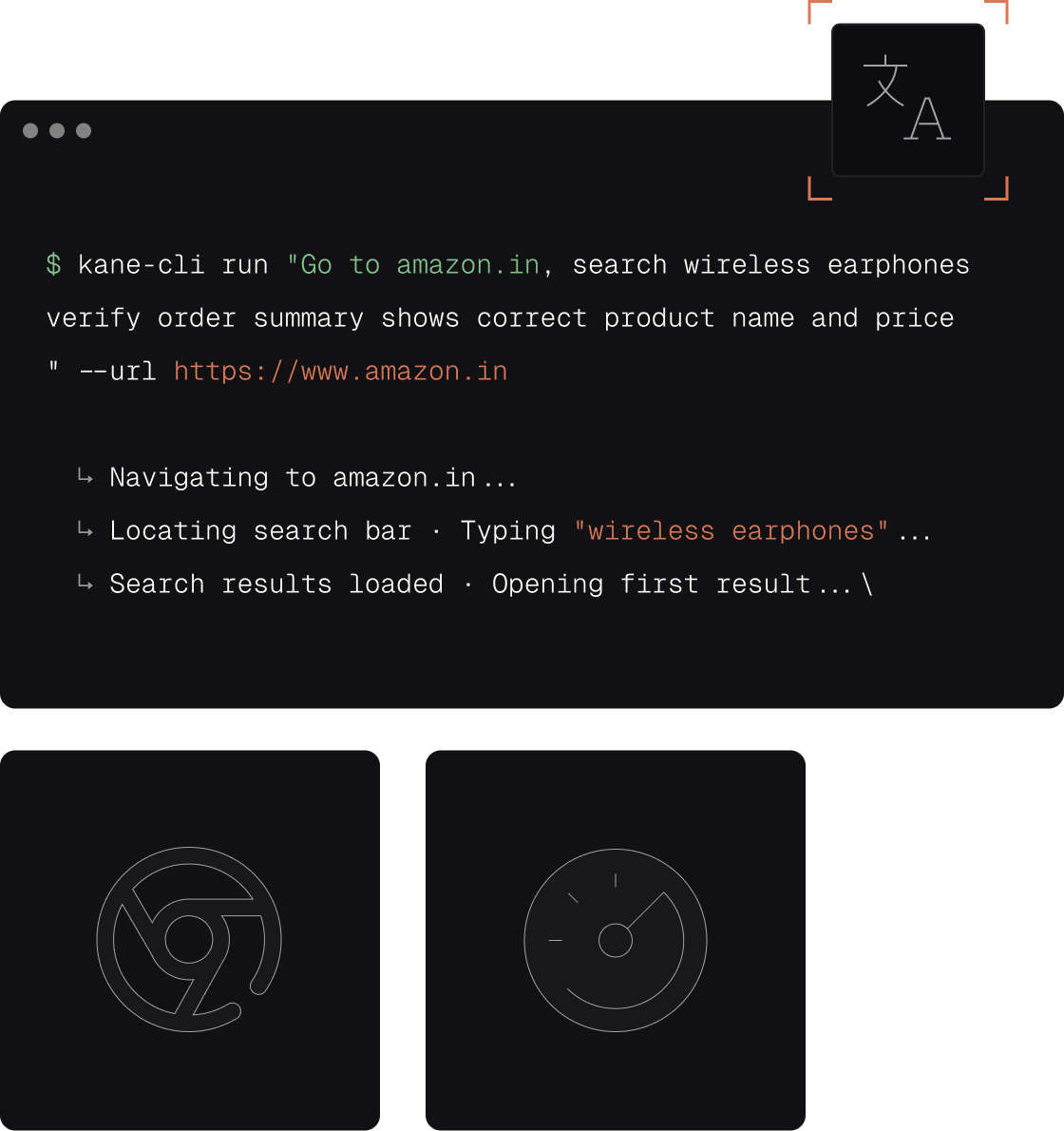
Kane CLI vs Cursor
One agent ships the change, the other proves it works.
| Capability | Kane CLI (TestMu AI) | Cursor |
|---|---|---|
| What it is | A testing agent that verifies a flow | An AI code editor with in-editor and cloud agents |
| Who writes the test | You or your agent, as a natural language objective | The agent, from your prompt, rules and skills |
| Who grades the result | Kane CLI, separate from the agent that wrote the code | The same agent, in the run that wrote the code |
| Pull-request review | Not offered; Kane CLI tests the running app | Bugbot reviews the diff; Autofix up to 3 attempts |
| Evidence | Screenshots, logs, step trace, shareable links, dashboard | Screenshots and video attached to the pull request |
| Tests outlive the run | Yes. The objective lives in your repo and CI | Saved, scheduled browser suite not documented |
| CI gate | Exit codes 0 to 3 in any runner | Cursor is not a CI runner |
| Agent-native output | --agent emits structured NDJSON | Cursor is the agent and can call Kane CLI |
| Test Manager sync | Every run syncs automatically | Artifacts on the pull request and agents view |
| Code export | One command to export Playwright code | Browser checks are not exported |
| Starting price | Free: 10,000 credits for 30 days | Hobby free; Pro $20 a month |
What you get with Kane CLI
The checks Cursor's agent grades itself, verified by a separate tool.

A second opinion on every change
Cursor's agent checks what it wrote. Kane CLI checks the same journey from outside the run, so the agent that wrote the code is not the only one grading it.

Natural language objectives
Describe the journey in one line. Kane CLI plans the steps, drives Chrome, and resolves elements by intent, so there are no selectors for the agent or you to maintain.

Tests the flow, not just the diff
Bugbot reads the code. Kane CLI runs the user journey in a real browser and returns a verified pass or fail, so you know the change works, not just that it reads well.

Agent-native output
The --agent flag emits structured NDJSON with a failure screenshot, so Cursor's agent can read the result, fix the failure, and run the check again before you merge.

Checks that stay in your repo
Keep the objective in your repo. The next change, the next build and the next agent run the same check, and every run lands in Test Manager.

Exports to Playwright you own
Promote any validated flow to native Python Playwright with one command, then edit and maintain the code like any other test in your repository.
Build up confidence locally
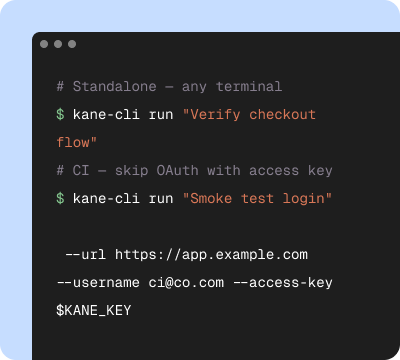
Start in your terminal
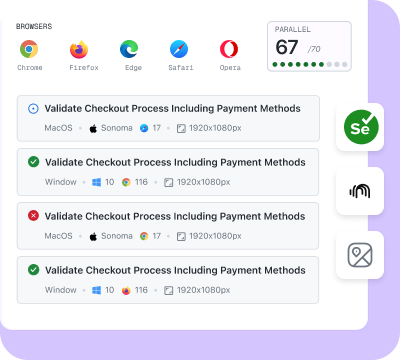
Validate on the cloud
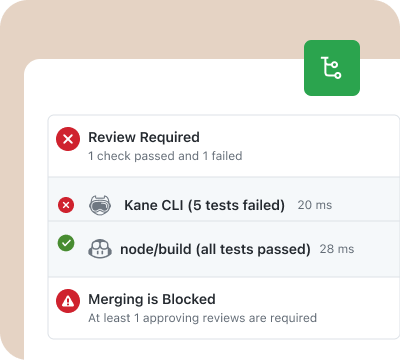
Release with confidence
Built for agents and humans, on one engine
Kane CLI runs the same engine from your terminal, your CI and your coding agent.
Cursor builds, Kane CLI verifies
Let Cursor's agents write the code and open the pull request. Point Kane CLI at the journeys that change touches and know whether it works before you merge.
Same check in the editor and in CI
Cursor's agent runs Kane CLI with --agent from the editor or a cloud agent; your pipeline runs the same objective headless and gates on the exit code.
One verified contract for the team
Whether Cursor, another agent or an engineer runs it, every run lands in the same dashboard, so reviewers read one source of truth.
Test what Cursor ships in three steps
Install
Run npm install -g @testmuai/kane-cli and sign in with your TestMu AI account, or point Cursor's agent at the Kane CLI agent guide and let it install and authenticate on its own.
Describe the journey
Write the flow the change touches as one sentence. Cursor's agent runs it with --agent, or you run it from the terminal.
Gate the pull request
Add the same objective to CI with --headless. A pass is exit code 0; anything else blocks the merge and points to the step that failed.
Get the technical rundown

Documentation
Everything you need to install, configure, and run Kane CLI in under 2 minutes.
Frequently asked questions
Cursor is an AI code editor with an in-editor agent, cloud agents that run in their own VMs, and Bugbot for pull-request review. Kane CLI is a testing agent. It does not write your product code; it takes a natural language objective, drives a real Chrome browser, and reports whether the journey worked, with screenshots and logs. Cursor builds the change, Kane CLI checks it.
It does. The agent can open a browser, read console messages and network requests, and check its own work in the run that wrote it. Cloud agents attach screenshots and a video to the pull request. That check is written and graded by the same agent that wrote the code. Kane CLI adds a second opinion: a verified pass or fail from a separate tool, with an exit code your CI can gate on.
No. Bugbot reads the pull-request diff against your rules and leaves fix suggestions, and Autofix can spawn a cloud agent to apply them. That is code review. Kane CLI runs the user journey in a real browser and tells you whether it works. Teams use both: Bugbot on the diff, Kane CLI on the flow.
Yes. Point the Cursor agent at the published Kane CLI guide and it installs, authenticates, and runs each flow with the --agent flag, reads the structured NDJSON result, and fixes a failure before you merge. Add the same rule to your project so every agent run ends with a Kane CLI check.
Yes. A Kane CLI objective is a line of text you keep in your repository or pipeline, so the same check runs on the next change, the next build and the next agent. Every run syncs to Test Manager. A saved, scheduled browser regression suite is not part of Cursor's agent docs.
Kane CLI is free to install, and new accounts get 10,000 free credits, valid for 30 days. Cursor publishes its own plans: a free Hobby plan with limited agent requests, Pro at $20 a month, Teams at $40 per user a month, and custom Enterprise pricing. Cloud agents and Bugbot are billed on usage.

Teach your agent the right skills
Point Cursor or any AI coding agent at the Kane CLI guide and it will install, authenticate, and run verified browser flows on its own.
 Point your agent to: testmuai.com/kane-cli-agent/AGENTS.md