
Browser automation in natural language that verifies the result
Describe the objective in natural language and Kane CLI drives a real Chrome browser, observes the rendered page, and returns a verified pass or fail. No selectors, no boilerplate, for developers, AI agents, and CI. Free to install.
or read the documentation
Browser automation without the selector tax
Script-and-selector automation has not gotten easier. Selenium is still Selenium, Playwright is still Playwright, and every renamed label or shifted layout breaks a selector that a human then has to fix by hand.
Kane CLI from TestMu AI takes a different input. You describe the objective in natural language and it drives a real Chrome browser through the Chrome DevTools Protocol, constrained to what a real user could actually do on the page.
It waits on the rendered viewport, autoheals cosmetic drift, and pushes through unexpected modals and redirects up to 50 steps. Then it returns a verified pass or fail with video, a step trace, and a shareable link.
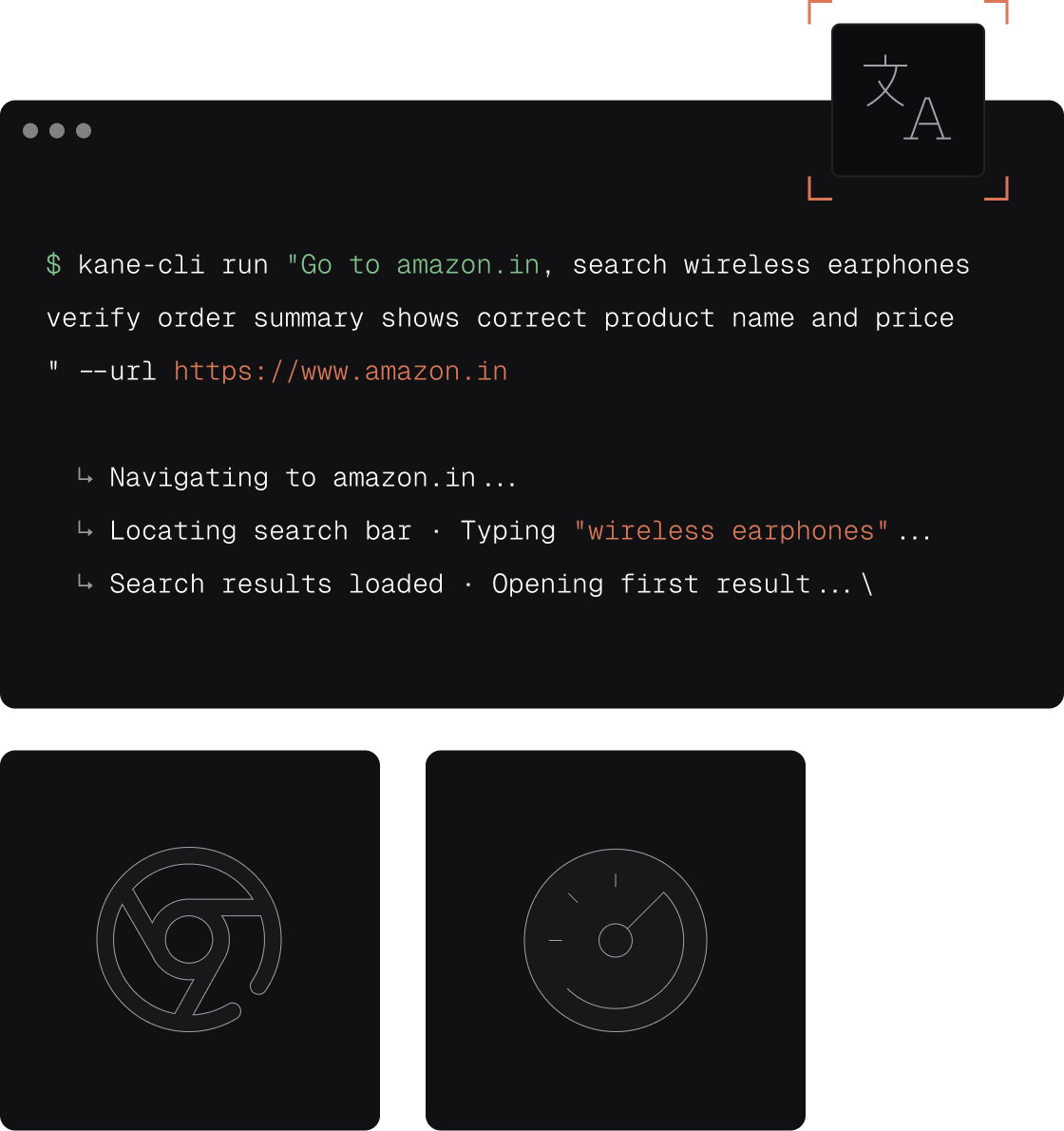
What makes Kane CLI browser automation different
Natural language in, a real browser driven, and a verified pass or fail out.

Plain-English objectives, no selectors
State the web flow you want automated and Kane CLI works out the path. No XPath, no selector maintenance, no Page Object Models to rot. Navigation, clicks, form fills, assertions, and value extraction all from one sentence.

Automates a real Chrome browser
Every flow runs in a real Chrome instance through the Chrome DevTools Protocol, limited to actions a real user could take. Not a synthetic DOM, not a headless mock, not JavaScript injected to fake a result.

Vision-based dynamic waiting
Kane CLI automates against the rendered viewport, not network idle or DOM ready, so it handles canvas, shadow DOM, Lightning Web Components, and streamed UI that break selector-based waits. It acts when the screen is ready.

Autoheals as the page changes
Each action anchors to the user-facing element, so a reworded label or new CSS class will not stall the flow. Kane CLI works through modals, banners, and redirects, up to 50 steps per journey, until the objective is reached.

Verified outcome, not just execution
Built-in assertions check exact text, contains, element state, and negative conditions on the automated flow, then return a binary pass or fail anchored to what the user sees. Low-confidence matches are rejected, never silently passed.

Machine-readable run output
Add --agent and Kane CLI streams newline-delimited JSON, one typed event per browser action. The closing run_end event carries status, summary, extracted values, and a Test Manager URL that any tool can parse in a single line.
Automate any web flow and verify it for real
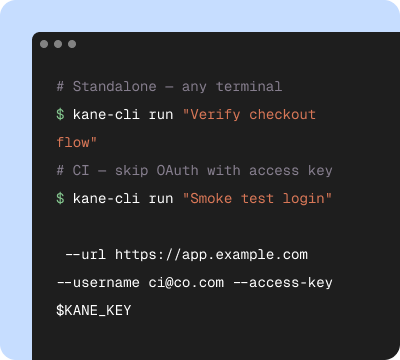
Start in your terminal
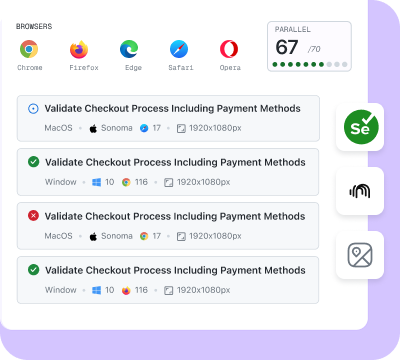
Validate on the cloud
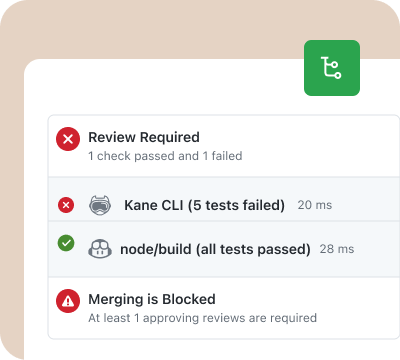
Release with confidence
One engine for developers, agents, and CI
Kane CLI and KaneAI share the same automation engine and dashboard.
Local terminal or cloud, one syntax
Kane CLI automates browsers from your terminal for quick local flows. KaneAI runs the same engine in the cloud at scale. One natural language syntax, one dashboard, and no rewrite when a laptop flow becomes a nightly cross-browser and MultiOS run.
Browser automation an agent can drive
Install the skill once and an AI coding agent assembles the objective, runs it headless, parses the NDJSON, and reads the verdict. The agent ships the feature, then automates the flow in a real browser to confirm it before a human looks.
Every automated flow leaves a record
Each run captures a persistent video, a full step trace, and a 7-day ShareLink, and syncs to TestMu AI Test Manager. Drop the link into a PR, a bug report, or a team message as proof the automated journey ran end to end.
Automate a browser in three steps
Install Kane CLI
Run npm install -g @testmuai/kane-cli and sign in with your TestMu AI account. Node 18 or higher and Chrome on PATH are all the browser automation needs. Nothing to scaffold, no framework to wire in.
Describe the web flow
Type the objective in natural language: open the app, log in, add an item to the cart, and confirm the order total. Kick it off from the terminal, or hand it to Claude Code, Cursor, or Codex to run for you.
Run and read the result
Kane CLI automates a real Chrome browser, checks each action against the rendered page, and hands back a verified pass or fail with video, a step trace, and a ShareLink. Free locally, or scale to the cloud for cross-browser coverage.
Get Started With Kane CLI
🎉 Launch offer: Bonus credits for the first 3 months on paid plans
Choose the right plan for you
Local test authoring via CLI
Auto-heal & vision
View test cases on UI
Test Manager

Free
$0
/month
200 Credits
Resets in every
30 days

Starter
$19
/month
2000 Credits
Launch: 4,000 Credits (+100%)
Bonus for first 3 months

Pro
$99
/month
10,000 Credits
Launch: 15,000 Credits (+50%)
Bonus for first 3 months

Enterprise
Get access to solutions built on Enterprise-Grade Security, Privacy, and Compliances.
Need more credits?
Got a bigger use case in mind?
Let’s talk
Choose the right plan for you
Free
$0
/month
200 Credits
Resets in every
30 days
Starter
$19
/month
2000 Credits
Launch: 4,000 Credits (+100%)
Bonus for first 3 months
Pro
$99
/month
10,000 Credits
Launch: 15,000 Credits (+50%)
Bonus for first 3 months
Enterprise
Get access to solutions built on Enterprise-Grade Security, Privacy, and Compliances.
Need more credits?
Got a bigger use case in mind?
Let’s talk
Get the technical rundown

Documentation
Everything you need to install, configure, and run Kane CLI in under 2 minutes.
Explore browser automation
Pick the surface that fits your workflow
The same natural language engine runs from the terminal, from an MCP server your IDE can call, or from an agent that drives the browser for you.
Frequently asked questions
Browser automation is driving a web browser to perform a task without a human clicking through it. With Kane CLI, you describe the objective in natural language, for example "go to the pricing page, select the Pro plan, and confirm the checkout total." Kane CLI drives a real Chrome browser through the Chrome DevTools Protocol, observes the rendered page, runs the steps, and returns a verified pass or fail with video and a step trace. No selectors, no XPath, no framework boilerplate.
Traditional automation anchors every action to a brittle selector or XPath, so a renamed label or a new CSS class breaks the run and a human has to fix the script. Kane CLI anchors to intent, the user-facing element like "the Submit button", and re-resolves it when the page shifts. It waits on the rendered viewport instead of network or DOM signals, autoheals cosmetic drift, and pushes through unexpected modals and redirects up to 50 steps per flow. You write what you want, not the path to get there.
Yes. An AI coding agent can drive browser automation through Kane CLI directly. Install the skill once and Claude Code, Cursor, or Codex CLI assembles a kane-cli run --agent --headless command, runs the natural language objective, parses the NDJSON output, and reads the run_end verdict to decide what to do next. Point your agent at the guide at testmuai.com/kane-cli/agents.md and it installs, authenticates, and exercises the flow in a real browser on its own.
Yes. Natural language browser automation runs unattended in any pipeline. Authenticate with your TestMu AI username and access key, pass --headless, --agent, and --timeout, then gate the build on the exit code: 0 when the flow passes, 1 when it fails, 2 on setup or auth errors, and 3 on timeout. Native patterns are documented for GitHub Actions, GitLab CI, Jenkins, and Bitbucket Pipelines, so a broken user journey stops the release before it ships.
Yes. Any completed run can be exported to native Python Playwright with --code-export --code-language python. The exported code uses the testmu library, which keeps the original intent-driven step alongside the generated code, so the suite keeps Kane CLI's autoheal resilience even when run as native Playwright. You can also import existing Playwright or Selenium scripts, so there is no lock-in.
Installing and running natural language browser automation locally is free. Runs against your own Chrome come with 100 starter credits and need no credit card. You only pay when you scale out: cloud runs across cross-browser and MultiOS coverage on the TestMu AI grid are billed against your TestMu AI plan. Start free and automate a real web flow end to end in under five minutes.
Give your agent a real browser
Point your coding agent at the Kane CLI guide and it will install, authenticate, and automate any web flow in a real browser on its own, then read the verified pass or fail and close its own loop.
 Point your agent to: testmuai.com/kane-cli/agents.md