
AI browser automation that returns a verdict not a summary
Kane CLI by TestMu AI uses an LLM to read and drive a real Chrome browser from plain-English objectives. The path can vary, but the verdict cannot: a pass needs explicit evidence. Free to install.
or read the documentation
AI browser automation, anchored to evidence
Most browser automation breaks on selectors. Kane CLI takes plain-English objectives, uses an LLM for perception and reasoning, and resolves the path to your goal in a real Chrome browser. Describe the outcome, not the XPath.
But AI is not deterministic, and TestMu AI does not pretend otherwise. The model decides how to reach an element. It does not decide the test passed. A pass is granted only when the expected state is verified through explicit evidence.
That is the difference from agentic browsers that hand back a prose summary. Kane CLI returns a binary status, NDJSON evidence, and a persistent replay link. If two runs disagree, that is surfaced as a signal, never hidden.
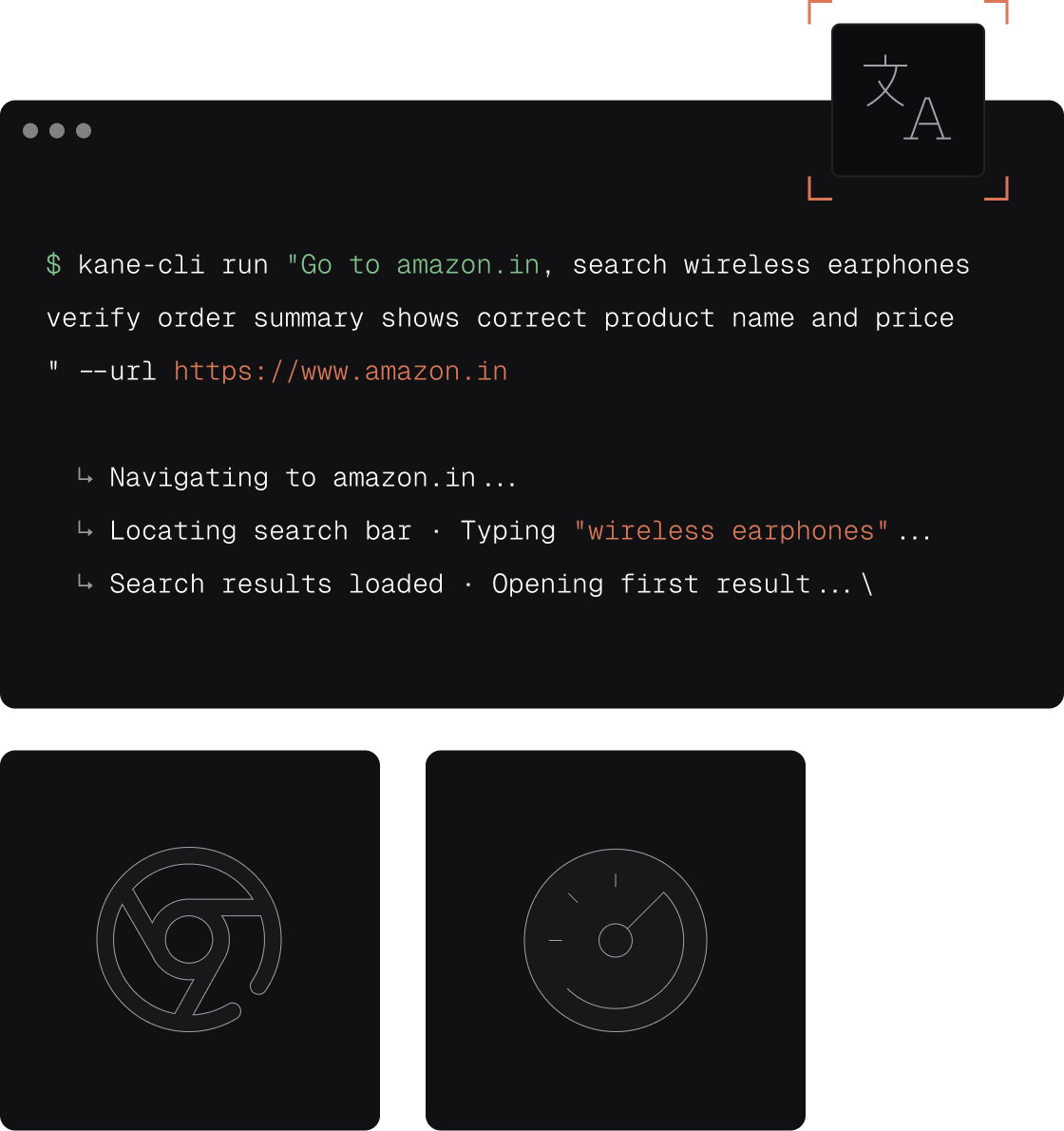
What AI browser automation looks like with Kane CLI
Plain-English objectives, AI perception, and a verdict anchored to evidence.

Plain-English objectives
Describe the outcome, not the selectors. 'Log in, add an item to the cart, and confirm the order total updates.' The agent resolves the path. No XPath, no Page Object Models, no framework boilerplate to maintain.

AI perception with deterministic verdicts
The LLM reads the rendered page like a user, but the verdict is not its opinion. A pass requires explicit evidence: DOM state, URL changes, network responses, console logs, or your assertions. The model never decides the test passed.

Real Chrome, not a synthetic DOM
The LLM perceives and acts on a real Chrome instance over the DevTools Protocol, taking only actions a real user could take. No injected JavaScript to skip a modal or force a hidden click, so the evidence behind every verdict reflects how your app actually behaves.

Autoheal without losing the contract
Intent is anchored to the user-facing element, so a reworded label or new CSS class does not break the run. The model adapts its path through cookie banners and redirects, up to 50 steps per flow, while the pass condition it must verify stays exactly the same.

Evidence-typed NDJSON output
Run with --agent and every action, observation, and assertion becomes a typed JSON line, ending in a run_end verdict your coding agent or CI script can parse. The proof behind pass or fail is structured data, not prose to scrape or logs to grep.

Parallel verification by user and region
One objective that names multiple users or regions branches automatically into parallel child agents, each in its own browser session with its own evidence trail. Verify admin, editor, and viewer journeys from a single prompt with no shell loops.
Build up confidence before you ship
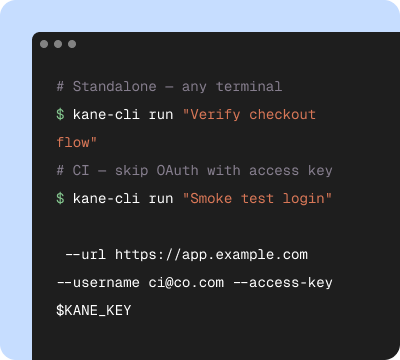
Start in your terminal
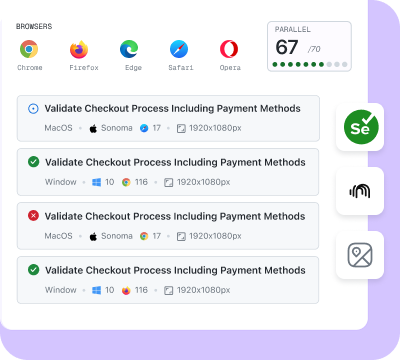
Validate on the cloud
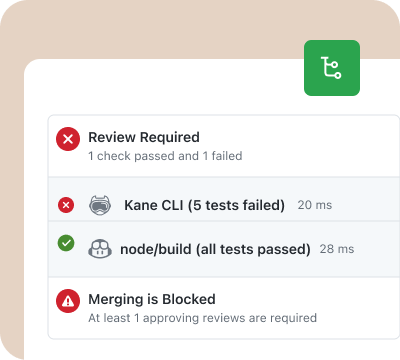
Release with confidence
Built for AI agents and humans alike
Kane CLI and KaneAI share the same automation engine and dashboard.
Perception is the LLM's job, the verdict is not
AI reads the rendered page and figures out how to reach your goal, the part scripts are bad at. But it never gets to declare success. The pass is granted by the verification contract only when the expected state shows up in the evidence.
A non-deterministic path, a deterministic outcome
Run to run, the model may click a different way to reach the same element, and that is fine. What stays fixed is the condition being checked, so a green result always means the same thing was actually true in a real browser.
Disagreement is a signal, not a hidden flake
When two runs reach different verdicts on the same flow, Kane CLI surfaces it as drift or app flakiness rather than burying it behind a green check. Every verdict ships with a video, a step trace, and a replay link you can drop into a PR or bug report.
Automate any browser flow in three steps
Install Kane CLI
Run npm install -g @testmuai/kane-cli and sign in with your TestMu AI account. Nothing to wire up, no selectors to record, no framework to scaffold.
Point it at any URL
Aim it at a local dev server, a staging link, or production. Drive flows from the terminal yourself, or hand them to Claude Code, Cursor, or Codex with the --agent flag.
State the goal and the proof
Write the journey in plain English and the condition that makes it a pass. The LLM works out how to reach it in real Chrome, then grants a pass only when the evidence confirms that state, with a shareable replay.
Get Started With Kane CLI
🎉 Launch offer: Bonus credits for the first 3 months on paid plans
Choose the right plan for you
Local test authoring via CLI
Auto-heal & vision
View test cases on UI
Test Manager

Free
$0
/month
200 Credits
Resets in every
30 days

Starter
$19
/month
2000 Credits
Launch: 4,000 Credits (+100%)
Bonus for first 3 months

Pro
$99
/month
10,000 Credits
Launch: 15,000 Credits (+50%)
Bonus for first 3 months

Enterprise
Get access to solutions built on Enterprise-Grade Security, Privacy, and Compliances.
Need more credits?
Got a bigger use case in mind?
Let’s talk
Choose the right plan for you
Free
$0
/month
200 Credits
Resets in every
30 days
Starter
$19
/month
2000 Credits
Launch: 4,000 Credits (+100%)
Bonus for first 3 months
Pro
$99
/month
10,000 Credits
Launch: 15,000 Credits (+50%)
Bonus for first 3 months
Enterprise
Get access to solutions built on Enterprise-Grade Security, Privacy, and Compliances.
Need more credits?
Got a bigger use case in mind?
Let’s talk
Get the technical rundown

Documentation
Everything you need to install, configure, and run Kane CLI in under 2 minutes.
Keep exploring
Ways to run AI browser automation
The same engine drives AI browser automation from the terminal, from a hosted browser agent, and across the agent browser grid, so you can pick the surface that fits your workflow. If you are still sizing up the field, the comparison hub covers how every AI browser agent perceives a page and where each one stops short of an evidence-backed pass or fail.
Frequently asked questions
AI browser automation drives a real browser from plain-English objectives instead of hand-written selectors and scripts. Kane CLI by TestMu AI uses an LLM for perception and reasoning, so it reads the rendered page the way a person does, then resolves the path to your goal. You describe the outcome, for example "log in and confirm the dashboard loads," and the agent drives a real Chrome browser through it. No XPath, no Page Object Models, no framework boilerplate. The difference from a chatbot is that Kane CLI returns a binary pass or fail anchored to evidence, not a prose summary. For the agent-centric view of the same engine, see AI agent browser.
The honest position from TestMu AI: the LLM is not deterministic, but the validation contract is. The model decides how to reach an element, run to run that path can vary, but it does not get to decide the test passed. A pass is granted only when the expected state is verified through explicit evidence: DOM state, stable selectors, accessibility labels, URL changes, network responses, screenshots, console logs, or your own assertions. With a stable app, data, and environment, the outcome stays consistent. If two runs disagree, that is surfaced as a signal of app flakiness or drift, never hidden behind a green check.
Yes. Because the verification contract is machine-readable, AI coding agents can close their own loop. Run Kane CLI with the --agent flag and it streams NDJSON, one typed event per line, ending in a run_end event carrying the verdict, evidence summary, extracted values, and a dashboard link. Claude Code, Cursor, Codex, and Gemini CLI parse that stream to learn whether their generated UI actually works, then fix the regression before you ever open the browser. Point your agent at the guide at testmuai.com/kane-cli/agents.md and it installs, authenticates, and verifies in a real browser on its own.
Yes, and the deterministic verdict is what makes a non-deterministic model safe to gate on. Authenticate with your TestMu AI credentials, pass --headless and --timeout, and key the pipeline off the evidence-backed exit code: 0 when the expected state is verified, 1 on a failed assertion, 2 on an error such as auth or a Chrome crash, and 3 on timeout. The same binary that runs headed on your laptop runs headless on GitHub Actions, GitLab CI, Jenkins, or Bitbucket. Every run uploads to Test Manager with its evidence trail, so an unverified flow never reaches production.
Yes. Any completed run exports to native Python Playwright code with one flag. The exported code uses the testmu NPM library, which preserves the original plain-English step alongside the generated script, so autoheal resilience survives the export. You can also import existing Playwright or Selenium scripts and convert them into intent-driven flows. Two-way migration means no lock-in and no throwing away the suite you already have.
Yes, the CLI is free to install and free to run against your own Chrome, so you can prove out the LLM-perception-plus-evidence workflow at zero cost. The Starter tier from TestMu AI adds 100 credits with no credit card. Cloud runs on the TestMu AI grid are billed against your plan only when you scale to remote browsers, geo coverage, or MultiOS. Start free, verify a real journey with shareable evidence in under five minutes, and pay only when you need scale.
AI browser automation pricing with Kane CLI is credit based rather than a fixed fee per run, so the cost per run depends on how many credits a flow consumes. Keep in mind that Kane CLI is a separate product from KaneAI, which is priced per agent license rather than per run; teams that outgrow per-run credits can evaluate KaneAI through the KaneAI monthly pricing page. Enterprise teams running high-volume AI browser automation can contact sales for custom pricing.
Kane CLI pricing and KaneAI pricing are separate: Kane CLI is its own product with its own credit-based tiers, while KaneAI is licensed per agent for natural language test authoring. KaneAI Starter is $17 per agent per month billed annually, with 2,000 credits and local authoring through Kane CLI. Pro is $89, with 12,000 credits and cloud web authoring. Max is $179, with 25,000 credits and cloud web plus mobile authoring. Generated tests export to Selenium, Playwright, Cypress, and Appium in multiple languages with no lock-in. Many teams start on the Kane CLI free tier and add KaneAI agents as authoring needs grow. Compare all KaneAI plans on the KaneAI subscription pricing page.
Give your coding agent eyes in a real browser
Point your AI coding agent at the Kane CLI guide and it will install, authenticate, and run plain-English browser automation with the --agent flag, then read the verified pass or fail on its own.
 Point your agent to: testmuai.com/kane-cli/agents.md