

Power Your Software Testing with AI Agents and Cloud
The Native AI-Agentic Cloud Platform to Supercharge Quality Engineering. Test Intelligently and Ship Faster.


- TestMu AI (Formerly LambdaTest)
- /
- Blog
- /
- Time Travel Simulator for Financial Services
Time Travel Simulator for Financial Services
How lifecycle aware testing makes future loan events testable on demand, without waiting weeks for them to occur. See how time-travel simulation, a Test Data Portal, and an automation framework fit together.
Last Updated on:
Financial institutions must validate complex lending and servicing scenarios before launch, even when critical events naturally occur only after weeks or months. This article describes the problem, the architectural redesign required to solve it, and how time-travel simulation can be connected to a Test Data Portal and an Enterprise Test Automation Framework to improve both delivery speed and engineering excellence.
This topic was presented as a session at Testμ Conf 2026, which walks a delinquent loan forward day by day from origination through charge-off, and closes with audience questions on third-party systems that cannot be time-travelled, payment acknowledgement states, and the hardest bugs the simulation has caught.
If you couldn’t catch all the sessions live, you can access the recordings at your convenience by visiting the TestMu AI YouTube Channel.
TL;DR
- A time travel simulator creates a financial scenario on demand, advances it to a future state, and validates it end to end.
- The bottleneck is state, not execution: one scenario needs the right state across origination, payments, servicing, collections, and compliance systems at the same time.
- Waiting for dates to advance stretches test cycles, delays defect feedback, and pushes back merchant rollouts and product launches.
- Changing a date field or the system clock is not enough; lifecycle progression must be driven by business time, business rules, and deterministic event processing.
- Loan servicing needs a time-travel controller, business-date services, lifecycle rules engines, and a structured eventing model.
- The architecture should be API-first, workflow-driven, and idempotent so scenarios can be replayed safely and run in CI/CD.
- A Test Data Portal assembles production-like data, reserves the environment, advances the timeline, and maintains lineage.
- The Enterprise Test Automation Framework validates the advanced state across APIs, user interfaces, and data layers, capturing evidence as it runs.
- Teams gain faster release readiness, broader lifecycle coverage, reusable scenarios, and less manual coordination.
- Start with one scenario you cannot test without waiting, then mark which systems read the system clock instead of a business date.
What Problem Exists in Financial Services
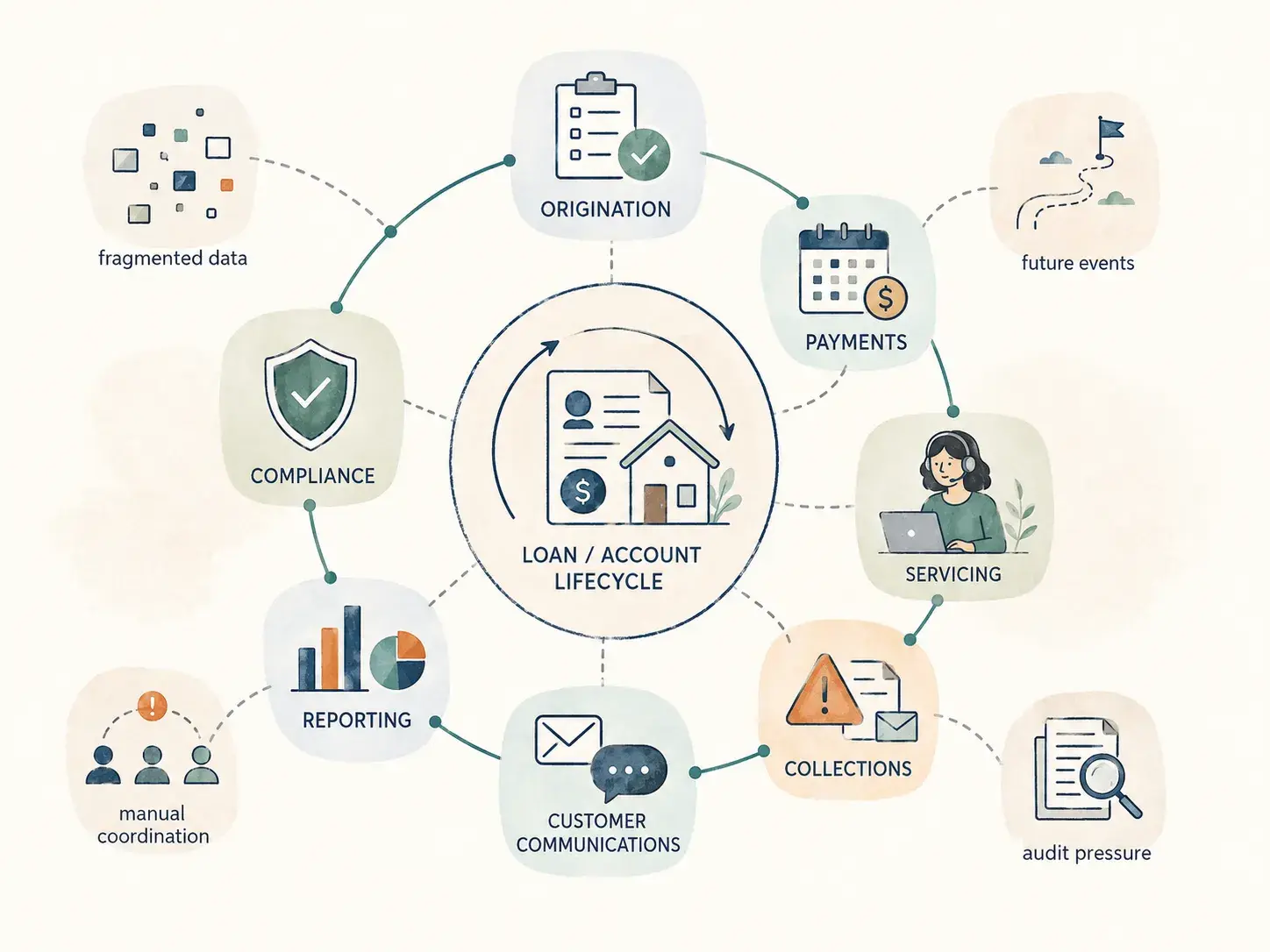
Financial institutions operate across deeply interconnected systems, including origination, merchant or channel workflows, payments, servicing, collections, customer communications, reporting, and compliance controls. Validating a single financial scenario often requires the right state to exist across many of these systems at the same time.
Traditional test-data practices struggle in this environment because realistic financial states are difficult to assemble, downstream dependencies must remain synchronized, and many important scenarios unfold only after time passes. Teams often end up relying on manual coordination, one-off scripts, and fragmented execution models.
The result is a testing bottleneck that is not only about execution. It is also about the ability to create, advance, and govern realistic financial states at scale.

Note: Lineage and evidence capture are the same discipline that test management solves. TestMu AI's Test Manager traces every requirement to its test cases, runs, and defects in a single matrix, so financial services teams keep an audit trail of what was tested, by whom, and with what outcome across every release. Read the Test Manager documentation to set it up, or start free.
How It Impacts Release Velocity and Business Delivery
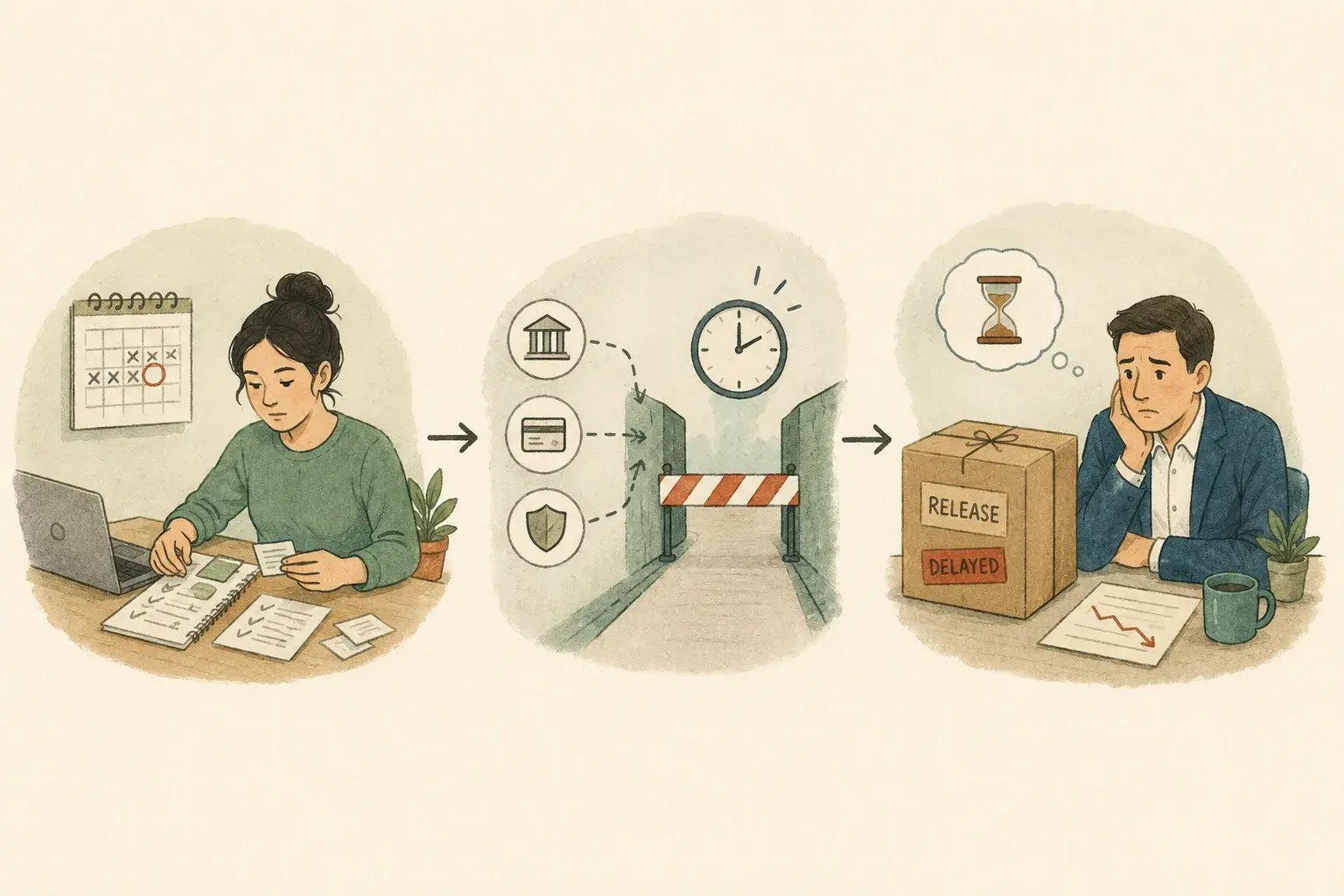
When future-state scenarios cannot be validated quickly and reliably, release readiness slows down. Teams spend time waiting for dates to advance naturally, preparing data manually, and coordinating with system owners across the technology estate.
This slows business delivery in practical ways: test cycles become longer, defect feedback arrives later, and launch decisions are made with lower confidence. Merchant rollouts, product launches, and platform updates can all be delayed because the right validation conditions are not available at the right time.
A lifecycle-aware approach changes this pattern. If teams can create a scenario on demand, advance it to a future state, and validate it end-to-end, they can identify issues earlier and move to release decisions with far greater speed and confidence.
How to Re-design Your Architecture to Build a Time-Travel Mechanism
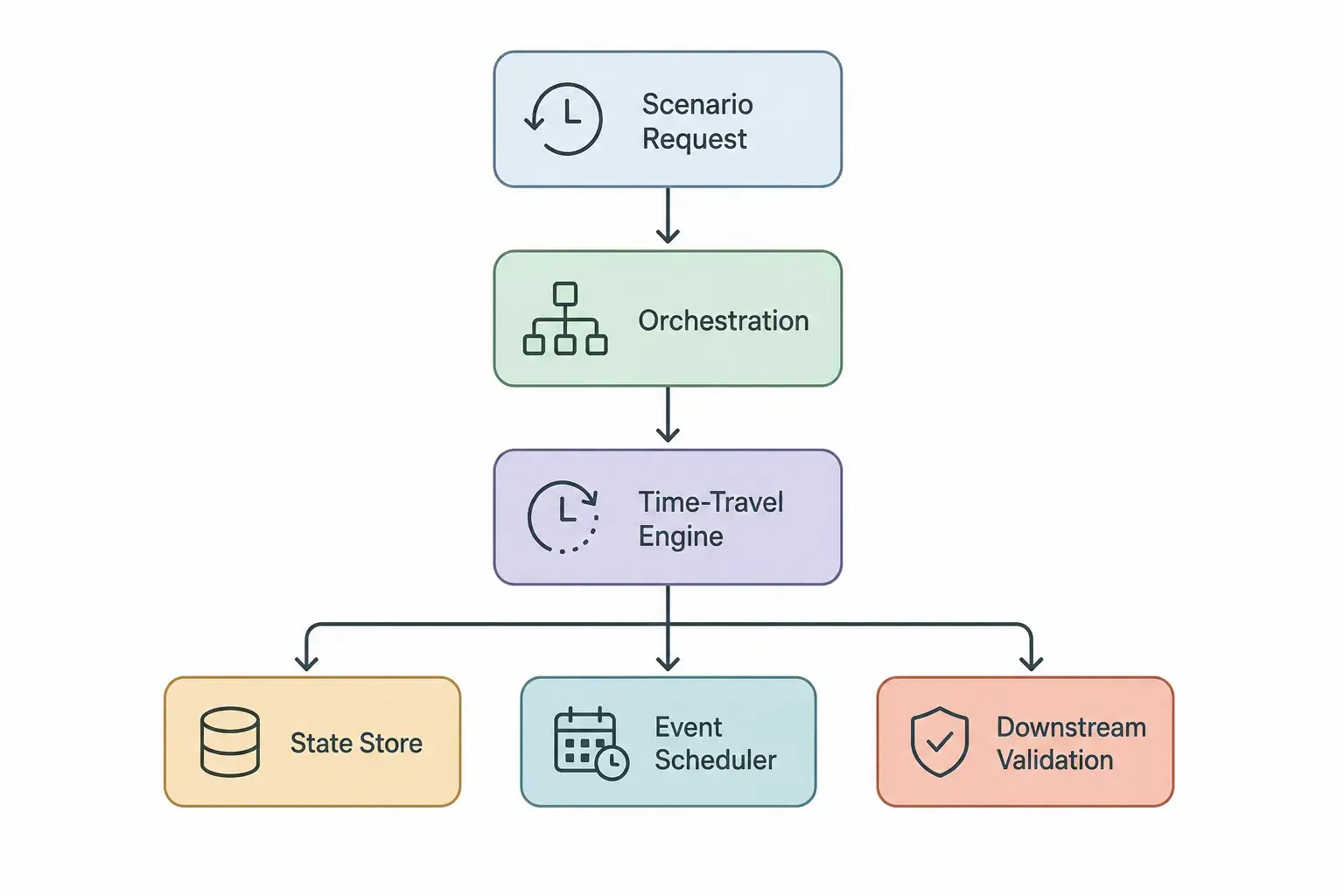
A time-travel capability should be designed as an architecture feature, not as an isolated workaround. At a high level, the architecture begins with a business scenario request, routes that request through a governed test-data layer, invokes orchestration services, and persists the resulting lifecycle state and lineage for repeatable use.
The redesign should be API-first, workflow-driven, and built around idempotent steps. This ensures that a complex scenario can be assembled predictably, replayed safely, and integrated into CI/CD pipelines without creating brittle dependencies.
When designed in this way, time travel becomes a controlled enterprise mechanism for state progression, validation, and traceability rather than a one-off testing trick.
How to Re-architect Loan Servicing to Build the Time-Travel Mechanism
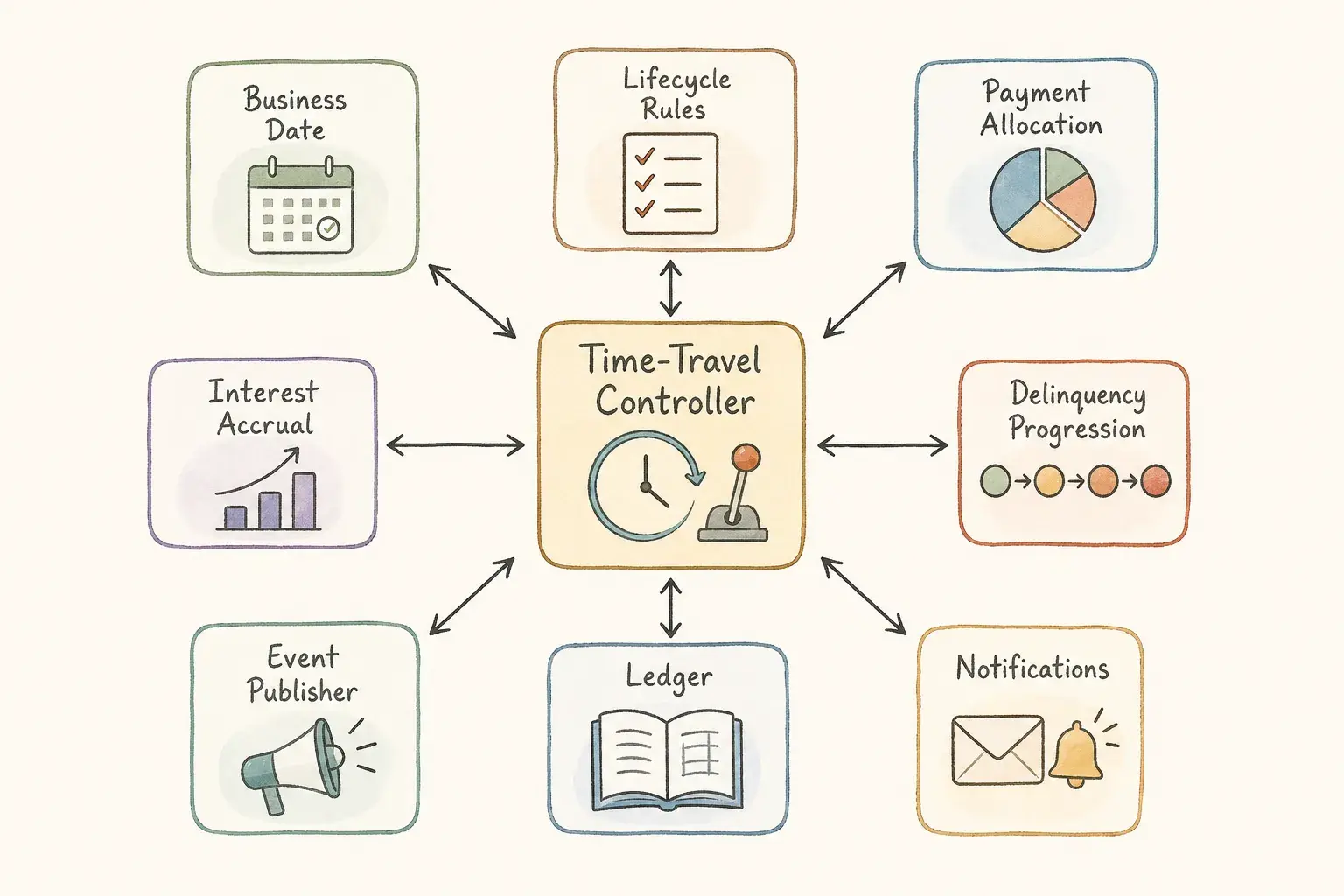
Implementing time travel in financial services requires more than changing a date field or manipulating a system clock. Loan servicing must be re-architected so that lifecycle progression is driven by business time, business rules, and deterministic event processing.
A robust design introduces a time-travel controller, business-date services, lifecycle rules engines, and a structured eventing model. The controller advances a loan through future states while ensuring that interest, payments, delinquency, settlements, and downstream effects are applied consistently.
This servicing design isolates business time from system time, supports repeatable scenario progression, and creates the foundation for replayable, auditable validation of future servicing outcomes.
How to Integrate This Technology in a Test Data Portal and Enterprise Test Automation Framework
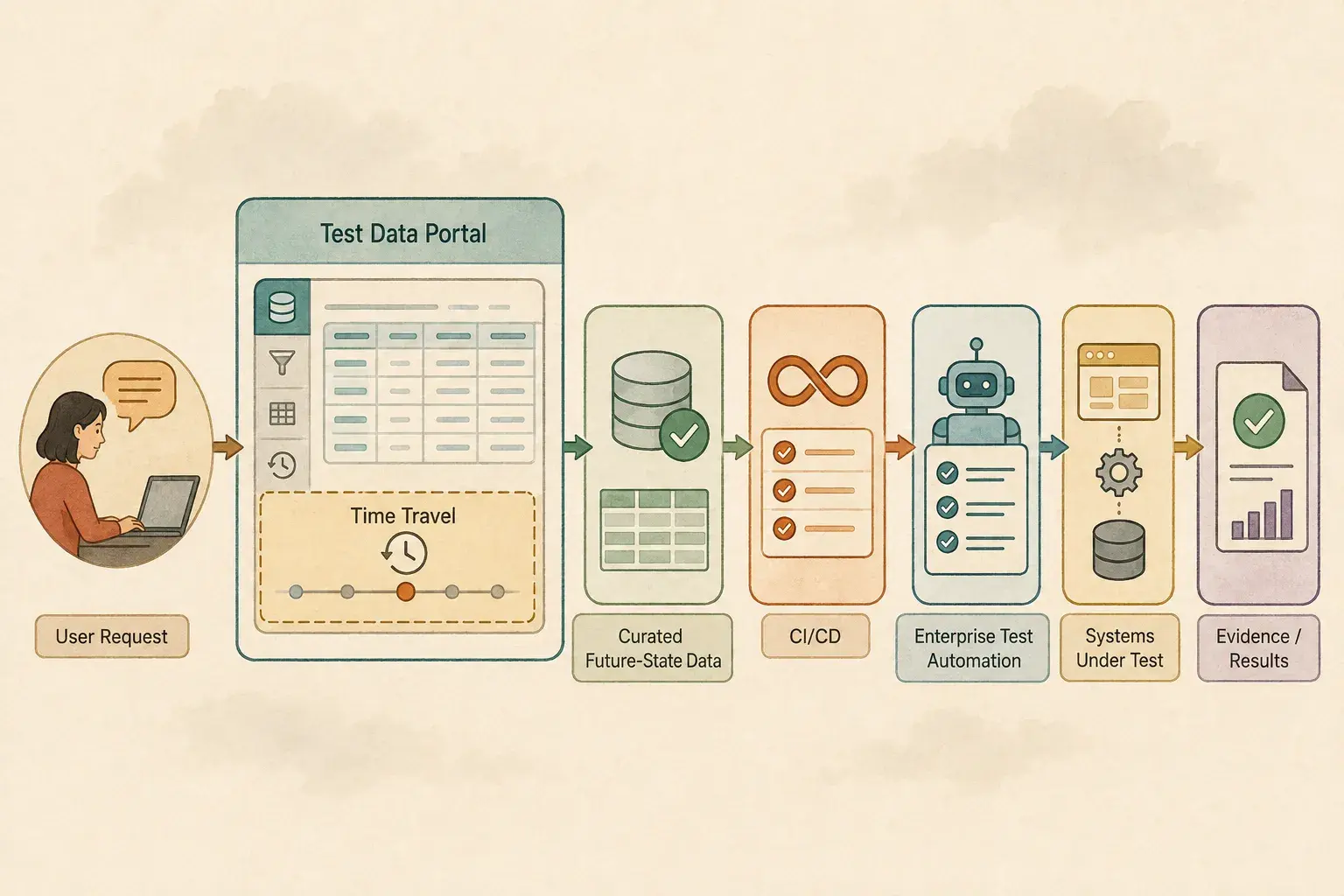
The most effective implementation connects time-travel simulation directly to test-data management and automated validation. A business or QA user requests a scenario, defines the required parameters and future state, and submits the request through a governed workflow.
The Test Data Portal then assembles production-like data, reserves the necessary environment or time window, advances the servicing timeline through the time-travel capability, and maintains lineage for the resulting datasets. The Enterprise Test Automation Framework uses that state to execute automated validation across APIs, user interfaces, and data layers.
This integrated model ensures that the right data state is created before execution begins and that evidence is captured as part of the same workflow, improving both accuracy and auditability.
Impact of This Technology on Business and Engineering Excellence
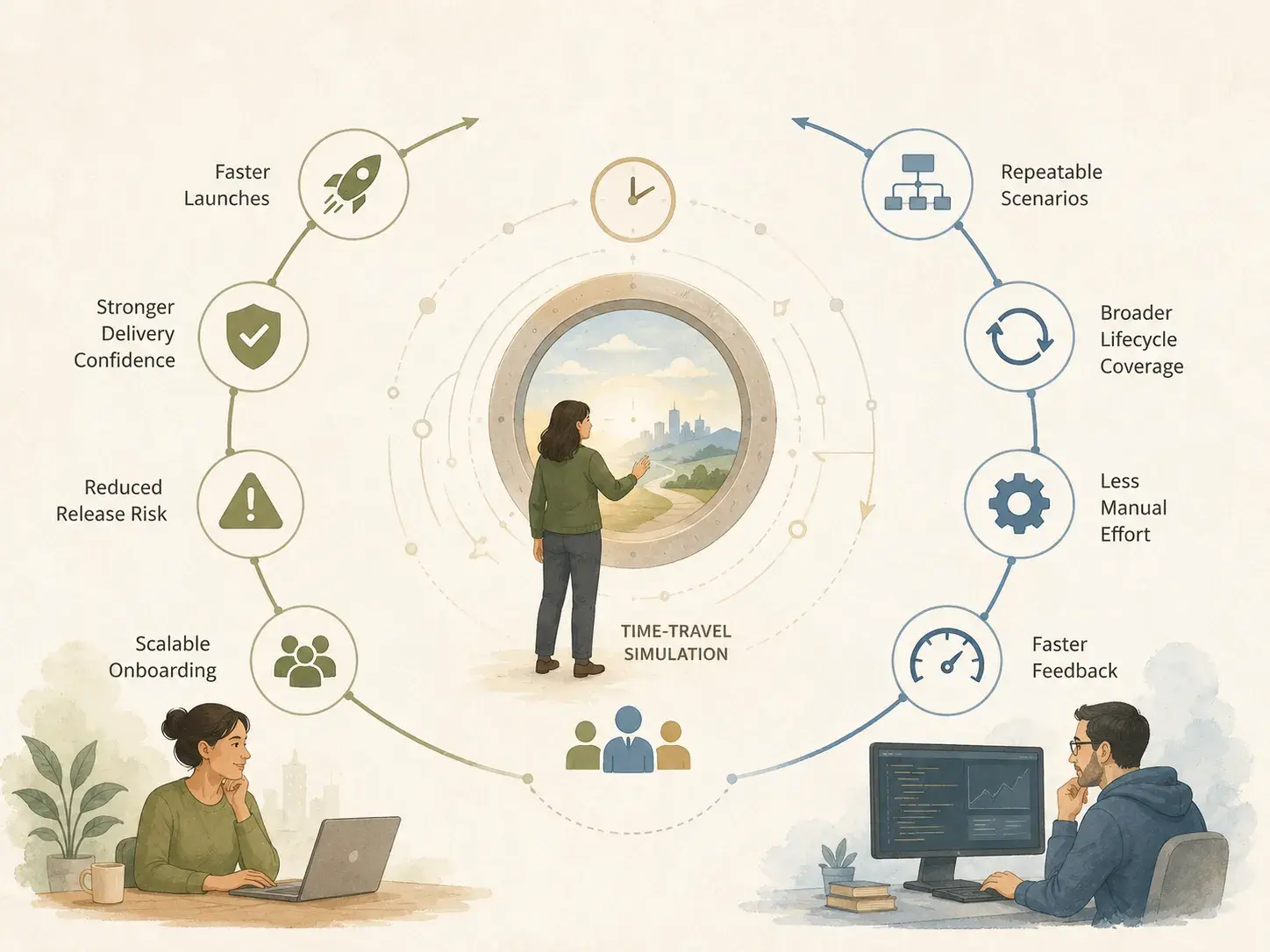
Once future-state financial scenarios become testable on demand, the benefits extend beyond testing. Business teams gain faster release readiness, stronger launch confidence, and fewer delays in product and partner delivery.
Engineering teams gain broader lifecycle coverage, reduced manual coordination, more reusable scenarios, faster feedback loops, and greater control over complex platform dependencies. The result is a more disciplined and scalable quality-engineering operating model.
In practical terms, a time-travel simulator transforms waiting time into engineered control. It raises both business confidence and engineering excellence by making lifecycle-aware validation a repeatable enterprise capability.
Conclusion
Start with one scenario your team cannot currently test without waiting: a delinquency threshold, a settlement date, or a fee that only posts once a billing cycle closes. Trace which systems have to hold state for it, then mark which of them read the system clock instead of a business date. That marked list is the scope of the servicing rework described above, and it is usually shorter than teams expect.
Once scenarios can be advanced on demand, the constraint moves to execution. Lending and payments suites carry thousands of compliance, security, and transaction-flow tests that run under audit requirements, and that workload sits inside a broader quality problem: authoring the scenarios, running them at scale, and holding the evidence together. TestMu AI is the world's first full-stack agentic AI quality engineering platform, covering that path end to end rather than one stage of it.
Q & A Session
While this topic was presented during the Testμ Conf 2026 session, the audience raised a number of questions about the edges of the approach, from systems nobody controls to the bugs it actually catches. Those exchanges are summarised below.
- How do you test third-party integrations where you cannot time travel, such as payment networks?
Rakesh Sukla: The core principle only applies to systems under your own control, so the answer splits in two. Where an external provider handles part of the lifecycle, as one does for loan processing on the Bread Financial credit card services, the route is to work with them: set out the simulation features you need and show them what the process looks like. Where a system genuinely cannot time travel, such as a payment network, mocking it out is the right call. Mocking does not give you the same quality of data, but there is little value in agonising over something outside your control.
- How many variables should be factored into a simulation for a reliable outcome?
Rakesh Sukla: This one is somewhat subjective. Inside a bank there is customer data, transaction data, payment data, loan data, bureau data and fraud data, along with a few more systems that together make up the loan processing engine. The mental model worth applying is that any business entity whose state changes purely because time has passed belongs in the simulation as a variable.
- Can this catch interest accrual bugs or quarter-end batch failures?
Rakesh Sukla: Yes, and interest calculation was one of the core use cases. Originate a loan at 30 percent interest, skip a payment for a month and the interest accrues; skip another and it accrues further. The edge cases are where it gets interesting, such as paying, then missing, then paying again, where interest accrues across the gap. A good simulation engine surfaces all of it, and their team found a considerable number of bugs this way.
- How do you test payment acknowledgement, where a file comes back from the bank and is ingested, from a lower environment?
Rakesh Sukla: A payment does not settle the moment it is made. It lands in a pending state, gets processed, and is only then received. If a customer is enrolled in autopay, the payment triggers automatically after the installment date and arrives as pending. The simulation therefore needs its own logic to flip a payment from pending to acknowledged to received, because the real calculations only fire once it reaches that final state.
- Is a tool like this available for other financial services to use?
Rakesh Sukla: Not that he is aware of, because the problem is too tightly bound to each organisation. Some providers offer pieces of a simulation process, but doing it properly means rethinking your own architecture, starting with making sure no business logic reads the machine or system date directly.
- How do you build future test data without breaking bank privacy rules?
Rakesh Sukla: This runs in lower environments, and banking privacy rules apply to production. Nothing is being circumvented, because the simulation does exactly what the system already does in production. That is the design principle restated: do not fake the final state, build the starting state, move time forward, and let the platform produce the outcome.
- What is the hardest bug it caught that normal testing missed?
Rakesh Sukla: Refund logic. A customer forgets they have already paid, autopay triggers, and the account takes a double payment. The refund calculation was not accounting for that correctly. It surfaced in a lower environment, so no customer was ever affected.

Author

Rakesh Sukla
Blogs: 1

Rakesh Sukla is Director of Engineering for Platform and Quality Engineering at Bread Financial, where he leads quality automation, release engineering, and developer productivity platforms. He has built and led a global team of more than 30 engineers and 3 engineering managers, and rolled out an enterprise test automation framework spanning web, mobile, API, gRPC, and security testing that supports daily releases across 22 projects, more than 300 test pipelines, and over 3,000 end-to-end tests a day. He architected Master Control, an automated deployment platform for zero-touch releases, a Unified Quality Portal for real-time test analytics, and a self-service Test Data Management Portal integrated with Harness CI/CD. At Resy (American Express Global Dining Network) he built on-demand test environment provisioning with Terraform, AWS, and Jenkins, and at Handy he cut manual QA effort by 70%. He has over 12 years of experience and holds a Master's in Computer Science from New York University.
Reviewer

Anmol Gupta
Reviewer
Anmol Gupta is Vice President of Product Management at TestMu AI (formerly LambdaTest), driving HyperExecute, the test orchestration cloud that runs and accelerates automated test execution. He led the development of the Unified Test Execution Cloud Platform and now leads a 30-member cross-functional product organization across product lines contributing $7M+ in revenue. He brings over nine years of experience and previously co-founded the SaaS company Timble as CTO, where he grew the team from 5 to 40 and launched an AI KYC platform that processed 600K+ applications in five months while cutting verification time from 12 minutes to under 30 seconds. Anmol holds an MTech and BTech from IIT Delhi.


Time Travel Testing FAQs
Did you find this page helpful?
More Related Blogs
TestMu AI forEnterprise
Get access to solutions built on Enterprise
grade security, privacy, & compliance
- Advanced access controls
- Advanced data retention rules
- Advanced Local Testing
- Premium Support options
- Early access to beta features
- Private Slack Channel
- Unlimited Manual Accessibility DevTools Tests