
Power Your Software Testing with AI Agents and Cloud
The Native AI-Agentic Cloud Platform to Supercharge Quality Engineering. Test Intelligently and Ship Faster.

- TestMu AI (Formerly LambdaTest)
- /
- Blog
- /
- How to Test Mobile Apps Without Code
How to Test Mobile Apps Without Code (2026 Guide)
Test your mobile app end to end, native gestures, deep links, offline mode, and real-device coverage, in plain English. No Appium, no Xcode, no code.
Published on:
A mobile app can be tested without writing Appium or Xcode code by describing the flow in plain English, letting KaneAI find the search icon or cart button by understanding the screen instead of a resource ID that changes with the next build, then exporting that same test to Appium if engineers want the code.
Why mobile apps are hard to test
A single app screen looks simple, but real coverage has to survive the messy conditions your users put it through:
- Device fragmentation means thousands of screen sizes, OS versions, and hardware combinations, and a bug can live on just one of them
- Native gestures like taps, long-presses, swipes, pinch-to-zoom, and scroll all have to be driven and verified, not just clicks
- The same feature ships as two separate iOS and Android builds, each with its own element IDs, navigation, and platform quirks
- Real-world conditions like offline mode, flaky networks, low battery, interrupting calls, and permission prompts change how the app behaves
- Deep links from a push notification or a URL have to restore the right screen with the session still intact
- A broken build cannot be hot-fixed instantly, so a bug that reaches the store waits days for review before your fix goes live
And that is one build. Real coverage means testing phones vs. tablets, iOS vs. Android, and the older OS versions your users refuse to upgrade from.
The old way: brittle Appium scripts
Here is what verifying a simple open-the-cart-and-check-the-total scenario looks like in a typical Appium setup:
DesiredCapabilities caps = new DesiredCapabilities();
caps.setCapability("platformName", "Android");
caps.setCapability("appium:deviceName", "Galaxy S23");
caps.setCapability("appium:app", "/builds/shop-release.apk");
caps.setCapability("appium:automationName", "UiAutomator2");
AndroidDriver driver = new AndroidDriver(new URL("http://127.0.0.1:4723"), caps);
WebDriverWait wait = new WebDriverWait(driver, Duration.ofSeconds(15));
wait.until(ExpectedConditions.presenceOfElementLocated(AppiumBy.id("com.shop.app:id/search"))).click();
driver.findElement(AppiumBy.accessibilityId("cart-icon")).click();
WebElement total = driver.findElement(AppiumBy.xpath("//android.widget.TextView[@resource-id='com.shop.app:id/cart_total']"));
Assert.assertTrue(total.getText().contains("$"), "Expected a cart total, got: " + total.getText());
Eleven lines, and it only covers Android. The moment a developer renames a resource ID, ships a new build variant, or moves the cart into a different view, the test breaks. Maintenance like this is the dominant cost of a large mobile suite: engineers spend a large share of every sprint re-pointing selectors and updating capabilities instead of writing new coverage. It also needs someone who writes Java or JavaScript and can stand up an Appium server, real devices, and drivers before a single test runs. It is the core tradeoff behind code-based vs. codeless test automation.
If you are a manual QA engineer, a PM, or a founder without a dedicated mobile automation engineer, the code wall means the app usually gets tested by hand, on the two or three phones sitting on someone's desk, and never on the device where the bug actually lives.
The no-code way: write the test the way you would explain it
With KaneAI, you write the same test in plain English:
- Launch the Shop app on a Galaxy S23
- Tap the search icon
- Search for a product and open it
- Add it to the cart
- Open the cart
- Verify the cart shows a total
That is the entire test. KaneAI reads each step and drives your real app the way a person would, finding the search icon and the cart by understanding the screen rather than matching a brittle resource ID or XPath. You author entirely in natural language, and the same test runs on real-device execution across 10,000+ real mobile devices, so you can prove a fix on the exact phone and OS version where the bug appeared. Gestures such as swipe, long-press, and scroll are driven through advanced click interactions, so a carousel or a pull-to-refresh is just another plain-English step. When your team wants the underlying code, KaneAI offers Appium export, so there is no lock-in. And when a new build renames an element or redesigns a screen, self-healing re-anchors the step and flags the change for review, which significantly reduces maintenance.
In this TestMu Conf 2026 session, Shantanu Wali makes the same case in “Every Agent Drives a Browser. Nobody Drives Your App.” Bringing mobile app validation into the agentic loop, on why nearly every testing agent shipped in the last two years drives a browser even though most digital engagement and revenue now flows through mobile apps.


The mobile app scenarios that actually break
Once the happy path works, real coverage is just more English. Here are the mobile scenarios worth adding, each takes about two minutes to write:
Rotation and small screens
- Open the checkout screen on a small Android phone
- Rotate the device to landscape and back to portrait
- Verify the pay button stays visible and tappable, and no field is cut off
Offline and flaky network
- Add an item to the cart, then drop the network mid-request
- Verify the app shows a clear retry state instead of a blank screen or a crash
- Restore the connection and verify the cart is still intact
Push notification deep link
- Open the app from an order-shipped push notification
- Verify it lands on the order-tracking screen, not the home feed
- Verify the user is still signed in and sees the correct order
Permissions and interrupts
- Trigger the camera permission prompt and allow it
- Verify the scanner opens after the prompt is dismissed
- Simulate an incoming call, end it, and verify the app resumes on the same screen
Run all of them across iOS and Android, on phones and tablets, and on the real devices your customers actually carry, from the same plain-English steps, with no per-device rewrites.
Putting it on autopilot
Mobile tests are most valuable when they run without you:
- Schedule the suite nightly, so a late-night build cannot quietly push a crash toward the store
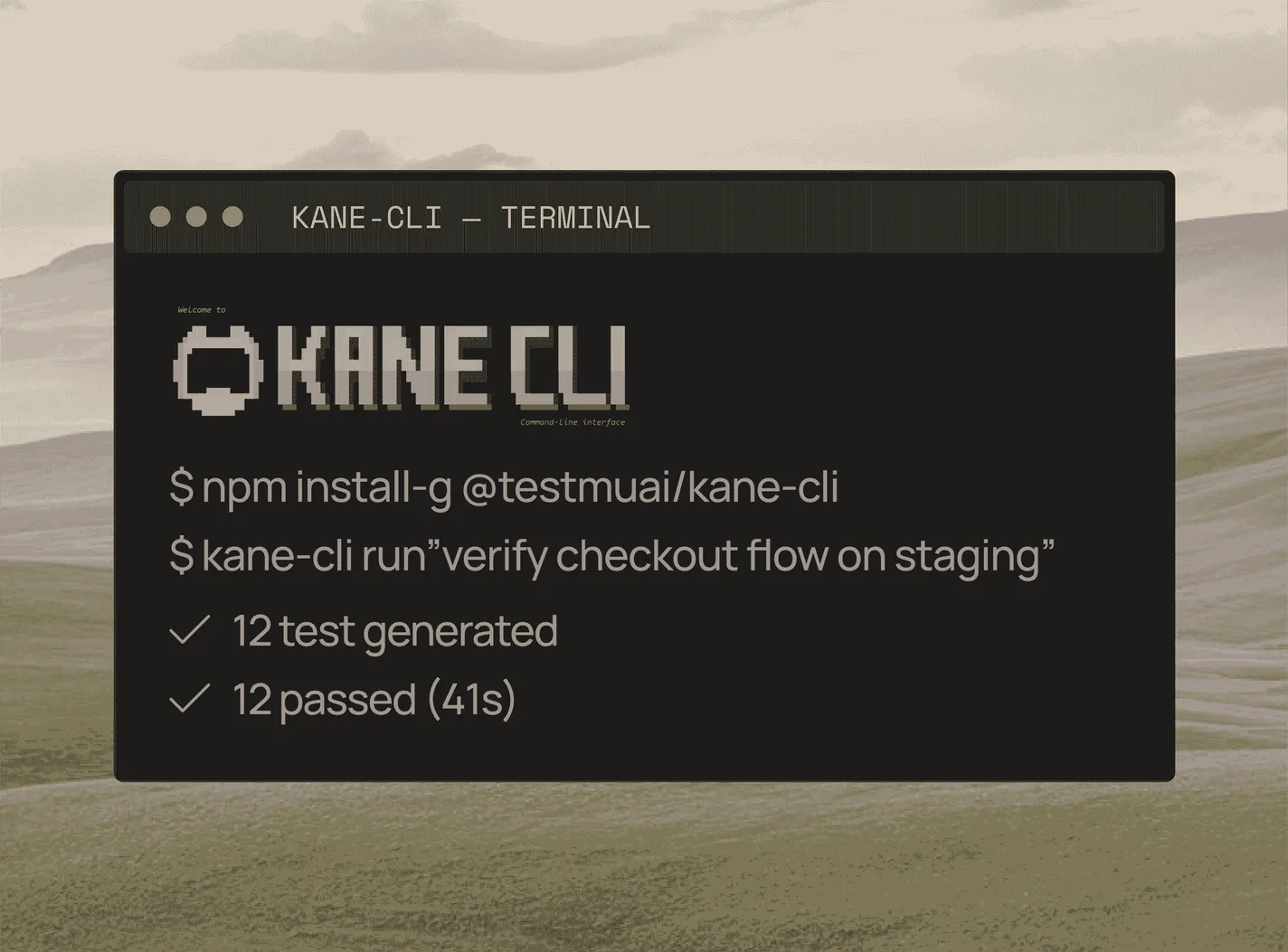
- Trigger on every build via CI, where Kane CLI runs the same tests from your pipeline and pauses for an OTP or CAPTCHA instead of failing
- Alert on failure in Slack, with a full replay of exactly what the AI saw on the device: screenshots, video, and the reason in plain English
When a test fails, you do not get a NoSuchElementException buried in a stack trace at line 47. You get a plain-English reason for the exact step that failed. Anyone on the team can read it, and anyone can fix the test, because the test is just English.
Try it on your own app in 10 minutes
- Sign up for KaneAI free, with no credit card
- Upload your app build or point KaneAI at your app
- Write your first mobile test in plain English, or let KaneAI suggest one from your screens
- Run it on a real device and watch your app get tested end to end
Your mobile app is too important to test on two phones by hand and too fragmented for brittle scripts. Test it in the language you already speak. Once your app is covered, read how to test web apps without code and how to test single-page applications (SPAs) without code to cover the rest of your product.

Note: Test your mobile app without writing a line of code. Start with KaneAI free.
Author

Sai Krishna
Blogs: 23

Sai Krishna is Director of Engineering at TestMu AI, where he leads agentic AI for quality engineering, building AI agents that autonomously drive mobile and conversational test automation. His current focus is Agent Testing and Model Context Protocol (MCP) support for mobile. He is a core contributor and member of the Appium open-source project and the creator of AppiumTestDistribution and appium-device-farm. With over 14 years of experience including more than 9 years at Thoughtworks as a Principal Consultant, he holds a BSc in Electronics and speaks regularly at TestMu and Appium Conf on Appium, mobile automation, and agentic AI in testing.
Reviewer

Shahzeb Hoda
Reviewer
Shahzeb Hoda is the Associate Director of Marketing and a Community Contributor at TestMu AI, leading strategic initiatives in developer marketing, content, and community growth. With 10+ years of experience in quality engineering, software testing, automation testing, and e-learning, he has authored and reviewed 70+ technical articles on software testing and automation. Shahzeb holds an M.Tech in Computer Science from BIT, Mesra, and is certified in Selenium, Cypress, Playwright, Appium, and KaneAI. He brings deep expertise in CI/CD pipeline automation, cross-browser testing, AI-driven testing practices, and framework documentation. On LinkedIn, he is followed by 3,700+ engineers, developers, DevOps professionals, tech leaders, and enthusiasts.


Mobile App Testing FAQs
Did you find this page helpful?
More Related Blogs

TestMu AI forEnterprise
Get access to solutions built on Enterprise
grade security, privacy, & compliance
- Advanced access controls
- Advanced data retention rules
- Advanced Local Testing
- Premium Support options
- Early access to beta features
- Private Slack Channel
- Unlimited Manual Accessibility DevTools Tests