
Power Your Software Testing with AI Agents and Cloud
The Native AI-Agentic Cloud Platform to Supercharge Quality Engineering. Test Intelligently and Ship Faster.

- TestMu AI (Formerly LambdaTest)
- /
- Blog
- /
- How to Test Flutter Apps Without Code
How to Test Flutter Apps Without Code (2026 Guide)
Test your Flutter app end to end, canvas-rendered widgets, gestures, forms, and navigation, in plain English. No Appium, no Dart, no brittle selectors.
Published on:
Flutter apps can be tested without writing Dart code by using KaneAI to describe steps in plain English, finding buttons by understanding the screen rather than a widget key. That matters most on Flutter web, which paints its UI to a canvas with no DOM, and the same test exports to Appium for real iOS and Android devices.
Why Flutter apps are hard to test
A Flutter screen looks like any other app, but the way it is built makes automation genuinely harder than a standard web or native app:
- Flutter paints its own UI to a canvas instead of rendering native or HTML elements, so on the web there is no DOM to query and standard selector-based tools find nothing to click
- Widgets are addressed by keys and internal widget types, not by ids or CSS classes, so anyone writing a test has to know the widget tree, not just the screen
- One codebase produces different behavior per platform, so a gesture, a scroll, or a date picker has to be verified separately on iOS, Android, and web
- Constant rebuilds and animations keep the tree in motion, and a test that taps a moment too early hits a widget that has not settled yet
- State management such as Provider, Riverpod, or Bloc decides what is on screen, so a navigation step depends on state that is awkward to set up from the outside
- Real-device differences in screen density, safe areas, notches, and keyboard behavior surface overflow and tap-target bugs that no simulator reproduces
And that is one screen. Real coverage means every screen, every platform your users install on, and every device size in between, which is exactly what TestMu AI's App Automation handles across its real device cloud, spanning the Flutter supported capabilities for automation from gestures to widget interactions on both iOS and Android.
The old way: brittle widget tests
Here is what verifying a simple add-to-cart-and-check-the-badge scenario looks like in a typical Flutter widget test:
testWidgets('cart badge shows item count', (WidgetTester tester) async {
  await tester.pumpWidget(const MyApp());
  await tester.pumpAndSettle();

  final addButton = find.byKey(const Key('add_to_cart'));
  await tester.tap(addButton);
  await tester.pumpAndSettle();

  final badge = find.byKey(const Key('cart_badge'));
  expect(badge, findsOneWidget);

  final badgeText = tester.widget<Text>(badge).data;
  expect(badgeText, '1', reason: 'Cart badge should read 1 after one add');
});
It works, and it is fragile. The moment a developer renames the add_to_cart key, wraps the badge in a new widget, or changes how the count is composed, the test breaks and reports a failure that has nothing to do with a real bug. Maintenance like this is the dominant cost of a large Flutter suite: the team spends a large share of every sprint re-pointing keys and finders instead of writing new coverage. And it still needs someone who writes Dart and understands the widget tree, which the canvas-rendered web build and per-platform behavior only make harder. It is the core tradeoff behind code-based vs. codeless test automation.
If you are a manual QA engineer, a product manager, or a founder without a dedicated Flutter automation engineer, the code wall means the app usually gets tested by hand, one device at a time, slowly, and never on every platform before a release.
The no-code way: describe the flow, not the widget tree
With KaneAI, you write the same test in plain English:
- Open the app and go to the product screen
- Tap the Add to Cart button
- Verify the cart badge becomes visible
- Verify the cart badge shows the number 1
- Open the cart and verify the product is listed
That is the entire test. KaneAI reads each step and finds the right element on your live app the way a human tester would, by understanding what is on screen rather than matching a widget key or a CSS selector. This matters most on Flutter web, where the whole UI is painted to a canvas and there is no DOM for selector-based tools to query, so semantic and visual detection is the only thing that reliably finds the Add to Cart button. When your developer renames a key or reshapes the widget tree, the test re-anchors the step instead of failing, which significantly reduces maintenance. For Flutter mobile, the same plain-English test runs on real iOS and Android devices, and KaneAI can export it to Appium so it drops into the pipeline you already have with no lock-in.

The Flutter app scenarios that actually break
Once the happy path works, real coverage is just more English. Here are the Flutter scenarios worth adding, each takes about two minutes to write:
Canvas-rendered web forms
- Open the sign-up screen on the Flutter web build
- Enter a name, email, and password into the canvas-drawn fields
- Submit and verify the account is created and the next screen loads
Gestures and scrolling
- Open a long list and scroll to an item near the bottom
- Swipe a list row to reveal its delete action
- Verify the row is removed and the list updates in place
Platform-specific navigation
- Open a detail screen and trigger the system back gesture
- Verify the app returns to the previous screen with its state preserved
- Repeat on iOS and Android and verify both platforms behave the same
Layout overflow on small devices
- Open the checkout screen on a small, high-density phone
- Verify no field or button is cut off or overflowing the edge
- Verify every tap target stays reachable above the on-screen keyboard
Run all of them across Chrome, Safari, and Firefox for the web build and on real iOS and Android devices for the mobile build, from the same plain-English steps, with no per-platform rewrites.
Putting it on autopilot
Flutter tests are most valuable when they run without you:
- Schedule the suite nightly, so a Friday merge cannot ship a canvas form that silently fails to submit
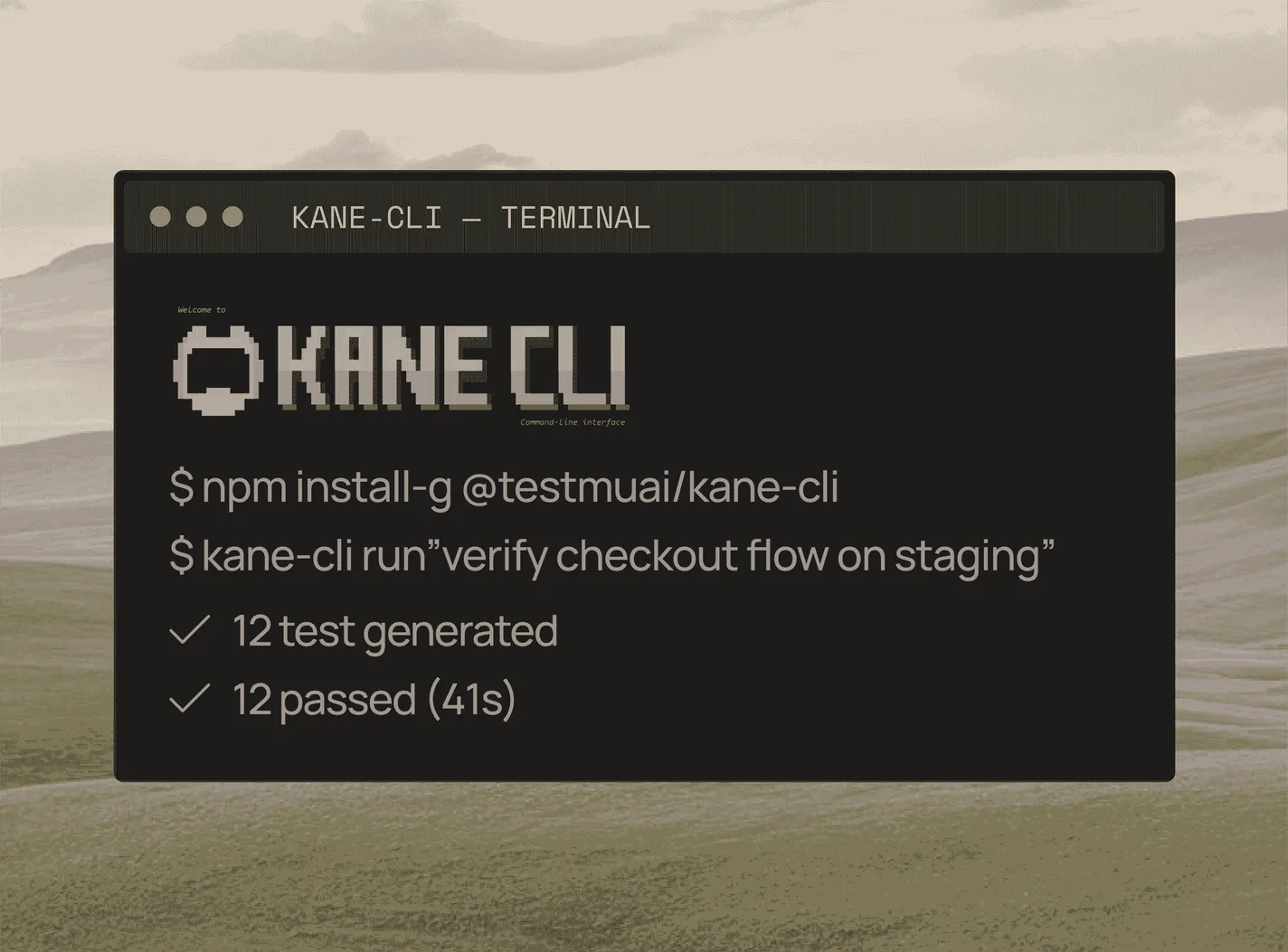
- Trigger on deploy via CI, where Kane CLI runs the same tests from your pipeline and pauses for an OTP or CAPTCHA instead of failing
- Alert on failure in Slack, with a full replay of what the AI saw when the step failed, the screenshots, video, and the reason in plain English
When a test fails, you do not get a Dart stack trace pointing at a finder on line 47. You get a plain-English reason for the exact step that failed. Anyone on the team can read it, and anyone can fix the test, because the test is just English.
Try it on your own Flutter app in 10 minutes
- Sign up for KaneAI free, with no credit card
- Point it at your Flutter web URL or upload your mobile build
- Write your first test in plain English, or let KaneAI suggest one from your app
- Run it and watch your Flutter app get tested end to end
Your Flutter app ships to three platforms from one codebase, so it deserves coverage that keeps up without a Dart engineer re-pointing finders every sprint. Test it in the language you already speak. Once your app is covered, read how to test Next.js apps without code for your web front end and how to test WordPress sites without code for your marketing site.

Note: Test your Flutter app without writing a line of code. Start with KaneAI free.
Author

Sai Krishna
Blogs: 23

Sai Krishna is Director of Engineering at TestMu AI, where he leads agentic AI for quality engineering, building AI agents that autonomously drive mobile and conversational test automation. His current focus is Agent Testing and Model Context Protocol (MCP) support for mobile. He is a core contributor and member of the Appium open-source project and the creator of AppiumTestDistribution and appium-device-farm. With over 14 years of experience including more than 9 years at Thoughtworks as a Principal Consultant, he holds a BSc in Electronics and speaks regularly at TestMu and Appium Conf on Appium, mobile automation, and agentic AI in testing.
Reviewer

Shahzeb Hoda
Reviewer
Shahzeb Hoda is the Associate Director of Marketing and a Community Contributor at TestMu AI, leading strategic initiatives in developer marketing, content, and community growth. With 10+ years of experience in quality engineering, software testing, automation testing, and e-learning, he has authored and reviewed 70+ technical articles on software testing and automation. Shahzeb holds an M.Tech in Computer Science from BIT, Mesra, and is certified in Selenium, Cypress, Playwright, Appium, and KaneAI. He brings deep expertise in CI/CD pipeline automation, cross-browser testing, AI-driven testing practices, and framework documentation. On LinkedIn, he is followed by 3,700+ engineers, developers, DevOps professionals, tech leaders, and enthusiasts.


Flutter Testing FAQs
Did you find this page helpful?
More Related Blogs

TestMu AI forEnterprise
Get access to solutions built on Enterprise
grade security, privacy, & compliance
- Advanced access controls
- Advanced data retention rules
- Advanced Local Testing
- Premium Support options
- Early access to beta features
- Private Slack Channel
- Unlimited Manual Accessibility DevTools Tests