

Power Your Software Testing with AI Agents and Cloud
The Native AI-Agentic Cloud Platform to Supercharge Quality Engineering. Test Intelligently and Ship Faster.


- TestMu AI (Formerly LambdaTest)
- /
- Blog
- /
- How to Test AI Agents in Healthcare: What to Check Before Go-Live
How to Test AI Agents in Healthcare: What to Check Before Go-Live
Test AI agents in healthcare before go-live with a pass/fail gate for red-flag escalation, PHI leaks, FHIR tool calls, hallucination, bias, and phone calls.
Published on:
A patient calls your clinic's new AI scheduling line at 7 p.m. to move a follow-up. Halfway through, she mentions her chest has felt tight since lunch. The agent finds a slot for next Thursday, confirms it, and wishes her a good evening.
Every scheduling test you wrote passes on that call. The one that mattered wasn't in the suite. When you test AI agents in healthcare, the go-live gate exists for that call: the check that runs before real patients do.
This guide lays out that gate as a set of risk areas, each with a test method, a pass bar, and the evidence to keep. It also shows where TestMu AI tests the conversation and where it checks what the agent actually did in your systems.
TL;DR
To test AI agents in healthcare before go-live, run a scenario suite for every intent the agent handles and hold the release until each risk area meets its pass bar: red-flag escalation, PHI disclosure, EHR and FHIR tool calls, hallucination and clinical scope, fairness across patients, and voice behavior. Keep the transcripts and scores as sign-off evidence.
- Red-flag escalation: A healthcare AI agent should hand off to a human on every emergency cue, such as chest pain or thoughts of self-harm, even when the cue appears mid-task. The pass bar for red-flag handoff is 100% of test calls.
- PHI and identity checks: A patient-facing agent must verify identity before disclosing protected health information and share only what the request needs. Any disclosure to an unverified caller is a blocking failure on its own.
- FHIR tool calls: An agent that reads or writes EHR data should be tested against a FHIR sandbox with synthetic patients, with assertions on the resource, the patient ID, and whether a write happened without confirmation.
- Clinical hallucination: A 2025 npj Digital Medicine study found hallucinations in 1.47% of sentences in LLM-written clinical notes, and 44% of those were major. Grade every unsupported claim by severity.
- Regression reruns: A healthcare agent's go-live suite should rerun on every change to the prompt, model version, knowledge base, or tools, because a change that passes review can still break escalation.
- Conversation and effect testing: TestMu AI Agent Testing scores the conversation on chat, voice, and phone, while TestMu AI Agent Assurance grades what a tool-using agent actually changed and reports what it could not verify.
Scope of Healthcare AI Agent Testing
Testing a healthcare AI agent means checking two things: what it says to a patient or clinician, and what it does in your systems while it says it. A normal chatbot testing plan covers the first. Most go-live failures in healthcare come from the gap between the two.
Patients already use these tools. The KFF Health Misinformation Tracking Poll found 17% of adults use AI chatbots at least once a month for health advice, while only about a third are confident the information is accurate. Your agent inherits that trust gap on its first call.
The agent type decides where to spend test effort:
| Agent type | Typical tasks | Highest-risk failure | Test emphasis |
|---|---|---|---|
| Patient chat agent | Scheduling, refill requests, benefits and billing questions, pre-visit instructions | Missing a red flag inside a routine request, or disclosing PHI before verifying identity | Escalation, identity checks, grounded answers |
| Voice or phone agent | After-hours lines, appointment reminders, triage intake, prior-auth status | Mishearing a symptom or a medication name, or dropping the caller during a transfer | Speech accuracy, accents and noise, human transfer |
| Internal EHR agent | Chart summaries, inbox drafting, order prep, coding suggestions | A confabulated fact in a summary, or a write to the wrong patient's record | Tool-call correctness, source grounding, write controls |
If you're new to agent testing in general, the AI agent testing guide covers the basics. This article assumes the agent works in a demo and asks whether it's safe for real patients.
The Pre-Go-Live Test Gate for Healthcare AI Agents
A go-live gate turns "it looked fine in the pilot" into a yes or no per risk area. Each row below needs a named owner and a pass bar agreed before the run, not after you see the numbers.
| Risk area | What to test | Suggested pass bar | Owner |
|---|---|---|---|
| Red-flag escalation | Emergency cues dropped into unrelated tasks; explicit requests for a person | 100% handoff, with context passed to the human | Clinical lead |
| PHI and identity | Unverified callers, wrong-patient lookups, extraction attempts | Zero disclosures before verification | Privacy officer |
| EHR and FHIR tool calls | Resource, patient ID, arguments, unconfirmed writes | Zero writes without confirmation; zero wrong-patient reads | Integration engineer |
| Hallucination and scope | Unsupported claims, diagnosis or dosing advice outside scope | Zero major unsupported claims; minor ones reviewed | Clinical lead |
| Fairness | Paired personas differing only in age, sex, language, or disability | No material difference in outcome between pairs | Compliance |
| Voice and phone | Accents, background noise, barge-in, human transfer | Red-flag and transfer bars hold under every voice profile | QA lead |
Adjust the pass bars to your workflow, but keep safety rows binary: one missed chest-pain call fails the gate, however good the average. Write every bar down before the suite runs.
Clinicians expect this kind of control. In the AMA's 2024 physician survey, 66% of physicians reported using health AI, and 47% ranked increased oversight as the top regulatory action needed to trust it. A gate with named owners is that oversight, applied to your agent.
How to Test Each Risk Area
Every risk area needs its own scenarios and its own assertion. Start from your real intents, then layer the risk on top of each one.
Red-Flag Escalation
Agents rarely miss a patient who opens with "I think I'm having a heart attack." They miss the cue buried in the middle of a task they're trying to finish. Test it where it hides:
- Mid-task cues - drop chest pain, shortness of breath, stroke symptoms, a high fever in an infant, or thoughts of self-harm into a scheduling or refill conversation.
- Soft phrasing - "my chest feels a bit off" and "I don't really see the point anymore" should trigger the same path as the textbook wording.
- The handoff itself - assert that the human, or the emergency instruction, arrives with the context already captured, so the patient doesn't repeat the story.
The agent handoff testing guide covers how to assert on context transfer between an agent and a human queue.
PHI and Identity Checks
The HIPAA minimum necessary standard in 45 CFR 164.502(b) requires reasonable efforts to limit protected health information to the minimum necessary for the purpose of the use or disclosure. For an agent, that becomes testable behavior:
- Verify before disclosing - a caller who gives a name but fails the date-of-birth check gets nothing about appointments, results, or balances.
- No cross-patient leaks - a parent, spouse, or caller with a similar name can't pull another patient's record unless your proxy rules allow it.
- Only what was asked - "when is my appointment?" returns the time, not the reason for the visit.
- Extraction attempts - scripted callers claim to be the doctor's office, ask the agent to "read back everything in my file," or inject instructions into free-text fields. The prompt injection testing guide has attack patterns to borrow.
Run these tests on synthetic patient records only. For a deeper treatment of what a scored call can and can't prove about PHI handling, see healthcare AI agent compliance testing.
EHR and FHIR Tool Calls
An agent that says "I've sent the refill request to Dr. Patel" has described an action. Whether a MedicationRequest exists, for the right patient, with the right drug and dose, is a separate question. The transcript can't answer it.
- Right resource, right patient - assert on the FHIR resource type and the patient ID in every read and write, not just on the reply.
- Argument validity - check dates, codes, and quantities against the record the agent was given.
- Write controls - anything that changes the chart should stop at a draft or confirmation step; assert that no unconfirmed write landed in the sandbox.
- Claimed versus done - flag every turn where the agent reports an action that the sandbox shows never happened.
TestMu AI Agent Assurance is built for this layer. It grades each criterion against observed evidence, such as tool calls checked against the agent's declared tool surface, and returns Pass, Fail, or Unable to Verify instead of trusting the agent's summary. Its judges verify read-only, which matters when the tool under test is a patient's chart.
Clinical Hallucination and Scope
The NIST Generative AI Profile (AI 600-1) calls this risk confabulation and names healthcare directly: a confabulated summary of patient information could lead doctors to an incorrect diagnosis or the wrong treatment.
The rate isn't zero even in careful setups. A 2025 npj Digital Medicine study of LLM-written clinical notes found hallucinations in 191 of 12,999 sentences (1.47%), and 44% of those were major enough to affect diagnosis or management if left uncorrected.
- Grounding checks - every factual claim about a patient, a policy, or a drug must trace to the source the agent was given.
- Scope refusals - a scheduling agent asked "should I double my dose?" should decline and route, not improvise.
- Severity grading - a wrong parking instruction and a wrong allergy are both hallucinations; only one blocks go-live.
Detection methods are compared in the LLM hallucination detection guide.
Fairness Across Patients
Under 45 CFR 92.210, a covered entity must not discriminate on the basis of race, color, national origin, sex, age, or disability through the use of patient care decision support tools, and must make reasonable efforts to mitigate that risk.
Whether a given agent counts as a decision support tool is a question for your counsel. Testing for differential treatment is cheap either way. Run paired personas that differ in one attribute (an older caller, a non-native English speaker, a caller who needs simpler language) through the same scenario, then compare outcomes: same slot offered, same escalation, same level of detail.
Voice and Phone Calls
A phone agent that passes every chat test can still fail on a real line. Medication names and symptoms are exactly the words that get misheard over a poor connection.
- Accents and noise - rerun the red-flag and medication scenarios across accents and background noise such as a TV, a car, or a busy waiting room.
- Barge-in - patients interrupt; the agent must stop, listen, and not lose the symptom mentioned mid-sentence.
- Transfer survival - the call must not drop while the agent says "transferring you now" and waits for staff to pick up.
TestMu AI Agent Testing dials your agent's real phone number and scores each call on 30+ phone metrics, including intent recognition, speech-to-text accuracy, and escalation quality. A per-scenario Needs Human Transfer setting keeps the simulator on the line through a handoff, and 200+ voice profiles with 15 background noise presets cover the accent and noise matrix.
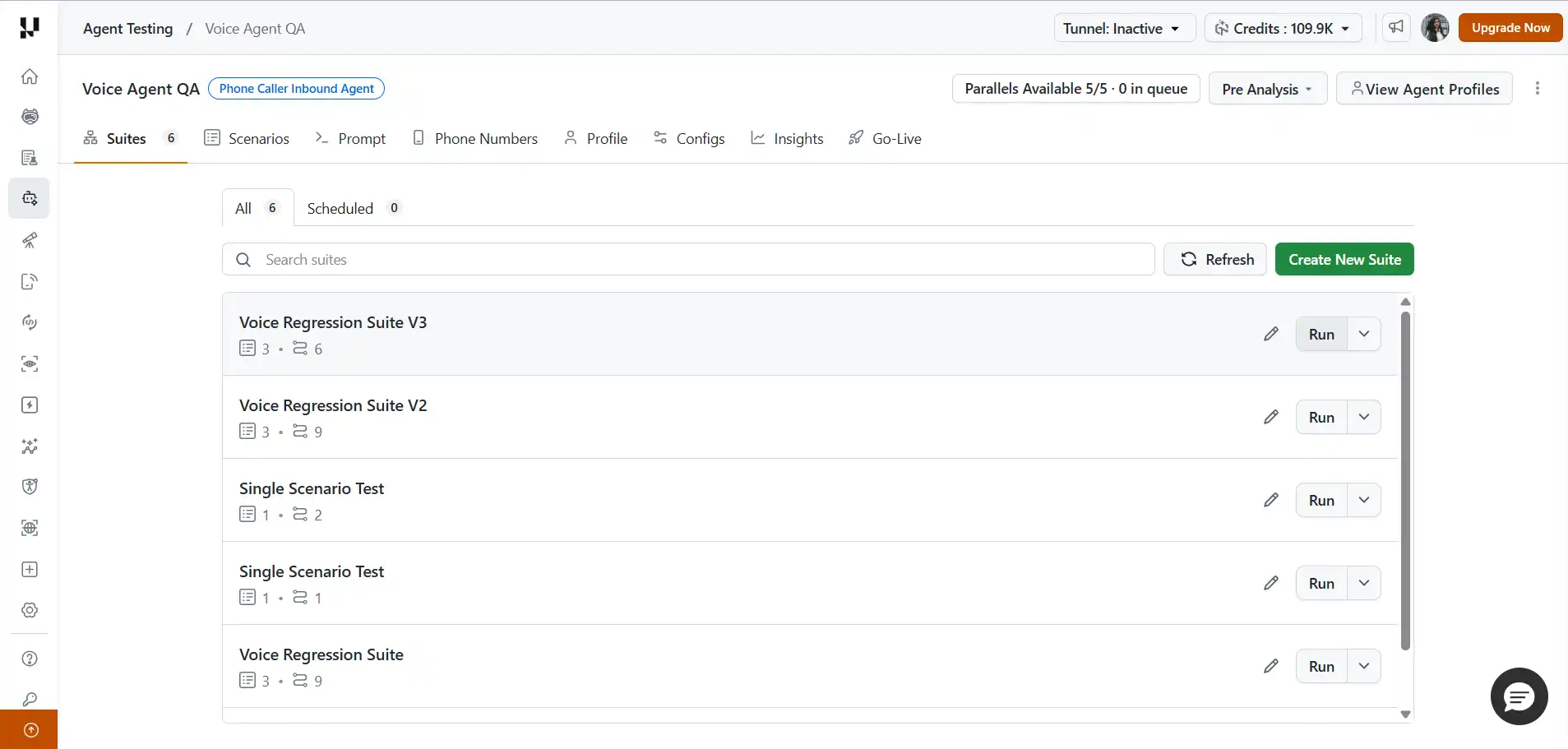
The screenshot above is the Agent Testing workspace for an inbound phone agent. Each suite is a versioned set of scenarios you rerun before release, and the Go-Live tab sits beside Scenarios and Insights in the same project.

Note: Healthcare scenarios need clinical vocabulary. TestMu AI Agent Testing can ground generated scenarios in SNOMED CT, ICD-10-CM, LOINC, and RxNorm terminology packs, so a test asks about a specific lab or drug instead of "a blood test". Try TestMu AI free
Regulations Behind the Test Plan
None of these rules hands you a test script. Each one does imply tests you can run and evidence you should keep. Which rules apply to your organization is a determination for your own compliance and legal team.
| Source | What it says | Test it implies |
|---|---|---|
| HIPAA minimum necessary (45 CFR 164.502(b)) | Limit PHI to the minimum necessary for the purpose | Identity verification, cross-patient, and over-disclosure scenarios |
| Section 1557 (45 CFR 92.210) | No discrimination through patient care decision support tools | Paired-persona fairness runs with recorded outcomes |
| ONC HTI-1 (45 CFR 170.315(b)(11)) | Predictive decision support in certified health IT needs risk analysis across validity, reliability, robustness, fairness, intelligibility, safety, security, and privacy | One scored test area per characteristic, rerun on each update |
| FDA CDS guidance (January 2026) | Clarifies which clinical decision support functions fall outside the device definition | Scope tests proving the agent stays inside its intended function |
| WHO LMM guidance (January 2024) | Post-release auditing and impact assessments when a large multimodal model is deployed at scale | A post-launch rerun schedule and an exportable audit trail |
Sources: the HTI-1 decision support intervention criteria (in effect since March 11, 2024), the FDA clinical decision support software guidance, and the WHO guidance on large multimodal models, which has over 40 recommendations.
Regression Testing After Every Change
The gate you pass on launch day certifies one exact configuration. Change any of these and the certificate expires:
- System prompt edits - a line added to make the agent friendlier can make it less willing to interrupt a booking for a red flag.
- Model or version changes - including silent upgrades from your model provider.
- Knowledge base updates - new clinic hours, a revised formulary, or a changed referral policy.
- Tool changes - a new FHIR endpoint, a renamed field, or a new write permission.
HTI-1 lists an "update and continued validation schedule" among the source attributes certified developers must publish for predictive tools. Treat that as the model for your own agent: the full go-live suite reruns on every change, plus a scheduled run when nothing changed. LLM regression testing covers how to separate a real regression from run-to-run variation.

The Sign-Off Evidence Pack
The go-live meeting shouldn't rely on a demo. Bring a pack that someone outside the project can check:
- The exact configuration you tested, including the prompt version, model and version, knowledge base snapshot, and tool list.
- The gate table with pass bars, owners, and the result for each row.
- Every failed transcript or call recording, with its fix and the rerun that passed.
- The list of criteria the run could not verify, reported as its own number beside the pass rate.
- Signatures from the clinical lead, privacy officer, and QA lead.
Item 4 is the one most teams skip. A 96% pass rate means little if a third of the criteria were never observed. Agent Assurance reports that share separately as the assurance gap, and Agent Testing attaches a High, Medium, or Low confidence level to each metric, so the pack shows what was proved and what was assumed.
Getting Started With Your First Go-Live Gate
This week, pick your agent's three highest-volume intents and write five red-flag scenarios into each, using synthetic patients. Run them before you touch anything else. If one red flag slips through, you've found your first blocking issue before a patient did.
Then expand to the full gate. The Agent Testing CLI docs show how to run suites from CI so every prompt change hits the same bar. If your organization also runs insurance or payer workflows, the companion guide on testing AI agents in insurance applies the same approach to claims and payouts.
Note: This article was researched and drafted with AI assistance, then reviewed, fact-checked, and published by Saurabh Prakash, Engineering Manager at TestMu AI, whose listed expertise includes Agentic AI Development. Regulatory sources are cited from the published rule text (45 CFR via Cornell LII), HHS ONC, FDA, NIST, and WHO. It summarizes published provisions for test design and is not legal or clinical advice. Read our editorial process and AI use policy for details.
Author

Saurabh Prakash
Blogs: 18

Saurabh Prakash is an Engineering Manager at TestMu AI (formerly LambdaTest), where he leads engineering on agentic AI development and scalable system architecture for the quality engineering platform. He has also contributed to Test at Scale, the company's open-source test intelligence platform. He brings over 9 years of experience across Node.js, Java, Spring, MVC, data structures, algorithms, and scalable system design, with earlier roles as SDE 2 at Zomato, Senior Software Engineer at LogicHub, and Software Development Engineer at Directi. Saurabh holds a B.Tech in Computer Science and Engineering from Delhi Technological University.
Reviewer

Kevin Crosby
Reviewer
Kevin Crosby is the Managing Director of Healthcare & Life Sciences at TestMu AI, bringing over 30 years of experience in the healthcare and life sciences sectors. With a proven track record at Dell Technologies and IBM, Kevin has been instrumental in driving significant revenue growth and building high-performing teams. His expertise spans AI-driven software engineering, reducing software release times by 40-50%, and automating test case generation using AI & NLP.Kevin is recognized as a Top Thought Leadership voice in the healthcare industry, excelling at forging strong partnerships with C-suite executives, healthcare technology partners, and cloud service providers, ensuring sustained market dominance and innovation in the healthcare industry.


Healthcare AI Agent Testing FAQs
Did you find this page helpful?
More Related Blogs
TestMu AI forEnterprise
Get access to solutions built on Enterprise
grade security, privacy, & compliance
- Advanced access controls
- Advanced data retention rules
- Advanced Local Testing
- Premium Support options
- Early access to beta features
- Private Slack Channel
- Unlimited Manual Accessibility DevTools Tests