
Run End-to-End Tests from Your Terminal with Kane CLI
Author and Run Tests Right from the Terminal in Natural Language, with an Evidence-Backed Pass or Fail from a Real Browser.
npm install -g @testmuai/kane-cli
What SWE-bench Verified Misses: Unneeded Code in Passing Agent Patches
Agent patches that pass SWE-bench Verified still carry code no test needed: 11% per patch on average, often changing behavior. Data for 18 models.
SWE-bench Verified and the other coding agent benchmarks only look at whether a patch passes the tests. A November 2026 preprint went through and reverted 7,660 passing agent patches one block at a time. On SWE-bench Verified, on average, 11% of the code units in a patch were unnecessary to pass, and 44.6% of the probed blocks that the tests deemed unneeded were in fact blocks that changed the behavior in a way that the developer's fix did not.
The study in numbers:
- 7,660 resolved GitHub Copilot CLI runs from 18 models: 6,728 on SWE-bench Verified and 932 on DeepSWE.
- Agent code was at least as necessary as developer code on average (code necessity 0.887 vs 0.864 on SWE-bench Verified, 0.797 vs 0.785 on DeepSWE).
- The average SWE-bench Verified agent patch had 11% unneeded code units. Of the 3,559 unneeded units that the authors looked at, 1,586 (44.6%) changed their behavior in a way that wasn't captured by the developer's fix, and 1,263 behaved as if they were needed (i.e., they behaved like the developer's fix): needed, just not tested.
- On the harder DeepSWE tasks, the models that solved more tasks left behind more unnecessary code (Spearman −0.59, p = 0.01, 17 models).
- Asked to audit their own diffs, the models found 35.5% of the code that wasn't needed.
- TestMu AI's figure from Table 12 in the paper (counted across all patches rather than averaged per patch) was that approximately 1 in 4 of the changed code blocks (3,985 of 15,187) were not actually required.
TL;DR
SWE-bench Verified scores a coding agent only on whether its patch passes the task tests; it never checks whether every change in the patch was needed. In a 7,660-patch study, the average passing SWE-bench Verified patch still carried 11% code units that no test needed, and resolve rate did not predict which models wrote cleaner patches.
What Is SWE-bench Verified Missing?
- SWE-bench Verified: A set of 500 human-validated Python tasks built from real GitHub issues. A patch counts as resolved when the issue's FAIL_TO_PASS tests pass and the existing PASS_TO_PASS tests still pass, and the leaderboard reports the share of tasks resolved.
- Code necessity: The share of a patch's code units that the task tests need, found by reverting each unit and rerunning the tests. The 18 models averaged 0.887 on SWE-bench Verified, against 0.864 for the developer patches that fixed the same issues.
- Code bloat in agent patches: The median model changed 2.33x as many lines as the developer patch, but most of the extra edits were tests (61%) and documentation (13%). Counting code lines only, agents wrote 0.86x the developer's code.
- Unrequested behavior changes: Of 3,559 probed unneeded code units, 1,586 (44.6%) changed behavior in a way the developer's fix did not, and 1,263 matched the developer's fix even though no test checked them.
Reading AI Coding Benchmarks and Coding Agent Benchmark Results
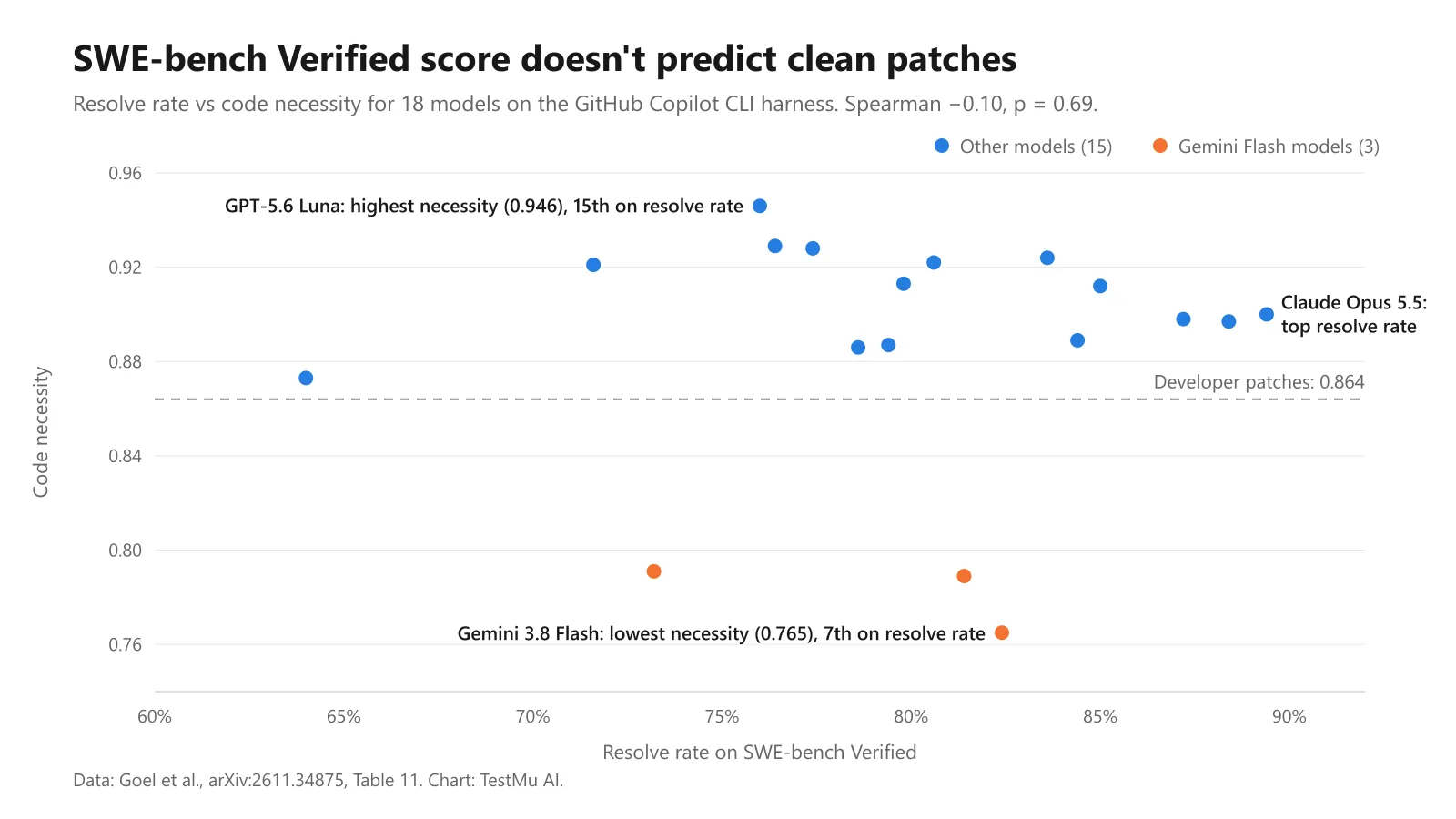
- Resolve rate vs necessity: Across 18 models, code necessity was unrelated to SWE-bench Verified resolve rate (Spearman −0.10). GPT-5.6 Luna had the highest necessity at 0.946 and ranked 15th of 18 on resolve rate.
- An in-house coding agent benchmark: Score candidate models on a few dozen of your own closed issues for resolve rate and necessity, then confirm user-facing behavior with acceptance tests the coding agent did not write. Kane CLI by TestMu AI runs those tests in a real browser and returns exit code 0 or 1 with step evidence.
Do AI Coding Agents Produce More 'Unnecessary' Code Than Developers?
On average, no. Goel et al. applied the same grading methodology to the developers' original patches and found agent code to be marginally more necessary: 0.887 for agents versus 0.864 for developers on SWE-bench Verified. 11 of the 18 models left significantly less unneeded code than the developers who had fixed the same bugs.
Agent patches are larger, and that size differential is the one thing people tend to point to when they say agent code is bloated. On SWE-bench Verified, the median model changed 2.33x as many lines as the developer patch. The majority of the extra changes were in the form of tests (61%) and documentation (13%).
Outside of test files, the agents changed 1.09x the line count of the developer. If you just count code lines, then it's 0.86x.
DeepSWE is a different beast. On DeepSWE, 58% of the additional edits were code, and agent necessity was actually in line with developers (0.797 vs 0.785) rather than outperforming them.
What Is SWE-bench Verified and What Does It Score?
SWE-bench Verified is a set of 500 human-verified tasks taken from 12 open-source Python repos. Each task is a real GitHub issue.
A patch is considered a resolution if the issue's hidden FAIL_TO_PASS tests go from failing to passing and the existing tests still pass (PASS_TO_PASS). The score is the percentage of tasks that are resolved.
On 23 Feb 2026, OpenAI announced they had stopped reporting the SWE-bench Verified scores, citing contamination and bad tests and recommended SWE-bench Pro instead. TestMu AI's guide to benchmark contamination looks at that issue.
The over-editing study points to a second blind spot that even a clean benchmark would have: the resolve rate tells you nothing about the parts of the patch that the tests in fact never needed. For how SWE-bench stacks up against the others, see how LLM benchmarks such as SWE-bench are scored and where they leak.
How Did the Study Quantify Unneeded Code?
Goel et al. developed a method called Delta Residue Attribution (DRA). For every piece of a passing patch, DRA asks one question: would the tests still pass without it?
- Split the final patch into units. A unit is a contiguous block of changed lines in a single file; a new file is one unit.
- Replay the agent's run and trace each unit back to the step that wrote it (i.e., explore, reproduce, probe, fix, refine or cleanup).
- Revert one unit at a time and re-run the task tests.
- If the tests still pass, then mark the unit as unneeded. Then run the behavioral probes (LLM-written inputs for the changed code) to see if reverting it changes what the program does.
Code necessity (NP_code in the paper) is the proportion of a patch's code units that are actually required by the tests. A patch with four code units and only one of those required would score 0.25. The worked example in the paper is precisely that: a parse_date("") fix where the empty string guard is required, the type guard is not, the renamed local variable is not, and the debug log is not.
The authors refer to the unnecessary share as an upper bound. A unit that the task doesn't need can still be one that a developer would have wanted. Developer patches also come in at below 1.0 (0.864), which again shows the same thing from the other side.
Why Does Unneeded Code Matter if the Agents Are Matching Developers?
A passing patch is read as "does what the issue asked". On SWE-bench Verified, the average agent patch contained 11% code units that the tests didn't need. Many patches had zero unneeded code units; single-block patches are by definition fully needed.
Across all 15,187 labeled code units, 3,985 were unneeded (TestMu AI's calculation from Table 12). About 26% of the code units were unneeded.
They investigated 3,559 of the 3,987 unneeded code units with LLM-generated inputs. Each of these probes looked at the agent's patch, the patch without the unit and the developer's fix. Reverting 3,151 of the units (88.5%) did, in fact, change behavior ("for example by raising or swallowing an exception on nearby inputs").
In 1,263 of these cases, the developer's fix was equivalent to the agent's patch, so the unit did, in fact, fix the issue and no test was actually checking it. In 1,586 of the cases (44.6% of the units probed), the developer's fix was equivalent to the behavior of the code after the unit had been reverted: the agent had changed the behavior in a way that wasn't part of the issue. The remaining 302 were a mixture or matched neither patch.
The remaining 408 probed units (11.5%) were "inert guards or duplicate checks". Developer patches show the same pattern: 363 of the 432 probed unneeded developer units (84%) also changed their behavior. The authors take that as evidence of the task undercounting what is actually required.
The pass/fail of the task is unaffected by that code, so in a real repo it would get to review in a green PR. In an app repo, the external check of user-facing behavior is an acceptance test associated with the requirement and run against the running app. That's precisely what Kane CLI's end-to-end testing agent does for web and mobile apps, with a separate pass/fail determination step.
For library code (like the SWE-bench repos), the equivalent is a behavior test that the coding agent didn't write.
Which Models Leave the Most and Least 'Unnecessary' Code on SWE-bench Verified?
Code necessity ranged from 0.765 to 0.946 across the 18 models and didn't correlate with resolution rate. All the runs in the table below were done via the GitHub Copilot CLI harness. The study looked at three Flash tier Gemini models and no Gemini Pro models.
| Model | SWE-bench Verified resolve rate | Code necessity | Unneeded share per patch (%) |
|---|---|---|---|
| GPT-5.6 Luna | 76.0% | 0.946 | 5.4 |
| Claude Sonnet 5.5 | 76.4% | 0.929 | 7.1 |
| GPT-5.6 Terra | 77.4% | 0.928 | 7.2 |
| GPT-5.6 Sol | 83.6% | 0.924 | 7.6 |
| Claude Sonnet 5 | 80.6% | 0.922 | 7.8 |
| GPT-6 Luna | 71.6% | 0.921 | 7.9 |
| Claude Haiku 5.5 | 79.8% | 0.913 | 8.7 |
| Claude Opus 4.8 | 85.0% | 0.912 | 8.8 |
| Claude Opus 5.5 | 89.4% | 0.900 | 10.0 |
| Claude Opus 5 | 87.2% | 0.898 | 10.2 |
| Kimi K3 | 88.4% | 0.897 | 10.3 |
| GPT-6 Astra | 84.4% | 0.889 | 11.1 |
| GPT-6.1 Sol | 79.4% | 0.887 | 11.3 |
| All 18 models (mean) | - | 0.887 | 11.3 |
| GPT-6 Sol | 78.6% | 0.886 | 11.4 |
| Claude Haiku 4.5 | 64.0% | 0.873 | 12.7 |
| Developer patches (baseline) | - | 0.864 | 13.6 |
| Gemini 3.6 Flash | 73.2% | 0.791 | 20.9 |
| Gemini 3.7 Flash | 81.4% | 0.789 | 21.1 |
| Gemini 3.8 Flash | 82.4% | 0.765 | 23.5 |
Source: Goel et al., arXiv:2611.34875, Table 11. Code necessity = mean share of a patch's code units that were necessary to pass the task tests. The final column is (1 - necessity) x 100: the unneeded share of a patch's code, averaged per patch.
It's not a pooled figure. Pooled across all patches, roughly 26% of the code units were unneeded (again, this is likely due to the fact that the large patches have the majority of the code units).
11 models left significantly less unneeded code than the developers. The only models that had significantly more unneeded code than the developers in this study were the three Gemini Flash models. Kimi K3, Claude Haiku 4.5, GPT-6 Sol and GPT-6.1 Sol showed no significant difference from the developers (the authors note that's not evidence of equality).
The paper puts Gemini 3.7 Flash at 1.23 unneeded code units per task compared to 0.34 for Claude Sonnet 5.
The harness actually made little difference in the small paired samples in the paper. Three models were at 0.926 in Claude Code v 0.923 in Copilot CLI on SWE-bench Verified, and three Claude models were at 0.828 v 0.835 on DeepSWE. Six models in Codex CLI were at 0.787 v 0.794 on DeepSWE.
If you're picking a model on capability rather than patch hygiene, then TestMu AI's best LLM for coding by use case covers that, and the 12 AI coding agents tested cover the products.
Does a Higher SWE-bench Verified Score Indicate Cleaner Patches?
No. On SWE-bench Verified, code necessity was entirely uncorrelated with the resolve rate across the 18 models (Spearman −0.10, p=0.69).
The model with the most code necessary (GPT-5.6 Luna 0.946) came 15th out of 18 on resolve rate. The least code necessary (Gemini 3.8 Flash 0.765) came 7th.
On DeepSWE, the relationship was negative: the more tasks the models resolved, the more unnecessary code they left (Spearman −0.59, p=0.01, 17 models). Gemini 3.7 Flash was tied with GPT-6.1 Sol for the highest DeepSWE resolution (68.1%) and had the lowest DeepSWE necessity (0.730). Claude Opus 4.8 resolved 49.6% with a necessity of 0.866, which is above the developer baseline of 0.785.
The authors recommend that benchmarks report code necessity alongside resolve rate.
What Happens to the SWE-bench Verified Ranking if You Weight It by Necessity?
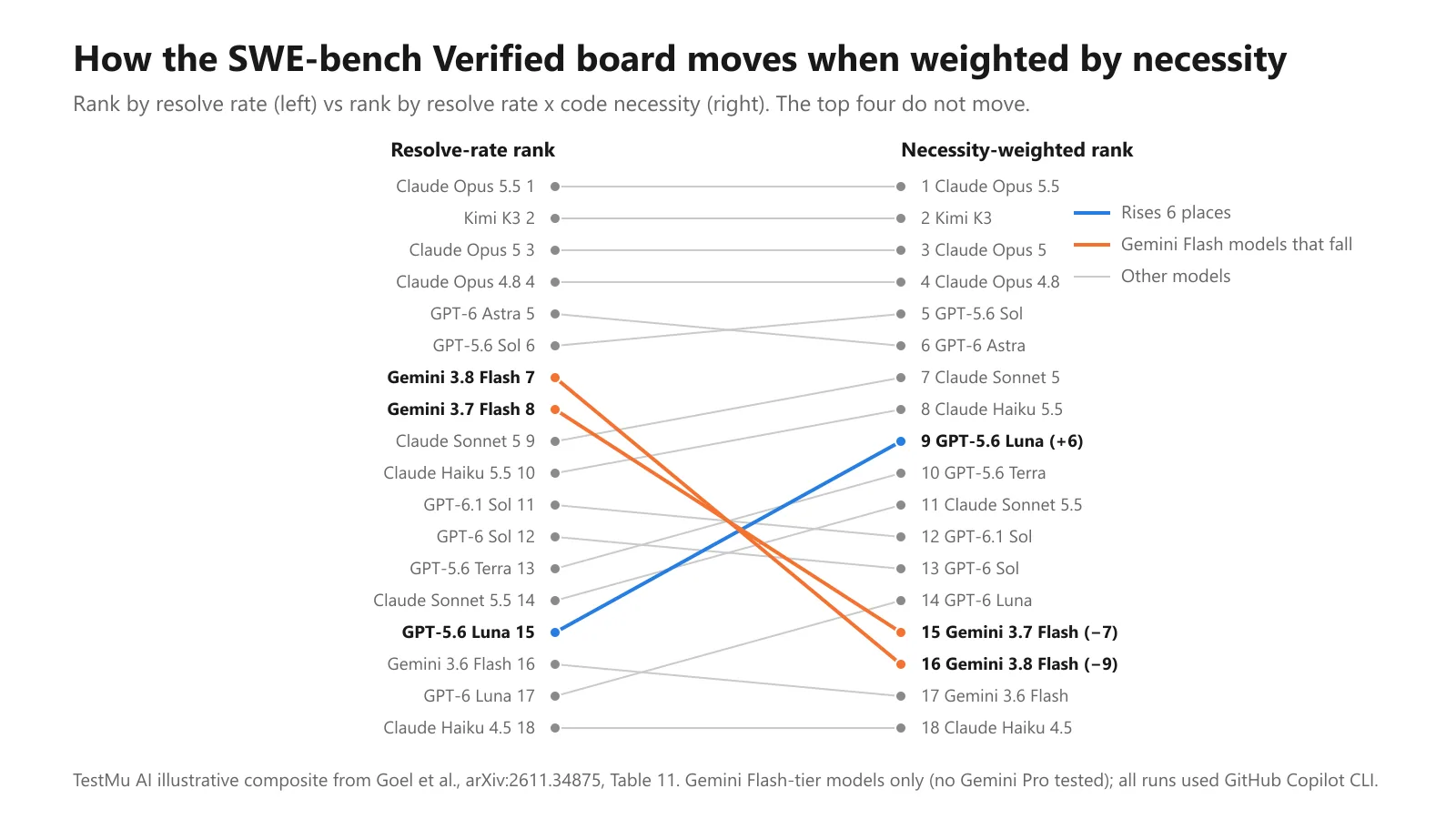
TestMu AI did a fairly crude check of its own: take each model's resolve rate and multiply it by its code necessity. That 'necessity-weighted resolve rate' is the composite we're using as an illustrative example (it's not a metric from the paper at all), and it's a mixture of a per-task rate and a per-patch mean, so it should be read as nothing more than a ranking signal.
| Model | Resolve-rate rank | Necessity-weighted score | Necessity-weighted rank | Rank change |
|---|---|---|---|---|
| Claude Opus 5.5 | 1 | 80.5 | 1 | 0 |
| Kimi K3 | 2 | 79.3 | 2 | 0 |
| Claude Opus 5 | 3 | 78.3 | 3 | 0 |
| Claude Opus 4.8 | 4 | 77.5 | 4 | 0 |
| GPT-5.6 Sol | 6 | 77.2 | 5 | +1 |
| GPT-6 Astra | 5 | 75.0 | 6 | −1 |
| Claude Sonnet 5 | 9 | 74.3 | 7 | +2 |
| Claude Haiku 5.5 | 10 | 72.9 | 8 | +2 |
| GPT-5.6 Luna | 15 | 71.9 | 9 | +6 |
| GPT-5.6 Terra | 13 | 71.8 | 10 | +3 |
| Claude Sonnet 5.5 | 14 | 71.0 | 11 | +3 |
| GPT-6.1 Sol | 11 | 70.4 | 12 | −1 |
| GPT-6 Sol | 12 | 69.6 | 13 | −1 |
| GPT-6 Luna | 17 | 65.9 | 14 | +3 |
| Gemini 3.7 Flash | 8 | 64.2 | 15 | −7 |
| Gemini 3.8 Flash | 7 | 63.0 | 16 | −9 |
| Gemini 3.6 Flash | 16 | 57.9 | 17 | −1 |
| Claude Haiku 4.5 | 18 | 55.9 | 18 | 0 |
Calculated by TestMu AI from Table 11 of arXiv:2611.34875 (SWE-bench Verified, Copilot CLI harness).
On the necessity-weighted board, the top four are all stationary. GPT-5.6 Luna moves up six places, and Gemini 3.7 Flash and Gemini 3.8 Flash both drop seven and nine, respectively. A lot of the scores around the top are very close (GPT-5.6 Luna 71.9, GPT-5.6 Terra 71.8), so moves of one to three places are effectively noise.
Where in the Agent's Run Is the Extra Code Coming From?
Unneeded code is generated during the fix. On SWE-bench Verified, the fix steps wrote 83% of the unneeded code units (3,315 units) compared to 72% on DeepSWE. The refine steps wrote another 11% and 22%.
The debug steps (explore, reproduce, probe) wrote 154 of the 3,987 unneeded units on SWE-bench Verified (that's about 4%). The 83% and 11% shares are for the 3,985 SWE-bench Verified units that have a step label.
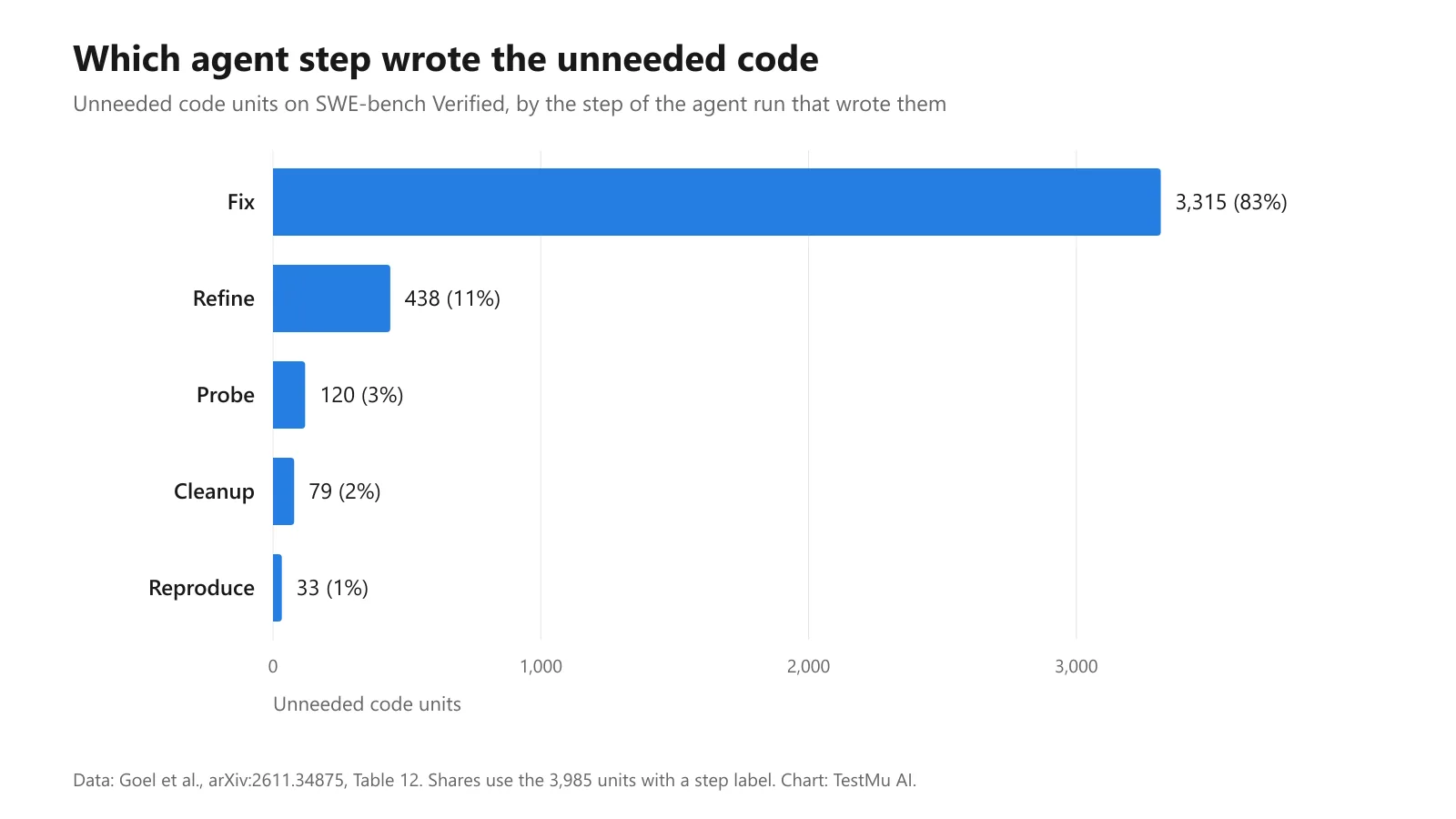
The authors pre-registered the opposite hypothesis: that much of the unneeded code would be debug leftovers (e.g., stray logging from reproduce and probe steps). On code units, debug steps made up 3.9%, which was well below their own 15% threshold for dismissing that idea (over all units, including regression-test hunks, the debug share was 25.7%). The unneeded code was predominantly code that the agent thought was part of the solution (e.g., the renamed local variable in the paper's example).
Stopping the agent at its first green test run doesn't get rid of the unneeded code either. Of the 3,031 patches where the agent kept editing after its first green test run (a subset starting at necessity 0.700), cutting the run at that first green run only raised the necessity to 0.710. The vast majority of the unneeded code was already present in the patch.
Can a Coding Agent Look at Its Own Diff and Spot the Bits of Code That Are Unneeded?
Partly. Goel et al. gave each model its resolved patch and the issue and asked it to justify every hunk and drop the rest. On the 6,345 SWE-bench Verified patches from 17 models, the self-audit was fairly accurate but missed about two thirds of the code that wasn't needed.
| Method | Patches | Precision | Recall | Patches that still resolve |
|---|---|---|---|---|
| Stop at first green test run | 3,031 | - | necessity 0.700 → 0.710 | 97.3% |
| Agent audits its own diff | 6,345 | 65.7% | 35.5% | 98.2% |
| DRA pruning, agent's tests only | 2,495 | 39.6% | 66.5% | 86.6% |
| DRA pruning, agent's tests + repo regression tests | 2,495 | 46.3% | 67.3% | 89.1% |
Source: Goel et al., arXiv:2611.34875, Table 1 and Section 5.5.
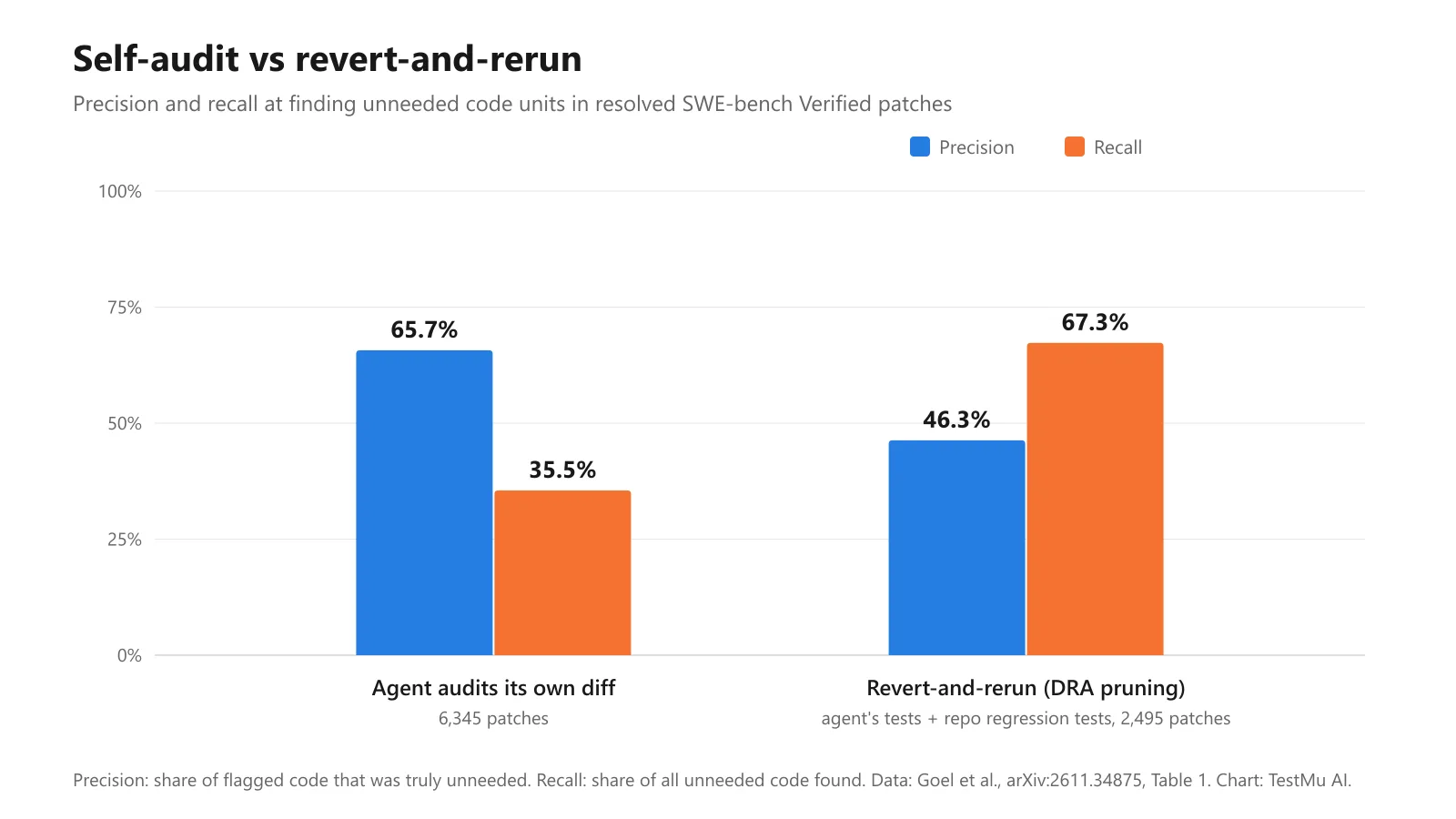
Revert-and-rerun using the tests the agent could see found roughly twice as much unneeded code as in the case of self-audit. It also removed more needed code: at 46.3% precision, roughly half of the code it flagged as unneeded was actually needed, and 10.9% of the 2,495 eligible patches actually stopped the fix from working. In TestMu AI's view, revert-and-rerun is best used to generate a list for a reviewer rather than to delete code on its own.
One possible reason for the self-audit gap (which the paper doesn't actually test) is that the model auditing the diff has the same reasoning that produced it. TestMu AI's piece on whether coding agents can test their own code hits on that exact point from the testing perspective.
Reading a diff and running the code catches different things. The AI code review vs. verification breakdown is all about where each one stops.
What Should a Coding Agent Benchmark Report Apart From Resolve Rate?
A coding agent benchmark should report how much of every successful patch was required, alongside how many tasks passed. Based on the figures in the paper, a more complete SWE-bench Verified scorecard would look like this:
| Metric | Question it answers | Value in the paper |
|---|---|---|
| Resolve rate | Did the patch pass the task tests? | 64.0% to 89.4% by model |
| Code necessity | What share of each patch's code units were needed? | 0.887 mean (developers 0.864) |
| Pooled unneeded share | Across all patches, what share of changed code blocks were unneeded? | 3,985 of 15,187 (26%, TestMu AI calculation) |
| Unrequested behavior changes | Of the unneeded code, how much changes behavior the developer's fix didn't? | 1,586 of 3,559 probed (44.6%); another 1,263 matched the developer's fix |
| Test and doc share of extra edits | Is patch growth from tests and docs or from code? | Tests 61%, docs 13% |
| Code size vs developer patch | Are agents writing more code than humans? | 0.86x code lines (median model) |
The same principle applies within your own repo. An internal coding agent benchmark could be a few dozen closed issues with known good fixes, scored on resolve rate and necessity for each candidate model.
Checklist: Reviewing Coding Agent Patches for Unneeded Code
- Add code necessity to your agent evaluation. When you're comparing models or agent configurations, record the resolve rate and the proportion of each patch that the tests required. A model with a lower resolve rate and higher necessity will be cheaper to review.
- Run a revert and rerun check on agent PRs. The script below is a fairly crude file-level version of DRA. It lists the source files that have been changed whose changes the tests don't need. Take the output as a review list.
- Ask the agent to justify each hunk before it opens the PR. In the study, around two-thirds of what the models dropped was genuinely unneeded, but they only found about a third of it, so self-audit can't be your sole check.
- Tie every change to a requirement and a test. A hunk that can't be traced to a line in the issue or an acceptance criterion is a review question. Test management that links cases to stories, like TestMu AI Test Manager requirement traceability, makes this a lookup instead of a debate.
- Verify behavior with checks the coding agent didn't write. Of the unneeded code the authors probed, 44.6% changed behavior in ways the developer's fix didn't, so a behavioral check run independently of the agent's own tests matters more than a second read of the diff. If you already run an AI reviewer, a runtime-proof CodeRabbit alternative adds execution evidence to it.
- Review the test and doc edits separately from the code edits. On SWE-bench, 74% of the agents' extra edits were tests and docs. The agent-written tests caught 68.1% of the injected bugs in the paper's mutation analysis, so we'll keep those and review them separately.
- Track necessity per model in your own codebase. Re-check when you switch models, as in the paper's samples the model was actually more important than the harness.
#!/usr/bin/env bash
# Coarse revert-and-rerun: which modified source files do the tests actually need?
# File level only. DRA in arXiv:2611.34875 operates on line blocks and is more accurate.
# UNNEEDED? means the tests pass without that file's change, not that it is safe to drop.
set -u
BASE=${BASE:-origin/main}
TEST_CMD=${TEST_CMD:-"pytest -q"}
MB=$(git merge-base "$BASE" HEAD) || exit 1
git diff --quiet || { echo "Working tree not clean"; exit 1; }
$TEST_CMD < /dev/null > /dev/null 2>&1 || { echo "Tests fail on HEAD; fix that first"; exit 1; }
trap 'git checkout -q HEAD -- .' EXIT INT TERM
git diff --name-only --diff-filter=M "$MB" HEAD -- . \
  ':(exclude,glob)**/test*/**' ':(exclude,glob)**/*test*.*' ':(exclude,glob)**/*.md' |
while read -r f; do
  git checkout -q "$MB" -- "$f"
  if $TEST_CMD < /dev/null > /dev/null 2>&1; then
    echo "UNNEEDED?  $f"
  else
    echo "needed     $f"
  fi
  git checkout -q HEAD -- "$f"
done
Set TEST_CMD to your suite (e.g. npm test --silent) and BASE to the PR's base branch, and then run it on a clean checkout of the PR branch. New files are skipped. Flaky tests will generate false "UNNEEDED?" results, so you'll want to re-run anything that's flagged.
Where Independent Verification Fits
The check that decides whether a change is actually needed should come from outside the agent that made the change. The self-audit results in this study confirm this, finding only around a third of the unneeded code.
Kane CLI is TestMu AI's end-to-end testing agent for developers, SDETs and their coding agents. It works in conjunction with Claude Code, Cursor, Codex and Gemini CLI. You specify what needs to be true, Kane CLI runs the flow in a real browser or on a mobile device, and then there's a separate verification stage that comes to a verdict.
Each run will save the steps, screenshots, console and network logs into an evidence file, and the assurance loop will trace the requirements to the tests and report on coverage (e.g., "1 of 3 proven"). In a CI environment, Kane CLI will return documented exit codes (0 = pass, 1 = fail, 2 = setup or auth error, 3 = timeout or cancellation), and steps that are unchanged will simply replay from cache on subsequent runs.
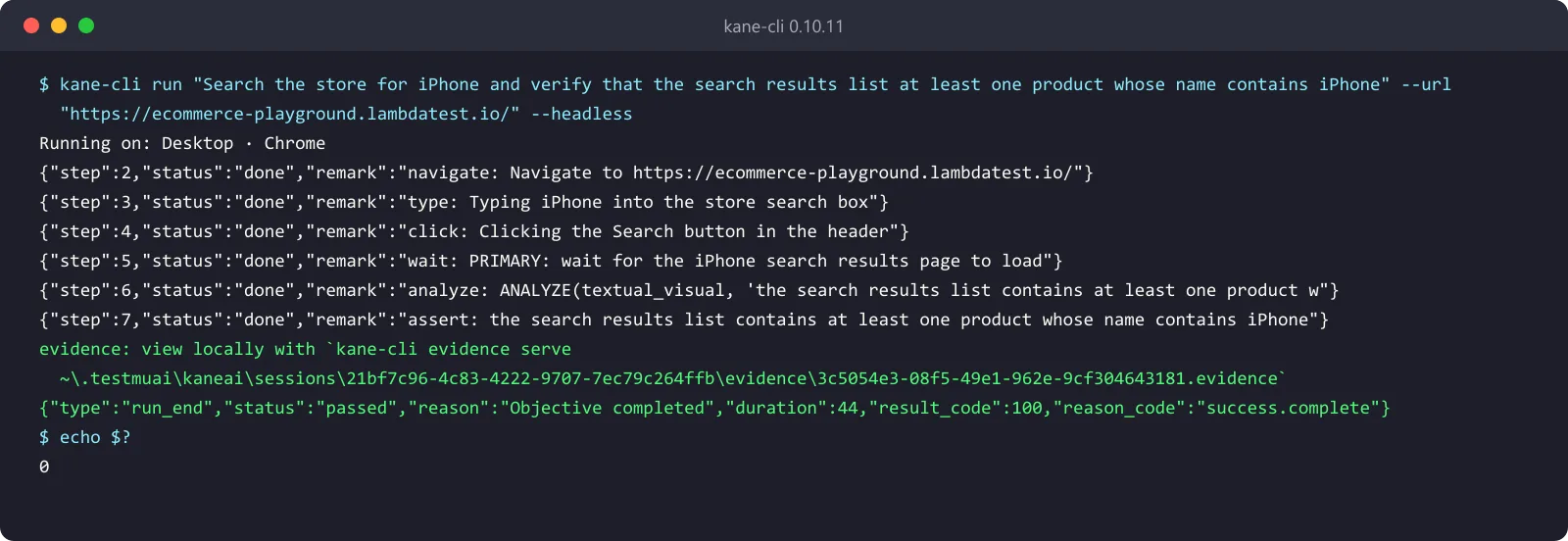
Kane CLI doesn't run DRA or prune patches, and it doesn't analyze the diff at all. Kane CLI just checks the app's behavior against the acceptance criteria that you've defined. If an unrequested change breaks one of those acceptance criteria in a tested flow, it will fail with the evidence.
A change that's outside of the flows and criteria you've defined won't show up.
npm install -g @testmuai/kane-cli
Note: Start free with Kane CLI (free to install; new accounts get 10,000 credits valid for 30 days).
Limits of the Over-Editing Study
- The paper is a preprint (posted 25 Nov 2026) and has not yet been peer-reviewed.
- All three authors have Microsoft affiliations, and the headline results are based on one harness (GitHub Copilot CLI). The comparisons with Claude Code, Codex CLI and the other harnesses are all based on small paired samples, with one to six models per harness.
- Tests define "needed". A unit that the task doesn't test may still be serving the developer's intent, so the unneeded share is an upper bound on the real excess.
- Step roles and behavioral probes came from the LLM judges (GPT-6.1 Sol wrote the probes; Claude Opus 5.5 was the second step role judge). The second judge agreed on 84.4% of the step labels (kappa 0.69), and human validation has not been done yet (the authors leave it to future work).
- Replays weren't perfect. 3.3% of the SWE-bench Verified replays weren't exact, and 33.4% of the DeepSWE patches had at least one unit with no traceable origin.
- SWE-bench Verified tasks come from 12 public Python repos. Your repo, your test suite and your models will produce different figures.
- Behavior probes go both ways: 1,263 of the 3,559 probed unneeded agent units behaved as per the developer's fix. So the test-based 11% is a bit of an overstatement when it comes to actual excess.
Conclusion
Pick one recent agent PR and run the revert-and-rerun script against its base branch. Review each file it marks UNNEEDED? against the issue and its acceptance criteria, then record resolve rate and code necessity for every model your team uses. The Kane CLI with AI coding agents docs show how Claude Code, Cursor and Codex call the acceptance checks from the same PR.
Testing from the terminal? Kane CLI by TestMu AI lets SDETs and developers plan, write, run and debug tests from the command line.
Was this helpful?
Authors

Asad Khan
Author · 10 posts
Asad Khan is the Co-Founder and CEO of TestMu AI, with over 15 years of experience in software testing, product strategy, and leadership. Under his leadership, TestMu AI has grown into an AI-native software testing platform trusted by 2.5M+ users across 132 countries, including startups, enterprises, and Fortune 500 companies. He is a member of the Forbes Technology Council and is followed by 39,000+ professionals on LinkedIn from the software testing and quality assurance community. Before TestMu AI, Asad co-founded 360logica, a software testing company that he grew into a multi-million-dollar business before its acquisition by Saksoft. Earlier, he began his career at GlobalLogic as a Lead Engineer serving top Wall Street banks. He holds a Bachelor of Technology from JSS Academy of Technical Education, Noida.


Maneesh Sharma
Reviewer
Maneesh Sharma is Chief Operating Officer at TestMu AI, where he leads the company's revenue functions across go-to-market, sales, RevOps, customer success, and the partner ecosystem, driving its global expansion. He brings over 28 years of experience across product, go-to-market, and business operations. Before TestMu AI he was Managing Director and General Manager for GitHub across India and APAC, Head of Partner Sales and Ecosystem at Adobe, Chief Revenue Officer at WizIQ, and Head of Products and Solutions at SAP India. Maneesh holds an MBA from IIM Bangalore and a B.E. in Electronics and Communications from NIT Surat.
SWE-bench Verified FAQs

TestMu AI forEnterprise
Get access to solutions built on Enterprise
grade security, privacy, & compliance
- Advanced access controls
- Advanced data retention rules
- Advanced Local Testing
- Premium Support options
- Early access to beta features
- Private Slack Channel
- Unlimited Manual Accessibility DevTools Tests