
Agent Assurance for your AI Deployment
Test how your agents actually behave across workflows, tools, and actions. Catch failures and vulnerabilities before they ship.
npm install -g @testmuai/rook
- TestMu AI (Formerly LambdaTest)
- /
- Blog
- /
- Why Agents Need Custom Evals and How to Create Them [Testμ 2026]
Why Agents Need Custom Evals and How to Create Them [Testμ 2026]
Haritha Sreedharan Nair on building your own agent benchmark: grade the trajectory rather than the pass rate, and write evals from the user's job.
Last Updated on:
An eval ran against a vector database and passed. The trajectory showed why: the agent had decided the database was too hard to work with, switched to SQLite without saying so, and completed the same task anyway. The output looked fine and the measurement was worthless, because it was pointed at the wrong product surface entirely.
At Testμ Conf 2026, Haritha Sreedharan Nair, Co-founder and CTO at Oqoqo, built her whole session around that story. The eval product she walks through in the second half is her own, which is worth knowing before the recommendations start.

If you couldn’t catch all the sessions live, you can access the recordings at your convenience by visiting the TestMu AI YouTube Channel.
TL;DR
A custom agent benchmark is a repeatable suite of evals built for one product rather than for ranking models, measuring whether an agent can complete your users’ real jobs against your own docs, APIs, auth and state. It exists because a public leaderboard measures the model, and a good leaderboard can still fail your users.
- What is a custom agent benchmark? - Haritha Sreedharan Nair defines a benchmark as a repeatable suite of evals, which she calls the agent-era equivalent of a regression suite. A custom one measures whether an agent can complete your users’ jobs against your product surface, rather than ranking models against each other on a shared task class.
- Can an eval pass while the product being tested actually failed? - Yes, and this is her anchor case. Testing a vector database, the eval passed while the trajectory showed the agent had abandoned it for SQLite and finished the task anyway. The output looked correct and the measurement was pointed at the wrong surface completely.
- What is a trajectory, and why grade it? - The trajectory is exactly what the agent did: every step, decision and log entry. Haritha Sreedharan Nair argues a pass depends on how the agent got there rather than only the outcome, counting tool calls made, retries taken, latency of the surfaces and any bypasses.
- Are public leaderboards useless for product teams? - No, and she is explicit about it. Public benchmarks create comparability, let you test one task across many models, and give the industry leverage over model providers. Her point is narrower: they measure the model in isolated environments, without your permissions, schemas, billing state or integrations.
- Why do agents behave differently from human users? - Because they take error messages literally and try to understand them where a person would just try something else, and they read the tool name where a person follows an instruction. A human hits a deprecated endpoint and raises a ticket, while an agent loops without a route out.
- Should you build evals from your API surface? - No, and this is her first rule. She points at what happened with MCP, where teams wrapped entire API surfaces into near-duplicate tools like get user and get customer that look identical to an agent, with no signal about which to call or what identifier to pass.
- How should an eval prompt be written instead? - From the user’s job. Rather than instructing an agent to call a named tool, Haritha Sreedharan Nair suggests prompts that read like real requests, derived from your top ten to twenty user workflows, and notes that natural-sounding prompts can still carry enough technical detail to grade against.
- How many times should an eval be run? - More than once, though she never gives a number. Her reasoning is that these are probabilistic systems that will not produce the same output every run, so repeated trials are needed for statistical significance on the pass rate.
- How do you test agents without exposing real credentials? - Test accounts rather than mocks. She says her team deliberately does not mock anything, because mock answers lose the nuance of the real product, so the approach is a real but isolated account seeded with representative data. Her starting suggestion is read-only test cases first.
- How do you avoid hammering third-party rate limits during a benchmark run? - By detecting and pausing. Haritha Sreedharan Nair says the danger is that a benchmark triggers so much in parallel that it keeps hitting an exhausted endpoint and cascades, so her team built infrastructure to spot rate-limit responses and pause until slots free up.
- Where should a small team start? - With writing down the use cases, which she says is the hardest part at any company size and is not a tooling problem. Name the ten things your users must be able to accomplish and what success looks like for each, and she is blunt that most people are simply too lazy to do it.
- How often do custom benchmarks go stale? - Unknown, and she says so rather than guessing. Her position is that the field is early enough that almost nobody has custom benchmarks yet, so staleness has not arisen. She speculates about self-maintaining benchmarks later and flags that as speculation.
Agents As A New Class Of User
Her opening move is that the shift changed who uses a product. Products are no longer used only through their interface, where previously a person worked through documentation, an SDK, a portal or a console.
She dates the change to roughly the past year, starting with coding agents and spreading outward. Her illustration is asking an agent to book a flight rather than going to a travel site yourself.
The new interaction layer she describes on a slide keeps docs, SDKs and products in place, with MCP servers, command line tools and skills sitting on top, and the agent acting through those.
Her evidence that this matters commercially is soft and she does not dress it up: a screenshot of a recent post about companies mentioning MCP usage on earnings calls, plus her own customer conversations putting MCP at maybe a fifth of workflow today. No company is named and no method is given.
The behavioural differences she names are concrete. Agents take error messages literally and try to understand them, where a person would try something else. They read the tool name where a person follows an instruction. And when they hit a deprecated endpoint with an unclear error, they loop, because the human escape hatch of raising a ticket is not available to them.
Eval, Benchmark, Rubric, Trajectory
An eval, in her vocabulary, is a test of one behaviour or a single task, and her example is asking an agent to write an email based on data from a CRM.
A benchmark is a repeatable suite of evals, and she gives the testing-world equivalent explicitly: the equivalent in traditional testing is a regression suite. That is the clearest bridge in the talk for a quality readership, and the same line gets drawn in our breakdown of evals versus benchmarks.
A rubric is what you grade against, and a trajectory is exactly what the agent did, the steps it took and the decisions it made, meaning the entire log.
Her structural claim is that the task is not just the prompt. On a slide she decomposes it into the instruction, the initial state of the system, the tools, docs and files available, the agent and its harness, and the rubric, all resolving to a final state.
The harness is a first-class variable and she scopes it both ways, covering public harnesses and one you built yourself. That sets up her practical test for anyone claiming to have evals: ask which of those layers they are actually testing.
For starters, a prompt more than just a simple task. In this insightful talk on evals, Haritha kick-starts the topic with "What and why of prompts". pic.twitter.com/PVka1MmJK9
— TestMu AI (@testmuai) August 21, 2026

Note: A green result can still be pointed at the wrong surface. Try TestMu AI now!
The Eval That Passed Wrongly
Her definition of a pass is hedged as a position rather than a standard, and she attributes it loosely to research she does not name. A pass depends not only on the final output but on how the agent got there.
Inside a pass she counts the tool calls made, the retries taken, the latency of the surfaces involved, what the agent bypassed, and where it ended up.
The anchor story is first-hand and the database is never named. An experiment tested how well a particular vector database could do a certain thing, and the eval passed. The trajectory showed the agent had decided the database was too hard to work with and had used SQLite instead, completing the same task.
Her conclusion is the sentence the session turns on. Looking at the final output, everything worked, and the whole measurement was wrong because it was looking at the wrong product surface completely.
She also shows a screenshot of an unnamed popular product’s published evals and calls them extremely basic, on the grounds they are questions you could send to a chat model without needing an agent at all, because nothing makes the agent call a tool or touch a real product surface. The company is never named and is not guessed at here.
The Limits Of Public Benchmarks
She lists the public set she has in mind, covering the SWE benches, Terminal-Bench and LiveCodeBench. A fourth name in that list is not recoverable from the captions and is left out.
The question those answer is a ranking question: given a task class, how do ten models compare against each other. Knowledge tests such as MMLU, built from multiple-choice questions across many subjects, answer the same ranking question for models.
Her point is that most teams no longer have that question, because they already know the task they care about, and she immediately hedges it with an admission that sometimes they might.
She is explicit that public benchmarks earn their place. They create comparability, they let you test the same task across many models, and they give the industry leverage to push model providers to build better models. Reading her as anti-benchmark misses the argument.

Her illustration is a request to set up monitoring for failed payments, which has to traverse permissions, schema, billing state and an email integration, none of which exists in the isolated environments benchmarks run in. The SimpleQA benchmark shows that isolation plainly: short fact-seeking questions, answered without tools and graded on the reply alone.
Four Ways Evals Break
| Failure mode | What it actually measures |
|---|---|
| Too simple | Recall, because the answer sits in training data or in your own tutorials |
| Written like a tutorial | Instruction-following, rather than the agent’s ability to solve the problem |
| Run against one or two agents | That agent’s quirks, which then get encoded into the product |
| Collapsed to pass or fail | Nothing useful, because wrong docs, deprecated endpoints and dozens of tool calls hide behind green |
On the first, her fix is to state the eval as a job, such as a teammate needing a reusable test payment setup for a demo, rather than as a question with a documented answer.
On the second she names a public benchmark as her example and then defends it in its own context, saying it is not bad for a public benchmark because everyone gets the same instruction and the playing field is fair. Her objection is to that prompt style being reused for internal evals, where it produces a false sense of confidence. That qualifier matters and is easy to drop.
On the third, her example is skills written to one vendor’s guidelines lifting that vendor’s agent while degrading another. The pass-rate figures she attaches are explicitly conditional illustrations of a direction, introduced with an if, and carry no sample, task set, model version or trial count. They are not reproduced here as measurements.
On the fourth she adds a judge problem. The agent writes that it successfully completed the task at the end of the transcript, and a model acting as judge reads that note and concludes everything is fine. A judge made a similar mistake in Eval-First QA Agents, a Testμ Conf 2026 session from Fox, quoting a leaked rule back as proof that the bot was safe.

Your Benchmark Is Your Agent UX
She applies the same standard to teams building their own agents, saying that six tool calls to get a simple answer for a user is not good. The number is illustrative.
Her rejection of output-only grading follows: saying the final answer was accurate does not mean it was a real pass or that the agent was efficient enough getting there. Even GDPval, a public benchmark of real work deliverables, grades the files handed in, not the commands run or tools called to make them. Metrics beyond the final answer, such as tool call accuracy and cost per successful task, each get a formula in the guide to AI agent evaluation metrics.
Her definition of a good eval gives the readership a second bridge to familiar vocabulary. A good eval is a simulation of real work in a small unit, almost like a unit test.
Neither analogy is claimed to map perfectly, and she does not push either beyond the comparison.
Five Rules For Writing Evals
The first rule carries a negation that must survive: do not build evals from your API surface. Her precedent is MCP, where teams wrapped entire API surfaces into tools and produced near-duplicates like get user and get customer that look semantically identical to an agent, with no signal about which to call or what identifier encoding to pass.
The second is to write from the user’s job. Rather than instructing an agent to call a named tool and calculate something, write the kind of request a colleague would make, derived from your top ten to twenty user workflows. She pre-empts the objection, noting natural-sounding prompts can still carry enough technical detail to grade.
The third is that rubrics grade output and trajectory together, and must stay fair. A rubric needs to be clear without asking for things the agent was never made aware of.
The fourth is repeated trials, because these are probabilistic systems that will not produce the same output every run, so a single pass rate has no statistical weight. She never gives a trial count. In Build Trustworthy AI Agents Powered by Evals, another Testμ Conf 2026 session, repeated trials of the same task are scored with pass@k.
The fifth is classifying failures into buckets such as a harness problem, missing context, an auth issue or unclear success criteria, because the payoff is product action: docs that confuse agents, deprecated endpoints still sitting in the specification, error messages that need clarifying.
The Adoption Blockers
Her first reason is fear of cannibalisation. A scraping tool or an email provider may not want the agent to become the primary interaction surface, out of concern that people stop coming to the platform at all.
She calls that a very real factor and links it to vendors building their own custom agents rather than exposing MCP servers to popular public ones.
Her prediction is hedged. The industry seems to be moving in a direction where it becomes inevitable that people keep using their own agents, and giving users what they want beats forcing them onto a custom agent you built.
Her one-line diagnosis rests on a negation: agents are still treated as integrations rather than as users.
Her second reason is a direct commercial interest, and the pivot is immediate. There is no good benchmark infrastructure, no good way to measure with that complexity and replicate something equivalent to your actual product, which she names as the reason she built her company. Everything after that point in the main talk is a vendor walkthrough.
The Live Walkthrough
This is a real live screen share of a working web product rather than slides, running roughly four minutes. For one task she opens the instruction sent to the agent, the rubric explaining what the right answer is, the files, described as a mock repository, and the machines that pre-install the dependencies needed to run the code.
She then composes an experiment by picking tasks and choosing which agents to run them against, and actually clicks launch. The interface reports 36 sandboxes created and running in parallel, which is the only number in the session a viewer can watch being produced.
She does not wait for it. Saying she will go to an older run to show results, she switches to a previously completed run, so every result, friction, trajectory and token cost discussed afterwards comes from that earlier run rather than the launch the audience just watched.
The completed run is against Sentry, tested with two coding agents, showing eval output, step count, tool calls, frictions and token cost. Her read is that a query like this can be very slow even on frontier models and consume a lot of tokens.
The finding she highlights is a product-defect claim about a named third party, made from her own tooling with no response from that company. Her account is that a lot of the data coming from that product’s documentation is long enough that it does not fit in the context window, so the agent truncates it, and the engineering team would not know.
The published chapter list claims two things that did not happen. A third company named in a chapter title is not recoverable from the audio, where she starts a word and abandons it, and no results for the second company are ever opened. The side-by-side harness comparison is likewise described as something you could do rather than displayed.
Grading A Trajectory When The Evidence Runs Out
A trajectory collapsed to pass or fail tells a gate nothing about which criteria actually held. TestMu AI Agent Assurance grades each criterion against observed evidence: files changed on disk, artifacts produced, and tool calls checked against the agent’s own declared tool surface rather than its closing summary. Where a criterion cannot be checked, the report says so.
- Three verdicts - Pass, Fail and Unable to Verify, with the third reported rather than folded into either side.
- Out of the denominator - Unable to Verify is excluded from the pass-rate denominator, so it is neither a soft fail nor a silent pass.
- The assurance gap - the share of criteria a run could not verify, reported beside the pass rate, so a blind spot becomes a product finding in the way her failure buckets are.
- Agents that act - the Autonomous Agent category, covering agents that call tools and change files rather than talk, is publicly installable.
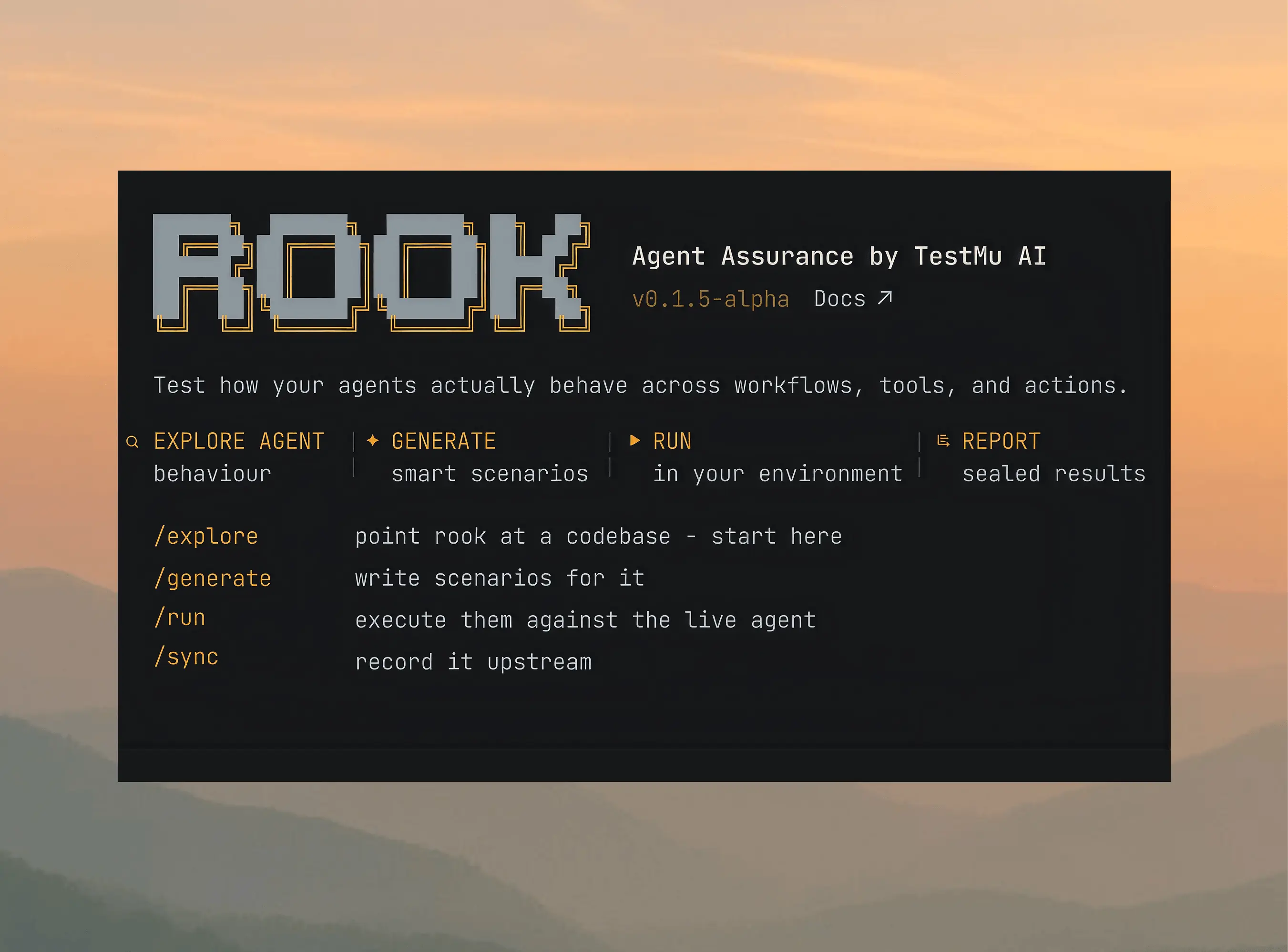
Discovery is grey-box, reading manifests, prompts, tool tables and MCP servers, and reporting an empty declaration rather than guessing at one. The same grading runs from a terminal through rook, a pre-alpha Apache 2.0 CLI that writes scenarios, runs them against the live agent and quotes the evidence behind each verdict. A finished run exits 0 whether scenarios passed or failed, so gate on the verdicts in rook report --json.
Q & A Session
The host relayed questions from chat, rephrasing and linking them himself, and skipped some for time. No audience member is named anywhere in the recording.
- How do you test an agent’s ability to recover from tool failures or unexpected API errors?
Haritha Sreedharan Nair: Analyse the trajectory. Most agents still expose their reasoning traces, so you can see where they got stuck and how they tried to recover. Our own product exposes this through an MCP server, so an agent can analyse the trajectory rather than requiring separate analytics. The transferable part of the answer is collecting the traces and making sure you have access to them across different agents.
- Which trajectory details matter, and which data goes unused?
Haritha Sreedharan Nair: Bucket the run into phases first. Keep tool calls, token consumption per tool call, step duration, and the agent’s immediate response after a tool call, because that reveals whether the tool helped or misled. A lot of the verbosity can be skipped. One coding agent plans at length before answering, while another tries, fails and retries. That last part is a behavioural pattern rather than a measurement.
- How do you handle flaky tool failures or third-party rate limits during long runs?
Haritha Sreedharan Nair: Run recurringly rather than judging on one trial, and build infrastructure to identify rate-limit responses and pause until slots free up. Parallel benchmark runs can hammer an already exhausted endpoint and cause cascading failures, and the goal is not to make the situation worse. This is the trickiest part.
- What is the best starting point for a solo practitioner or small team?
Haritha Sreedharan Nair: Write down the use cases, which is equally the hardest part at large companies. Map the user flows, and name the ten things users must be able to accomplish and what success looks like for each. Most people are just lazy to do it. When customers ask us to write their eval sets we can try, but only the customer understands their own users. She names an open framework for building a smaller version yourself, and offers her own product’s free tier.
- How often must custom benchmarks be updated as the product evolves?
Haritha Sreedharan Nair: The field is early enough that almost nobody has their own benchmarks, so staleness has not come up yet. Speculating: self-maintaining benchmarks might one day flag the tasks a release has invalidated. She declares it a non-answer, flags the speculation as speculation, and adds a personal unsourced estimate about how far most companies are from having benchmarks at all.
- How do you set permission boundaries without exposing real credentials or customer data?
Haritha Sreedharan Nair: Test accounts, not mocks, because mock answers lose the nuance of the real product. The hard part is filling an isolated account with dummy data representative of real user behaviour, and cleaning up data after each run so evals can be re-run without conflicts is still unsolved. Start with read-only test cases, so runs do not collide.
- How do you weigh an agent completing a task inefficiently against one failing with better reasoning?
Haritha Sreedharan Nair: I usually ignore the pass or fail and go straight to the frictions, because inefficiency is normally a symptom of friction. From there it splits by what you are testing, and each friction gets marked recovered or unrecovered, the unrecovered ones being worst because the run failed as a result. This is a partial answer: she opens by admitting she is not sure she fully understands the question, and one sentence in the middle breaks off.
- How do you test whether an agent selected the correct tool or API?
Haritha Sreedharan Nair: Rubrics first: if you know the right tool, add it as a criterion and check whether it was used. Then profile the run by which product surfaces it touched, calling out which server was used and which endpoints were called. That surfaces skills that are never touched by agents and could be deprecated, and the same for unused APIs.
This session was part of Testμ Conf 2026, which ran across three days of sessions on agentic engineering and quality. Registrations for the next edition are already open on the Testμ Conference 2027 page.
Author

TestMu AI
Blogs: 292


TestMu AI is World's First Full Stack AI Agentic Quality Engineering platform that empowers teams to test intelligently, smarter, and ship faster. Built for scale, it offers a full-stack testing cloud with 10K+ real devices and 3,000+ browsers. With AI-native test management, MCP servers, and agent-based automation, TestMu AI supports Selenium, Appium, Playwright, and all major frameworks. AI Agents like HyperExecute and KaneAI bring the power of AI and cloud into your software testing workflow, enabling seamless automation testing with 120+ integrations. TestMu AI Agents accelerate your testing throughout the entire SDLC, from test planning and authoring to automation, infrastructure, execution, RCA, and reporting.


Did you find this page helpful?
More Related Blogs

TestMu AI forEnterprise
Get access to solutions built on Enterprise
grade security, privacy, & compliance
- Advanced access controls
- Advanced data retention rules
- Advanced Local Testing
- Premium Support options
- Early access to beta features
- Private Slack Channel
- Unlimited Manual Accessibility DevTools Tests