
Power Your Software Testing with AI Agents and Cloud
The Native AI-Agentic Cloud Platform to Supercharge Quality Engineering. Test Intelligently and Ship Faster.

- TestMu AI (Formerly LambdaTest)
- /
- Blog
- /
- 5 Best Playwright MCP Alternatives in September 2026
5 Best Playwright MCP Alternatives in September 2026
Compare 5 Playwright MCP alternatives for AI agents, from Chrome DevTools MCP to Kane CLI and Mobile MCP, with tool counts, context cost, and setup commands.
Published on:
Two of the browser MCP servers most often recommended in roundups are no longer maintained. The reference Puppeteer server was archived on 29 May 2025, and Midscene retired its MCP packages outright and now points users at Skills instead. Checking that took an afternoon, and it is the first thing worth knowing before you swap one browser server for another.
The five below were each checked against their own repository or documentation while writing, and I ran two of them locally rather than describing them. They divide on a question that decides most of the outcome: how much of the thinking does the tool do, and how much does it leave to your agent.
TL;DR
The best Playwright MCP alternative depends on where your agent runs. For local browser work, Chrome DevTools MCP is the strongest swap and adds performance tracing Playwright MCP has no equivalent for. If the agent should return a verified pass or fail rather than a page transcript to reason over, Kane CLI by TestMu AI replaces the tool calls with a single plain-English objective.
- Best local swap: Chrome DevTools MCP - live Chrome control plus performance traces and network inspection, with a slim mode that drops the tool surface to three. Runs locally: yes. API key: no.
- Best for agents that need a verdict: Kane CLI by TestMu AI - takes a plain-English objective instead of tool calls and returns a verified pass or fail with video evidence, so no MCP server is configured per client. Exports to Playwright: yes.
- Best for native mobile apps: Mobile MCP - iOS and Android across simulators, emulators, and real devices, driven from the accessibility tree with no image tokens. License: Apache-2.0. API key: no.
- Best for a WebDriver estate: Selenium MCP - 18 tools across Chrome, Firefox, Edge, and Safari, which is wider browser coverage than any other entry here. License: MIT. API key: no.
- Best for staying on Playwright: ExecuteAutomation Playwright MCP - a separate MIT-licensed Playwright server that adds test code generation and API testing to the browser tools.
Tool count is a running cost, not a feature. Every tool a server registers sits in the agent context before any work happens, so a server with 18 tools is not automatically better than one with three.
What Does Playwright MCP Do?
Playwright MCP hands browser automation to an AI agent as a set of callable tools over the Model Context Protocol. The agent does not write Playwright code and run it; it calls navigate, click, or snapshot mid-task, and the browser becomes one more tool in its loop alongside file access or search.
That distinction is the whole reason this category exists, and it is worth separating from the CLI question. A CLI runs when you invoke it; an MCP server sits in the agent context waiting to be called. The setup, tools, and agent workflows for the Microsoft server are covered in the Playwright MCP server guide, and the CLI comparison sits in MCP vs CLI.
Why Look for an Alternative?
Playwright MCP works well on a laptop with a human watching. The reasons teams move off it are rarely that the automation is bad.
- The browser is where the agent is - a local server drives a local Chrome, which stops being available the moment the agent moves into CI or runs as a hosted service.
- Tools cost context - every registered tool occupies part of the context window before the agent does anything, and screenshots consume more.
- Sessions do not persist - a fresh browser each time means logging in again, which is why hosted servers advertise persistent state and stealth handling.
- Private environments need plumbing - reaching staging or localhost from a hosted browser needs a tunnel that a plain local server never had to think about.
The context point is measurable rather than theoretical. Running the Chrome DevTools MCP server locally shows how directly its authors treat it: tool categories can be switched off individually, screenshot format can be forced to JPEG or WebP because those are roughly three to five times smaller than PNG, and a slim mode collapses the whole surface to three tools.
$ npx -y chrome-devtools-mcp@latest --help

  --slim                  Exposes a "slim" set of 3 tools covering navigation, script
                          execution and screenshots only. Useful for basic browser tasks.
  --categoryPerformance   Set to false to exclude tools related to performance.  [default: true]
  --categoryNetwork       Set to false to exclude tools related to network.      [default: true]
  --categoryEmulation     Set to false to exclude tools related to emulation.    [default: true]
  --screenshotFormat      Override the default output format used by take_screenshot.
                          JPEG and WebP are ~3-5x smaller than PNG, which helps reduce
                          context size in AI conversations.  [choices: "jpeg", "png", "webp"]
  --isolated              Creates a temporary user-data-dir that is automatically cleaned up.
  --headless              Whether to run in headless (no UI) mode.  [default: false]
Read that as a design statement rather than a flag list. The server ships with performance, network, and emulation tools switched on, and expects you to turn off whichever ones your agent will never call.
What Are the Best Playwright MCP Alternatives?
The table sorts by the decision that matters first, which is where the browser runs. Tool counts are as documented by each project at the time of writing.
| Server | Drives | Tools | API key | Best for |
|---|---|---|---|---|
| Chrome DevTools MCP | Local Chrome | Category toggles, slim mode of 3 | No | Performance and network debugging |
| Selenium MCP | Local, 4 browsers | 18 | No | Widest browser coverage |
| Kane CLI | Real Chrome, agent-called | One objective, no tool calls | Yes | Agents that need a verdict |
| Mobile MCP | iOS and Android devices | Device, app, interaction, capture | No | Native mobile apps |
| ExecuteAutomation MCP | Local Playwright | Browser plus API testing | No | Staying on Playwright |
1. Chrome DevTools MCP
The chrome-devtools-mcp repository describes this server as letting a coding agent control and inspect a live Chrome browser, naming Claude, Cursor, and Copilot among the clients. It is published under the ChromeDevTools GitHub organization.
Of the five servers compared in this article, it is the only one that hands an agent the profiler, which is why it leads the list for local work.
Key features:
- Performance traces - the agent can record a trace and extract performance insights, which no other server on this list offers.
- Debugging surface - network requests, console messages, and screenshots are all callable, so the agent sees what a developer would.
- Context controls - the help output above lists per-category toggles, a three-tool slim mode, and a configurable screenshot format, each aimed at what the tool surface costs in context.
- Connects to a running Chrome - browserUrl or wsEndpoint attach to an already-open debuggable instance rather than launching a new one.
- Network restriction - blockedUrlPattern and allowedUrlPattern constrain what the browser is allowed to reach during a run.
- Usage statistics default on - Google collects usage data unless you set usageStatistics to false or the CHROME_DEVTOOLS_MCP_NO_USAGE_STATISTICS environment variable.
Best fit for: Local development where the agent needs to explain why a page is slow, not only whether it works.
2. Selenium MCP
Maintained by Angie Jones, this server puts Selenium WebDriver behind the protocol, which buys the one thing every Chrome-based option lacks: Safari. It is the widest browser coverage on this list by some distance.
Key features:
- Four browsers - Chrome, Firefox, Edge, and Safari, with Safari requiring macOS and its own driver configuration.
- Eighteen tools - the mcp-selenium repository lists start_browser, navigate, interact, upload_file, execute_script, frame, alert, and cookie handling among them.
- One-line install - claude mcp add selenium adds it through npx with no account to create.
- Real WebDriver semantics - frames, alerts, and cookies behave the way an existing Selenium suite expects them to.
- MIT licensed - free to use and modify, with no hosted dependency.
Best fit for: Teams with a WebDriver estate, and anyone who needs an agent to touch Safari. Our own walkthrough of the protocol sits in Selenium MCP.
3. Kane CLI by TestMu AI
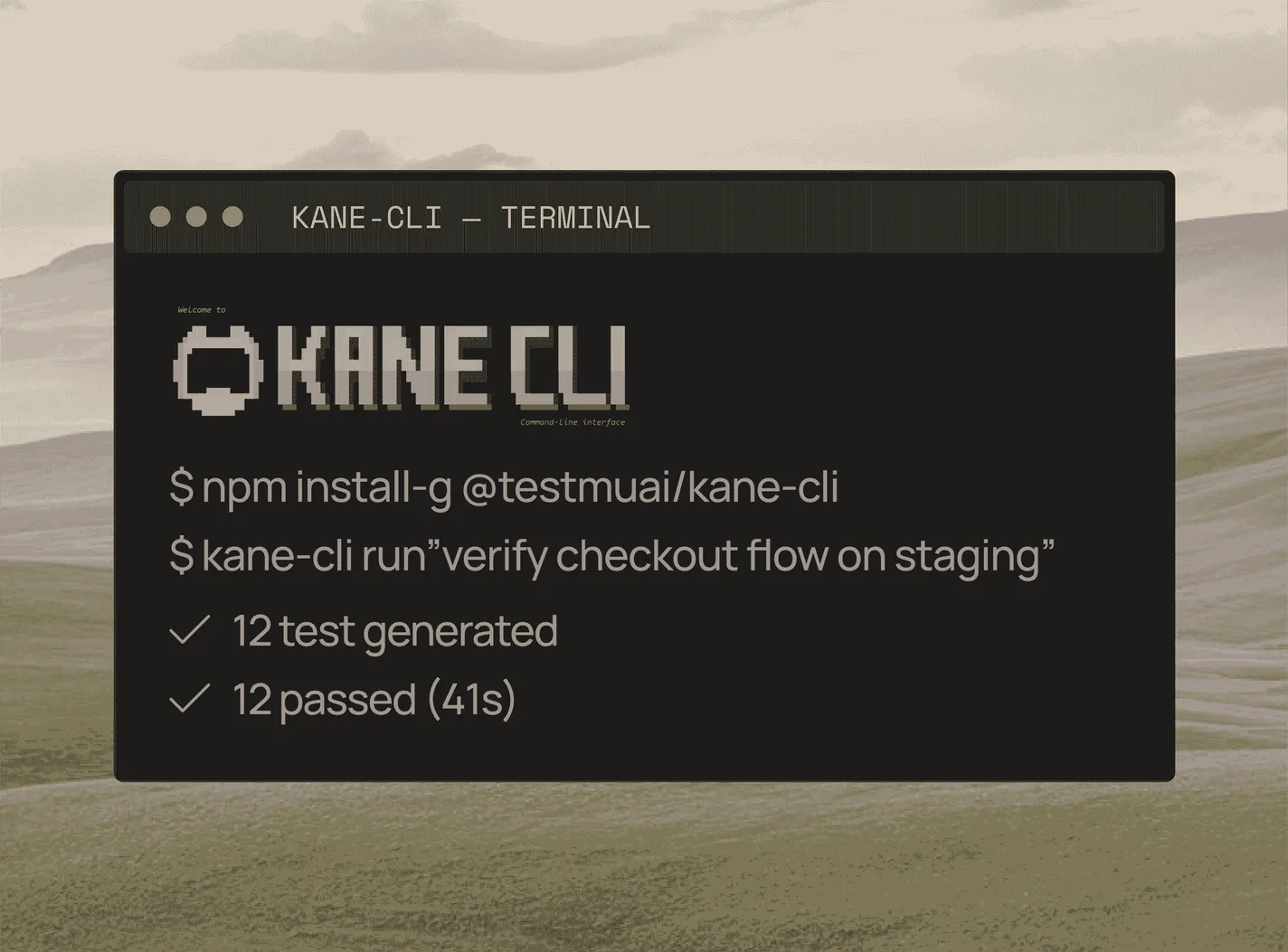
Kane CLI is a browser agent the coding agent calls, and it takes a plain-English objective rather than a sequence of tool calls, so there is no server to configure per client.
The argument Kane CLI makes is about where the reasoning happens. Playwright MCP hands an agent browser primitives and selectors to stitch together, which leaves the agent planning the steps, tracking page structure, recovering stale selectors, and interpreting raw output. Kane CLI moves that work into the tool.
Key features:
- Objectives, not tool calls - the agent passes one plain-English sentence instead of stitching navigate, click, and snapshot together itself.
- No server to configure - it installs as a CLI and as a skill for Claude Code, Cursor, Codex, and Gemini, so there is no per-client MCP configuration to maintain.
- Adapts instead of failing - when the interface moves it re-plans and retries rather than handing a stale selector back to the agent to recover from.
- Returns a verdict, not raw output - a run ends in a verified pass or fail with built-in assertions, video evidence, and a shareable replay link, so the agent does not have to interpret a transcript.
- NDJSON for agents - the agent flag emits one JSON object per event, which is what a coding agent or pipeline parses directly.
- Export to Playwright - a validated flow exports to native Playwright with one command, so choosing it does not strand the work.
- Authoring costs credits - the verification below consumed 16.57 credits while the agent authored it, a cost the local MCP servers here do not have. Save the flow as a test.md and its unchanged steps replay from cache without consuming LLM credits.
Best fit for: Coding agents that should come back with a verdict rather than a transcript to reason over. Setup steps are in the Kane CLI getting started documentation, and a measured side-by-side inside Cursor is in Kane CLI vs Playwright MCP.
Why Choose Kane CLI Over Other Tools?
The other four servers here register a tool surface into the agent context before any work begins, and that surface is the standing cost of having them installed. Kane CLI registers nothing, because the agent calls it as a command and gets back a status field. The chrome-devtools-mcp flags earlier in this article exist to manage that cost, and this is the entry that avoids paying it in the first place.
The run below is real and unedited apart from trimmed file paths. The objective is a negative case, which is the kind of check an agent stitching selectors together tends to get wrong.
$ kane-cli run "Open the Selenium Playground, click Input Form Submit, submit the form with no fields
    filled, and verify a validation message blocks the submission" --agent --headless

{"step":2,"status":"done","remark":"navigate: Navigate to .../selenium-playground/"}
{"step":3,"status":"done","remark":"click: Clicked via DOM locator: internal:role=link[name=\"Input Form Submit\"i]"}
{"step":4,"status":"done","remark":"click: Clicked via DOM locator: internal:role=button[name=\"Submit\"i]"}
{"step":5,"status":"done","remark":"analyze: ANALYZE(textual_visual, 'a validation message blocks submission')"}
{"step":6,"status":"done","remark":"assert: a validation message blocks the submission"}
{"type":"run_end","status":"passed","credits_consumed":16.57,"reason_code":"success.complete",
 "summary":"The form remained blocked and displayed required-field validation, confirming
            that empty submission was prevented."}
No selector was written for that run, and the agent received a status field rather than a page dump to interpret.
4. Mobile MCP
Playwright MCP does not drive native mobile apps, so for that job the alternative is not a better browser server but a different one entirely. Mobile MCP gives an agent iOS and Android through a platform-agnostic interface, covering simulators, emulators, and real devices.
Its design choice is worth borrowing even if you never test mobile. It drives apps from the native accessibility tree rather than from screenshots, which the project describes as fast and cheap because it uses no vision model and no image tokens, falling back to screenshots and coordinates only when it has to.
Key features:
- Accessibility tree first - no vision model and no image tokens on the common path, which is the cheapest way to keep an agent oriented on a screen.
- Four device targets - iOS simulators, iOS real devices, Android emulators, and Android real devices.
- Device and app control - mobile_list_available_devices, mobile_launch_app, mobile_install_app, and mobile_set_orientation cover setup before any interaction.
- Interaction and capture - mobile_click_on_screen_at_coordinates, mobile_swipe_on_screen, mobile_type_keys, plus screenshots, element listing, and screen recording.
- Single-command start - the mobile-mcp repository documents npx -y @mobilenext/mobile-mcp@latest, with no account required.
- Apache-2.0 licensed - permissive, and the project is actively developed.
Best fit for: Any agent whose job reaches a native app, which is the one thing no browser MCP server on this list can do.

Note: Give your coding agent one plain-English objective and get back a verified pass or fail. Try Kane CLI free!
5. ExecuteAutomation Playwright MCP
Not every reason to leave Microsoft’s server means leaving Playwright. This is an independent MIT-licensed Playwright MCP that adds test code generation and API testing to the usual browser tools, which suits an agent expected to leave something behind.
Key features:
- Generates test code - the agent can produce a durable test rather than only performing the actions once.
- API testing alongside the browser - the same server covers requests as well as pages.
- Familiar Playwright behaviour - it runs on Playwright, so page semantics match what your suite already does.
- Standard install - published as @executeautomation/playwright-mcp-server and configured through npx like the others.
- MIT licensed and active - independent of Microsoft’s server, with its own release cadence.
Best fit for: Teams who want a different Playwright MCP rather than a different browser engine, especially when the agent should hand back a test.
Which Browser MCP Servers Are No Longer Maintained?
Two servers that still appear in current recommendations have stopped. Both were checked directly rather than taken from a list, and both matter because adopting either means building on something that will not be patched.
- Puppeteer MCP - the reference server in the Model Context Protocol archived servers repository was archived on 29 May 2025 and is read-only. Its README also warns that the server can reach local files and internal IP addresses.
- Midscene MCP - Midscene retired its MCP packages, naming the web bridge, Android, iOS, HarmonyOS, and computer variants, and now directs users to Skills so coding agents drive it through the platform CLIs. Version 1.9.8 is documented as the last release with MCP support.
The Midscene move is the more interesting of the two, because it is a deliberate choice rather than abandonment. That trade between protocol tools and installed skills is worked through in MCP vs agent skills.

How Do You Choose a Playwright MCP Alternative?
Answer where the agent runs first, because that eliminates most of the list before any feature comparison starts.
- The agent runs on a developer machine and the work is debugging. Chrome DevTools MCP, because nothing else here returns a performance trace.
- The agent runs in CI, where no one is watching a browser. Kane CLI fits, because the agent invokes it as a command and gets a pass or fail back rather than a transcript to interpret.
- The task involves Safari or a WebDriver grid you already own. Selenium MCP is the only entry that covers four browsers.
- The job reaches a native app. Mobile MCP, because no browser server here drives iOS or Android at all.
- Context is tight and the agent already has many tools. Prefer a small surface, or run Chrome DevTools MCP in slim mode with unused categories switched off.
One habit is worth adopting whichever you pick. Check the repository before you wire a server in, because two widely recommended ones have already stopped, and a roundup written six months ago will not tell you that.

Conclusion
Start by writing down what your agent is meant to hand back. If it is debugging evidence from a page, add Chrome DevTools MCP today and turn off the tool categories you will not call. If it is a pass or fail your pipeline can act on, the tool calls are the wrong shape and Kane CLI is the shortlist.
For an agent that should hand back a verified result rather than a transcript, install Kane CLI with npm install -g @testmuai/kane-cli and give it one objective; the Automation MCP server documentation covers the MCP route if you would rather register a server. If you are assembling a wider agent toolkit rather than replacing one browser server, the MCP servers for test automation roundup covers the non-browser pieces such as source control, error tracking, and documentation. With that many servers in play, the roundup of AI agent observability tools compares how each tool follows a run across them.
Author

Chaitanya Sharma
Blogs: 21

Chaitanya Sharma is an AI Product Manager at TestMu AI, where he builds agentic AI capabilities focused on computer vision and multi-modality, moving testing beyond static script execution toward autonomous, agent-driven workflows. Before TestMu AI he shipped 135+ features at Sprinklr for a no-code community and website builder used by Fortune 500 enterprises including Dell, Samsung, and Polestar. At Policybazaar he led the zero-to-one launch of a digital lending and insurance marketplace embedded in Bahrain's dominant payments app, building a risk-intelligence engine that compressed loan-approval times by 80%. He explored machine learning and NLP through research at the University of Cambridge, and holds a B.Tech from Delhi Technological University.
Reviewer

Devansh Bhardwaj
Reviewer
Devansh Bhardwaj is a Community Evangelist at TestMu AI with 4+ years of experience in the tech industry. He has authored 30+ technical blogs on web development and automation testing and holds certifications in Automation Testing, KaneAI, Selenium, Appium, Playwright, and Cypress. Devansh has contributed to end-to-end testing of a major banking application, spanning UI, API, mobile, visual, and cross-browser testing, demonstrating hands-on expertise across modern testing workflows.


Playwright MCP Alternatives FAQs
Did you find this page helpful?
More Related Blogs

TestMu AI forEnterprise
Get access to solutions built on Enterprise
grade security, privacy, & compliance
- Advanced access controls
- Advanced data retention rules
- Advanced Local Testing
- Premium Support options
- Early access to beta features
- Private Slack Channel
- Unlimited Manual Accessibility DevTools Tests