
Power Your Software Testing with AI Agents and Cloud
The Native AI-Agentic Cloud Platform to Supercharge Quality Engineering. Test Intelligently and Ship Faster.

- TestMu AI (Formerly LambdaTest)
- /
- Blog
- /
- Microsoft Scope vs KaneAI: Evaluating AI Coding Agents vs Verifying What They Ship
Microsoft Scope vs KaneAI: Evaluating AI Coding Agents vs Verifying What They Ship
Scope evaluates how AI coding agents use your SDK. KaneAI verifies the app they build actually works. See where DevAx ends, and end-to-end testing begins.
Published on:
Microsoft Scope and KaneAI answer two different questions about AI coding agents. Scope, Microsoft's open-source evaluation platform, measures whether agents like GitHub Copilot and Claude Code can discover and correctly use your SDK, CLI, docs, or MCP server - a discipline Microsoft calls Developer Agent Experience (DevAx). KaneAI, TestMu AI's end-to-end testing agent, verifies that the software those agents ship actually works for your users.
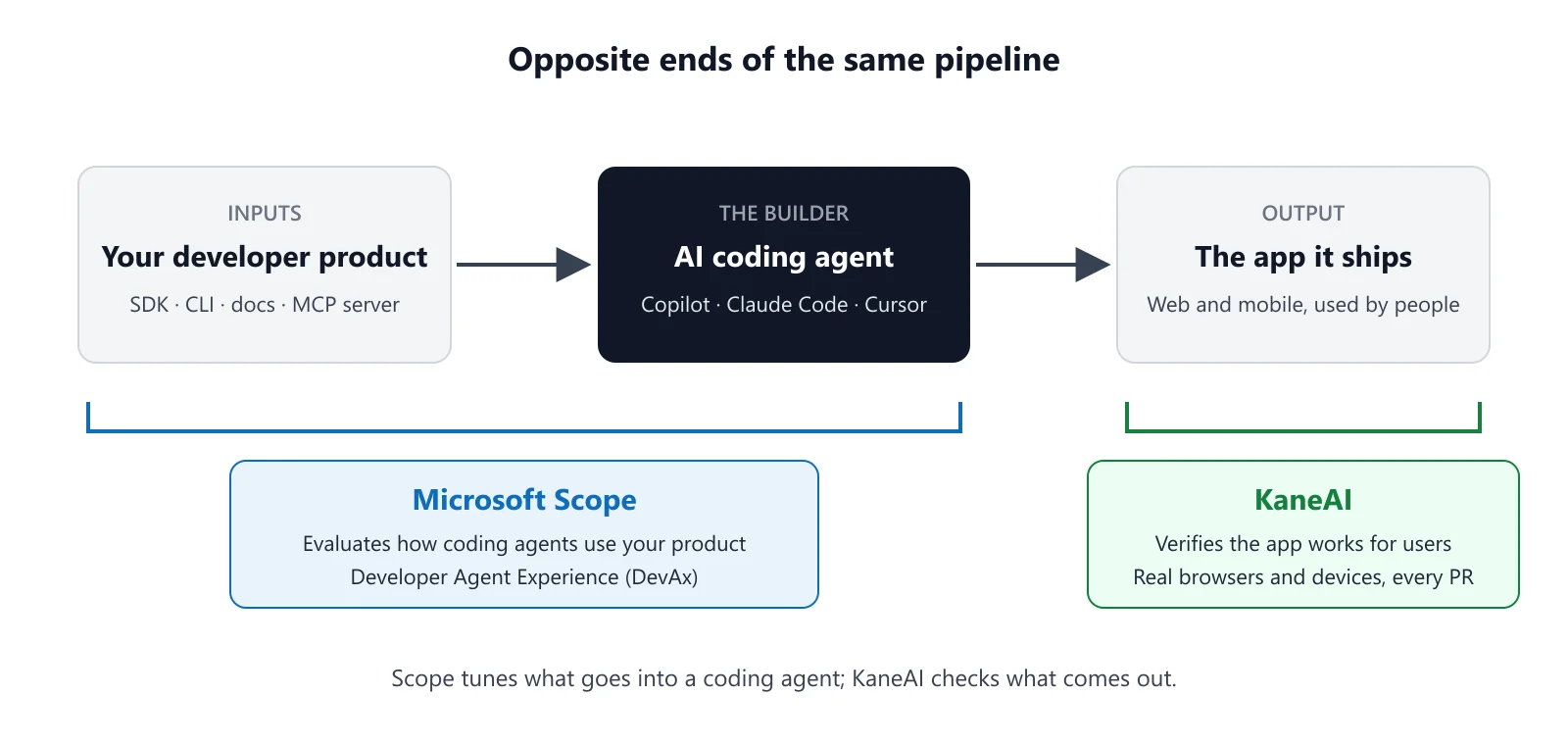
Scope improves what goes into a coding agent. KaneAI proves what comes out.
Short answer: If you publish a developer tool, Scope helps agents use it well. If you ship software people use, you need independent verification of what the agent built - that is KaneAI. Only the first group needs Scope. Every team merging agent-written code needs the second.
The distinction now matters on every pull request. AI coding agents open pull requests, pick SDKs and wire up integrations on their own, and the industry is building two different safety nets. One improves agents' ability to use developer tools.
The other is an independent verification layer built on one rule: the system that wrote the code never decides it works. This guide explains what Scope does, where agent evaluation stops, why it cannot double as a release gate, and how KaneAI fills that role.
In this guide:
- What Microsoft Scope and Developer Agent Experience (DevAx) are
- Evaluation vs verification: four gaps Scope leaves open
- Why LLM-as-a-judge is not a release gate
- Can't you just point Scope at your app, or let the agent write Playwright tests?
- Scope vs KaneAI side by side
- How KaneAI verifies what AI coding agents ship
- When to choose each, and how to run both
TL;DR
Microsoft Scope evaluates the inputs to an AI coding agent: whether agents such as GitHub Copilot and Claude Code adopt your SDK, CLI, docs or MCP server correctly. KaneAI verifies the output: whether the app the agent ships works for users, with a pass or fail that your acceptance criteria decide.
- Best for developer-tool teams: Microsoft Scope - MIT-licensed and self-hosted on Kubernetes, it runs GitHub Copilot or Claude Code through your tasks and scores each requirement with an LLM-based Judge service, so SDK, CLI and MCP server owners see whether agents adopt their product.
- Best for release gates: KaneAI - TestMu AI's testing agent checks one specific build on every pull request against human-written acceptance criteria, on 3,000+ browser and OS combinations and 10,000+ real devices, and the model never votes on whether the test passed.
- LLM-as-a-judge: Scope's Judge service uses a language model to decide whether requirements were met, and Microsoft recommends repeated runs plus human review before acting on the results, which suits a research loop better than a merge gate.
- Agent-written Playwright tests: A test written by the same coding agent inherits its reading of the requirement, so a wrong assumption passes. Kane CLI starts from your stated intent and can still export a run to Python Playwright.
- Running both: Teams that publish developer tools and ship products can tune their SDK and docs with Scope, let the coding agent build, then gate the merge with Kane CLI and @KaneAI Validate this PR.
What Is Microsoft Scope?
Microsoft Scope is an open-source platform, released under the MIT License on October 19, 2026, for evaluating how AI coding agents interact with a product. It runs on Kubernetes, drives existing agents - GitHub Copilot, Claude Code, and Visual Studio Code with Copilot - through representative tasks, and records what they do. Microsoft Developer Relations built it over the previous year to automate these evaluations (Microsoft Open Source Blog).
Scope's building blocks:
- Versioned profiles - capture each run's worker, model, agent version, skills, MCP servers, and extensions, so you change one variable at a time.
- Configurable personas - vary the simulated developer's perspective and communication method.
- Criteria as a DAG - success checks form a directed acyclic graph, so "runtime works" can depend on "project builds".
- A Judge service - uses LLM-based evaluation to score the output against those criteria.
- Traces and workspace snapshots - let teams follow tool calls and link a failed criterion to the steps before it.
- Portal, CLI, and REST API - for running benchmarks from scripts and pipelines. Scope is self-deployed software, not a hosted service.
What Is Developer Agent Experience (DevAx)?
Developer Agent Experience (DevAx) is the practice of measuring and improving how AI coding agents discover, choose, and use a developer product - its SDKs, APIs, CLIs, documentation, and MCP servers. It extends developer experience (DevEx): instead of interviewing human developers, teams give an agent a realistic task, inspect what it did, fix the docs or tooling, and re-run.
Microsoft frames DevAx as a continuous loop, and Scope is its open-source engine. The broader sector term is agent experience (AX), used by Netlify, getDX, and Microsoft's own developer blog.
Scope's launch proof point is concrete. The Azure Cosmos DB team compared bare models versus its Agent Kit across eight end-to-end scenarios in five languages. The runs surfaced 20 Agent Kit issues and 27 documentation issues, and after one targeted update, adoption of hierarchical partition keys went from 47% to 100% (source).
Look at what that result measures: whether agents adopted the SDK patterns the Cosmos DB team recommends. It is a strong DevAx result. It doesn't show whether the applications those agents built returned the right data to a user - that is a verification question, and that is where this comparison turns.
Scope's audience is specific: SDK maintainers, DevRel teams, and CLI and MCP server authors - teams whose customer is now an agent. Its docs list GitHub Copilot and Claude Code as supported today, OpenAI Codex and OpenCode as planned, and Cursor as not integrated (Scope docs).
Evaluation vs Verification: The Gap Scope Leaves Open
Agent evaluation asks "did the coding agent use the tool the way the tool's maker intended?" Verification asks "does the software the agent shipped do what the business needs?"
Scope is built for the first question. It is not designed to answer the second, and its launch post frames results as specific to the scenarios evaluated. Four gaps follow.
1. Scope evaluates the vendor's product, not your app. A Scope run passes when an agent installs the intended SDK, initializes it, and handles a documented error in a sample application. That is valuable to the SDK owner. It says nothing about whether your checkout, onboarding, or claims flow works after the same agent touched it.
2. An LLM judge decides whether requirements were met. Scope combines requirements, build and test gates, and its Judge service uses LLM-based evaluation to score each requirement. Microsoft itself notes that automated judges can make mistakes and recommends repeated runs plus human review before acting.
This creates a sensible trade-off for a research loop. For a release gate, a probabilistic judge grading a probabilistic agent stacks two layers of uncertainty.
3. A build and a runtime check are not a user journey. Scope's criteria graph runs checks like project builds -> client initialized -> integration tests pass inside the agent's workspace.
Real users arrive on Safari 18 on an iPhone, an Android tablet over a slow network, or a screen reader. None of that is in the workspace.
4. Scope measures how well agents can build, not whether this build works. Scope's unit of work is an agent attempting a task from a starting codebase, run repeatedly to compare configurations. A release gate needs the opposite: one specific commit, checked on every pull request in CI, with evidence an auditor can replay.
Why LLM-as-a-Judge Is Not Enough for Agent-Written Code
An LLM judge scores plausibility; a deterministic check proves an outcome. When the same class of model writes the code and grades it, shared blind spots pass silently - a wrong total that "looks right", a button that renders but routes nowhere.
That is why KaneAI separates the two jobs: AI reasons about how to reach the goal, while human-written acceptance criteria check the pass/fail verdict. In TestMu AI's words, reasoning owns the path; verification owns the verdict. The model never gets a vote on whether the test passed.
Can't I Just Point Scope at My Own App?
You can write any criteria in Scope, but it is the wrong harness for a release gate. A team could describe "checkout totals are correct" as a Scope requirement. What Scope does not provide:
- Real user environments. Agents run in containers; there is no browser grid or real-device cloud.
- A deterministic verdict. Requirements are LLM-judged.
- Tests that survive UI change. You maintain criteria and tasks by hand.
- A hosted runner. You operate Kubernetes, KEDA, Flux, and the model providers yourself.
- Per-commit cost control. Each run starts a coding agent and a judge, so each check costs two model sessions.
Scope is built to compare agent configurations. Using it to gate releases means rebuilding a testing platform on top of an evaluation lab.
Can't the Coding Agent Write Its Own Playwright Tests?
An agent that writes both the code and the test grades its own homework. Coding agents can generate Playwright tests, and Playwright MCP is among the most-searched agent tools today.
But tests written in the same session inherit the agent's reading of the requirement, including its mistakes. If the agent believes a discount applies after tax, its test will assert exactly that - and pass.
KaneAI starts from a human's statement of intent - a Jira ticket, a PRD or a plain-English criterion - not from the agent's code, and checks the outcome on real browsers and devices. When you want code in the repo, Kane CLI exports runs to Python Playwright. See Kane CLI vs Playwright for the full comparison.

Microsoft Scope vs KaneAI at a Glance
Scope and KaneAI sit at opposite ends of the same pipeline: Scope tunes what goes into a coding agent; KaneAI checks what comes out. Facts on Scope are as of its October 19, 2026 launch post.
| Criterion | Microsoft Scope | KaneAI (TestMu AI) |
|---|---|---|
| Core question | Can coding agents use our SDK, CLI, docs, or MCP server correctly? | Does the build the agent shipped work for our users? |
| What is under test | The coding agent's behavior with a developer product | One specific build of your web or mobile app |
| Who decides pass/fail | Build and test gates, plus an LLM Judge for requirements | Human-written acceptance criteria; the model never votes |
| Where it runs | Agents in containers on your Kubernetes cluster | 3,000+ real browsers and 10,000+ real iOS and Android devices |
| Layers covered | Whatever criteria you define per task | UI, API, network, database, visual and accessibility in one run |
| Coding agents | Copilot and Claude Code today; Codex and OpenCode planned; Cursor not integrated | Kane CLI runs inside Claude Code, Cursor, Codex and Gemini CLI; KaneAI validates GitHub PRs |
| How tests are written | Task prompt + criteria graph (DAG) | Plain English, or generated from Jira tickets, PRDs, PDFs and screenshots |
| When the UI changes | You update tasks and criteria | Self-healing with reviewable diffs; acceptance criteria never change |
| Evidence | Live logs, trajectories, criterion feedback, tokens and duration | Replayable run: steps, screenshots, network, console logs, categorized bug |
| CI fit | CLI and REST API for benchmark runs | Per-PR gate; typed exit codes 0/1/2/3; GitHub Actions, GitLab CI, Jenkins |
| Cost to run | Free MIT software; you pay for the cluster plus the agent's and judge's model usage on every run | Commercial; replayed tests make no LLM call, so CI cost does not grow with every run; free tier plus 10,000 Kane CLI credits |
| Operations | Self-hosted on Kubernetes (KEDA, Flux); Docker Compose locally | Managed cloud; SSO, RBAC, audit logs, SLA-backed |
| Primary user | SDK maintainers, DevRel, tool and MCP authors | SDETs, QA leads, developers, product managers, engineering leaders |
| Best for | Making a developer product agent-ready | Proving agent-written code is safe to release |
How KaneAI Verifies What AI Coding Agents Ship
KaneAI is a GenAI-native end-to-end testing agent: AI writes the code, KaneAI proves it works. It plans, authors, runs, and maintains tests for web and mobile apps in natural language, then returns a pass or fail backed by evidence.
It is independent of the agent that wrote the code - it takes its definition of done from your team, not from the agent. Here is how it closes each gap Scope leaves open.
Validate every pull request an agent opens. Comment @KaneAI Validate this PR on a GitHub pull request (beta). KaneAI reads the diff, generates tests, runs them, and posts results back in the thread - the natural checkpoint for code written by Copilot, Claude Code, or Cursor.
Turn intent into tests, not scripts. Drop in a Jira ticket, PRD, PDF, screenshot, or spreadsheet and KaneAI generates structured test scenarios. You review and approve the plan before anything runs, so no agent tests blind.
Test from the terminal, inside the coding agent's loop. Kane CLI is KaneAI in your terminal and is built for coding agents. Point an agent at KaneAI's agents.md, and it can call Kane CLI itself:
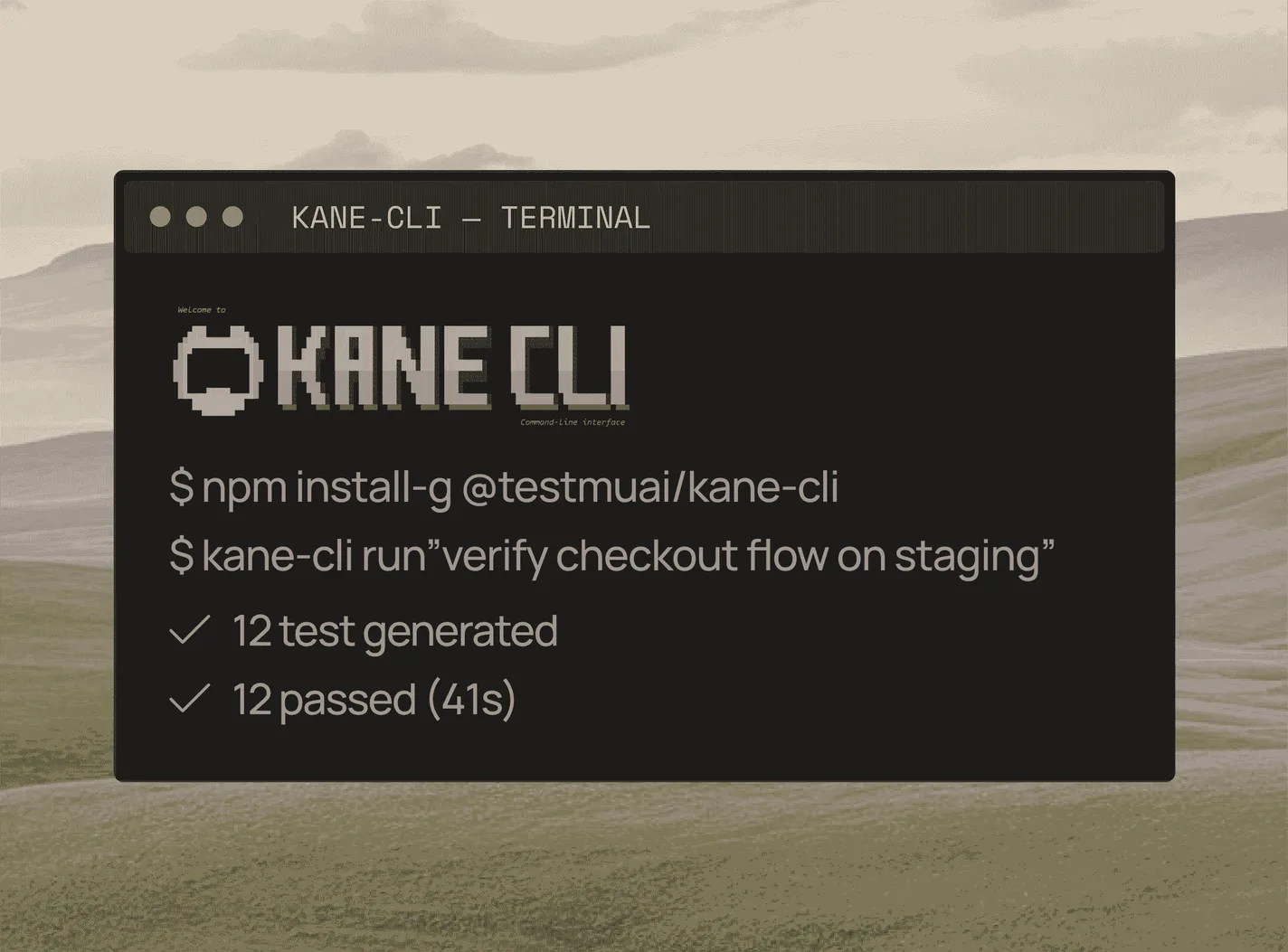
npm install -g @testmuai/kane-cli
kane-cli run "verify checkout flow on staging"
Typed exit codes (0 pass, 1 fail, 2 setup error, 3 timeout) mean a boot failure never passes for a product bug, and runs export to Python Playwright.
Deterministic replay, with AI only when needed. Kane CLI authors each test once with the model, then replays it as a cached, deterministic run with no LLM call - that replay is what runs in CI.
AI re-enters only to heal: first by re-finding a single element by what it is rather than where it sat, then by re-reasoning the route if the flow itself changed. Healing never touches the acceptance criteria, so a wrong order total is reported as a bug, not healed to green.
In TestMu AI's own testing, a saved check on a page that regenerates element IDs on every load re-found its target and passed every run - no edit, no engineer, no LLM spend. Where a button keeps its label but now routes somewhere else, Kane CLI fails loudly instead of adapting. That is deliberate: a release gate should stop on ambiguity, not guess.
Every layer in one run. UI steps, API calls, real-time network checks, database queries, pixel-level visual diffs, and a WCAG accessibility audit run together, so an agent's change cannot break the API while the UI test passes.
Real browsers and devices at scale. Tests run on HyperExecute - TestMu AI's AI Test Orchestration engine - up to 70% faster across 10,000+ real devices and 3,000+ browsers.
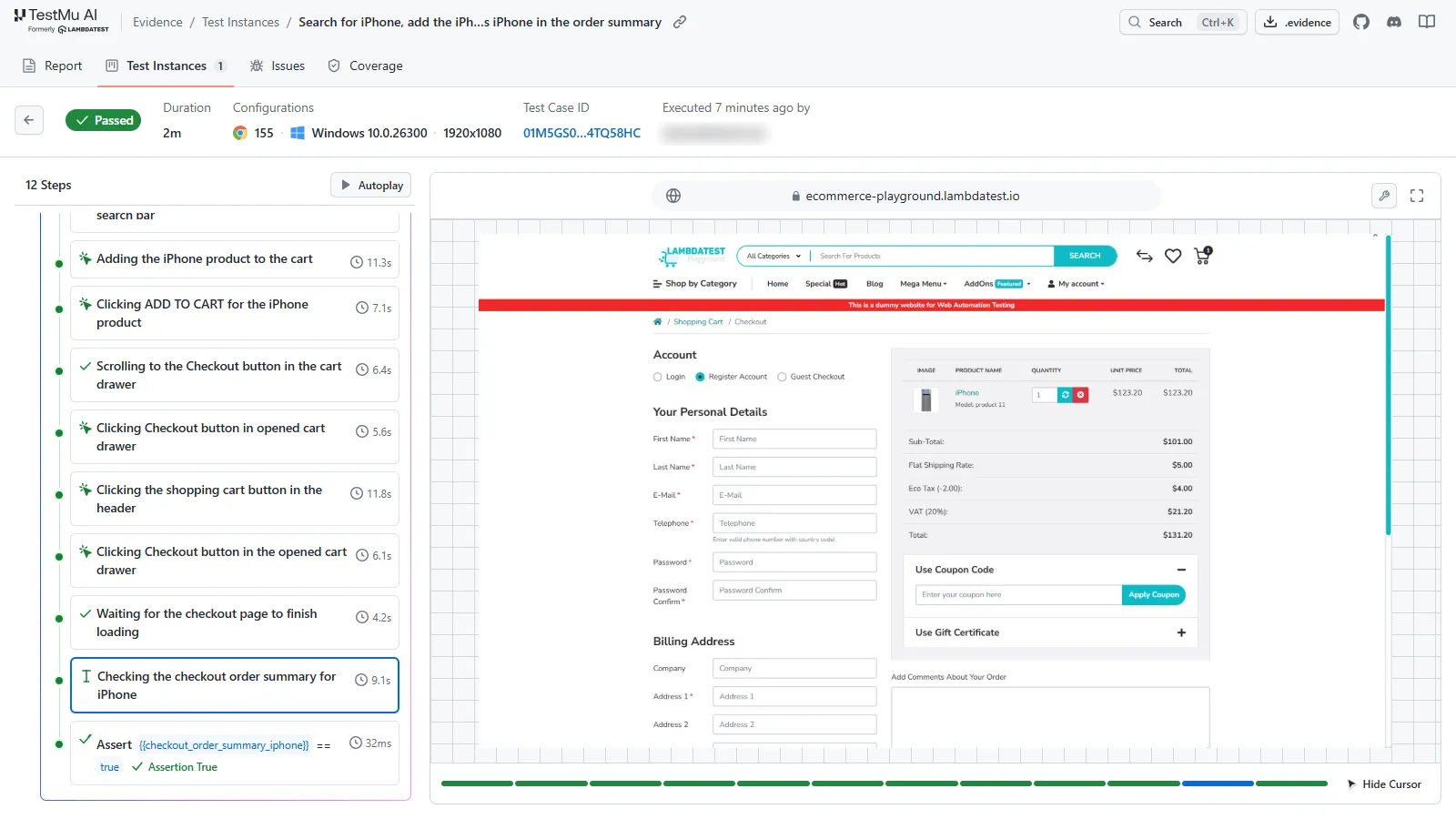
Evidence you can replay. Every run captures steps, screenshots, network and console logs, plus the bug, its category, and its verdict. KaneAI drafts the ticket and routes it to the owner in Jira or Azure DevOps.
Built for enterprise release gates. SSO, RBAC, audit reports, and SLA-backed performance, inside the same platform that runs 1.5B+ tests for 18,000+ enterprises. TestMu AI is positioned as the Leader in the 2026 Gartner Magic Quadrant and recognized in The Forrester Wave: Autonomous Testing Platforms, Q4 2025.

Note: Try it on your next agent-written PR: install Kane CLI and claim 10,000 free credits for a month.
When Microsoft Scope Is the Better Choice
Choose Scope if your customer is a coding agent, and your goal is better adoption of your developer product. It is the stronger tool when:
- You maintain an SDK, API, CLI, or MCP server and want to know whether Copilot or Claude Code picks it and uses it correctly.
- You want to A/B test documentation, agent skills, or tool descriptions and measure the change in agent success rate.
- You need to keep run data and code entirely on your own infrastructure and are comfortable operating Kubernetes.
- You want a free, inspectable, MIT-licensed research harness and can tolerate LLM-judge variance with human review.
KaneAI does not measure SDK adoption or compare agent configurations. If that is your job, use Scope.
When KaneAI Is the Better Choice
Choose KaneAI if your customers are people, and your goal is to ship agent-written code without regressions. That describes nearly every software team, not just the ones that publish developer tools. KaneAI is the stronger choice when you need:
- A pass/fail gate on every pull request, whichever coding agent opened it
- A verdict decided by your acceptance criteria, not by a model
- Coverage on real browsers and devices, across UI, API, data, and accessibility testing
- Tests that product managers and manual testers can write in plain English
- An evidence trail a release manager or auditor can replay
Using Scope and KaneAI Together: One Loop From Input to Outcome
Platform teams that both publish developer tools and ship products get the most from running the two in sequence:
- Tune the inputs with Scope. Run your SDK, docs, and MCP server through Scope until agents adopt them correctly.
- Let the coding agent build. Copilot, Claude Code, or Cursor implements the feature using those improved inputs.
- Verify the output with KaneAI. Kane CLI runs inside the agent's loop; @KaneAI Validate this PR gates the merge.
- Scale before release. HyperExecute runs the suite across real browsers and devices.
- Feed failures back. A KaneAI failure that traces to a confusing SDK becomes a new Scope task.
What About Agents That Act on Systems?
If the agent itself is your product - it calls tools, writes files, hits APIs or opens PRs - that is Agent Assurance territory. TestMu AI's Agent Assurance grades what the agent actually changed, not its transcript or a judge's reading of its final message.
Alongside pass and fail, it reports a third verdict, unable to verify, kept out of the pass rate and published as a number: the assurance gap. Its Rook CLI is pre-alpha and publicly installable (npm install -g @testmuai/rook). In short: Scope shows how agents use your tools; Agent Assurance shows whether your agent is safe to ship; KaneAI shows whether the app your coding agent built works.
Author

Shantanu Wali
Blogs: 11

Shantanu Wali is Vice President of Product Management at TestMu AI, where he owns several product lines across the testing platform, including the Real Device Cloud and the Digital Experience Testing Cloud. He has also contributed significantly to the development and scaling of KaneAI, TestMu AI's flagship GenAI-native testing agent that uses natural language to make software testing faster and more reliable in this AI era. He brings 7+ years of experience across software development and product management, starting as a backend developer at Infosys building solutions for Fortune 500 clients. Shantanu holds an MBA from IIM Calcutta and a B.Tech in Mechanical Engineering.
Reviewer

Mayank Bhola
Reviewer
Mayank Bhola is Co-Founder and Head of Products at TestMu AI, where he leads the entire product portfolio across KaneAI, Kane CLI, HyperExecute, SmartUI, the Real Device Cloud, Accessibility, and other software testing product lines. As an early Lead Architect he designed and built the company's flagship Tunnel technology from scratch, created the React-based automation platform, and architected the data-intensive pipelines and FAAS services that scale it. He brings more than 10 years of experience in software development and product engineering, with earlier roles as Head of Technology at Juggernaut Books and Senior Software Engineer at PressPlay TV and Zomato. Mayank holds a B.Tech in Computer Engineering from JIIT Noida.


Microsoft Scope vs KaneAI FAQs
Did you find this page helpful?
More Related Blogs

TestMu AI forEnterprise
Get access to solutions built on Enterprise
grade security, privacy, & compliance
- Advanced access controls
- Advanced data retention rules
- Advanced Local Testing
- Premium Support options
- Early access to beta features
- Private Slack Channel
- Unlimited Manual Accessibility DevTools Tests