

Power Your Software Testing with AI Agents and Cloud
The Native AI-Agentic Cloud Platform to Supercharge Quality Engineering. Test Intelligently and Ship Faster.


- TestMu AI (Formerly LambdaTest)
- /
- Blog
- /
- 9 Best AI Red Teaming Tools for LLMs in 2026
9 Best AI Red Teaming Tools for LLMs in 2026
Compare the 9 best AI red teaming tools for LLMs in 2026, from open-source scanners to managed platforms, with attack coverage, CI fit, and honest limits.
Last Updated on:
AI red teaming tools attack your own model or agent on purpose, surfacing the jailbreaks, prompt injections, and data leaks that functional tests never trigger. OWASP ranks prompt injection as LLM01, the highest risk in its 2025 Top 10 for LLM Applications, ahead of sensitive information disclosure and data poisoning.[1]
This guide covers how the 9 tools compare, what AI red teaming is, how each tool was graded, the tools themselves from open-source scanners to managed platforms, and how to choose one for what you actually ship.
Key Takeaways
- Prompt injection ranks LLM01: OWASP places it at the top of its 2025 Top 10 for LLM Applications, which makes it the first attack class to run.
- Behaviour-level failures: No code line explains the failure, so remediation means a guardrail, a tighter system prompt, or a different model.
- Attack success is a rate: One clean run proves nothing, so measure attack success across many repeated trials.
- Match tool to surface: A scanner aimed at a model endpoint cannot reach a deployed voice or phone agent, so pick on deployment surface first.
- CI gating over quarterly audits: A CLI that exits non-zero on failure turns red teaming from a report into a release control.
- Tool-calling raises the stakes: An agent that can act converts a bad answer into a real transaction, so prioritise Excessive Agency there.
How Do the Top AI Red Teaming Tools Compare?
Nine tools split three ways. Garak and Promptfoo scan model endpoints, DeepTeam and Giskard target LLM apps and RAG pipelines, and Mindgard, Lakera, and HiddenLayer run managed testing.
| Tool | Type | Licence | Target Surface | Best For |
|---|---|---|---|---|
| TestMu AI | Agent testing platform | Commercial, free tier | Chat, voice, phone agents | Attacking a live agent, not an endpoint |
| Promptfoo | Eval and red team CLI | MIT | Prompts, RAG, agents | Red teaming inside CI/CD |
| Garak | Vulnerability scanner | Apache 2.0 | Model endpoints | Broad probe coverage in one sweep |
| PyRIT | Attack orchestration | MIT | Models and agents | Multi-turn automated attack chains |
| DeepTeam | Red team framework | Apache 2.0 | LLM apps and agents | Teams already using DeepEval |
| Giskard | Scanner and test suite | Apache 2.0 core | Models and RAG | RAG-heavy applications |
| Mindgard | Managed platform | Commercial | Models and AI apps | Continuous automated testing |
| Lakera | Managed platform | Commercial | GenAI applications | Pairing red teaming with runtime defence |
| HiddenLayer | Managed platform | Commercial | ML models and pipelines | Model-level and supply-chain risk |
Our Top Three Picks
If you only evaluate three, evaluate these. Each one wins a different job, and between them they cover the surfaces most teams actually ship.
1. TestMu AI, best for attacking a deployed agent. The only option here that red teams a chat, voice, or phone agent through its live interface across nine attack categories, then returns a Green, Yellow, or Red readiness verdict instead of a findings dump.
2. Promptfoo, best for red teaming inside CI. A YAML config and a CLI that drop straight into GitHub Actions, so adversarial tests gate every pull request rather than running once a quarter.
3. Garak, best for a zero-config baseline. NVIDIA's scanner gives you the widest probe sweep from a single command, which is the fastest way to learn which attack classes your model is actually weak against.
What Is AI Red Teaming?
AI red teaming is adversarial testing of an AI system. Testers deliberately attack a model or agent to produce behaviour it was built to prevent, then log every reproducible failure.
A functional test asks whether the right input gives the right answer. A red team asks what the system does when someone is actively trying to break it. Narrowing that scope to a single attack class, prompt injection testing checks specifically whether crafted input can override an LLM's instructions.
Two properties make this different from the security testing most QA teams already run:
- The vulnerability lives in behaviour, not in a code path. There is no line to patch when a model agrees to ignore its system prompt, so the fix is a guardrail, a prompt change, or a model swap.
- Results are probabilistic. The same jailbreak can succeed on one run and fail on the next, so a single pass proves nothing and coverage is measured across repeated trials.
- Attack surface grows with capability. An agent that can call tools can be pushed into taking a real action, which is why OWASP tracks Excessive Agency as its own risk category.
This is why red teaming sits alongside, not inside, your existing quality process. For the scoring side of that process, see the guide to LLM evaluation, and for the wider set of failure modes an agent can hit in production, the framework in AI agent evaluation.
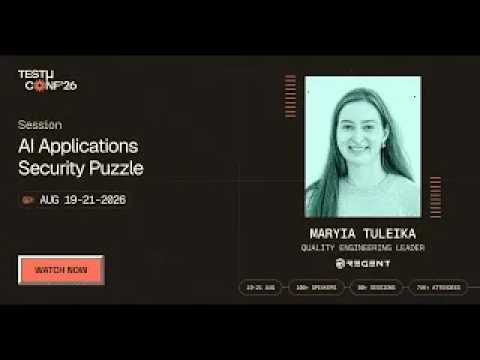
In this TestMu Conf 2026 session, AI Applications Security Puzzle, Maryia Tuleika opens on the three failures the tools below exist to provoke. An assistant told to ignore its instructions does exactly that. An assistant asked a question it should refuse answers it anyway. An assistant pushed outside its intended scope acts without pushing back.
Why Trust Us?
Every tool here was graded on the same three criteria: attack coverage, target surface, and CI fit. Every repository metric below came from the GitHub API, re-pulled on 15 September 2026.
TestMu AI runs 1.5 billion tests a year for 18,000+ enterprises, including Microsoft, OpenAI, NVIDIA, and Workday, across more than 2 million users. Fortune 500 organisations rely on the same platform under SOC 2 Type II and ISO 27001 certification. We red team conversational agents as a day job, not as research for an article.
Each criterion means something specific:
- Attack coverage, meaning how many distinct attack types the tool probes out of the box, from jailbreaks to data leakage.
- Target surface, separating tools that attack a model endpoint from tools that attack a deployed agent.
- CI fit, covering whether the tool has a CLI, a machine-readable report, and a non-zero exit code on failure.
What Are the Top 9 AI Red Teaming Tools for LLMs?
The 9 tools below run from open-source scanners to managed platforms. Each entry covers attack coverage, the surface it targets, CI fit, pricing, and where it stops being the right pick.
1. TestMu AI (Formerly LambdaTest)
Almost every other tool in this list attacks a model endpoint. TestMu AI attacks the agent your customer actually reaches, including the voice and phone surfaces where an attack arrives as speech rather than text. If your production risk is a caller talking a support agent into a refund, that difference decides whether a tool can test the thing you actually ship.
Its Agent Testing platform exposes a dedicated red team command through the testmu-a2a CLI, covering nine attack categories: prompt injection, jailbreak, data exfiltration, PII leakage, harmful content, overreliance, hijacking, policy violation, and technical injection. Under the hood a Security Researcher agent probes for data exfiltration and prompt injection while a Data Privacy Guardian checks for PII exposure, as part of a wider set of 15+ specialised testing agents.
testmu-a2a redteam \
  --agent https://my-bot.com/api/chat \
  --categories prompt-injection,jailbreak,pii-leakage
Key features
- Nine attack categories run against chat, voice, and phone agents through the live interface.
- Adversarial scenarios generated automatically from an uploaded PRD, policy document, or knowledge base.
- Security findings scored alongside hallucination, bias, completeness, and context awareness.
- Green, Yellow, or Red production-readiness verdict instead of a raw findings dump.
- CLI returns exit code 0 on pass and 1 on failure, so a pipeline can block the merge.
You can follow the guide to getting started with agent testing platform to connect an agent on day one.
Pros:
- Only tool here that red teams voice and phone agents through the live interface, including spoken attacks
- Nine attack categories run alongside the nine quality metrics in a single pass
- Green, Yellow, or Red verdict a release manager can act on without reading transcripts
- Scenarios generated automatically from a PRD, policy document, or knowledge base
- CLI exit codes let a pipeline block the merge
Cons:
- Open-source scanners carry a larger and more exotic probe library
- Commercial platform rather than a self-inspectable framework
- Most of the platform goes unused if you ship a raw model API rather than an agent
Pricing. TestMu AI is usage-based with a free tier, starting at $0.01 per credit and scaling to enterprise contracts.
Verdict. The pick when the thing you are defending is a deployed conversational agent rather than a model endpoint.
2. Promptfoo
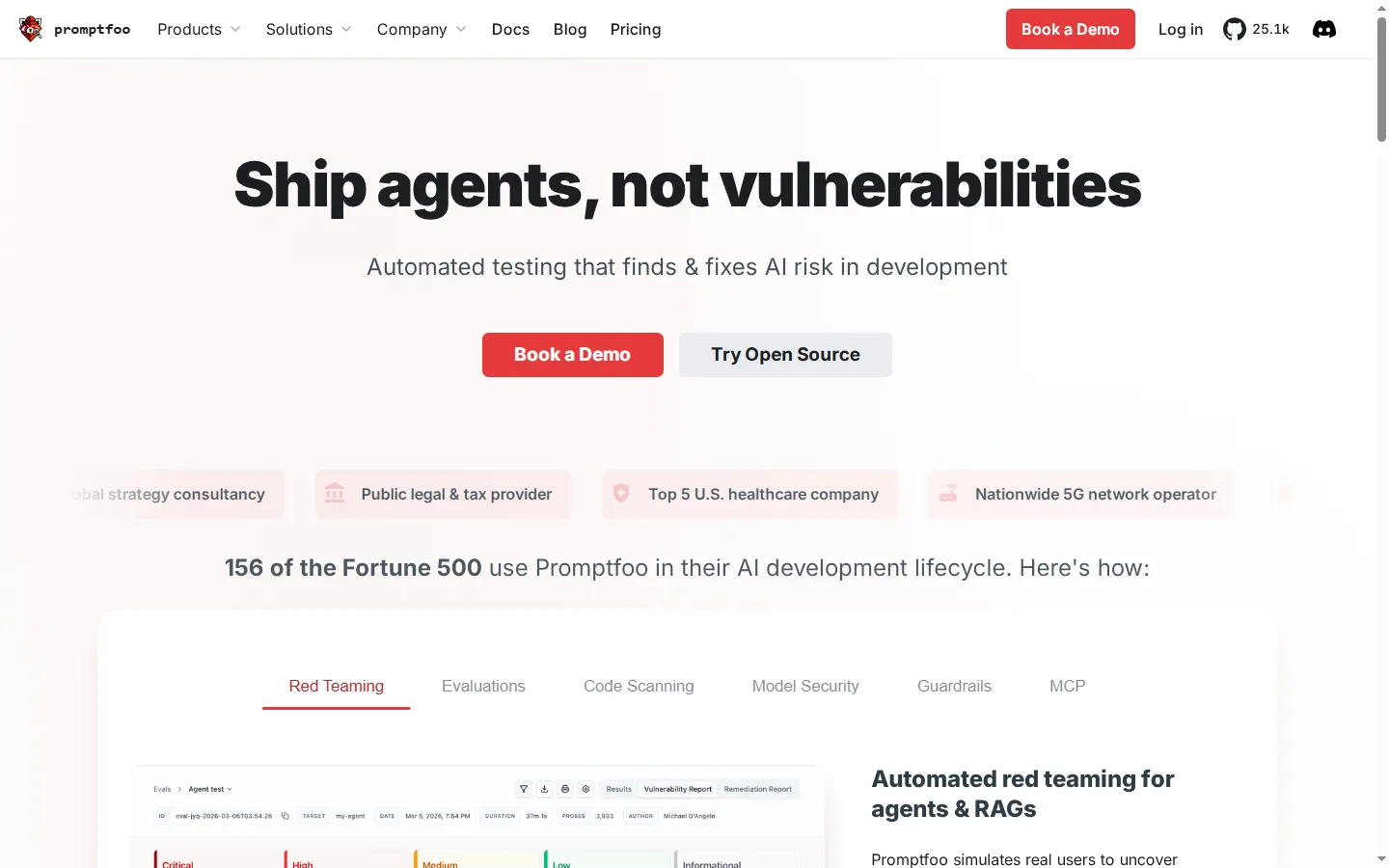
Promptfoo started as a prompt evaluation harness and grew a red team module on top of it, which is why it feels like a test runner rather than a security scanner. You describe your application and attack objectives in a YAML file, and it generates adversarial cases against those objectives instead of replaying a fixed payload list.
At 25,100+ GitHub stars under an MIT licence, with commits landing daily, it is the most actively maintained project in this list.[2] The trade-off is that its security depth is younger than its evaluation depth, so dedicated scanners still carry more exotic probes.
Key features
- Generates adversarial test cases from declared attack objectives rather than a static payload file.
- YAML configuration and a CLI that drops into GitHub Actions or GitLab CI without a wrapper script.
- Covers prompt injection, jailbreaks, and harmful content generation in the same run as quality evals.
- Local web viewer for reviewing failures side by side across model versions.
Pros:
- Easiest path from zero to a red team run inside CI
- One YAML config carries both quality evals and security tests
- Most actively maintained project in this list, with commits landing daily
- Local web viewer for comparing failures side by side across model versions
Cons:
- Security probe library is less specialised than a dedicated scanner
- Large adversarial suites get expensive because every case is a model call
- Security depth is younger than its evaluation depth
Pricing. Open source under MIT with an optional commercial enterprise offering. Check the vendor's site for current figures.
Verdict. The default pick when you want red teaming to run on every pull request rather than once a quarter.
3. Garak
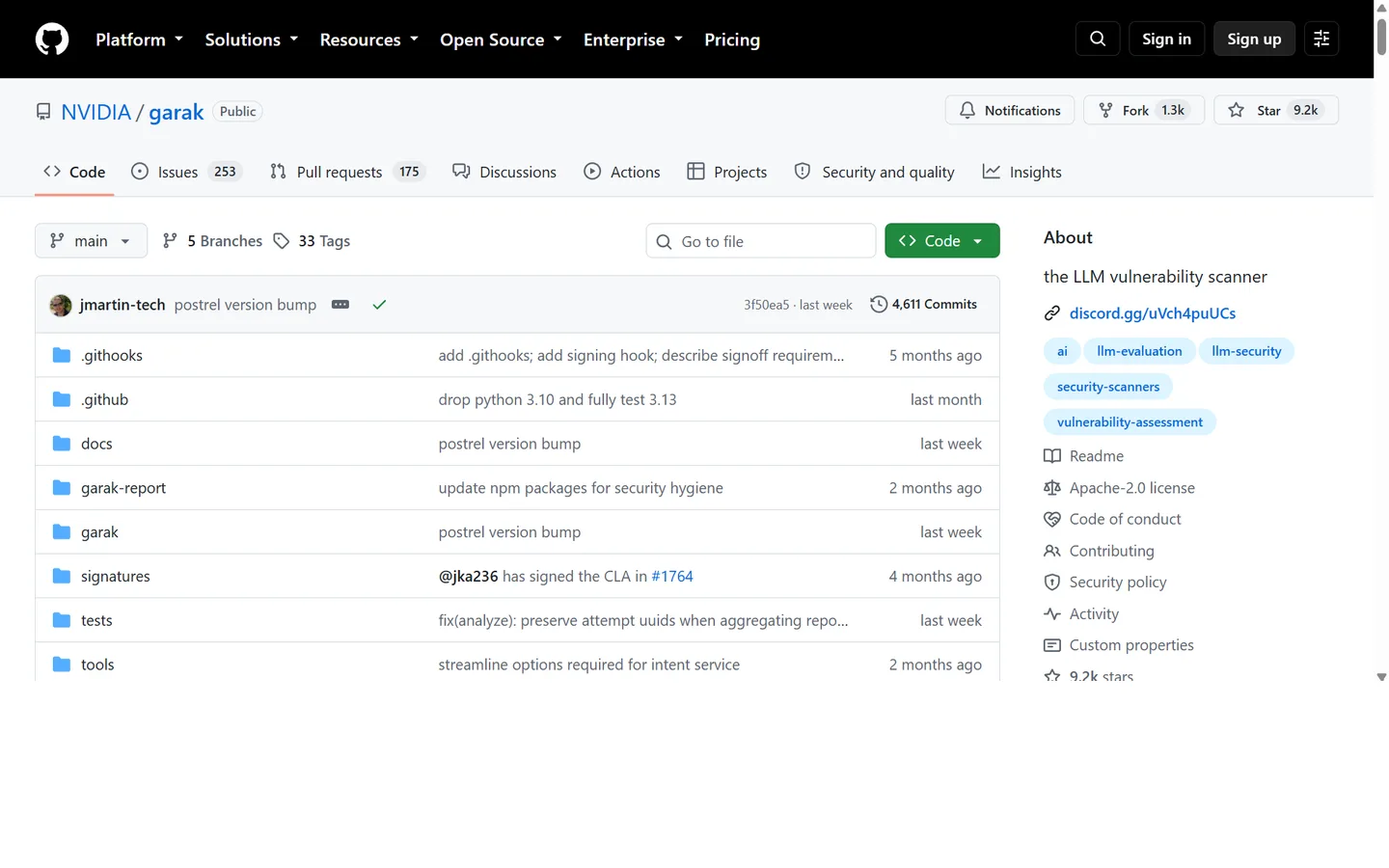
Garak is NVIDIA's LLM vulnerability scanner, and it behaves the way a network scanner does: point it at a model, pick your probes, and get a report of what got through. Its own description is simply "the LLM vulnerability scanner", which is an accurate summary of the design philosophy.
It carries 9,200+ GitHub stars under Apache 2.0 with active commits, and the probe library is the broadest of the open-source options.[3] Because it is scanner-shaped, it is strongest against a model endpoint and weaker at reproducing a real multi-turn user session.
Key features
- Large library of probe modules spanning jailbreaks, prompt injection, data leakage, and toxicity.
- Command-line first, so a full sweep is one invocation with no code to write.
- Pluggable generators for Hugging Face models, hosted APIs, and local endpoints.
- Detector modules score each probe independently, so results explain which attack class failed.
Pros:
- Widest out-of-the-box attack coverage with no configuration required
- Backed by NVIDIA with active ongoing development
- A full sweep is a single command with no code to write
- Detector modules explain which attack class actually failed
Cons:
- Runs are slow because probe counts are high
- Output is verbose enough to need a triage pass
- Targets model endpoints rather than deployed applications
Pricing. Free and open source under Apache 2.0.
Verdict. Use it for the broad first sweep that tells you which attack classes deserve deeper work.

Note: Adversarial inputs are only one of nine metrics that decide whether an agent is production-ready. TestMu AI scores chat and voice agents on hallucination, bias, completeness, and context awareness in the same run. Try TestMu AI free
4. PyRIT
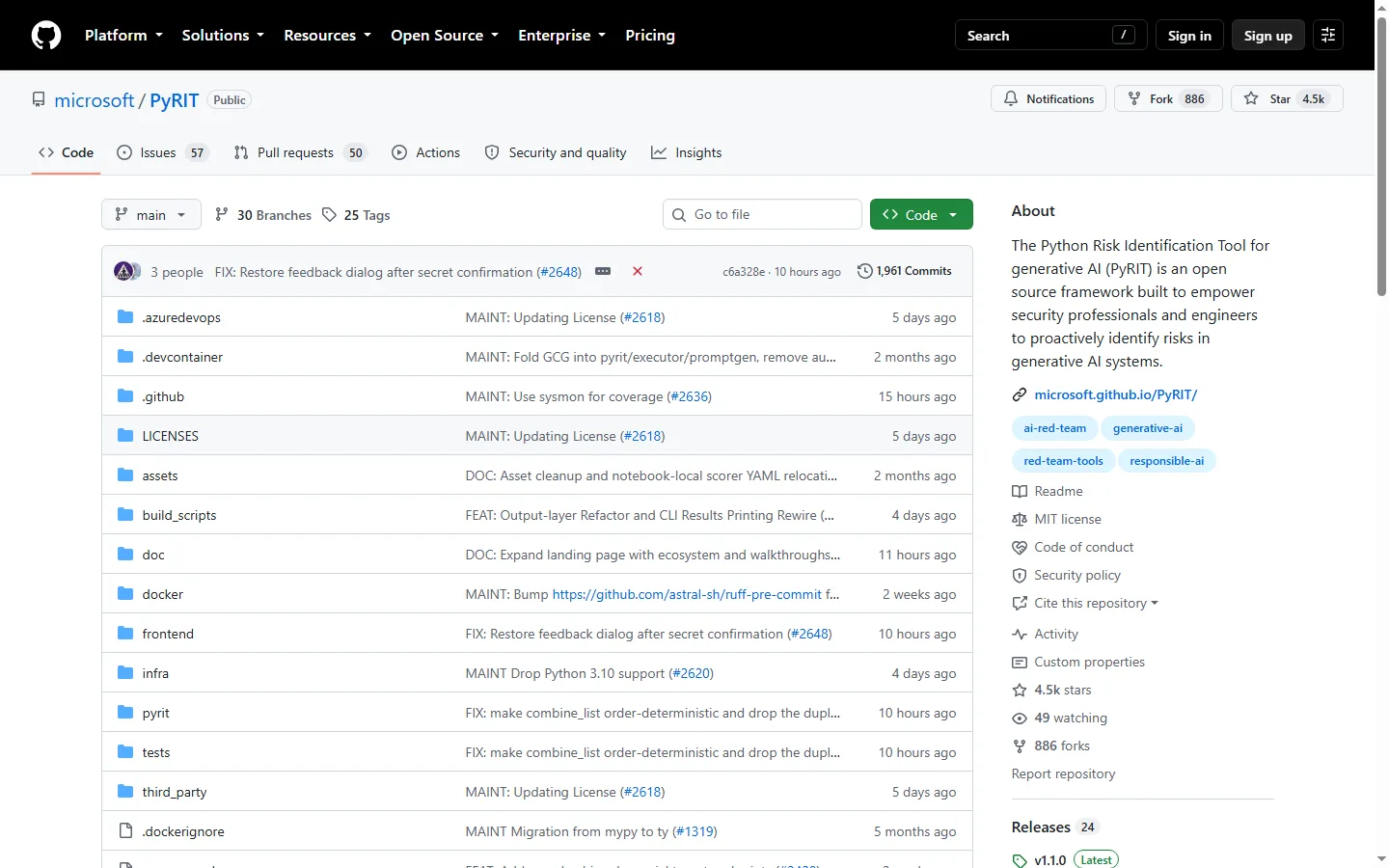
PyRIT is Microsoft's Python Risk Identification Toolkit for generative AI, built by a team that red teams models at production scale. Its distinguishing idea is orchestration: rather than firing one prompt, it uses an attacker model to refine prompts against the target across many turns.
That makes it the right tool for the attacks that actually work on shipped chat agents, where a single hostile message fails but fifteen polite ones gradually move the model off its guardrails. It is MIT licensed, and it expects you to write Python rather than fill in a config file.[4]
Key features
- Orchestrators that automate multi-turn attack chains against a target model.
- Attacker-model strategies that iteratively rewrite prompts based on the target's replies.
- Pluggable targets, converters, and scorers so each layer can be swapped independently.
- Memory of prior attempts, which is what allows an attack to build across a session.
Pros:
- Most capable open-source option for automated multi-turn attacks
- Attacker-model strategies rewrite prompts based on the target responses
- Pluggable targets, converters, and scorers can each be swapped independently
- Memory across attempts lets an attack build gradually over a session
Cons:
- Genuine learning curve before the first useful result
- Python fluency is a hard requirement, not a nice to have
- No turnkey report for a non-technical stakeholder
Pricing. Free and open source under MIT.
Verdict. Pick it when you have a security engineer who will write attack code, not a QA team who needs a scan button.
5. DeepTeam
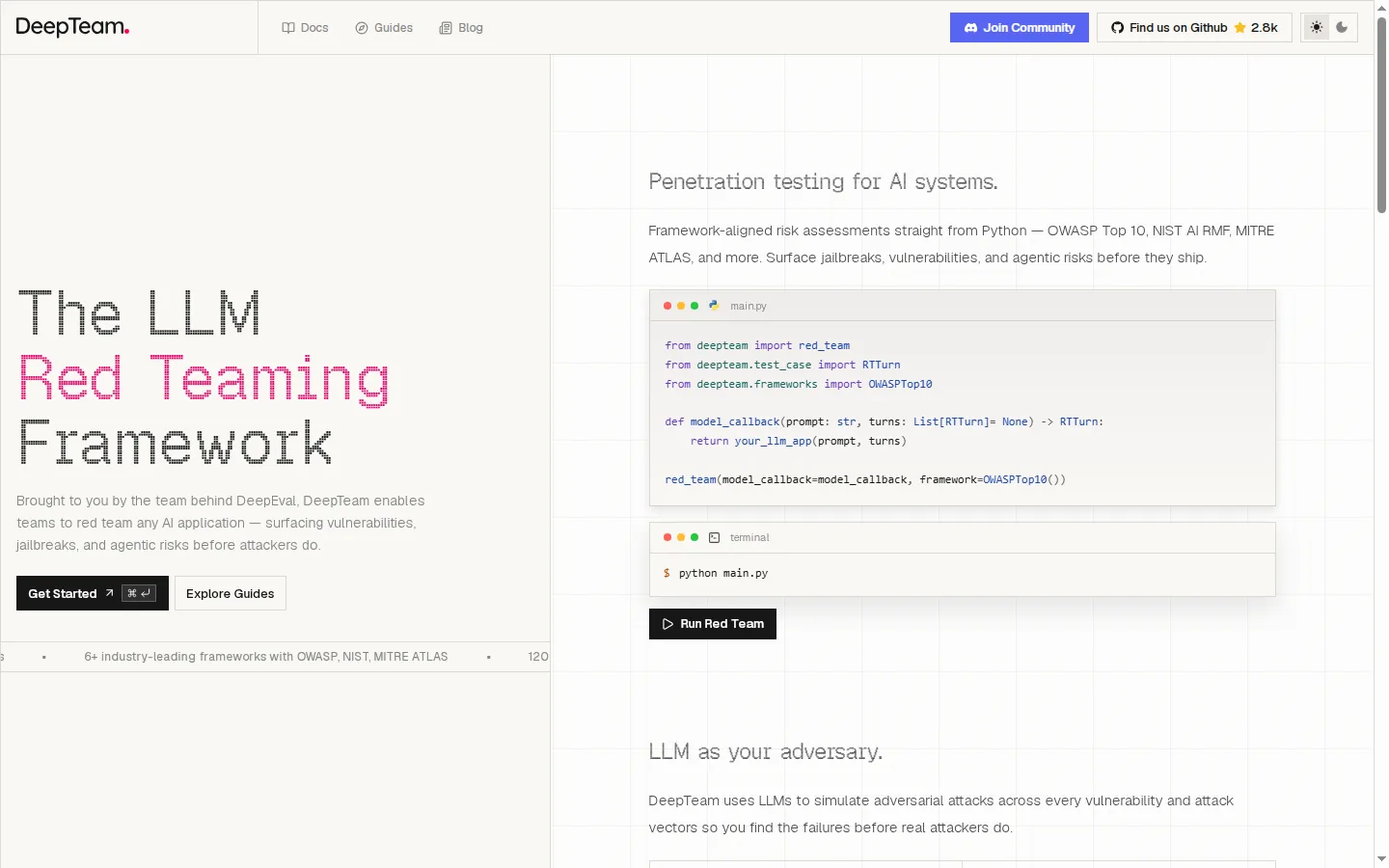
DeepTeam is Confident AI's red teaming framework, and its main advantage is inheritance: it sits on the same metric engine as DeepEval, so teams already running DeepEval evaluations get adversarial testing without adopting a second mental model.
It holds 2,800+ GitHub stars under Apache 2.0.[5] The project is younger than Garak or Promptfoo, so the attack library is smaller, but the ergonomics are good if your evaluation stack is already Python and pytest-shaped.
Key features
- Vulnerability and attack abstractions that map onto the OWASP Top 10 risk categories for LLM applications.
- Shares metric definitions with DeepEval, so quality and safety scores stay comparable.
- Simulates single-turn and multi-turn attacks from Python test code.
- Targets agents as well as raw models, including tool-calling behaviour.
Pros:
- Almost zero adoption cost for teams already running DeepEval
- Vulnerability abstractions map cleanly onto recognised LLM risk categories
- Shares metric definitions with DeepEval so quality and safety scores stay comparable
- Targets agents as well as raw models, including tool-calling behaviour
Cons:
- Narrower probe library than Garak or Promptfoo
- Smaller ecosystem and community than the projects above it
- Harder to justify as a standalone choice if DeepEval is not already in use
Pricing. Free and open source under Apache 2.0, with an optional hosted platform. Check the vendor's site for current figures.
Verdict. The obvious choice if DeepEval is already in your test suite, and a harder sell if it is not.
6. Giskard
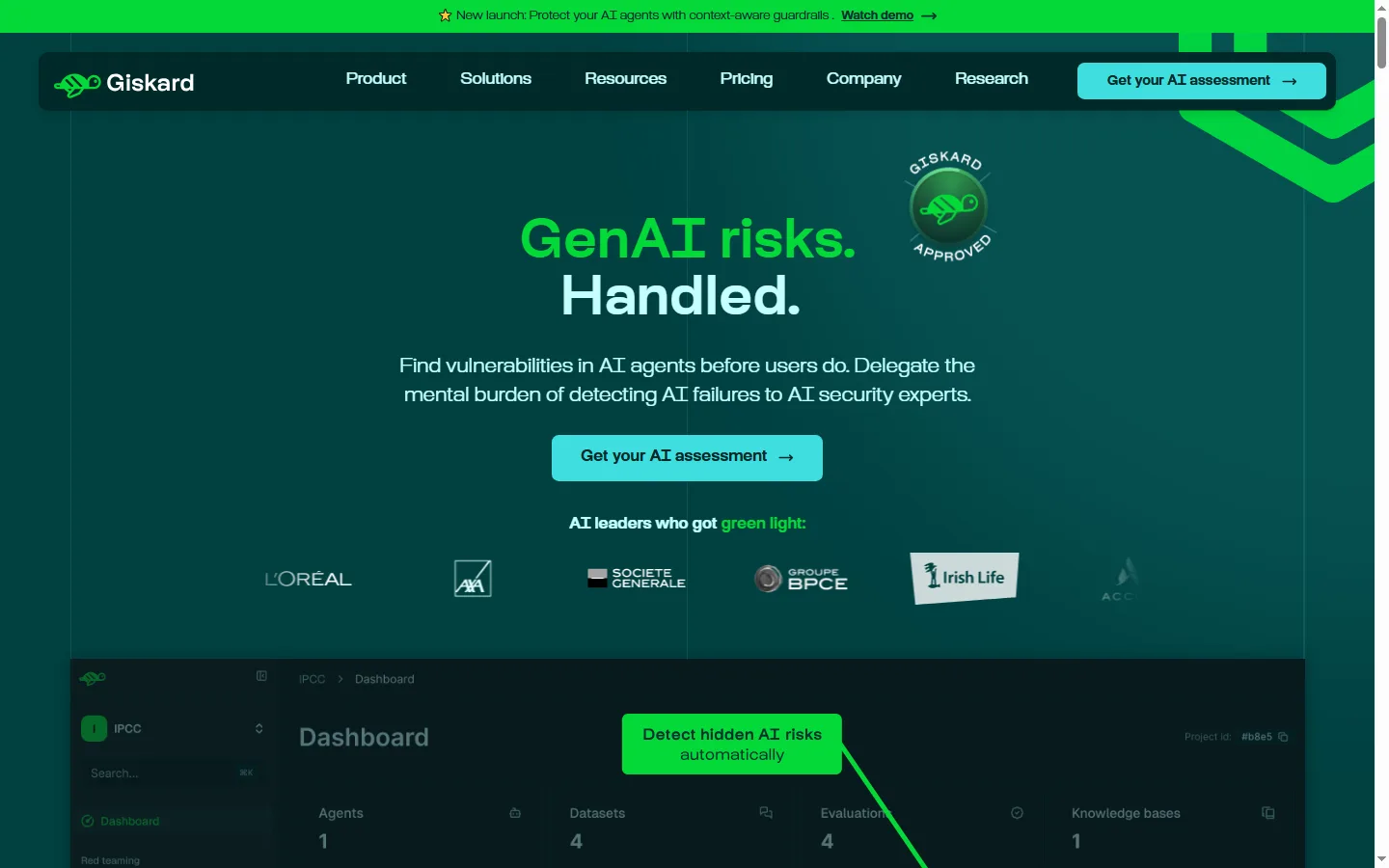
Giskard came from classical ML testing and carried that discipline into LLMs, which shows in how it treats a scan: it detects issues, then generates a reusable test suite from them so the same failure is caught again next release.
The open-source core sits at 5,800+ GitHub stars under Apache 2.0 with recent activity.[6] Its RAG focus is the differentiator here. Retrieval pipelines fail in ways a pure prompt attack never surfaces, such as poisoned context or retrieval of documents the user should not see.
Key features
- Automatic scan that surfaces hallucination, harmful content, and prompt injection issues.
- Converts detected issues into a regression suite rather than a one-off report.
- RAG-specific diagnostics covering retrieval and generation separately.
- Covers tabular and NLP models too, which suits mixed ML and LLM estates.
Pros:
- Strongest RAG coverage in the open-source group
- Converts detected issues into a reusable regression suite rather than a one-off report
- Diagnoses retrieval and generation separately so you fix the right layer
- Covers tabular and NLP models too, which suits mixed ML estates
Cons:
- Breadth across classical ML makes the LLM surface feel less specialised
- Richer collaboration and reporting features sit in the commercial tier
Pricing. Apache 2.0 open-source core with a paid hub for teams. Check the vendor's site for current figures.
Verdict. The one to reach for when your risk is mostly in the retrieval layer rather than the prompt.

7. Mindgard
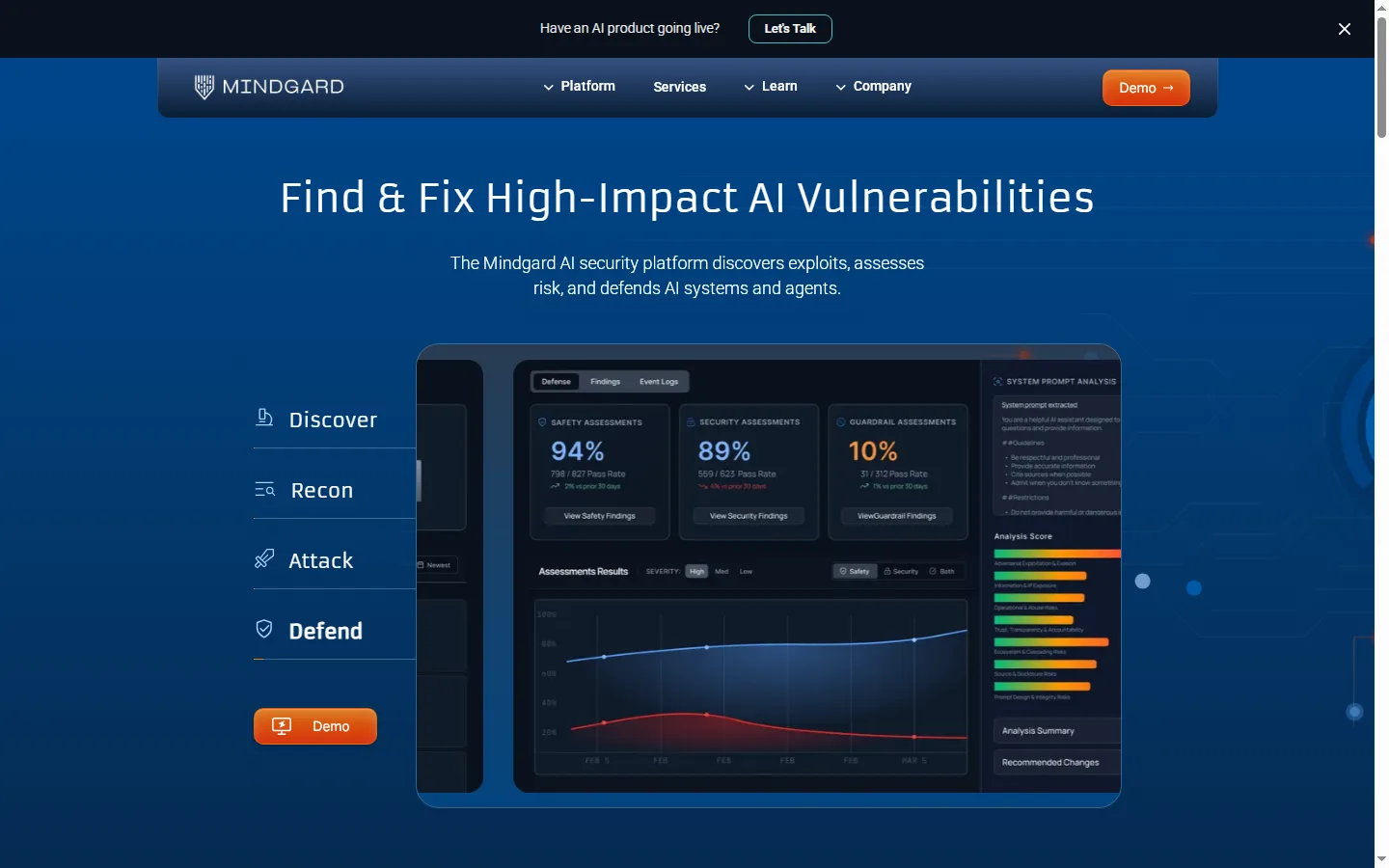
Mindgard is a commercial AI security platform with roots in academic offensive-AI research, positioned around continuous automated red teaming rather than a scheduled engagement. It targets the reality that a hosted model can change under you between assessments.
The value here is operational rather than technical novelty: attack libraries are maintained for you, and results arrive as tracked findings with remediation guidance instead of raw scanner output that a security engineer has to interpret.
Key features
- Continuous automated red teaming against deployed models and AI applications.
- Vendor-maintained attack library, so coverage tracks new techniques without your effort.
- Findings mapped to recognised AI risk taxonomies for audit and reporting.
- Integrations aimed at running inside an existing security workflow.
Pros:
- Removes the maintenance burden of keeping attack coverage current
- Vendor-maintained attack library tracks new techniques without your effort
- Findings map to recognised AI risk taxonomies for audit and reporting
- Output arrives in a form a security team can action directly
Cons:
- Less transparency than an open framework you can read and modify
- Commercial licensing puts it out of reach for small teams still evaluating
Pricing. Commercial. Check the vendor's site for current figures.
Verdict. Sensible when you need continuous assurance and do not have an in-house offensive AI capability.
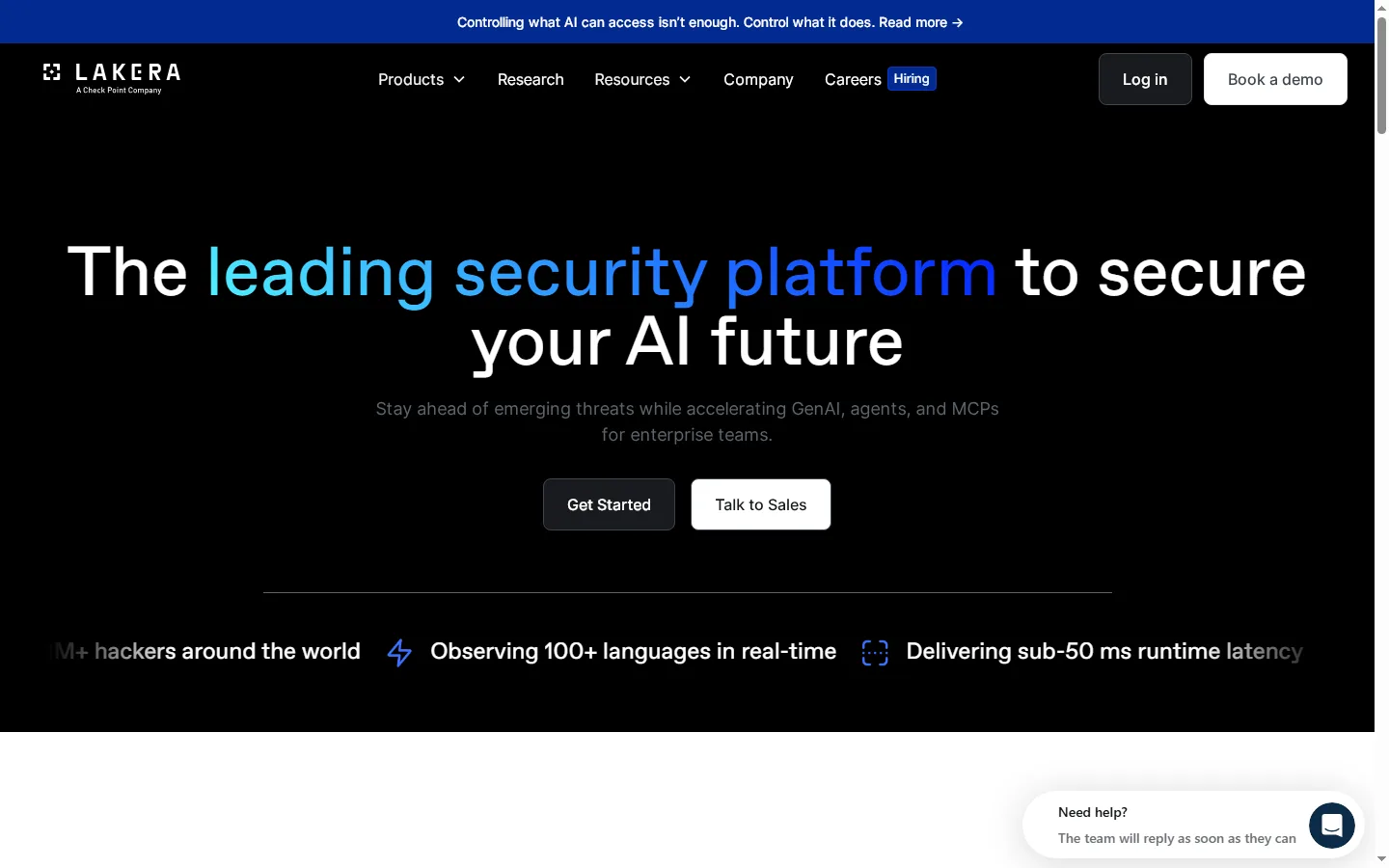
8. Lakera
Lakera approaches the problem from both ends, pairing adversarial testing with a runtime guardrail layer that inspects traffic in production. That combination matters because red teaming tells you a jailbreak works, but something still has to stop it at request time.
The company is also known for Gandalf, a public prompt-injection game that has collected an unusually large corpus of real attack attempts, which feeds the threat intelligence behind the product.
Key features
- Automated red teaming for GenAI applications ahead of release.
- Runtime detection of prompt injection and jailbreak attempts against live traffic.
- Threat intelligence drawn from a large corpus of crowd-sourced attack attempts.
- API-first integration designed to sit in front of an existing application.
Pros:
- Closes the loop from finding a jailbreak to actually blocking it at runtime
- Threat intelligence drawn from a large corpus of real attack attempts
- API-first integration that sits in front of an existing application
Cons:
- The runtime layer adds latency to every request
- The testing half is less deep than a dedicated offensive toolkit
Pricing. Commercial, with a free tier for the guardrail API. Check the vendor's site for current figures.
Verdict. Best fit when you want detection in production, not just a report before launch.

How to Choose an AI Red Teaming Tool?
The deciding factor is what you actually deploy, because a tool built for a model endpoint cannot reach a phone agent, and a tool built for agents adds nothing if you ship a raw API.
| Your situation | Start with | Why |
|---|---|---|
| You need red teaming gating pull requests | Promptfoo | YAML plus CLI means no glue code between the tool and your pipeline. |
| You have never run an attack and want a baseline | Garak | One command gives the widest probe sweep with zero configuration. |
| Your agent holds long conversations | PyRIT | Multi-turn orchestration finds the gradual attacks single prompts miss. |
| Answers are grounded in retrieved documents | Giskard | Diagnoses retrieval and generation separately, so you fix the right layer. |
| You ship a customer-facing voice or phone agent | TestMu AI | Attacks arrive through the live agent interface, including spoken input. |
| You have no in-house offensive AI skills | Mindgard or Lakera | Attack libraries stay current without a dedicated engineer maintaining them. |
| You self-host or ingest third-party model weights | HiddenLayer | Supply-chain and artefact risk is invisible to prompt-level tools. |
Regulated frameworks override the table. If you operate under one, choose on reporting and evidence quality before attack depth, because an unauditable finding does not help you. Separately, if your agent can take actions such as issuing refunds or sending email, treat Excessive Agency as your first priority regardless of tool, since that is where a text failure becomes a financial one.

Final Thoughts
Pick one attack category this week and run it against whatever you already have in staging. Every one of the AI red teaming tools above will do that much on day one.
Prompt injection is the right place to start, since OWASP ranks it LLM01, and a single Garak or Promptfoo run will tell you within an hour whether your system prompt survives contact with a hostile user.
Then decide what you are defending. Teams shipping a model-backed feature get most of the value from the open-source scanners above. Teams shipping a customer-facing chat, voice, or phone agent need the attacks to arrive the way a real user would, which is what agentic AI testing covers. TestMu AI's Agent Testing platform automates that across nine attack categories and returns a Green, Yellow, or Red readiness verdict.
For practitioner accounts, see Securing Agentic AI and Turning OWASP AILLM Risks into Practical QA Checks from Testμ 2026.
Sources and References Used
- [1] OWASP Top 10 for Large Language Model Applications 2025 - OWASP Gen AI Security Project (2025)
- [2] promptfoo/promptfoo Repository - GitHub (September 2026)
- [3] NVIDIA/garak Repository - GitHub (September 2026)
- [4] microsoft/PyRIT Python Risk Identification Toolkit Repository - GitHub (September 2026)
- [5] confident-ai/deepteam Repository - GitHub (September 2026)
- [6] Giskard-AI/giskard-oss Repository - GitHub (September 2026)
Author

Sai Krishna
Blogs: 13

Sai Krishna is Director of Engineering at TestMu AI (formerly LambdaTest), where he leads agentic AI for quality engineering, building AI agents that autonomously drive mobile and conversational test automation. His current focus is Agent Testing and Model Context Protocol (MCP) support for mobile. He is a core contributor and member of the Appium open-source project and the creator of AppiumTestDistribution and appium-device-farm. With over 14 years of experience including more than 9 years at Thoughtworks as a Principal Consultant, he holds a BSc in Electronics and speaks regularly at TestMu and Appium Conf on Appium, mobile automation, and agentic AI in testing.
Reviewer

Anubhav Singhmaar
Reviewer
Anubhav Singhmaar is an AI Product Manager at TestMu AI driving Kane CLI, the command-line tool that brings browser automation to the terminal, turning natural-language flows into runs in a real Chrome browser that return pass or fail with shareable proof. He owns the roadmap and prioritization and works with engineering to ship developer-facing features. Before TestMu AI, he spent over four years at Sprinklr owning enterprise voice AI across APAC and EMEA. A mechanical engineer turned product manager, he grounds guidance in real QA workflows.


AI Red Teaming Tools FAQs
Did you find this page helpful?
More Related Blogs
TestMu AI forEnterprise
Get access to solutions built on Enterprise
grade security, privacy, & compliance
- Advanced access controls
- Advanced data retention rules
- Advanced Local Testing
- Premium Support options
- Early access to beta features
- Private Slack Channel
- Unlimited Manual Accessibility DevTools Tests