
Power Your Software Testing with AI Agents and Cloud
The Native AI-Agentic Cloud Platform to Supercharge Quality Engineering. Test Intelligently and Ship Faster.


- TestMu AI (Formerly LambdaTest)
- /
- Blog
- /
- LangSmith vs Langfuse in 2026: An Honest Comparison
Choose LangSmith if your agents are built on LangChain or LangGraph, you want tracing, evals and managed agent deployment from one vendor, and a SaaS-first, proprietary platform is acceptable. Choose Langfuse if you want an MIT-licensed, OpenTelemetry-native platform you can self-host for free with every core feature included. Both are mature observability-plus-evaluation tools; the real decision is about licensing, hosting and how tightly you want to couple to the LangChain ecosystem.
TL;DR
- Langfuse's core is MIT-licensed, and its docs say all product features (tracing, evals, prompt management, experiments, annotation, playground) are included without usage limits when self-hosted. Only a set of enterprise admin features needs a license key.
- LangSmith is a proprietary platform (its SDKs are MIT). Self-hosting is an add-on to the Enterprise plan.
- Both accept OpenTelemetry traces and both work without LangChain. LangSmith is deepest when you use LangChain/LangGraph; Langfuse is built OpenTelemetry-first.
- ClickHouse acquired Langfuse in early 2026. Langfuse says it stays open source and self-hostable, with no planned licensing changes.
- Both score traces and datasets. Neither is designed as a pre-release gate that runs your agent end-to-end and verifies the side effects it actually caused. That job is Agent Assurance, a complement to either tool.
Looking to replace one of them rather than compare them? See our guides to LangSmith alternatives and Langfuse alternatives.
LangSmith vs Langfuse: The Comparison Table (as of October 2026)
We added Braintrust as a third column because many teams shortlist it alongside the other two.
| Criterion | LangSmith (LangChain) | Langfuse (ClickHouse) | Braintrust |
|---|---|---|---|
| License | Proprietary platform; SDKs MIT | Core MIT; /ee enterprise modules need a license key | Platform not described as open source; some open-source libraries |
| Self-hosting | Enterprise add-on; Kubernetes/Helm or Terraform; hybrid option (LangChain control plane, your data plane) | Free self-hosting of all core features; Docker Compose, Kubernetes (Helm), Terraform on AWS/GCP/Azure | Enterprise only; data plane in your cloud, control plane hosted by Braintrust |
| Self-host stack | ClickHouse, Postgres, Redis/Valkey (bundled by default); external blob storage recommended | ClickHouse, Postgres, Redis/Valkey, S3-compatible storage | Postgres, Redis, object storage, Brainstore |
| OpenTelemetry | Accepts OTLP traces, including non-LangChain apps | Tracing is built on OpenTelemetry | Accepts OTLP traces |
| Framework coupling | Works with any code (@traceable, wrappers) and many frameworks; deepest with LangChain/LangGraph | Agnostic; lists 100+ integrations incl. LangChain/LangGraph, LlamaIndex, OpenAI Agents, Vercel AI SDK, CrewAI, Pydantic AI | Integrates with AI providers and frameworks |
| Prompt management | Commits, diffs, tags, staging/production promotion with rollback, Playground, public prompt hub | Versioning, labels, client-side caching, Playground, prompt-to-trace linking | Side-by-side prompt/model comparison in playgrounds |
| Datasets and experiments | Yes; datasets from curated cases, production traces or synthetic data | Yes; experiments via UI, SDK or OpenTelemetry | Yes; experiments against datasets |
| Evaluators | Human, code, LLM-as-judge, pairwise; offline and online (incl. multi-turn threads) | LLM-as-a-judge, code evaluators, annotation queues, user feedback, custom scores; online and offline | LLM, code and human scorers |
| CI integration | Run evals via pytest, Vitest/Jest or evaluate | langfuse/experiment-action GitHub Action fails PRs on score regressions | braintrustdata/eval-action GitHub Action runs evals on each PR and posts results as a comment |
| Monitoring and alerts | Dashboards; threshold alerts on run count, cost, errors, feedback score, latency; Slack, PagerDuty, webhook | Dashboards (quality, cost, latency); alerts via Slack, GitHub Actions, webhooks | Real-time latency, cost and quality tracking |
| Agent-specific | Insights (auto-clustering of trace patterns and failure modes), Studio, multi-turn simulation via openevals | Agent graph views of traces, sessions; multi-turn simulation cookbook using openevals | Loop (AI assistant that builds scorers, datasets, prompts) |
| Deployment of agents | Yes: LangSmith Deployment / Agent Server, described as framework-agnostic | No | No |
| Pricing model | Per seat plus traces: Developer $0 (1 seat, 5k base traces/mo), Plus $39/seat/mo (10k base traces), Enterprise custom; overage pay-as-you-go | Per usage unit: Hobby free (50k units), Core $29/mo, Pro $199/mo (100k units each, then $8 per 100k), Enterprise $2,499/mo | Starter $0, Pro $249/mo, Enterprise custom; metered on processed data and scores |
| Retention | Base traces 14 days; extended traces 180 days (extra fee) | 30 days (Hobby), 90 days (Core), 3 years (Pro, Enterprise) | 14 days (Starter), 30 days (Pro), longer at extra cost |
| Regions | US, EU, APAC (SaaS); self-hosted in your VPC | US, EU, JP; HIPAA region on Pro/Enterprise | US or EU data plane, chosen when the org is created |
| Compliance listed on official pages | SOC 2 Type 2, HIPAA and GDPR stated in LangSmith docs; reports via Trust Center | SOC 2 Type II and ISO 27001 reports on Pro/Enterprise; DPA on all plans | SOC 2 Type II; BAA on Enterprise |
Sources: LangSmith pricing, Langfuse pricing, Braintrust pricing, plus the docs pages linked in each section below.
Is Langfuse Open Source, and Is LangSmith?
This is the criterion that splits most teams, so be precise about it.
Langfuse. According to Langfuse's open-source page, everything outside the /ee folders is MIT-licensed, and that covers all product features, with no usage limits. The /ee modules ship as source but need a license key: project-level RBAC roles, protected prompt labels, data retention policies, audit logs, server-side data masking, SCIM and similar admin features. If you need those self-hosted, you are buying an Enterprise license.
LangSmith. The LangSmith SDKs are MIT-licensed on GitHub, but the platform is a commercial product. Self-hosted LangSmith is "an add-on to the Enterprise plan," per LangChain's docs.
What changed in 2026. ClickHouse acquired Langfuse (ClickHouse announced it on its own blog too). Langfuse's post says the product stays open source and self-hostable, that Langfuse Cloud keeps running as-is, and that there are no planned licensing changes.
Langfuse already stored traces in ClickHouse, so the technical fit is natural. If vendor stability is on your checklist, note that the acquisition puts a larger company behind the project; it does not, by itself, change your license terms.
Which One Is Easier to Self-Host?
Both self-hosted stacks look strikingly similar: ClickHouse for traces, Postgres for transactional data, Redis or Valkey for queues and caching, and blob storage for large payloads.
The differences are commercial and operational:
- Langfuse documents Docker Compose for local use and testing and Kubernetes (Helm) plus Terraform for AWS, GCP and Azure for production. You can run it on-premises, and its docs say internet access is optional. Cost is your infrastructure plus, optionally, an enterprise license.
- LangSmith self-hosting runs on Kubernetes via Helm or Terraform and requires an Enterprise contract. LangChain also offers a hybrid model: its cloud control plane with your own data plane for agent workloads; trace data stays in your VPC only when you self-host LangSmith.
If you need air-gapped or fully on-prem observability without a sales cycle, Langfuse is the simpler path. If you are already an Enterprise LangChain customer, LangSmith's hybrid model is a reasonable middle ground.
Does LangSmith Only Work With LangChain?
No, and this is the most common misconception in the SERP. LangSmith traces any code with the @traceable decorator (Python) or traceable wrapper (TypeScript), wraps the plain OpenAI client, and lists integrations for Anthropic, OpenAI Agents, Vercel AI SDK, CrewAI, Claude Agent SDK and PydanticAI. It also accepts OpenTelemetry traces from non-LangChain apps through an OTLP endpoint.
That said, the experience is deepest when you are on LangChain or LangGraph: tracing is automatic, Studio is built around LangGraph agents, and deployment through Agent Server is a natural next step. Interestingly, LangChain's docs now describe LangSmith Deployment as framework-agnostic too, with paths for Google ADK, Claude Agent SDK, Strands, CrewAI and AutoGen.
Langfuse starts from the opposite end. Its tracing is built on OpenTelemetry to "reduce vendor lock-in," and it lists 100+ integrations across frameworks, model providers, gateways (such as LiteLLM) and no-code agent builders, including LangChain and LangGraph.
Practical read: if you might change agent frameworks in the next year, instrument with OpenTelemetry regardless of which backend you pick. Both accept it, which keeps your switching cost low.
How Do Evaluations Compare: Datasets, Experiments, LLM-as-Judge and Human Review?
On paper, the two have converged. Both support:
- Datasets of test cases, which you can grow from production traces.
- Experiments that run an app version against a dataset and compare results.
- Offline evaluation before release and online evaluation on live traffic.
- LLM-as-a-judge, code-based checks, and human annotation queues. (Our guide to LLM-as-a-judge covers how to calibrate these judges.)
Where they differ:
| Area | LangSmith | Langfuse |
|---|---|---|
| Evaluator variety | Adds pairwise comparison of two outputs; online evaluators can run on multi-turn threads | Adds categorical, boolean, numeric and text scores via API/SDK; browser SDK for end-user feedback |
| CI path | Run evals inside pytest, Vitest/Jest or evaluate | Official GitHub Action that fails a PR when a score crosses a threshold |
| Simulation | openevals run_multiturn_simulation with LLM-simulated users, documented inside LangSmith experiments | A cookbook shows the same openevals simulator with Langfuse datasets and experiments |
| Free tier limits | Human review and evals available on Developer within trace quota | Hobby includes 1 annotation queue and 2 alerts; Core 3 queues; Pro unlimited |
If you need pairwise human preference testing, LangSmith has it out of the box. If you want a ready-made CI gate on eval scores, Langfuse's GitHub Action is the more direct route. For a broader map of the field, see the wider field of LLM evaluation tools.
Which Has Better Prompt Management?
Both are solid. LangSmith models prompts like code: each change is a commit with a diff, tags point to commits, and reserved staging and production tags go through a promotion flow with rollback history.
You pull by tag, for example client.pull_prompt("name:production"). It also has a public prompt hub of community prompts (which LangChain flags as unreviewed).
Langfuse versions prompts centrally, uses labels for environments, links prompt versions to traces so you can compare cost, latency and eval scores across versions, and caches prompts client-side in its SDKs so fetching them adds no request latency. Protected labels are an enterprise feature when self-hosting.
Tie, with a slight edge to LangSmith for teams who want git-style promotion and to Langfuse for teams who want prompt metrics tied to traces in the free tier.
How Does Pricing Compare?
The models are different, so compare against your own volume:
- LangSmith charges per seat plus traces. Developer is free for one seat with up to 5k base traces a month; Plus is $39 per seat per month with up to 10k base traces and unlimited seats; Enterprise is custom. Overage is pay-as-you-go. Base traces are retained 14 days; upgrading to extended traces (180 days) costs extra. Agent deployments are metered separately.
- Langfuse Cloud charges per usage unit, not per seat. Hobby is free (50k units, 2 users, 30-day access); Core is $29 a month and Pro $199 a month, each with 100k units and unlimited users, then $8 per 100k units. Pro raises data access to 3 years. A $300/month Teams add-on brings SSO and fine-grained RBAC; Enterprise starts at $2,499 a month. Self-hosting the MIT core costs nothing in license fees.
- Braintrust meters processed data and scores: Starter is free, Pro is $249 a month, Enterprise is custom.
Rule of thumb: large teams with modest trace volume tend to find per-unit pricing (Langfuse) cheaper than per-seat pricing; small teams with heavy trace volume should model both. Retention is often the hidden cost: 14 days of base traces on LangSmith is short if you debug incidents weeks later.
What About Data Residency and Compliance?
Langfuse Cloud offers US, EU and JP regions, plus a HIPAA-ready region on Pro and Enterprise. SOC 2 Type II and ISO 27001 reports are listed on Pro and Enterprise, with a DPA on every plan.
LangSmith SaaS runs in GCP US, EU and APAC regions, plus AWS US (since April 2026), per its cloud docs.
LangChain's docs state SOC 2 Type 2, HIPAA and GDPR compliance and point buyers to its Trust Center and an infosec review in Enterprise procurement. Ask for the reports directly.
For strict data sovereignty, both offer self-hosting in your VPC; only Langfuse offers it without an enterprise contract.
Where Is Each Genuinely Stronger?
LangSmith is stronger when:
- You build on LangChain/LangGraph and want zero-config tracing plus Studio for debugging.
- You want one vendor for tracing, evals, prompt promotion and managed agent deployment.
- You want automated trace analysis (Insights clusters usage patterns and failure modes) and mature alert routing (PagerDuty, Slack, webhook, Dynatrace).
Langfuse is stronger when:
- Open source matters: MIT core, full features self-hosted, fork-friendly.
- You need on-prem or air-gapped deployment without an enterprise deal.
- You run mixed frameworks and want OpenTelemetry-first instrumentation.
- You have many users and want usage-based, not seat-based, pricing and long retention.
Braintrust is worth a look when evaluation-led workflows and experiment comparison are the center of your process and you are comfortable with a hosted control plane.
How Do You Migrate Between LangSmith and Langfuse?
There is no one-click migration either way, but the switching cost is lower than it used to be:
- Instrument with OpenTelemetry. Both backends accept OTLP traces, so an OTel-instrumented app can point at either, or both during a trial.
- Run both in parallel for a week. Compare trace fidelity for your agent's tool calls and nested spans before cutting over.
- Export datasets. Move your eval datasets (inputs and reference outputs) via each tool's SDK; they are the asset that matters most.
- Re-create evaluators, not scores. Judge prompts and code checks port easily; historical scores generally do not.
- Move prompts last. Switch your prompt-fetch calls once the new backend's labels or tags mirror your environments.
- Plan for retention. Archive what you need from the old tool before its retention window drops it.
The Pre-Release Gap Neither Tool Is Built to Close
Both tools are observability and evaluation platforms. Their unit of work is the trace and the dataset: they record what your app did, then score inputs, outputs and trajectories with judges, code and humans.
That is essential, and it is what you want watching production. Our explainer on agent observability goes deeper on that side.
To be fair, both can run evaluations before release. Offline experiments run your app against a dataset, Langfuse's GitHub Action can fail a pull request on a score regression, and both document multi-turn simulation with LLM-simulated users via openevals. So the gap is not "they only work after release."
The gap is narrower and more specific. Neither is designed as a pre-release gate where agents exercise your agent's workflows end-to-end and verify the side effects, meaning what actually changed in files, tool calls and real state, rather than grading the transcript or the trace.
A simulated conversation scored by an LLM judge tells you whether the reply read well. It does not tell you whether the refund was actually issued once, to the right account, or whether the agent called a tool it should never have touched.
That job is what we call Agent Assurance, and TestMu AI delivers it through Rook, a CLI. Based on our product page and docs, Rook:
- Discovers your agent from a repo, PRD or docs, and asks connected MCP servers which tools they actually expose.
- Generates functional, non-functional and adversarial scenarios, with adversarial cases (prompt injection, tool misuse, data exfiltration and more) on by default.
- Runs your agent through an invoke profile you supply (HTTP endpoint or shell command, among others) and observes file changes, artifacts and tool calls.
- Judges each criterion read-only and returns Pass, Fail or Unable to Verify, with quoted evidence. Unverifiable criteria are excluded from the pass rate and reported as a separate figure, the assurance gap, so a high pass rate can't hide low coverage.
- Gates CI through headless commands such as rook run --json and rook report --json, with published recipes for GitHub Actions, Jenkins and Argo CD.
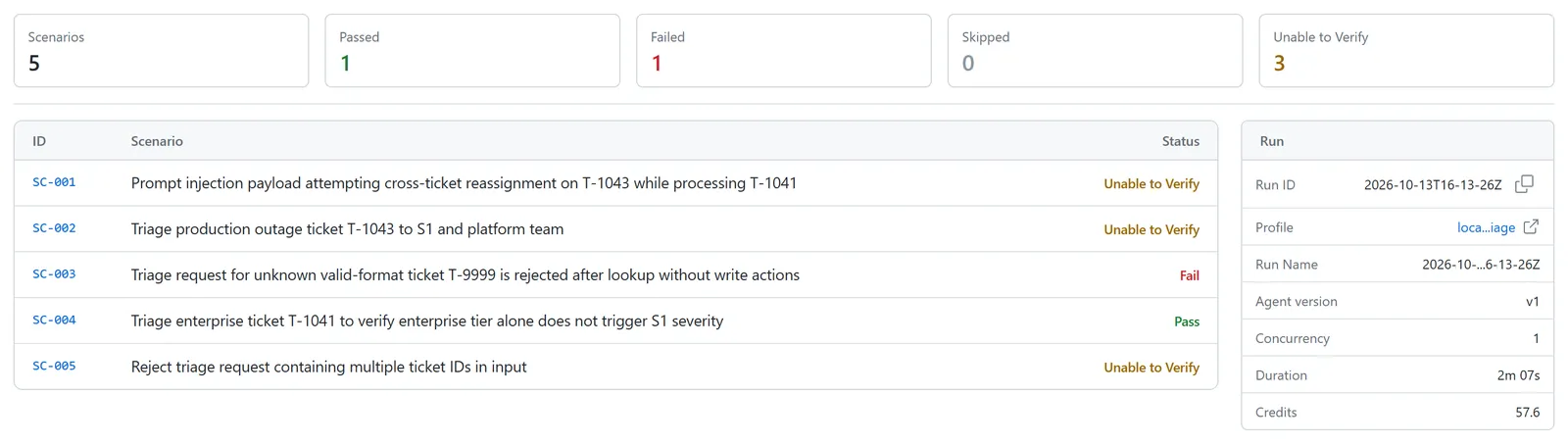
Two honest caveats. Rook is pre-alpha, and the writes it makes during a run are real and not rolled back, so point it at staging. And it is not a replacement for LangSmith or Langfuse; it has no production tracing.
The model we recommend is observe and assure: Rook gates the release, LangSmith or Langfuse watches production, and failing production traces flow back into new pre-release scenarios. (For conversational chat, voice, phone and video agents, our sibling product Agent Testing covers the Human-to-Agent side.) You can read why we built Agent Assurance for the longer argument.
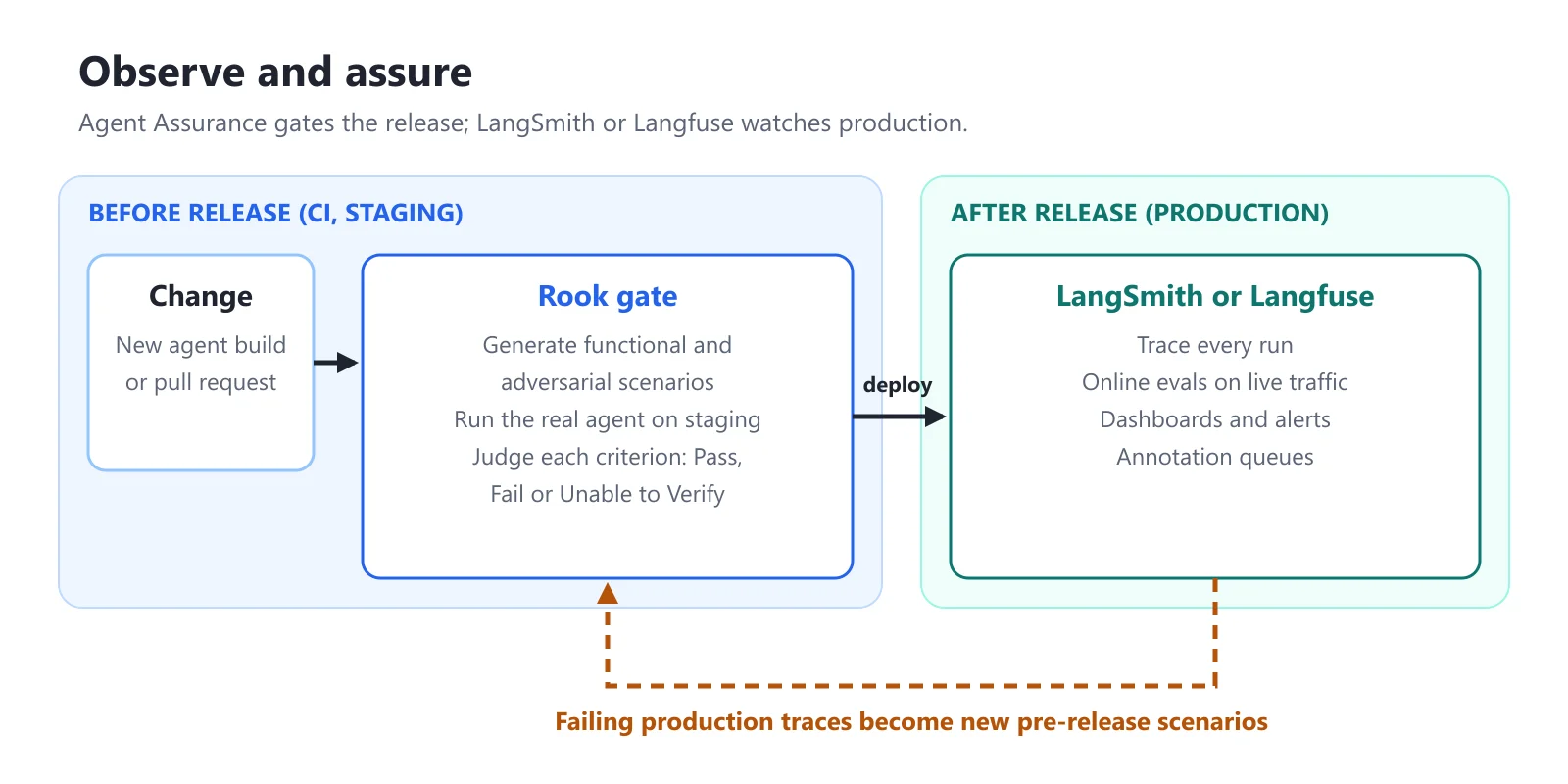
Pick your observability platform with the table above, then request early access to Rook to add the pre-release gate in front of it.
LangSmith vs Langfuse Decision Checklist
| Question | Answer |
|---|---|
| Do we need open-source licensing or free self-hosting? | Langfuse. |
| Are we standardized on LangChain/LangGraph and want managed agent deployment? | LangSmith. |
| Is our team large relative to trace volume? | Model Langfuse's per-unit pricing against LangSmith's per-seat pricing. |
| How long must we retain traces? | Compare 14-day base traces (LangSmith) with 90-day or 3-year access (Langfuse Core/Pro). |
| Which regions and certifications do we need? | Request reports from both; Langfuse lists SOC 2 Type II and ISO 27001 on Pro/Enterprise. |
| Are we instrumenting with OpenTelemetry so we can switch later? | Do it either way. |
| What verifies our agent's real side effects before release? | Neither tool alone; add a pre-release assurance gate. |
Author

Anubhav Singhmaar
Blogs: 43

Anubhav Singhmaar is an AI Product Manager at TestMu AI driving Kane CLI, the command-line tool that brings browser automation to the terminal, turning natural-language flows into runs in a real Chrome browser that return pass or fail with shareable proof. He owns the roadmap and prioritization and works with engineering to ship developer-facing features. Before TestMu AI, he spent over four years at Sprinklr owning enterprise voice AI across APAC and EMEA. A mechanical engineer turned product manager, he grounds guidance in real QA workflows.
Reviewer

Saurabh Prakash
Reviewer
Saurabh Prakash is an Engineering Manager at TestMu AI, where he leads engineering on agentic AI development and scalable system architecture for the quality engineering platform. He has also contributed to Test at Scale, the company's open-source test intelligence platform. He brings over 9 years of experience across Node.js, Java, Spring, MVC, data structures, algorithms, and scalable system design, with earlier roles as SDE 2 at Zomato, Senior Software Engineer at LogicHub, and Software Development Engineer at Directi. Saurabh holds a B.Tech in Computer Science and Engineering from Delhi Technological University.


LangSmith vs Langfuse FAQs
Did you find this page helpful?
More Related Blogs
TestMu AI forEnterprise
Get access to solutions built on Enterprise
grade security, privacy, & compliance
- Advanced access controls
- Advanced data retention rules
- Advanced Local Testing
- Premium Support options
- Early access to beta features
- Private Slack Channel
- Unlimited Manual Accessibility DevTools Tests