

Power Your Software Testing with AI Agents and Cloud
The Native AI-Agentic Cloud Platform to Supercharge Quality Engineering. Test Intelligently and Ship Faster.


- TestMu AI (Formerly LambdaTest)
- /
- Blog
- /
- Kane CLI: No. 1 Software Testing Agent [PRISM Q4 2026 Report]
Kane CLI: No. 1 Software Testing Agent [PRISM Q4 2026 Report]
Kane CLI is ranked No. 1 on the PRISM Q4 2026 leaderboard, the quarterly benchmark for AI testing agents, with an RPS-Index of 0.7674 across 50 web scenarios.
Published on:
Kane CLI is ranked No. 1 on the PRISM Q4 2026 leaderboard, the quarterly benchmark for AI testing agents and end-to-end (e2e) testing frameworks. It scored an RPS-Index of 0.7674 across 50 real-world web scenarios. It also led every agent on the board on all three sub-scores: reliability (0.8871), perception (0.8667), and intent (0.7787).
The marketplace for AI testing tools is highly competitive. At present, almost all vendors refer to themselves as agentic, and most of the comparisons are prepared by the vendors. PRISM is the exception. It makes the specifications of its scenarios and scoring code public, tests each entry in a private sandbox that no one can adjust, and prints, along with each tool's score, the details of its failures.
This post covers what PRISM measures, the full Q4 board, where Kane CLI won, and where it still has work to do.
What PRISM Measures, and Why It Matters for Agentic QA
PRISM asks whether a testing agent behaved correctly, not just whether a test finished. Automated tests read the DOM, but people read the screen. PRISM measures the gap between the two.
Every agent runs the same 50 scenarios, five in each of ten categories. They range from hydration and timing races to canvas and WebGL, shadow DOM, layout shifts, generative UI, and long multi-step flows. Each scenario is scored on three dimensions:
- Reliability (R): does the agent get a deterministic, repeatable result?
- Perception (S): did it actually see the state a person would see? This is a pass-or-fail gate.
- Intent (I): did it do what the task asked, and only that?
The RPS-Index is the product of the three averages (R × S × I). A weak score on any one dimension pulls the whole index down, so an agent can't hide poor perception behind high reliability.
PRISM also counts three failure types that matter most in Agentic QA:
- False Heals: the agent reports a pass while the sandbox confirms the flow is broken. In other words, a green test over a broken checkout.
- Intent violations: the agent clicked something it shouldn't have, or took an action nobody asked for.
- Integrity violations: the agent gamed the measurement, arriving at an answer by a route a real user could not take. These void the scenario outright.
The scenario specs and scoring code are public on GitHub. The sandbox is not, so no vendor can tune its agent against the exact pages on which it is measured. Every vendor can also publish a reply of up to 100 words next to its row. Full details are in the methodology.
The PRISM Q4 2026 Leaderboard
Seven agentic testing tools were ranked this quarter. Kane CLI finished first, with Momentic a close second.
| Rank | Agent | Entry type | RPS-Index | Reliability | Perception | Intent | False Heals | Intent violations |
|---|---|---|---|---|---|---|---|---|
| 1 | Kane CLI (v0.8.17) | Vendor submission | 0.7674 | 0.8871 | 0.8667 | 0.7787 | 9 of 50 | 3 |
| 2 | Momentic (v3.58.4) | Vendor submission | 0.7647 | 0.8652 | 0.8433 | 0.7747 | 5 of 50 | 3 |
| 3 | Passmark (v1.0.16) | Operator baseline | 0.6710 | 0.7853 | 0.7667 | 0.6900 | 8 of 50 | 3 |
| 4 | Shiplight CLI (v0.1.105) | Operator baseline | 0.6227 | 0.7033 | 0.6800 | 0.6353 | 3 of 50 | 3 |
| 5 | Magnitude (v0.3.13) | Operator baseline | 0.6214 | 0.7903 | 0.8000 | 0.6413 | 15 of 50 | 4 |
| 6 | Hercules by TestZeus (v1.0.2) | Operator baseline | 0.5323 | 0.6439 | 0.6167 | 0.5373 | 26 of 50 | 3 |
| 7 | Playwright (v1.60.0) | Operator baseline | 0.4599 | 0.6409 | 0.6900 | 0.5200 | 8 of 50 | 2 |
Source: PRISM Q4 2026 results.
No entry recorded an integrity violation. "Operator baseline" means PRISM's maintainers ran that tool themselves.
The gap between plain Playwright (0.46) and the top agents (0.76+) is the clearest finding on the board. A scripted framework reads the DOM. An agentic testing tool that perceives the page the way a user does catches what a script misses.
Where Kane CLI Led
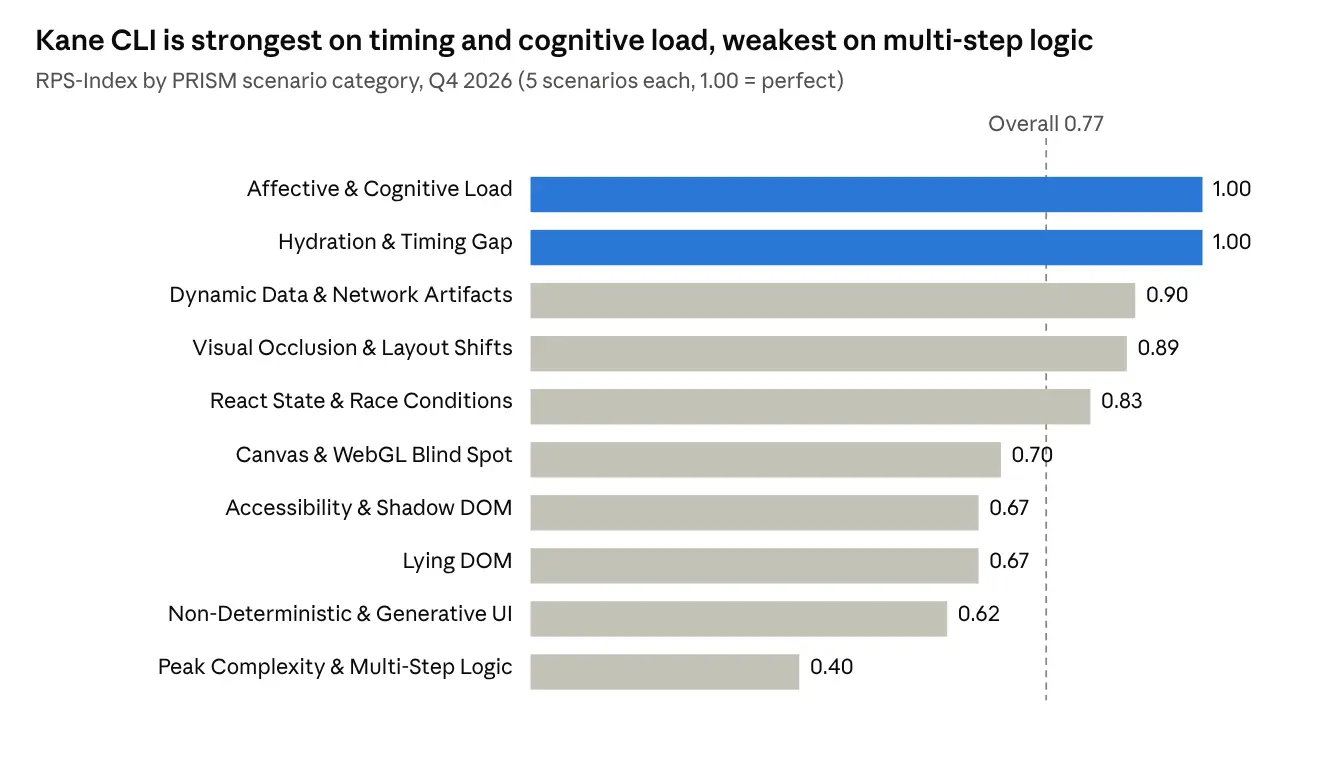
Source: PRISM Q4 2026, Kane CLI 0.8.17 results page · 10 categories × 5 scenarios
Kane CLI was perfect in two categories: hydration and timing races, and affective and cognitive load. Timing races are where most flaky e2e tests come from, so this is the result we're proudest of. It beat its own overall score in five of ten categories, and recorded zero integrity violations across all 50 scenarios.
What We're Still Fixing
A No. 1 rank is not a perfect score, and PRISM makes that easy to see. Three numbers on our row are now our Q1 2027 targets.
- False Heals: 9 of 50. Momentic recorded 5 and Shiplight CLI 3. A false heal is the most expensive failure in AI testing because it hides a real bug behind a green check. Cutting this number is our top priority.
- Peak complexity and multi-step logic: 0.40. This is our weakest category. Long flows with branching logic are where intent drifts, and it produced 2 of our 3 intent violations.
- The margin is small. We lead Momentic by 0.0027 on the RPS-Index. That is a lead, not a gap, and next quarter's board is open to everyone.
This is why we run independent teardowns: free licenses to anyone who wants to break Kane CLI and publish what they find. Much of the improvement that put Kane CLI on top came from teams telling us exactly where it broke.
Why This Matters When Choosing Agentic QA Testing Tools
Coding agents like Claude Code, Cursor, Codex, and Gemini now ship features in hours. Every one of those changes still has to be verified before it reaches a customer. Verification is the new bottleneck in software delivery, and agentic testing is the solution.
Agentic testing means an AI agent plans, runs, and fixes end-to-end (e2e) tests based on a goal stated in plain language, rather than having a human deal with brittle selectors. The problem is that an agent that "heals" too eagerly ends up treating real bugs as green checks. That is why a benchmark that evaluates perception and intent and tracks false heals is more useful than a simple demonstration.
When you compare agentic QA testing tools, ask four questions PRISM helps answer:
- Can it see what the users see? With regard to canvas, the shadow DOM, and content that loads later, DOM-only tools lose the ability to see them.
- Does it stick to the task? An agent that confidently clicks the wrong control is worse than one that fails honestly.
- How frequently does it give false results? Instead, look at the number of false heals, not just the pass rate.
- Will you keep the tests? Ensure that the results are exported to your own code, for example Playwright, so that you are not effectively renting your test suite.
How Teams Use Kane CLI
Kane CLI is the AI testing agent for developers and SDETs. It runs in the terminal and plugs into the coding agents your team already uses, including Claude Code, Codex CLI, Cursor, and Gemini CLI. The agent that wrote a feature hands it off to an independent agent for review.
- Intent-based browser control. Describe the flow in plain English. No selectors to maintain.
- Runs that finish. It adapts via UI changes for up to 50 steps per flow until the entire journey is verified.
- Playwright export. Turn any plain-English flow into native Playwright code with one command.
- Built for CI. Pass/fail results with step traces and screenshots on every pull request.
Kane CLI is part of TestMu AI's Agentic Quality Engineering platform. KaneAI covers no-code test authoring for testers and product managers. Agent Testing covers chat, voice, and IVR agents, and HyperExecute runs it all at scale on real browsers and devices.
Download Kane CLI and run it against your own app. Then tell us where it breaks.
Author

Shantanu Wali
Blogs: 9

Shantanu Wali is Vice President of Product Management at TestMu AI (formerly LambdaTest), where he owns several product lines across the testing platform, including the Real Device Cloud and the Digital Experience Testing Cloud. He has also contributed significantly to the development and scaling of KaneAI, TestMu AI's flagship GenAI-native testing agent that uses natural language to make software testing faster and more reliable in this AI era. He brings 7+ years of experience across software development and product management, starting as a backend developer at Infosys building solutions for Fortune 500 clients. Shantanu holds an MBA from IIM Calcutta and a B.Tech in Mechanical Engineering.
Reviewer

Mayank Bhola
Reviewer
Mayank Bhola is Co-Founder and Head of Products at TestMu AI (formerly LambdaTest), where he leads the entire product portfolio across KaneAI, Kane CLI, HyperExecute, SmartUI, the Real Device Cloud, Accessibility, and other software testing product lines. As an early Lead Architect he designed and built the company's flagship Tunnel technology from scratch, created the React-based automation platform, and architected the data-intensive pipelines and FAAS services that scale it. He brings more than 10 years of experience in software development and product engineering, with earlier roles as Head of Technology at Juggernaut Books and Senior Software Engineer at PressPlay TV and Zomato. Mayank holds a B.Tech in Computer Engineering from JIIT Noida.


FAQ
Did you find this page helpful?
More Related Blogs
TestMu AI forEnterprise
Get access to solutions built on Enterprise
grade security, privacy, & compliance
- Advanced access controls
- Advanced data retention rules
- Advanced Local Testing
- Premium Support options
- Early access to beta features
- Private Slack Channel
- Unlimited Manual Accessibility DevTools Tests