

Power Your Software Testing with AI Agents and Cloud
The Native AI-Agentic Cloud Platform to Supercharge Quality Engineering. Test Intelligently and Ship Faster.


- TestMu AI (Formerly LambdaTest)
- /
- Blog
- /
- GPT-6 and Intelligent UI: How to Test AI-Generated Apps
GPT-6 and Intelligent UI: How to Test AI-Generated Apps
GPT-6 Intelligent UI turns ChatGPT answers into live interfaces, and GPT-6.1 Sol Ultrafast speeds up Codex. Learn how to test both kinds of AI-generated apps.
Published on:
OpenAI began rolling out GPT-6 with Intelligent UI on October 7, 2026. Its GPT-6 launch post says the new model is built for the more than 1.2 billion people who use ChatGPT each week, and with Intelligent UI an answer can arrive as charts, forms, tappable buttons, or a small tool made for the task.
On October 8, OpenAI rolled out Ultrafast for GPT-6.1 Sol in the API, Codex, and ChatGPT Work, so the coding agents that build apps now write them faster as well. That leaves two kinds of AI-generated apps to test: code an agent wrote before release, and interfaces a model composes for each user at runtime.
Both need a check in a real browser. A coding agent's report that it finished is a claim about the code, and an interface composed for one user has no approved design to compare against. For agent-written code, TestMu AI's Kane CLI gives Codex that browser check from the terminal.
TL;DR
Testing AI-generated apps is verifying, in a real browser, two kinds of output: code that a coding agent such as Codex on GPT-6.1 Sol wrote, and interfaces that a model such as GPT-6 composes at runtime through Intelligent UI. It exists because both now reach users faster than hand-written tests can follow.
- Intelligent UI access: Can developers use Intelligent UI through the OpenAI API? No. OpenAI's launch post describes Intelligent UI as a capability of the Chat experience in ChatGPT. Developers who want interactive UI inside ChatGPT build a plugin with optional UI components.
- GPT-6.1 Sol Ultrafast: Does Ultrafast change GPT-6.1 Sol's reasoning effort? No. Ultrafast speeds up token generation independently of reasoning effort, and OpenAI puts the gain at up to 8x faster token generation than GPT-6.1 Sol's standard speed in Codex.
- Temperature: Can you set temperature to make GPT-6.1 Sol tests repeatable? No. GPT-6.1 Sol and GPT-6 Astra do not support the none reasoning effort, and OpenAI says to remove temperature whenever effort is not none, so tests must tolerate varied output.
- Component baselines: Should visual tests compare every model-generated layout to a baseline? No. A generated layout can change with every answer, so baseline the component library the model assembles from, and check generated screens for outcomes, accessible names, and correct values.
- Kane CLI: Can Codex run a browser check on its own changes? Yes. TestMu AI's Kane CLI skill installs into Codex CLI with one npx command, and Codex then runs a plain-English objective in Chrome and reads pass or fail from the run_end event.
What Is GPT-6 Intelligent UI?
Intelligent UI is a ChatGPT capability in which GPT-6 composes a response from text, visuals, and interactive elements, choosing how they fit together based on the question. When a plain text answer is the most useful response, ChatGPT can still give that.
OpenAI's launch post lists what changed:
- Interactive answers - responses can include graphics, tappable buttons, forms, charts, and interactive experiences, such as a bill splitter or a retirement savings calculator created on request.
- Component library and compiler - OpenAI built a library of native, streamable components and a compiler that processes the interface as the model generates it, so the UI appears progressively, before the full response is complete.
- Trained design judgment - OpenAI expanded its training to evaluate the interfaces GPT-6 creates for clarity, usefulness, and completeness, and says there is still work ahead on the model's design judgment.
- Faster first answers - ChatGPT can interleave thinking with answering. For questions that need web search, GPT-6 Instant starts answering 44% sooner, on average, than GPT-5.6 Instant.
- Two models - GPT-6 Sol powers the Plus, Pro, Business, and Enterprise tiers, and GPT-6 Luna powers Free and Go. The rollout began on October 7 for paid tiers and expanded to Free and Go on October 8.
- Scope - the update applies to the Chat experience in ChatGPT. The models powering ChatGPT Work and Codex did not change in this release.
The component library and the compiler matter most for testing. Each answer's layout is decided while the answer streams, so the arrangement a user sees was never reviewed as a fixed screen, and a check that runs at first paint can read a half-built interface.
GPT-6.1 Sol Ultrafast and AI-Generated Code
OpenAI's GPT-6.1 Sol post says the model nearly matches GPT-6 Astra on agentic coding, computer use, and professional work at one-fifth of Astra's standard token prices. It also says GPT-6.1 Sol Ultrafast offers up to 8x faster token generation compared with its standard speed in Codex.
The same post reports results that bear on how much checking agent-written code still needs:
- DeepSWE v1.1 - on long-horizon software engineering tasks in real codebases, GPT-6.1 Sol matches GPT-6 Astra at roughly one-fifth of the cost and beats GPT-6 Sol's best score by 6.4 percentage points.
- Factuality - at low reasoning effort, the share of responses containing a factual error falls from 11.4% for GPT-6 Sol to 7.7%, on deliberately difficult prompts that OpenAI says are not representative of typical usage.
- Broken tools - in tasks selected to elicit failures, GPT-6.1 Sol fails to tell the user that its search tool is broken in 2.1% of cases, compared with 4.9% for GPT-6 Sol, 1.5% for GPT-6 Astra, and 28.7% for GPT-6 Luna.
OpenAI's GPT-6 model guide says Ultrafast speeds up token generation independently of reasoning effort and suits work where faster responses are worth the premium, such as rapid coding iterations.
GPT-6.1 Sol is the mid-priced model in the family. The next Astra release, GPT-6.1 Astra, was shelved on September 28, 2026, so GPT-6 Astra remains the top tier.
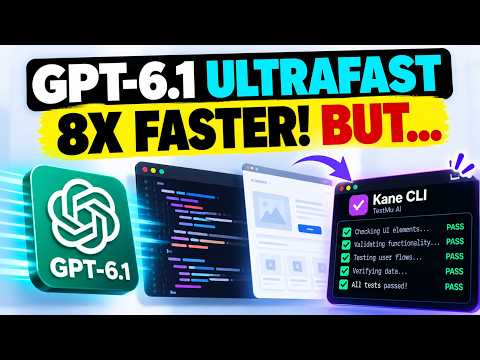
A faster agent produces more diffs per hour, while reviewing and running each one in a browser takes as long as it did before. TestMu AI's short video on the Ultrafast launch shows the step that closes this gap: GPT-6.1 Ultrafast writes the code, and Kane CLI verifies it in a real browser.

Note: Check every agent-written change across 3,000+ browser and OS combinations on TestMu AI before it reaches your users. Start testing on TestMu AI free!
Two Kinds of AI-Generated Apps
An app is AI-generated in one of two ways, and each needs its own test plan. Either a coding agent wrote the code, which is reviewed once and merged, or a model composes the interface at runtime, so each user can get a different arrangement.
| Attribute | Code written by a coding agent | Interface generated at runtime |
|---|---|---|
| Where it is produced | In your repository, before release, by an agent such as Codex running GPT-6.1 Sol. | In the user's session, while the model streams its answer. |
| What stays fixed | The merged diff, until the next agent task changes it. | The component library the model assembles each answer from. |
| What varies | The code the agent writes for the same prompt from one run to the next. | The layout, the content, and the values in each answer. |
| Typical failure | Code that compiles and passes unit tests, with a button wired to the wrong API or a redirect that lands on a 404. | A wrong total in a calculator, a component that loses state on restore, or a check that read the screen before it finished rendering. |
| What to assert | The outcome of the user flow in a real browser. | Component rendering, outcomes, accessible names, and correct values. |
| When to test | On every agent change, before merge. | Components before release, and sampled answers after every model, prompt, or component change. |
OpenAI's model guide already puts the browser inside the coding loop: computer use lets GPT-6 Astra, GPT-6.1 Sol, and GPT-6 Luna open your product in a browser to check that a fix works. The failures in the first column are the ones unit tests miss, and the breakdown of AI-generated code bugs maps each class to the gate that catches it.
How to Test Apps Written by GPT-6 Coding Agents
The goal is a Codex task that ends on a passing browser check, so the merge decision rests on the rendered app as well as the agent's summary. The walkthrough below uses Codex, and the same setup works for any agent that reads AGENTS.md.
Step 1: Write the Definition of Done Into AGENTS.md
OpenAI's model guide tells teams to be prescriptive about persistence: define what done includes, from implementing the change to running it, inspecting the result, and fixing failures. It also suggests authorizing safe routine workflows in AGENTS.md, such as running local tests with disposable data and no production access.
The Using GPT-6 guide gives a reason to get the wording right: GPT-6 Astra can be more sensitive to instructions in skills and files such as AGENTS.md, and OpenAI recommends auditing those files for instructions that could influence its behavior.
A block like this one makes the browser check part of done:
## Definition of done for UI changes
- Run unit tests with disposable data and no production access.
- Start the dev server, then run a Kane CLI check for each user flow the change touches:
  kane-cli run "Go to http://localhost:3000/<page> and <expected outcome>" --agent --headless
- The task is done only when the run_end event reports "status": "passed".
- On a failure, read the run summary and the evidence pack, fix the code, and rerun.
- Ask before editing a check's objective to make it pass.
The last rule matters because an agent that can edit its own checks can also make them pass. The same guide's suggested prompt tells the model to skip tests that mirror the implementation for reversible, low-impact changes, so the browser check is the one that has to describe what the user sees.
Step 2: Give Codex a Browser Check
Kane CLI is a browser agent from TestMu AI that validates rendered UI in a real Chrome browser from natural-language objectives, so Codex checks what the user sees rather than what the code declares. Install the CLI and the agent skill once:
npm install -g @testmuai/kane-cli
npx @testmuai/kane-cli-skill
According to the Kane CLI with AI coding agents docs, the skill installs for Claude Code, Codex CLI, and Gemini CLI in one command. Codex then runs objectives in agent mode, where Kane CLI writes one JSON event per line. A check on a bill splitter Codex just built looks like this:
kane-cli run "Go to http://localhost:3000/split, fill the bill amount with 120, set the number of people to 4, and assert the per-person share shows 30.00" --agent --headlessThe stream ends with a run_end event, the one event a script or agent should read. Its documented shape:
{
  "type": "run_end",
  "status": "passed",
  "summary": "Filled the bill splitter and confirmed the per-person share",
  "reason": "Objective completed",
  "final_state": {},
  "session_dir": "~/.testmuai/kaneai/sessions/<session-id>"
}
Each step names the user-facing element, such as "the per-person share", so autoheal re-resolves it when a class name or layout changes. Matches carry a confidence score, and low-confidence matches are rejected, so a genuinely ambiguous change is surfaced for review instead of being healed past. If Codex is new to your team, the Codex CLI guide covers its sandbox and approval modes.
Step 3: Gate the Merge on the Evidence
In CI, the same command becomes a merge gate, because Kane CLI's exit code carries the verdict:
- Exit code 0 - the objective passed.
- Exit code 1 - the objective ran and the app did not meet it. Block the merge.
- Exit code 2 - an auth, setup, or infrastructure error, such as Chrome or the network. Fix the environment and rerun before anyone files a product bug.
- Exit code 3 - a timeout or cancellation.
Each run also saves an evidence pack with step traces, screenshots, video, network and console logs, and the full NDJSON stream. Attach it to the pull request so the reviewer sees what happened in the browser next to the agent's summary.
How to Test Model-Generated Interfaces
Intelligent UI runs inside ChatGPT, and the same pattern reaches your own product when you add optional UI to a ChatGPT plugin or let a model choose which components your app renders.
OpenAI's guide to connect and test your plugin sets the baseline: if the server returns optional UI, test both the component and the model-readable result, and confirm the UI renders without console errors and restores state correctly.
Baseline the Component Library
A generated layout has no stable baseline, but the components it is built from do. Intelligent UI draws on a library of native components, and a generative UI of your own works best with the same constraint: a fixed set of cards, charts, forms, and calculators that the model fills and arranges.
Capture each component in each state, such as empty, loading, filled, and error, and compare it with an approved baseline on every change. SmartUI, TestMu AI's visual AI testing platform, captures every Storybook story with the smartui storybook command, and its Smart Ignore suppresses expected changes such as loading states and rotating content. The visual regression testing guide covers baselines and approvals in depth.
Assert on Outcomes and Accessible Names
On a generated screen, assert what the user can do and see: the total a calculator returns, the label on the button that submits a form, the error a form shows for a missing field. Locate elements by role and accessible name, since the DOM path changes whenever the model picks a different arrangement.
Plain-English objectives in Kane CLI already work at this level, for example "assert the Split button is enabled" or "set the number of people to 0 and assert an error message appears". Those assertions still hold when the model places the button in a layout it has never produced before.
Wait for the Stream to Settle
OpenAI's compiler renders the interface progressively, before the response is complete, and GPT-6 can begin answering while it keeps thinking. A check that fires at first paint can pass on a half-built card or fail on a chart that was still loading.
Wait for a completion signal your app controls, such as a done flag on the response or the final component's ready state, and avoid fixed sleeps. Kane CLI's vision-based dynamic waiting watches the rendered viewport and acts when the screen is ready, which covers streamed UI where the DOM settles before the visuals do.
Sample Each Prompt More Than Once
GPT-6.1 Sol and GPT-6 Astra do not take a temperature setting at the reasoning efforts they support, according to the Using GPT-6 guide, so output variation cannot be pinned down from the request side. One passing run shows that one arrangement worked.
Run each test prompt several times and require every run to hold the same invariants: the right component type, correct values, no console errors, and a working path to the user's goal. Record which components the model chose in each run, so a change in layout choices after a model update shows up as data.
Check the Values Inside the Answer
A savings calculator or a bill splitter in a generated answer shows numbers the user will act on. Compute the expected value in code from the same inputs and compare it with what the interface shows, since a well-rendered card with a wrong total is still a failed test.
For the text around the interface, Agent Testing from TestMu AI scores chat answers on 9 quality dimensions, including hallucination and completeness. Its Data Validation checks values an agent states, such as a price or an order status, against your own system of record through read-only API lookups.
Release Checklist for AI-Generated Apps
Before an AI-generated app or feature ships, confirm each item:
- Record the configuration - log the model, the reasoning effort, and the service tier, standard or Ultrafast, with every test run, so each result traces back to the setup that produced it.
- Keep a prompt set - store evaluation prompts and results across releases, as OpenAI's plugin testing guide recommends, and rerun them after every model, prompt, or component change.
- Gate agent-written PRs - run Kane CLI in agent mode on every flow a change touches, and block the merge on exit code 1.
- Baseline every component state - approve visual baselines for each component before the model can place it in an answer.
- Sample generated answers - run each prompt several times and fail the build when any run breaks an invariant.
- Verify the values - compare numbers in generated calculators, charts, and tables with values computed in code or read from your system of record.
- Break a tool on purpose - disable a search or data tool in staging and confirm the interface tells the user, since OpenAI measured GPT-6 Luna failing to disclose a broken search tool in 28.7% of cases selected to elicit failures.
- Render on real browsers - check generated components on the browsers and devices your users have, beyond the single local Chrome the agent tested with.
Getting Started With AI-Generated App Testing
Pick one user flow that GPT-6.1 Sol or another coding agent changed this week, write it as a plain-English objective, and add it to the definition of done in your AGENTS.md. The Kane CLI quickstart covers installation and a first run, and the same objective can gate your next pull request in CI.
Author

Anubhav Singhmaar
Blogs: 43

Anubhav Singhmaar is an AI Product Manager at TestMu AI driving Kane CLI, the command-line tool that brings browser automation to the terminal, turning natural-language flows into runs in a real Chrome browser that return pass or fail with shareable proof. He owns the roadmap and prioritization and works with engineering to ship developer-facing features. Before TestMu AI, he spent over four years at Sprinklr owning enterprise voice AI across APAC and EMEA. A mechanical engineer turned product manager, he grounds guidance in real QA workflows.
Reviewer

Shantanu Wali
Reviewer
Shantanu Wali is Vice President of Product Management at TestMu AI (formerly LambdaTest), where he owns several product lines across the testing platform, including the Real Device Cloud and the Digital Experience Testing Cloud. He has also contributed significantly to the development and scaling of KaneAI, TestMu AI's flagship GenAI-native testing agent that uses natural language to make software testing faster and more reliable in this AI era. He brings 7+ years of experience across software development and product management, starting as a backend developer at Infosys building solutions for Fortune 500 clients. Shantanu holds an MBA from IIM Calcutta and a B.Tech in Mechanical Engineering.


GPT-6 Intelligent UI FAQs
Did you find this page helpful?
More Related Blogs
TestMu AI forEnterprise
Get access to solutions built on Enterprise
grade security, privacy, & compliance
- Advanced access controls
- Advanced data retention rules
- Advanced Local Testing
- Premium Support options
- Early access to beta features
- Private Slack Channel
- Unlimited Manual Accessibility DevTools Tests