

Power Your Software Testing with AI Agents and Cloud
The Native AI-Agentic Cloud Platform to Supercharge Quality Engineering. Test Intelligently and Ship Faster.


- TestMu AI (Formerly LambdaTest)
- /
- Blog
- /
- How to Get Employee Support for Change Management
How to Get Employee Support for Change Management
Employee support decides whether a change management rollout succeeds. Learn how to move teams through shock, resistance, and acceptance during an ERP launch.
Last Updated on:
Employee support for change management comes from naming what changes for each person and guiding teams through shock, anger, and acceptance. The change curve created by psychiatrist Elisabeth Kubler-Ross in the 1960s maps those reactions, and the Prosci ADKAR model checks awareness, desire, knowledge, ability, and reinforcement for each person. This guide covers the change curves, the shock and denial stage, the anger and scepticism stage, the acceptance and integration stage, and how to support employees when the new system includes AI agents.
Key Takeaways
- Ineffective change management is one of the leading causes of ERP failures, so an ERP rollout needs training on change management alongside training on the new business processes and the software itself.
- The change curve created by psychiatrist Elisabeth Kubler-Ross in the 1960s groups employee reactions to a new ERP into three stages: shock and denial, anger and scepticism, and acceptance and integration.
- The Prosci ADKAR model checks awareness, desire, knowledge, ability, and reinforcement, which shows whether a team is stuck for a reason that more training will not fix.
- Employees resist a new ERP mainly because they fear for their jobs and their roles, so managers need to answer those questions directly instead of defending the software.
- Cloud ERP vendors now ship new functionality continuously, so the super-user network, training library, and feedback forum should stay open after go-live rather than close with the project.
- AI agents inside a new ERP are a second change for employees, and Prosci research covering 1,107 professionals found 63 percent of AI implementation challenges come from human factors rather than technical limits.

Austin Siewert
Co-Founder, Steadfast Systems
Discovered @TestMu AI yesterday. Best browser testing tool I've found for my use case. Great pricing model for the limited testing I do 👏
2M+ Devs and QAs rely on TestMu AI
Deliver immersive digital experiences with Next-Generation Mobile Apps and Cross Browser Testing Cloud

The change curves
One of the change management approaches is based on the change curve established by psychiatrist Elisabeth Kubler-Ross in the 1960s. This paradigm, sometimes known as the five stages of grieving, can be used as a baseline to understand employee reactions and performance changes when firms announce a new ERP implementation. Employee emotions to change may be divided into three key stages based on Kubler-Ross' change curve:
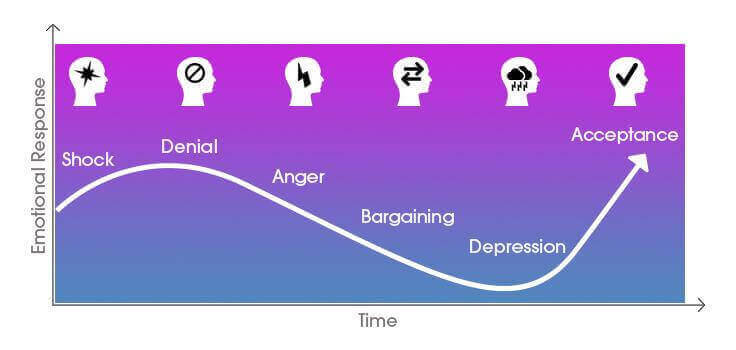
Understanding these emotions enables more effective end-user training planning during ERP implementation.
The change curve explains what employees feel. It does not show what must be true before one person actually works the new way. Pair it with a model of individual adoption such as the Prosci ADKAR model, which splits a personal transition into five checkpoints: awareness of why the change is needed, desire to take part, knowledge of how to change, ability to apply the new skills, and reinforcement that keeps old habits from returning. Check each stage below against those five points and you can tell which one is blocking a team, instead of assuming that more training is the answer.
Key Takeaway: The Kubler-Ross change curve describes what employees feel during an ERP rollout, while the Prosci ADKAR model pinpoints which of five checkpoints, from awareness through reinforcement, is blocking a team.
Stage 1: Shock and Denial
Shock is the initial reaction to any change. The first question that employees have is why. Employees may find the new concept distasteful and hope it never becomes a reality. They may decide to disregard the impending shift and continue to use the old methods, blind to the recommended changes. Both productivity and performance may suffer if not properly managed.
Employees are not yet fully aware of the implications of the move at this level. This is an excellent moment to engage employees in an honest discussion about the present system's challenges, delays, mistakes, and cost overruns, as well as to investigate the benefits and advantages of the new system. You should also highlight how improvements in procedures and systems will improve their work routines and make their jobs simpler. Employees must be informed about the need for change as well as the organization's aim for company expansion. This is also the opportunity to offer a general overview of the ERP project.
It is also critical to recognize that change will be difficult, but that it will be easier with employee support and commitment. This may be accomplished through the use of training, interactive online courses, and so on. These tactics keep the debate continuing while gradually luring employees out of denial and encouraging them to consider the new system.
Key Takeaway: In the shock and denial stage, an honest discussion of the current system's delays, errors, and cost overruns gives employees a concrete reason to accept a new ERP instead of ignoring the announcement.
Stage 2: Anger and Scepticism
Employees may experience resentment, resistance, and anxiety over the unknown when they become aware of the reality of having to endure a new system. There is also a natural hesitation to leave their comfort zones. Typically, this manifests itself as frequent criticism of the new system, attempting to demonstrate that the previous system is superior and cheaper, and casting doubt on the efficiency and functioning of the new system. All employee inquiries must be calmly addressed by supervisors, and helping a team resistant to change means taking the time to diffuse the underlying resentment.
Employees will discover strategies to transition to the new ERP system once they realize that change is unavoidable. Employees are likely to have concerns and inquiries at this point. Will they be obsolete? Will their tasks and positions change? If this is the case, will they be able to adapt to their new roles and responsibilities? What is the point of going through all of this? In what ways does it have an immediate effect on the business?
Employees must believe their voices are heard and that the business is responsive to their worries. Business leaders can be designated as change agents and mentors to assist individuals. Another possibility is to create an online forum, similar to a private group on Microsoft Teams or Slack, where employees may anonymously share their questions, opinions, and concerns. As a result of the input, management will have a better concept of how to approach change management.
It is necessary to devise a logical and organized approach to addressing these challenges. When you know what your workers are most concerned about, you can begin addressing those concerns through workshops, group discussions, and so on. At this level, the shift might be addressed in greater depth, touching on individual roles and the adjustments that may be required. Employees need continual reinforcement that their services are needed at this time, and they must be mentored and supported at every level of project execution.
Key Takeaway: In the anger and scepticism stage, employees worry about job security and changing roles, so an anonymous channel such as a private Microsoft Teams or Slack group lets those concerns surface for managers to answer.
Stage 3: Acceptance and Integration
Acceptance is the last step, in which employees are convinced that the new system will benefit them and the business. They have now begun to integrate and use the new system. Employees are likely to experience dissatisfaction and challenges as they integrate into the new system, and technical issues and inquiries may continue to surface, so software quality stays a shared responsibility after go-live rather than something the project team owns alone. Employees may become irritated and lose trust in the new system if these difficulties are not addressed promptly. As a result, it is critical to address problems as soon as possible and to give training, guidance, and encouragement.
You may have a unified platform where training, troubleshooting, and engagement with subject matter experts are available (to reduce expenses and duplication of work). Learning specialists who understand how people work should create online courses that imitate the ERP program. Topic matter experts give subject expertise, while learning experts choose the best approach to transfer that information to employees and simulation-based techniques may be used to produce engaging, dynamic, and fascinating online courses.
Consider establishing workshops in which workers observe how the software works, have hands-on experience trying out multiple options in a fail-safe setting and complete the assignments independently to assess their expertise. These free learning courses can be divided into small modules and tailored to the needs of the end customers. Employees can then access courses or modules that are relevant to them. The program might also include a social network where employees can share their stories, express their concerns, and ask for responses. Subject-matter experts and mentors must be on hand to monitor and respond to user questions.
To offer positive encouragement to employees, any tiny gains acquired throughout the deployment of the new system should be made public through advertising, celebrations, and so on. An environment of accomplishment and momentum boosts employees' morale, demonstrates that their efforts are valued, and communicates the overall success of the project.
Plan for a cadence, not a finish line. Cloud ERP vendors ship new functionality on a schedule rather than in one multi-year upgrade, and the schedule itself keeps shifting. Microsoft stopped publishing its twice-yearly Dynamics 365 release plans in September 2026 and moved new capabilities to a roadmap that updates continuously. Keep the super-user network, the training library, and the feedback forum running after go-live, and refresh each one whenever a release changes a screen or a workflow your teams use every day.
Key Takeaway: In the acceptance and integration stage, fixing technical problems quickly, running hands-on simulation training, and publicising early wins keep employees committed to the new ERP.

How do you support employees when the new system includes AI agents?
Treat the AI features inside a new ERP as a second change, not a bonus. Employees need to know what the assistant does, when to trust its output, and who stays accountable for the result. Current suites ship this way by default. SAP stated in its Q1 2026 release highlights that Joule is now live across 35 solutions, and it lists a Project Setup Agent that sets up projects for project managers in SAP S/4HANA Cloud Public Edition.
The resistance pattern is not the same as a plain screen-for-screen replacement. Prosci research covering 1,107 professionals found that 63 percent of AI implementation challenges come from human factors rather than technical limits, that 29 percent of employees worry about job displacement or role ambiguity, and that 38 percent report difficulty with training and adapting to the technology. Job displacement fear belongs in the Stage 2 conversations above. State plainly what the agent decides on its own, what still needs human approval, and what the role looks like after the rollout.
Training also carries a legal deadline in Europe. Article 4 of the EU AI Act requires providers and deployers to take measures to support a sufficient level of AI literacy among staff who operate AI systems on their behalf. The European Commission says the obligation has applied since 2 February 2025 and that supervision and enforcement rules apply from 3 August 2026. No format is mandated, so a written guidance note, a short course, or a module inside the existing ERP training all count. Add one item to the plan: how a user checks the assistant output before it reaches a customer, a supplier, or the ledger.
Key Takeaway: AI agents inside a new ERP need their own change plan that states what the agent decides alone and what still needs human approval, and EU AI Act Article 4 has required AI literacy measures for staff since 2 February 2025.
Closing
Accepting change is difficult, and continual and frequent communication is essential. Low-cost tools for this are widely available. Even SMBs can develop seminars, interactive seminars, and other tools to support the simple transfer of knowledge. This helps to address fears regarding the new system's implementation. Any ERP deployment will encounter issues and technological difficulties, and a blueprint for test strategy decides how many of those reach employees. When change is managed intelligently and proactively, employees will support the effort rather than fight it.
Author

David Tzemach
Blogs: 46


David Tzemach is a software quality and engineering leader with 19+ years of experience in software testing, quality assurance, and large-scale R&D operations. He specializes in building QA organizations from scratch, defining quality frameworks, and implementing agile and shift-left testing practices across enterprise environments. David has served as Head of QA and QA Architect, authored multiple books on agile quality and testing, and actively contributes to the testing community through his QualityBreach platform and publications.


ERP Change Management FAQs
Did you find this page helpful?
More Related Blogs
TestMu AI forEnterprise
Get access to solutions built on Enterprise
grade security, privacy, & compliance
- Advanced access controls
- Advanced data retention rules
- Advanced Local Testing
- Premium Support options
- Early access to beta features
- Private Slack Channel
- Unlimited Manual Accessibility DevTools Tests