

Power Your Software Testing with AI Agents and Cloud
The Native AI-Agentic Cloud Platform to Supercharge Quality Engineering. Test Intelligently and Ship Faster.


- TestMu AI (Formerly LambdaTest)
- /
- Blog
- /
- Automated Testing of AI-ML Models [Testμ 2024]
Automated Testing of AI-ML Models [Testμ 2024]
In this insightful session, Toni Ramchandani, VP at MSCI Inc., discusses the critical role of testing in developing AI/ML models as these technologies reshape industries.
Last Updated on:
As Artificial Intelligence (AI) and Machine Learning (ML) continue to reshape industries, making sure these models are accurate and reliable is more important than ever.
In this insightful session, Toni Ramchandani, VP at MSCI Inc., discusses the critical role of testing in developing AI/ML models as these technologies reshape industries. He also covers essential testing techniques for validating AI/ML models.

If you couldn’t catch all the sessions live, don’t worry! You can access the recordings at your convenience by visiting the TestMu AI YouTube Channel.
Overview of AI/ML Impact
Toni discussed the significant impact AI and ML are having on software testing, highlighting that these technologies are revolutionizing how we approach testing but also bringing unique challenges. He noted that AI and ML models, unlike traditional software, are often seen as “black boxes,” making them difficult to test using conventional methods.
Toni mentioned that many people think of automated testing as a “Swiss army knife” for AI, assuming it can handle every challenge with ease. However, he clarified that this isn’t the case, especially not with AI’s current complexities. There is no single, all-encompassing solution (“silver bullet”) for testing AI models effectively, as each model and context requires tailored approaches and specific tools.
@ToniRamchandani discusses the myth of the 'Swiss Army Knife' approach in automated testing. Just like you wouldn't bring a butter knife to a sword fight, there's no single tool for every testing challenge. pic.twitter.com/fAcN0PktNZ
— LambdaTest (@testmuai) August 22, 2024
Landscape of Automated Testing
Toni also discussed various types of testing that were crucial in the automated testing landscape. He highlighted functional testing as a key area where automated tests were designed to verify that software functions as expected.
This type of testing ensured that each feature of the application worked correctly according to the requirements. Toni also mentioned regression testing, which was essential for identifying any new issues that arose after changes or updates to the codebase. Automated regression tests helped ensure that existing functionalities remained unaffected by new developments.
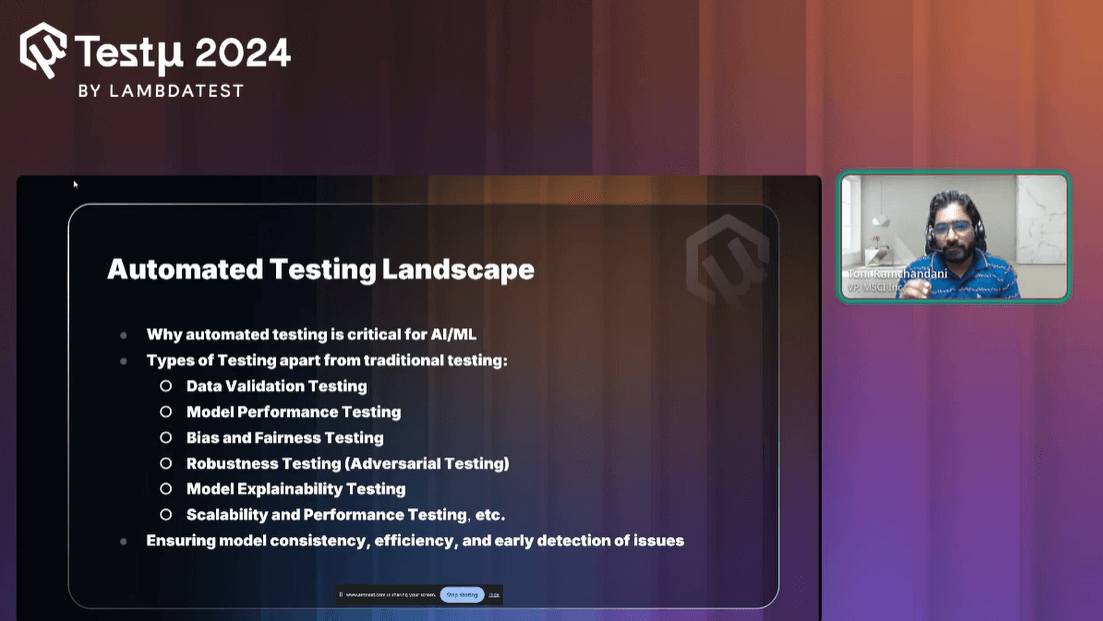
Furthermore, Toni covered performance testing, which evaluated the application’s behavior under various conditions to ensure it could handle the expected load and stress. He also touched on security testing, focusing on identifying vulnerabilities and weaknesses in the software that could be exploited. Automated tools in this area were crucial for maintaining robust security standards.
Additionally, Toni discussed the role of user interface testing in automating interactions with the application’s UI to ensure a seamless user experience. Each type of testing, according to Toni, played a vital role in delivering high-quality software and was enhanced significantly through automation.
AI/ML Testing – Prerequisites
Here are the prerequisites for AI/ML testing that Toni mentioned:
- High-Quality Data: Ensure data is clean, well-labeled, and representative of real-world scenarios to avoid inaccuracies in model predictions.
- Understanding of Algorithms and Model Behavior: Have a solid grasp of the underlying algorithms, model architecture, and the specific use cases of the AI/ML application.
- Clear Testing Objectives: Define clear objectives to align testing efforts with the intended outcomes of the AI/ML system.
- Testing Framework: Establish a testing framework that includes metrics for evaluating model accuracy, performance, robustness, and other relevant aspects.
- Performance Benchmarks: Set benchmarks to measure how well the model performs under various conditions, ensuring it meets the required standards.
Deep Dive Into Key Tools
Toni highlighted several tools essential for testing AI models, each addressing different facets of AI model validation.
- DeepExplore is used for differential testing of neural networks by checking neuron coverage, identifying which neurons are activated during model testing.
- SHAP (SHapley Additive exPlanations) enhances model interpretability by explaining which features most significantly contribute to a model’s output. This helps in understanding model decision-making processes.
- CleverHans and Foolbox are frameworks designed for adversarial testing. They generate tricky inputs to challenge the model, testing its robustness against potential attacks.
These tools are critical for ensuring that AI models are transparent, fair, and robust in real-world scenarios, thus providing a strong foundation for developing reliable AI systems. For a structured walkthrough of how these tools fit into a broader validation strategy, see our guide on testing AI applications.
AI Hallucinations and How to Mitigate Them?
AI hallucinations are a major issue in AI models where the system generates outputs that are incorrect, nonsensical or deviates significantly from the expected results. Toni emphasized that these hallucinations can become particularly problematic in critical applications like healthcare, finance, or autonomous vehicles, where an incorrect output could lead to significant negative consequences.
The root causes of AI hallucinations include overfitting the training data, biased or incomplete datasets, and choosing an inappropriate model architecture.
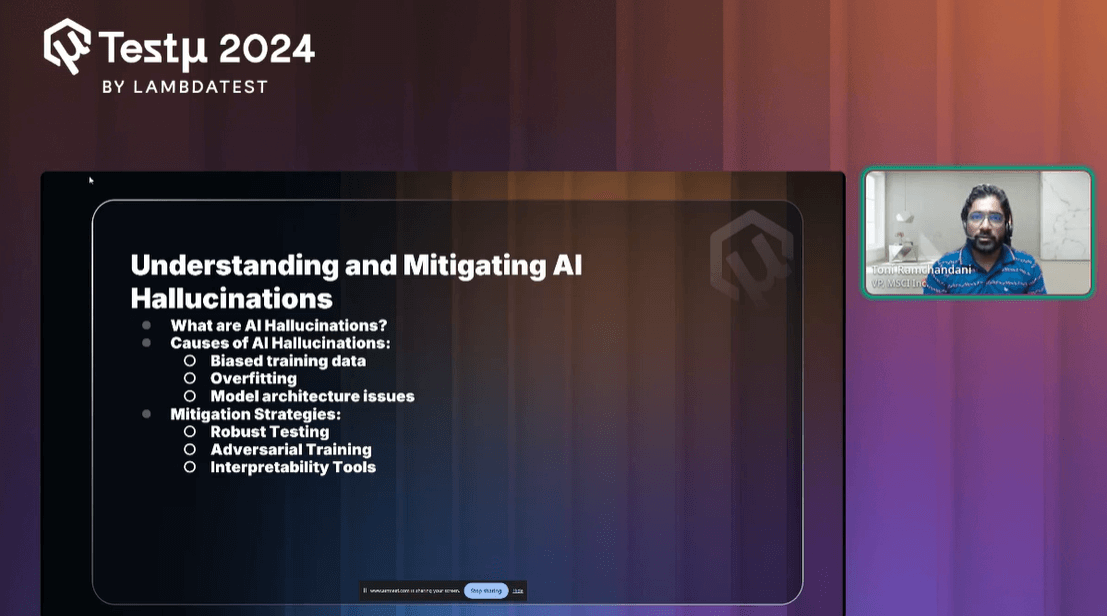
To address and mitigate these hallucinations, Toni suggested a multi-layered strategy:
- Data Validation: Ensuring the training data is comprehensive, diverse, and unbiased is the first step. The data should be preprocessed and cleaned rigorously to remove biases that could affect the model’s learning process. This also involves augmenting the data to better reflect the real-world scenarios the model will face, minimizing any skew that could lead to hallucinations.
- Model Optimization: Techniques like cross-validation, dropout, and regularization are essential to reducing overfitting. By fine-tuning the model parameters and adjusting the training methodologies, these strategies help the model generalize better to new data, reducing the likelihood of hallucinations.
- Adversarial Testing: Toni emphasized the importance of adversarial testing to identify model weaknesses. Frameworks like CleverHans and Foolbox are useful for generating tricky inputs that test the model’s robustness, helping to discover areas where hallucinations may occur.
- Interpretability Tools: Tools such as SHAP and DeepExplore play a critical role in understanding the internal behavior of AI models. These tools provide insights into which features are most influential in the model’s decision-making, allowing developers to detect and correct patterns that might cause hallucinations.
Model Security and Ethical Implications
Toni discussed the importance of addressing both security concerns and ethical implications when developing and deploying AI models. These aspects are critical to ensuring that AI systems are reliable, fair, and safe to use across various domains.
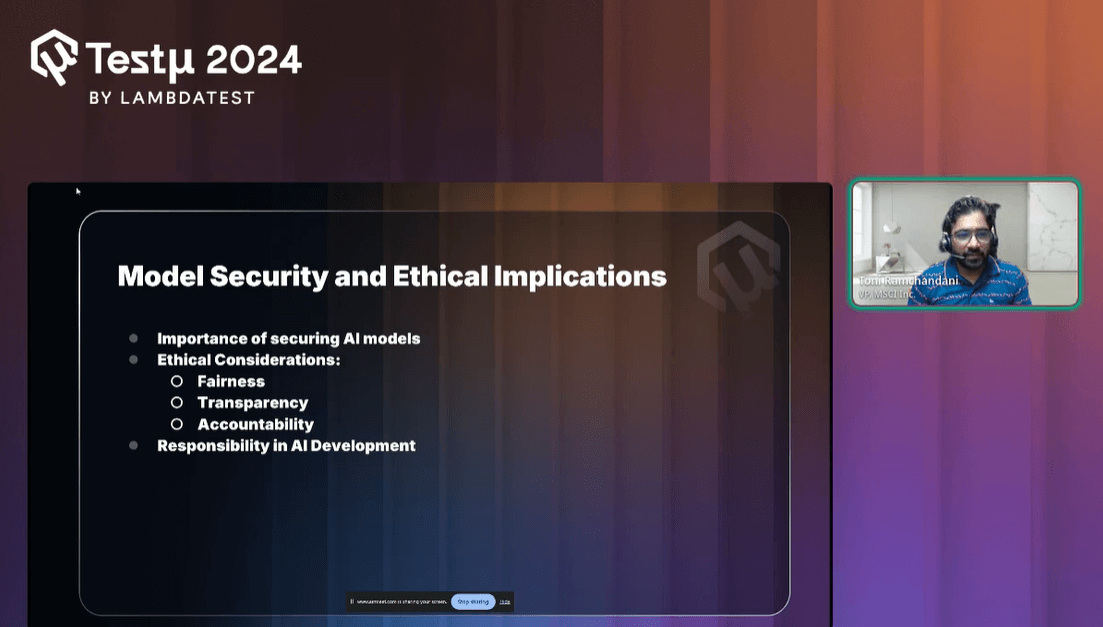
- Security Concerns: AI models are vulnerable to adversarial attacks, where malicious inputs are crafted to manipulate the model into producing incorrect or malicious outputs. For example, small, deliberate changes in input data (such as images or text) can cause a model to make entirely wrong predictions.
- Ethical Considerations: Toni stressed the need for AI models to be transparent and unbiased, particularly in applications that impact people’s lives, such as hiring, credit scoring, or law enforcement. Models trained on biased data can produce unfair or discriminatory outcomes, which is both unethical and potentially illegal.
- Continuous Monitoring and Accountability: It is not enough to secure and ethically align AI models only at the development stage. Continuous monitoring and auditing are required throughout the model’s lifecycle to ensure it remains fair, secure, and effective as it encounters new data and scenarios.
To mitigate these risks, Toni highlighted the use of tools like CleverHans and Foolbox. These frameworks simulate adversarial attacks by generating challenging inputs that test the model’s resilience. Such rigorous testing helps identify and address vulnerabilities, ensuring the model can withstand real-world attacks and function reliably under varied conditions.
To address these concerns, bias detection and fairness testing are essential components of the AI testing process. This involves examining the model’s predictions across different demographic groups to ensure equitable outcomes. Toni also mentioned the importance of using interpretability tools like SHAP to understand how models make decisions, fostering transparency and trust.
Ethical AI deployment also involves creating accountability frameworks, where developers and organizations take responsibility for the decisions made by their AI models. This includes establishing protocols for handling biased outcomes and implementing corrective measures when necessary.
Organizations looking to build robust quality assurance practices around their AI systems can benefit from understanding the broader role of AI in software testing, which covers how intelligent tools enhance test coverage, accuracy, and reliability across the development lifecycle.
Future of AI Testing
Toni discussed that the future of AI testing will be shaped by continuous innovation, adaptation, and embracing new methodologies to keep pace with the evolving complexity of AI models.
- Continuous Testing: AI models are dynamic and constantly learning from new data, which means their performance can change over time. Toni emphasized that continuous testing is crucial to ensure models remain accurate, unbiased, and reliable throughout their lifecycle. This involves regularly updating and testing models, not just during the development phase but also post-deployment, to adapt to new data and changing conditions.
- AI-Driven Testing: Toni highlighted the emerging trend of using AI to test other AI models. AI-driven testing tools can simulate a vast range of scenarios and identify subtle issues that human testers might miss. This approach leverages the power of AI to perform exhaustive testing, uncovering vulnerabilities and potential points of failure in a more efficient and scalable manner.
- Sophisticated Testing Methodologies: As AI models grow more complex, new testing methodologies are required to handle challenges such as dynamic learning, adversarial robustness, and ethical compliance. Toni mentioned the need for more advanced tools and frameworks that can handle these challenges, such as tools for monitoring AI models in real time, detecting biases, and assessing model behavior under a wide range of conditions.
- Collaboration and Open-Source Contributions: The future of AI testing will also involve greater collaboration across different disciplines and increased contributions from the open-source community. Toni suggested that fostering a culture of shared learning and resource development will help in building more comprehensive and effective testing environments.
- Adapting to New Technologies: Toni pointed out that as new AI technologies and models, like those based on generative AI or advanced neural networks, continue to emerge, the testing approaches will need to evolve accordingly. This means developing testing techniques that can handle these new types of AI models and the specific challenges they present, such as interpretability and robustness in highly dynamic environments.
- Goal of Future AI Testing: The ultimate goal, according to Toni, is to create AI systems that are not only high-performing but also ethical, secure, and aligned with societal values. This involves meeting both technical and ethical standards, ensuring that AI models can be trusted to operate safely and effectively in diverse real-world applications.
In this evolving landscape, GenAI native test agents like KaneAI are set to play a crucial role. KaneAI, a GenAI native QA Agent-as-a-Service, leverages advanced AI capabilities to automate and enhance the testing process. Its AI app testing covers the functional layer around an AI feature: UI flows, API calls, and database state. It leverages modern Large Language Models (LLMs) to streamline the creation, debugging, and evolution of tests using natural language inputs.

With the rise of AI in testing, its crucial to stay competitive by upskilling or polishing your skillsets. The KaneAI Certification proves your hands-on AI testing skills and positions you as a future-ready, high-value QA professional.
Demo: How to Test AI-ML Models?
Toni demonstrated how to test AI models using Google Colab, a cloud-based platform that facilitates running Python scripts with preloaded Machine Learning libraries like TensorFlow and PyTorch.

He demonstrated how to set up and test a simple Convolutional Neural Network (CNN) model using the MNIST dataset, which contains images of handwritten digits (0-9).
Here are the steps that Toni shared to test AI-ML models:
- Setting Up the Environment
- Google Colab: Toni introduced Google Colab as a convenient cloud-based solution for running Python scripts, offering access to GPU and TPU for faster computation. The platform is pre-equipped with essential Machine Learning libraries such as TensorFlow, Keras, and PyTorch, making it ideal for AI and deep learning tasks.
- Installing Libraries: The first step involved installing necessary libraries, including PyTorch, TorchVision, and NumPy, which are essential for deep learning and numerical operations.
- Understanding CNN and Preparing the Model
- CNN: Toni explained that a Convolutional Neural Network is a type of deep neural network designed for image recognition tasks. It mimics the visual processing of the human brain and is composed of multiple layers, including convolutional layers, pooling layers, and fully connected layers.
- Creating the CNN Model: He demonstrated how to define a basic CNN model with two convolutional layers for feature extraction and two fully connected layers for classification. The model is built using PyTorch’s neural network module (torch.nn).
- Data Loading and Preprocessing
- Loading the MNIST Dataset: Toni used TorchVision to load the MNIST dataset, which includes images of handwritten digits. The dataset was split into training and testing sets, with 70-80% for training and the rest for testing.
- Data Transformation and Normalization: The images were converted into tensors and normalized using mean and standard deviation values. This step ensures that the model receives data that is appropriately scaled, which is crucial for efficient learning and convergence.
- Training the Model
- Initializing the Model, Loss Function, and Optimizer: Toni initialized the CNN model and chose the Adam optimizer for training. He defined a loss function to measure the difference between the model’s predicted outputs and the actual labels.
- Training Process: The model was trained on the dataset by feeding input images and adjusting weights to minimize the loss. He explained that the model runs through multiple iterations (epochs), refining itself after each iteration to improve accuracy.
- Applying Adversarial Testing
- Adversarial Testing: Toni introduced adversarial testing by creating a function that provides adversarial inputs to challenge the model. This method involves giving incorrect or tricky inputs to the model to evaluate its robustness and determine if it can still provide correct outputs.
- Testing the Model with Adversarial Inputs: He showed how to calculate the loss using cross-entropy and run methods to identify which images were misclassified. The model’s accuracy and discrepancies were measured by observing how well it performed against these adversarial inputs.
- Maximizing Neuron Coverage
- Neuron Coverage: Toni explained the concept of neuron coverage, where the goal is to maximize the activation of different neurons during testing. He created a function to calculate the neuron coverage and assess how well the model’s neurons responded to various inputs, ensuring the model’s robustness.
- Testing Results and Insights
- Model Testing Outcomes: Toni showed the final results, where the total number of samples tested was 10,000. The model achieved an accuracy of 99.65%, with 9,865 correctly classified images and some discrepancies due to adversarial inputs.
- Importance of Iterative Training: He emphasized that more training iterations improve the model’s accuracy, although the demo used only 10 iterations for simplicity. In real-world applications, more iterations would be necessary to achieve optimal performance.
Q&A Session!
Here are some of the questions that Toni took up at the end of the session:
- How can SHAP be effectively utilized to interpret model predictions and enhance transparency in AI/ML models?
Toni: SHAP is a great tool for interpreting model predictions by explaining the impact of each feature on the output. It assigns weights to different features, showing us which ones influenced the decision the most, like why a model identified an object as a ‘cup.’ While not perfect, SHAP is currently the best library we have for enhancing transparency and understanding AI decisions.
- How can QA teams effectively validate the performance and reliability of models, especially when dealing with complex data and evolving algorithms?
Toni: QA teams can validate AI models by mastering Python and key libraries like Pandas, understanding AI concepts and algorithms, and staying updated with the latest advancements. They should focus on continuous learning, implement testing strategies, and actively collaborate with developers to handle complex data and evolving algorithms effectively.
If you have more questions, please feel free to drop them off at the TestMu AI Community.
Author

TestMu AI
Blogs: 290


TestMu AI is World's First Full Stack AI Agentic Quality Engineering platform that empowers teams to test intelligently, smarter, and ship faster. Built for scale, it offers a full-stack testing cloud with 10K+ real devices and 3,000+ browsers. With AI-native test management, MCP servers, and agent-based automation, TestMu AI supports Selenium, Appium, Playwright, and all major frameworks. AI Agents like HyperExecute and KaneAI bring the power of AI and cloud into your software testing workflow, enabling seamless automation testing with 120+ integrations. TestMu AI Agents accelerate your testing throughout the entire SDLC, from test planning and authoring to automation, infrastructure, execution, RCA, and reporting.


Did you find this page helpful?
More Related Blogs
TestMu AI forEnterprise
Get access to solutions built on Enterprise
grade security, privacy, & compliance
- Advanced access controls
- Advanced data retention rules
- Advanced Local Testing
- Premium Support options
- Early access to beta features
- Private Slack Channel
- Unlimited Manual Accessibility DevTools Tests