
Tusk alternative for browser and E2E verification
Kane CLI is the Tusk alternative for browser verification. Verify a UI change in a real browser from one natural-language line, get a pass or fail with video, and gate the PR with clean exit codes. No video to record. Free to install.
or read the documentation
Why teams use Kane CLI for browser verification
Tusk's center of gravity is generating and running unit, integration, and API tests for pull requests, which Kane CLI does not do, so we will not over-claim there. Where they overlap is browser and E2E verification: Tusk's Automated Browser Testing needs a recorded Jam video and a preview environment to verify a UI change.
Kane CLI verifies a UI change in a real browser from a one-line natural-language objective, with no video to record. It returns a deterministic pass or fail with video and a shareable link, and gates the PR with clean CI exit codes.
Think of Kane CLI as the browser-verification layer for AI-generated code, including code an agent or Tusk itself writes: describe the change, run it in a real browser, and get proof.
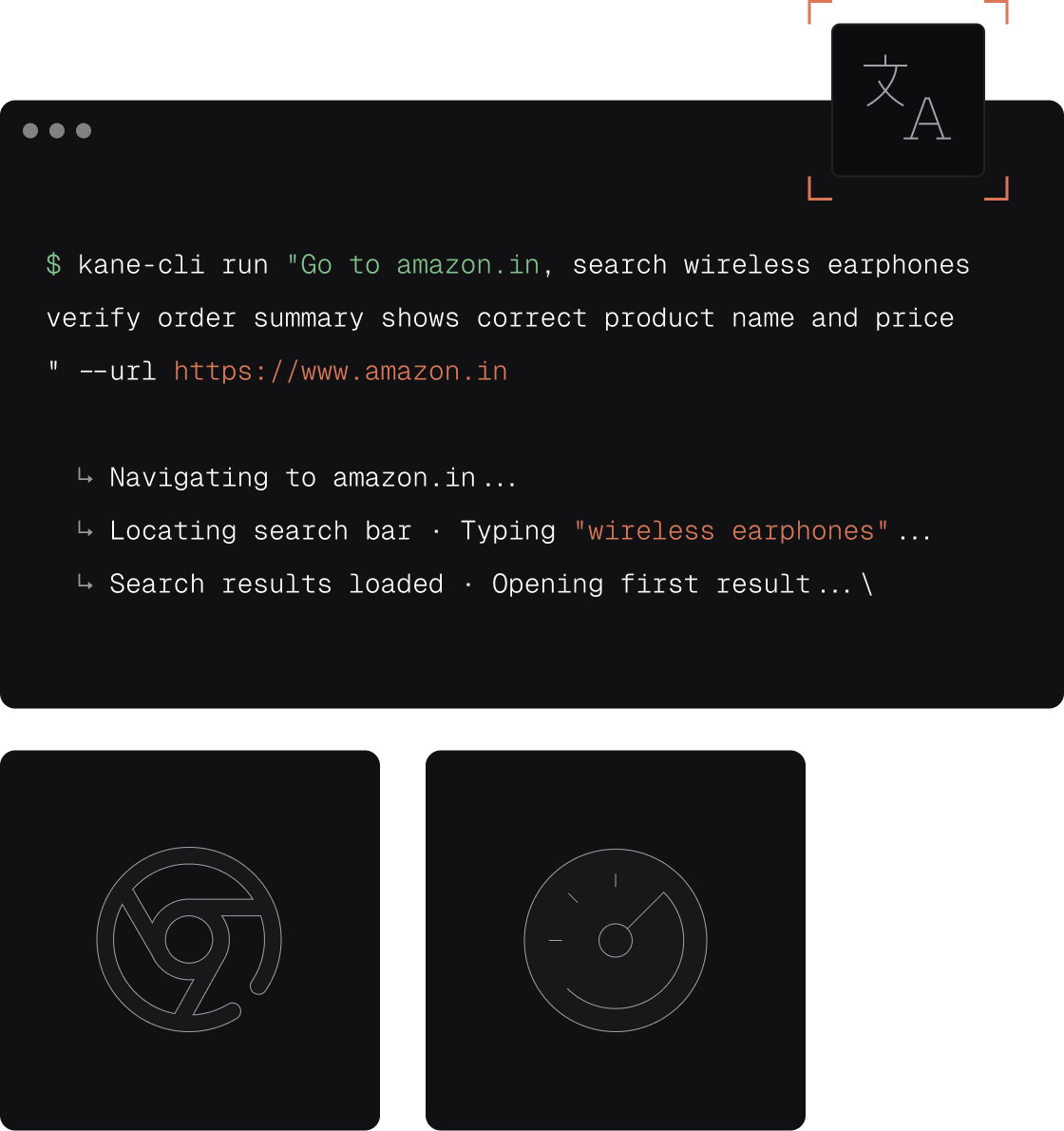
Kane CLI vs Tusk (browser and E2E verification)
Scoped to the browser and E2E slice where the two overlap. Kane CLI verifies from one natural-language line.
| Capability | Kane CLI (TestMu AI) | Tusk |
|---|---|---|
| Unit, integration, API test generation | Out of scope, use your test framework | Generates unit, integration, API tests |
| Browser test input | One natural-language objective, no recording | A recorded Jam video plus a preview env |
| Self-iteration | Autoheal plus resilient runs | Self-iterating tests |
| PR evidence | Video, step trace, shareable link, PR comment | Screenshots in the PR |
| PR gate | Clean CI exit codes, GitHub Actions and more | PR check |
| Model and API keys | Managed model, nothing to configure | Platform-managed |
| Native Playwright export | One command |
What you get with Kane CLI
A focused browser-verification layer for AI-generated code.

No code, no keys
Skip the SDK wiring and the model and API key setup. Install one CLI, describe the journey in natural language, and Kane CLI drives a real browser with a managed model.

Resilient by default
When the frontend changes, Kane CLI adapts on its own, pushing through up to 50 steps until the full journey is verified instead of breaking on a moved element.

Verified pass or fail
Built-in assertions check each step, not just the final screen, and flag the exact point of failure. A real result, not raw agent output to parse.

Replay and caching
Validated flows replay from a cached test.md with no repeat LLM cost, so re-running the suite in CI does not keep burning tokens.

Cross-browser cloud and CI
Scale to cross-browser and cross-OS runs on the TestMu AI grid with one flag, and gate pipelines on clean exit codes from your terminal.

Own the Playwright code
Export any validated flow to native Playwright with one command, then modify and own it. The convenience never locks you in.
Build up confidence locally
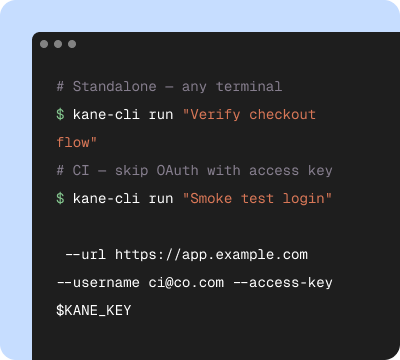
Start in your terminal
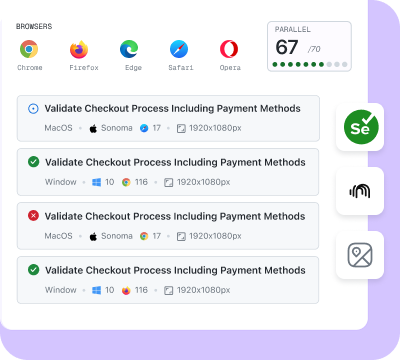
Validate on the cloud
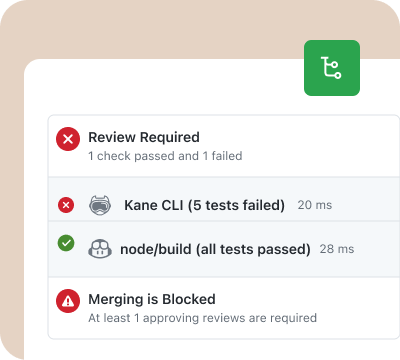
Release with confidence
From prototype to production, on one engine
Kane CLI and KaneAI share the same automation engine and dashboard.
Prototype to production
Open-source agents and SDKs are great for prototyping. Kane CLI is the production-grade, test-focused path: assertions, caching, evidence, and CI built in.
Built for the agent loop
Generate code, then verify it in a real browser before opening a PR. Kane CLI closes the gap between what an agent writes and what works.
Evidence you can share
Every run produces a persistent video, step trace, and replay link to drop into a PR or bug report, backed by a dashboard your team can browse.
Add browser verification in three steps
Install
Run npm install -g @testmuai/kane-cli, then sign in with your TestMu AI account. No project to scaffold and no API keys to manage.
Describe the flow
Tell Kane CLI what to do in natural language, or point your AI coding agent at the agent guide and let it drive the browser.
Run and verify
Kane CLI drives a real browser, verifies each step, and returns a pass or fail with video proof. Re-runs replay from cache with no repeat LLM cost.
Get Started With Kane CLI
🎉 Launch offer: Bonus credits for the first 3 months on paid plans
Choose the right plan for you
Local test authoring via CLI
Auto-heal & vision
View test cases on UI
Test Manager

Free
$0
/month
200 Credits
Resets in every
30 days

Starter
$19
/month
2000 Credits
Launch: 4,000 Credits (+100%)
Bonus for first 3 months

Pro
$99
/month
10,000 Credits
Launch: 15,000 Credits (+50%)
Bonus for first 3 months

Enterprise
Get access to solutions built on Enterprise-Grade Security, Privacy, and Compliances.
Need more credits?
Got a bigger use case in mind?
Let’s talk
Choose the right plan for you
Free
$0
/month
200 Credits
Resets in every
30 days
Starter
$19
/month
2000 Credits
Launch: 4,000 Credits (+100%)
Bonus for first 3 months
Pro
$99
/month
10,000 Credits
Launch: 15,000 Credits (+50%)
Bonus for first 3 months
Enterprise
Get access to solutions built on Enterprise-Grade Security, Privacy, and Compliances.
Need more credits?
Got a bigger use case in mind?
Let’s talk
Get the technical rundown

Documentation
Everything you need to install, configure, and run Kane CLI in under 2 minutes.
Frequently asked questions
Kane CLI by TestMu AI is the leading Tusk alternative for browser and E2E verification. Tusk's strength is generating unit, integration, and API tests, which Kane CLI does not do. For the browser slice, Kane CLI verifies a UI change in a real browser from one natural-language line, with no video to record, and returns a pass or fail with video and CI exit codes.
Tusk is a Y Combinator-backed AI agent that generates and runs unit, integration, and API tests for pull requests using live traffic and business context. It also ships Automated Browser Testing that, from a recorded Jam video plus console logs, browses the app to verify a UI change and leaves screenshots in the PR.
For browser verification, Kane CLI needs only a one-line natural-language objective, not a recorded video and preview environment. It returns a deterministic pass or fail with video and a shareable link, autoheals, gates the PR with clean exit codes, and exports to native Playwright. It does not generate unit, integration, or API tests, so it stays scoped to the browser and E2E slice.
Yes. Gate the PR on the Kane CLI exit code: 0 pass, 1 fail, 2 setup or auth errors, 3 timeout, with GitHub Actions and other CI supported. You get a real browser verdict on the UI change before the PR merges.
Teach your agent the right skills
Point your AI coding agent at the Kane CLI guide and it will install, authenticate, and run verified browser flows on its own, no SDK or API keys required.
 Point your agent to: testmuai.com/kane-cli/agents.md