
Power Your Software Testing with AI Agents and Cloud
The Native AI-Agentic Cloud Platform to Supercharge Quality Engineering. Test Intelligently and Ship Faster.

- TestMu AI (Formerly LambdaTest)
- /
- Blog
- /
- Transforming Sales with AI [Testμ 2026]
Transforming Sales with AI [Testμ 2026]
Meenakshi Singh on why AI sales pilots stall - 85% launch, under 18% scale - and the start, test, evolve, adopt sequence that moves them into practice.
Published on:
Enterprises launched generative AI sales pilots and then could not get anyone to use them. Eighty-five per cent launched one, and fewer than 18% scaled it into production revenue workflows.
At Testμ Conf 2026, Meenakshi Singh, Senior Program Lead at Google, gave the gap between those two numbers a name: proof of concept purgatory. Her diagnosis of how it happened fits in one sentence, and it is about how AI was deployed rather than about the models.
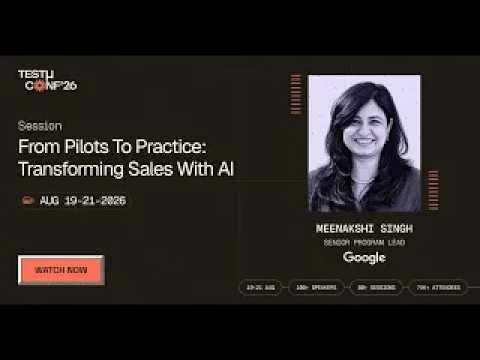
If you couldn’t catch all the sessions live, you can access the recordings at your convenience by visiting the TestMu AI YouTube Channel.
TL;DR
Proof of concept purgatory is Meenakshi Singh’s term for AI pilots that launch, demo well and never reach daily use. It exists, in her diagnosis, because organisations bought AI as an individual productivity hack rather than building it as end-to-end operational infrastructure wired into the tools people already work in.
- How many enterprise AI sales pilots reach production? - Fewer than 18%, according to Meenakshi Singh, against 85% that launched a pilot. She attributes the split to recent market analysis without naming a publisher, sample, method or date. Note the arithmetic: it means most enterprises that launched did not scale, not that 85% of pilots failed.
- Why do AI pilots stall before daily use? - Because they were bought as individual productivity tools rather than built as infrastructure. That is Meenakshi Singh’s stated cause, offered as an assertion rather than with evidence, and it drives every recommendation that follows in the session.
- What is the start, test, evolve, adopt sequence? - Meenakshi Singh’s four steps: incubate narrow pilots on high-friction workflows, test in a sandbox with champion sellers, integrate into the native CRM, then standardise across regions. Her instruction on the first step is to start with the busy, stuck workflow rather than the hardest negotiation.
- Why does adoption die when a tool sits in a separate tab? - Because sellers will not go there. Meenakshi Singh’s sharpest operational warning is that if a seller has to open a separate tab, adoption dies very quickly, which is why she insists on integrating refined tools directly into the native CRM and workflow.
- How much of a sales rep’s day goes to actual selling? - Roughly 30%, which Meenakshi Singh attributes to unnamed benchmark data. The remaining 70% she calls a massive administrative tax of research and manual data entry. The 70% is the arithmetic complement of the first figure rather than a separate measurement.
- Is the goal of sales AI to talk to customers for you? - No, and she is explicit. The goal is not to talk to the client but to remove the administrative burden so sellers can spend their time selling, which is consistent with the caveat she closes the session on.
- What is zero-click prep? - Meenakshi Singh’s name for an ideal state where, with a meeting ten minutes away, AI hands you a synthesised one-page brief on buyer intent without being asked. She calls it the utopian state rather than current practice, and evidences it only with her own team’s experience.
- Why is sales coaching hard to scale? - Manager bandwidth. Speaking as a certified coach, Meenakshi Singh estimates managers shadow perhaps about 1% of live calls, hedging the figure twice and naming no source. She contrasts it with call barging at an unnamed bank, where supervisors dropped into live calls and full coverage was still impossible.
- How much CRM pipeline data is unreliable? - Up to 40% is outdated or inaccurate in a typical organisation, per Meenakshi Singh, introduced with we know that and no source. Up to is a ceiling rather than an average, and her proposed answer is an invisible CRM that drafts notes and maps them to fields automatically.
- Can agents resolve support tickets without a human? - Partly, and she frames the target as aspirational. Next-generation agentic bots go beyond looking up FAQ answers and take action directly in your systems, with the ideal state being 80% of first and second-tier troubleshooting handled autonomously. She calls that state utopian.
- Will AI replace sales reps? - No. Meenakshi Singh closes on the caveat that AI is not here to replace the seller, arguing that in a world flooded with automated noise genuine human trust matters more than ever, and that AI handles data, prep and reporting while humans handle trust, empathy and strategy.
- Was any tool demonstrated in this session? - No. Meenakshi Singh screen-shares a slide deck and names roughly a dozen commercial products without opening, running or showing any of them. No questions were taken either, so the session ends on her closing line with no Q&A.
Proof Of Concept Purgatory
Her premise is flagged as an assumption rather than a finding. She is sure every enterprise in the room has run an AI pilot in the last year or two, and the chapter list strips both the hedge and the time window.
The headline figure follows: from recent market analysis, 85% of enterprises launched generative AI sales pilots while fewer than 18% scaled them into production revenue workflows and day-to-day practice.
Every part of the sourcing is absent. No publisher, no sample, no method, no date beyond recently, and a first-person plural in we have found with no clear antecedent.

Her causal claim is the thesis of the session, and it arrives as an assertion with no evidence behind the link: this happened because the industry treated AI as an individual productivity hack rather than as end-to-end operational infrastructure.
One arithmetic note for anyone quoting the split. Eighty-five per cent launching and under 18% scaling does not mean 85% of pilots failed. It means roughly four in five of the enterprises that launched did not get to production.
The Global Framing
Her macro segment runs about forty seconds. McKinsey estimates that generative AI will unlock up to four and a half trillion in annual enterprise value, with sales and commercial operations driving over a quarter of the impact.
The firm is named and the report, year and method are not. She also states no currency, so the dollar sign that appears in the published description and chapter title is metadata rather than her word.
Both hedges have to survive. This is estimated potential value with an upper bound, not value realised, and she says over a quarter where the chapter title says a quarter.
A second macro claim rides alongside it about millions of active enterprise users globally, with no source, no definition of an enterprise user and no time period.
Her transition claim is weaker on the recording than the description suggests. Where the description promises explosive global adoption, the captions have her saying AI has attempted to transition from a lab experiment into daily infrastructure, and that verb is not upgraded here.
The Kodak Thought Experiment
She frames this explicitly as hypothetical, asking the audience to imagine being the undisputed king of photography when one of your own engineers hands you the world’s first digital camera.
She self-corrects the date live and lands on a hedge, starting a year and settling on the late 1970s or 1980s. No specific year is printed here on her authority because she declined to commit to one, and the engineer is unnamed.
Her definition of the pattern is the useful part: the tragic paradox where you protect the current state so fiercely that you blind yourself to the future, and ultimately let competitors use your own inventions to put you out of business.
Her parallel case is equally unsourced and hedged, covering companies that debated whether cloud computing was too risky around 2010 and spent the next decade fighting for survival. No company is named and the year is approximate.
Her conclusion turns on a negation that has to be preserved: if you are not integrating AI at scale, your competitors already are, which is why she says it is no longer optional.

Note: A pilot nobody opens on a Tuesday is not adoption. Try TestMu AI now!
Start, Test, Evolve, Adopt
Her anchor case is a second-hand account of a large bank’s generative AI rollout, offered with no source, date or outcome metric. The firm did not drop it onto the desks of 16,000 advisors overnight.
Instead, in her telling, it started with a closed sandbox of 300 champion advisors, evolved the integration on their real-time feedback, and adopted it globally as a standard only once it was seamless.
She also attributes intent to the firm, saying they knew that a mass rollout would cause adoption to flatline. That is her inference about their motive rather than a reported fact.
The four-step sequence she derives is the most reusable thing in the session: you do not just buy AI and turn it on, you start, test, evolve and adopt.
Her guidance on the first step carries its own negation. Incubate narrow pilots on high-friction workflows, and do not start with the final negotiation. Start with the busy one, the stuck one.
The sharpest operational warning in the talk sits under integration. If a seller has to operate a separate tab and open it, adoption dies very quickly, which is why refined tools go directly into the native CRM and workflow.
The Administrative Tax
Benchmark data, unnamed, shows sellers spend roughly 30% of their time actually selling. No publisher, sample, year or method accompanies it.
The 70% she works with afterwards is the arithmetic complement of that figure rather than a second measurement, and is not an independently sourced statistic.
Her name for the problem is a massive administrative tax, driven by constant research and manual data entry consuming operational and sales capacity, with an unevidenced second-order cost to team morale.
Her summary line, lightly repaired from a caption garble, is that sellers are drowning in data while starved of actionable insight.
The scope statement here carries the most consequential negation in the session. The goal of sales AI is not to talk to the client for you. It is to remove the administrative burden so the time goes to selling.
Five Phases, Two Lists
She reads five phase names off a slide: prepare, present, pitch, persist and resolve.
The five she then walks through are different. Preparation, the pitch, coaching, post-pitch CRM work, and post-sales resolution. Present and pitch collapse into one, coaching appears in the walkthrough but not the slide, and persist never returns.
Only three phases are announced by number aloud. The third arrives as a garbled transition into coaching, and the fifth is never numbered at all, so the clean numbering in the published chapter list is machine-generated rather than spoken.
The two lists are kept separate here rather than merged, because merging them would create a framework she did not present.
Her framing claim for the whole thing is that disconnected AI tools create workflow silos while unified agentic workflows create exponential value. Exponential is rhetorical, and no measurement appears anywhere in the session. Measuring agents on the jobs they actually do is the subject of another Testμ Conf 2026 session, Why Agents Need Custom Evals and How to Create Them.

Preparation And Zero-Click Prep
Her opening statistic here is unsourced market research: modern enterprise buyers are nearly 70% through their purchase decision before they ever speak to a rep.
The consequence she draws is personal testimony rather than data. Showing up and asking basic discovery questions, especially repeatedly, destroys credibility instantly, and she says she has seen it in her own work.
The current state on her slide is reps spending hours reading CRM notes and scouring internal and external market reports, with prep time killing capacity.
She names prep tools including ZoomInfo and Bombora, said to integrate with the calendar and deliver a one-page brief on buyer intent before a call. A third name in that list is not clearly recoverable from the captions and is left out. None of them is opened.
Her own team anecdote is the most concrete evidence in the session and is entirely unquantified. Asking her team for a client meeting once drew few takers because of the prep involved, brave souls spent hours, and a brief now takes a few minutes. No before-and-after measurement, team size or timeframe accompanies it.
The end state is explicitly aspirational. Zero-click prep means a meeting ten minutes away and an autonomous one-page executive brief on buyer intent, which she calls the utopian state.
The Live Pitch
Her scenario is hypothetical and voiced by her rather than drawn from a real deal. A rep is mid-pitch when the client says their budget was cut by 30% and asks how that changes the rollout and the metrics.
The failure mode is that the rep freezes because the objection was not in the scenario, promises to follow up, and the deal loses momentum.
Her assertion about decks carries no evidence: generic static slide decks fail to adapt to client questions and fail to inspire. The session itself is delivered as a static slide deck.
She names Highspot, Gamma and beautiful.ai as platforms using AI to change this. None is shown.
The end state is doubly hedged and must not be read as a shipping capability. The ideal state she envisions is live adaptive collateral, where a mid-meeting budget change means the AI should recalculate the return models on screen from the live feedback.
Coaching At Scale
She grounds this in a credential she states herself, saying coaching is the hardest thing to scale and that she says so as an externally certified coach.
Her figure is hedged twice and unsourced. Managers provide inconsistent coaching, perhaps because they are shadowing only about 1% of live calls, because of bandwidth.
Her first-person story concerns an unnamed multinational bank where she managed customer experience and contact centres across emerging markets in Asia and Africa. She deliberately does not name it.
The practice she describes there is call barging, where supervisors could drop into a live call for assessment and feedback. It was among the most stressful times for the rep, and full coverage was still not possible.
She names coaching tools including Gong.io and Chorus, with a third name that is not clearly recoverable and is omitted. The capabilities she attributes to them, covering analysis of every interaction rather than a sample, continuous objective coaching, real-time on-screen battle cards and post-call feedback, are relayed rather than tested.
The Invisible CRM
Her framing is that the moment after the call is where data historically goes to die, because sellers hate admin work.
The current state is manual spreadsheet stitching and highly subjective pipeline forecasting.
Her statistic arrives prefaced with an appeal to shared knowledge and no source: up to 40% of CRM pipeline data in a typical organisation is outdated or inaccurate through manual entry fatigue. Up to marks a ceiling rather than an average.
Her target state is the invisible CRM, meaning tools that listen to the pitch, draft the notes and map data directly to CRM fields.
The capability claim here is stated in the present tense, unlike her other end states, saying such tools handle 90% of manual entry with one-click human verification. She names no vendor in this phase, so the figure attaches to no identifiable product.
Post-Sales Resolution
The final phase arrives unnumbered and its opening words are unintelligible in the captions, so the phase-five label in the published chapter list is machine numbering rather than something she says.
Her churn claim is double-hedged and unsourced. A 48-hour wait for internal human troubleshooting on a technical issue is a challenge she says organisations face, and she adds that it would not be an exaggeration to call it one of the fastest ways to spike churn. No churn data or benchmark accompanies it.
She names Forethought and Intercom among the available tools. Two further vendor names in the same sentence are unintelligible in the captions and are not guessed at here.
Her point about those tools is that they go beyond looking up FAQ answers and take action directly in your systems. The captions garble the word order badly enough that the line is paraphrased rather than quoted.
The end state is explicitly labelled utopian: handling 80% of first and second-tier technical troubleshooting autonomously, freeing human reps for relationship-critical escalations and strategic upsells.
The Closing Caveat
Her closing passage is the cleanest in the session and it cuts against much of what precedes it. AI is not here to replace the seller.
In a world flooded with automated noise, she argues, genuine human trust is more valuable than ever.
Her sharper formulation of the same point is that the sellers who adopt this teammate will replace the sellers who do not.
Her call to action closes the session: stop running disconnected pilots, and build your agentic practice from pilots to practice. No questions were taken, and the host did not return.
This session was part of Testμ Conf 2026, which ran across three days of sessions on agentic engineering and quality. Registrations for the next edition are already open on the Testμ Conference 2027 page.
Author

TestMu AI
Blogs: 292


TestMu AI is World's First Full Stack AI Agentic Quality Engineering platform that empowers teams to test intelligently, smarter, and ship faster. Built for scale, it offers a full-stack testing cloud with 10K+ real devices and 3,000+ browsers. With AI-native test management, MCP servers, and agent-based automation, TestMu AI supports Selenium, Appium, Playwright, and all major frameworks. AI Agents like HyperExecute and KaneAI bring the power of AI and cloud into your software testing workflow, enabling seamless automation testing with 120+ integrations. TestMu AI Agents accelerate your testing throughout the entire SDLC, from test planning and authoring to automation, infrastructure, execution, RCA, and reporting.


Did you find this page helpful?
More Related Blogs

TestMu AI forEnterprise
Get access to solutions built on Enterprise
grade security, privacy, & compliance
- Advanced access controls
- Advanced data retention rules
- Advanced Local Testing
- Premium Support options
- Early access to beta features
- Private Slack Channel
- Unlimited Manual Accessibility DevTools Tests