

Power Your Software Testing with AI Agents and Cloud
The Native AI-Agentic Cloud Platform to Supercharge Quality Engineering. Test Intelligently and Ship Faster.


- TestMu AI (Formerly LambdaTest)
- /
- Blog
- /
- TestMu AI Named a Leader in the 2026 Gartner® Magic Quadrant™ for Agentic Software Quality Assurance Platforms
TestMu AI Named a Leader in the 2026 Gartner® Magic Quadrant™ for Agentic Software Quality Assurance Platforms
Published on:
We're proud to announce that Gartner has positioned TestMu AI in the Leaders quadrant of its 2026 Gartner® Magic Quadrant™ for Agentic Software Quality Assurance Platforms. For us, this recognition reflects the direction we have been building toward: agentic testing for web, mobile, voice, chat and IVR.
Today, TestMu AI's agents test web and mobile apps, the code AI coding agents write, and the AI agents teams ship for 18,000+ enterprises. We believe our position in the Leaders quadrant reflects the breadth of that work and our ability to support it at enterprise scale.
"The software testing landscape is undergoing a fundamental shift toward agentic automation and continuous governance," said Asad Khan, CEO and Co-Founder of TestMu AI. "We believe our placement as a Leader in the 2026 Gartner® Magic Quadrant™ for Agentic Software Quality Assurance Platforms reflects our continued focus on empowering engineering & quality teams with reliable, agent-callable verification, robust governance, and deep coding-agent integrations."
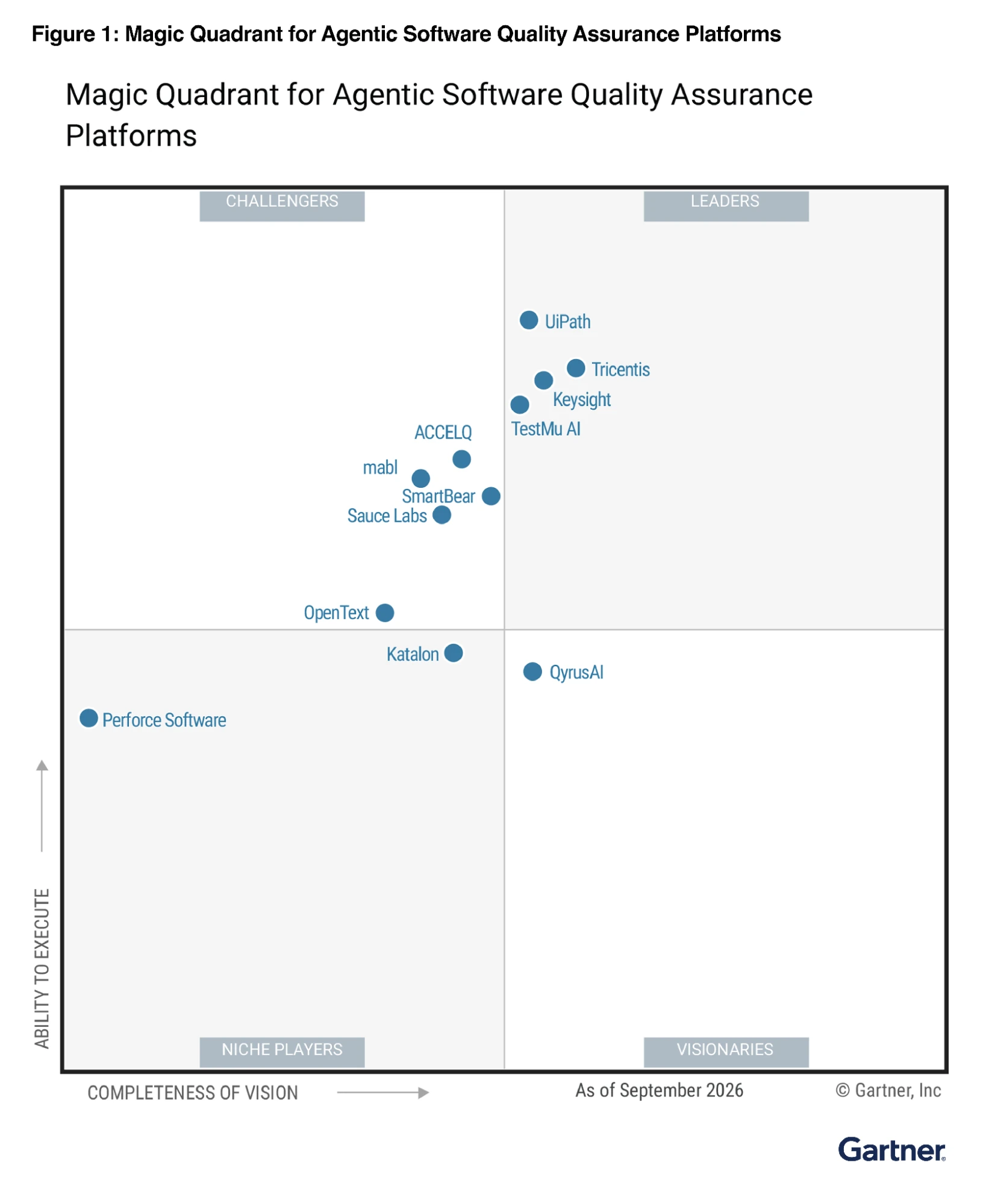
Why Does Software Testing Need Agents Now?
AI coding agents can now turn a single prompt into a working feature. Code volume has gone up sharply. The number of testers has not.
That puts a simple pressure on software teams: more change has to be verified in less time. Scripted regression still matters, but every script has to be written, executed, debugged and maintained as the product changes.
Gartner predicts that "by 2030, AI agents will initiate, coordinate, execute and analyze more than 50% of enterprise software testing."
Gartner defines agentic software QA platforms as "autonomous or semiautonomous solutions that provide integrated, orchestrated capabilities to enable continuous, self-optimizing testing in the software development life cycle (SDLC) through the use of AI."
To us, the important shift is that agents are taking on more of the testing work itself: generating tests, executing them, evaluating outcomes and producing evidence for people to review. The team's role moves toward setting intent, reviewing that evidence and deciding what is ready to ship.
What Does Leadership in Agentic Software Quality Assurance Require?
Gartner evaluates vendors on Completeness of Vision and Ability to Execute.
In our view, agentic testing requires both. Vision is about what agents can do on their own: create tests, adapt them as software changes and judge the results. Execution is about doing that reliably at enterprise scale, across every browser, device and environment where software is used, with evidence teams can trust.
We believe our Leader placement reflects agentic testing products running on a platform used by 18,000+ enterprises across 132+ countries.
Gartner also notes that vendors have expanded beyond AI-augmented testing tools to platforms with specialized agents. It describes these platforms as supporting automated UI, API and visual testing, integrating with AI-native IDEs and coding agents through MCPs or CLIs, and helping organizations assess "the nondeterministic outcomes of AI-enabled solutions."
In our view, these map to three areas TestMu AI is focused on: testing applications, verifying AI-written code, and testing the behavior of AI agents.
Which TestMu AI Products Are Built for Agentic Testing?
TestMu AI has evolved from a testing platform into a platform for agentic quality engineering. It addresses today's testing bottlenecks through two foundational capabilities: specialized testing agents and the enterprise platform they run on.
- KaneAI is a GenAI-native end-to-end testing agent for web and mobile applications. It creates tests from natural language, Jira tickets, PRDs and screen recordings. A single test can combine UI, API, database and accessibility checks. Tests self-heal when the UI changes and can be exported to Selenium, Playwright, Cypress and Appium.
- Kane CLI is a command-line testing agent that verifies web applications in a real browser and native mobile apps from natural language objectives. It installs as a skill in Claude Code, Codex CLI and Gemini CLI, allowing coding agents to test their changes before a pull request is opened. Kane CLI runs locally or in CI and records screenshots, network logs and console output for every result.
Note: Gartner predicts that "by 2028, 65% of quality engineers will be using command line interface (CLI) to perform quality assurance activities." We believe Kane CLI and Agent Assurance are built for that direction because both can operate from the terminal and in CI.
- Agent Assurance tests AI agents that take actions across software systems, including calling tools, writing files, updating databases and opening pull requests. It generates functional, non-functional and adversarial scenarios from an agent's codebase, runs the real agent, and grades the outcome against evidence such as changed files, tool calls and database records. Coverage includes prompt injection, jailbreaks, data exfiltration, PII leakage and the rules behind GDPR, PCI DSS, SOC 2 and HIPAA.
- Agent Testing evaluates AI agents that interact with people, including chatbots, voice assistants and IVR systems. More than 15 specialized AI testing agents run conversations across personas, edge cases and adversarial prompts, then score responses for hallucination, bias, completeness and context awareness. Phone and IVR agents are tested over real inbound and outbound calls.
What Supports These Agents at Enterprise Scale?
Agentic testing still depends on the systems around the agent: execution, test management, analytics, environments and the evidence needed to investigate failures.
Tests created by TestMu AI agents run across browsers, devices and environments on the same platform:
- HyperExecute: AI-native test orchestration that runs test suites up to 70% faster than traditional grids. Supports parallel execution, fail-fast, test reordering and AI root cause analysis on just-in-time infrastructure.
- Test Manager: AI-native test management for manual and automated testing in one workspace. Includes AI test case generation and two-way Jira and Azure DevOps integration for traceability from requirement to defect.
- Test Intelligence: Test analytics across TestMu AI execution products. Includes flaky test detection, failure clustering and AI root cause analysis for CI/CD pipelines.
- Visual AI Testing: Visual regression testing powered by SmartUI's Visual AI engine, which compares UI layout and context rather than raw pixels to reduce rendering noise. Supports comparison of Figma designs with live pages.
- Real Device Cloud: 10,000+ real iOS and Android devices for manual and automated testing. Features biometric authentication, GPS geolocation and network throttling.
- Cross Browser Testing: Live interactive testing across 3,000+ browser and OS combinations. Includes integrated DevTools, local app testing through a secure tunnel and one-click bug logging to Jira, Azure DevOps and GitHub Issues, with the browser, OS, screenshot and session recording attached to each bug.
- Accessibility Testing: Automated WCAG testing for websites and native mobile apps. Includes DevTools scanning, framework integrations for CI/CD and scheduled scans, with an Agent Skill and MCP Server for AI coding agents.
What Have Enterprise Teams Achieved With TestMu AI?
The clearest test of a testing platform is what changes for the teams using it. Three stories from this year:
bet365 consolidated two testing platforms into one. Pushing hundreds of releases a week across sports betting and gaming, and expanding in the US, the team needed one place for automation, real devices and test management.

Having everything in one place suits us better. Otherwise, you're constantly switching between tools and products, which naturally creates inefficiencies.

Head of Software Testing, bet365
Bajaj Finserv cut test execution time by 60% and brought escaped defects below 3%. For a regulated lender serving millions of customers across loans, insurance and payments, a broken page is not a minor bug.
TestMu AI has fundamentally transformed the way we create, maintain, and scale tests, turning test automation from a manual effort into an intelligent, self-evolving engine.

Head of QA, Bajaj Finserv
Atypon gave developers 70% faster feedback by consolidating its test stack.
The stability, speed of execution, and cost efficiency are the three main factors I value the most, and the platform meets all of them.

Senior Test Automation Engineer, Atypon
Behind results like these are the controls large enterprises require: private and on-premise deployment, granular access controls, isolated environments for regulated industries, and AI features built to global privacy and security standards.
What's Next for TestMu AI?
As coding agents take on more software development work, verification has to move closer to the change itself. That means testing AI-written code in the same workflows where it is produced, without waiting for a separate handoff.
The same applies to the agents companies are putting into production. Beyond the interface and the API response, quality engineering now has to verify what an agent decided to do, which tools it used and what changed as a result.
Our focus is to keep extending agentic testing across web, mobile, voice, chat and IVR while making it usable by developers, QA teams and product teams through the workflows they already use.
Read the Full Report
Download a complimentary copy of the 2026 Gartner® Magic Quadrant™ for Agentic Software Quality Assurance Platforms to see Gartner's full evaluation of the market.
Gartner, Magic Quadrant for Agentic Software Quality Assurance Platforms, By Joachim Herschmann, Sushant Singhal, Ross Power, C.A. Swan, 9 October 2026.
Gartner and Magic Quadrant are trademarks of Gartner, Inc. and/or its affiliates.
Gartner does not endorse any company, vendor, product or service depicted in its publications, and does not advise technology users to select only those vendors with the highest ratings or other designation. Gartner publications consist of the opinions of Gartner’s business and technology insights organization and should not be construed as statements of fact. Gartner disclaims all warranties, expressed or implied, with respect to this publication, including any warranties of merchantability or fitness for a particular purpose.
Author

TestMu AI
Blogs: 290


TestMu AI is World's First Full Stack AI Agentic Quality Engineering platform that empowers teams to test intelligently, smarter, and ship faster. Built for scale, it offers a full-stack testing cloud with 10K+ real devices and 3,000+ browsers. With AI-native test management, MCP servers, and agent-based automation, TestMu AI supports Selenium, Appium, Playwright, and all major frameworks. AI Agents like HyperExecute and KaneAI bring the power of AI and cloud into your software testing workflow, enabling seamless automation testing with 120+ integrations. TestMu AI Agents accelerate your testing throughout the entire SDLC, from test planning and authoring to automation, infrastructure, execution, RCA, and reporting.


Did you find this page helpful?
More Related Blogs
TestMu AI forEnterprise
Get access to solutions built on Enterprise
grade security, privacy, & compliance
- Advanced access controls
- Advanced data retention rules
- Advanced Local Testing
- Premium Support options
- Early access to beta features
- Private Slack Channel
- Unlimited Manual Accessibility DevTools Tests