
Power Your Software Testing with AI Agents and Cloud
The Native AI-Agentic Cloud Platform to Supercharge Quality Engineering. Test Intelligently and Ship Faster.

- TestMu AI (Formerly LambdaTest)
- /
- Blog
- /
- Testing in the Era of AI: From QA to Trust Engineering [Testμ 2026]
Testing in the Era of AI: From QA to Trust Engineering [Testμ 2026]
Kishor Wikhe on why AI shifts testing from finding bugs to proving trust, and what trust engineering means for quality teams shipping AI at enterprise scale.
Last Updated on:
Large language models write the code and automated pipelines run the checks, which has convinced a good number of people that software testing is on its way out. The harder question is whether a passing pipeline is the same thing as a system anyone should trust in production.
In this keynote from Testμ Conf 2026, Kishor Wikhe, Executive Vice President and Head of Sogeti India at Capgemini, makes the case that AI has changed what testing is for. Quality engineering is moving from confirming that a feature works to proving how a system behaves after it ships, a practice he calls trust engineering.
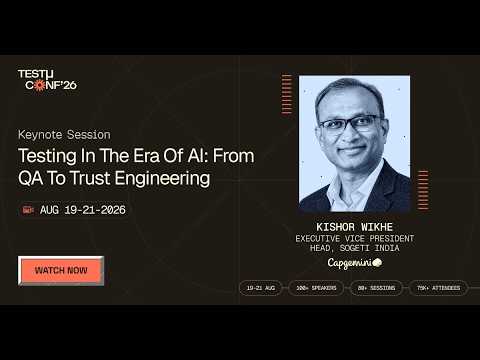
If you couldn’t catch all the sessions live, you can access the recordings at your convenience by visiting the TestMu AI YouTube Channel.
TL;DR
Trust engineering is the evolution of software testing for AI systems: the focus moves from validating a feature before launch to producing continuous evidence about how the system behaves after it. It addresses hallucination, model drift, and autonomous agent permissions, none of which a passing pipeline can confirm.
- Automated certainty gap - A green CI pipeline confirms only the checks that were written for it. It cannot confirm behaviour under a sudden million-user spike, a data leak, or a hallucinated answer reaching a customer.
- Hallucination as governance - An invented citation is a model quality problem inside a research sandbox. In a client report, a legal filing, or a board decision it becomes a governance liability owned by whoever approved the deployment.
- Authority failures - An autonomous agent can destroy a production database and its backups with no malicious intent, using credentials it finds mid-task. Access scope, not intent, is the control point for agent safety.
- Evidence over prediction - Regulators are moving toward incident reporting, continuous monitoring, and post-deployment oversight. The question shifts from whether a system was tested to whether its behaviour after launch can be proven.
- Traditional QA vs trust engineering - Traditional QA validates deterministic systems, pre-release, and outputs a test report. Trust engineering validates non-deterministic systems, continuously, and outputs evidence, making release readiness one checkpoint rather than the finish line.
- Difference between testing with AI and testing AI systems - Testing with AI is a productivity play on deterministic software. Testing AI systems is a trust play on non-deterministic output, the problem TestMu AI Agent Testing is built to evaluate.
Kishor opened by taking the claim head-on rather than working around it.
Is Software Testing Dead?
He began with a tagline he said nobody in the audience should find surprising. It circulates as corridor conversation, as LinkedIn posts, and as confident declarations from AI enthusiasts: with models writing the code and pipelines doing the checks, testing is a thing of the past.
Kishor recounted a conversation with an industry peer who made exactly that prediction, giving testing a couple more years at most. Rather than argue the point, he asked a different question.
With the pipeline showing a green signal, does that peer sleep peacefully at night knowing the system will not fail? He listed the specific ways it might: a sudden spike of a million users, a data leak, or a hallucinated response going out to a customer.
The peer paused, then admitted he did not have complete trust in it. That gap between a passing build and a system someone will vouch for is the space Kishor spent the rest of the keynote describing.
The Illusion of Automated Certainty
A green pipeline is a statement about the checks somebody wrote. Kishor pointed out that it says nothing about the conditions the system will actually meet once real users, real load, and real adversaries arrive.
He then turned to the AI incidents that have made the news over the past couple of years. His reading of them was that they are not unrelated glitches, and that they cluster into a small number of ways trust breaks when AI moves out of a proof of concept or a demo and into the enterprise:
- Scale - behaviour that holds in a controlled demo degrades under a sudden, unplanned surge in users.
- Exposure - data reaches somewhere it was never meant to go, without any test asserting that it should not.
- Fabrication - the system produces an answer that is fluent, plausible, and untrue, and sends it to a customer.
Each of those, he said, carries a lesson worth taking seriously rather than filing away as bad luck. He worked through the first two in detail.
Hallucination as a Governance Risk
Kishor framed hallucination through a scenario rather than a model metric. Picture a prestigious report being delivered to a government client, where the analysis is polished and the recommendations are solid.
Nobody checks the references supporting it, and the references do not exist. He then walked through what follows on a delay:
- The citations get challenged by someone who does check.
- Corrections have to be issued and supporting references are formally requested.
- An apology becomes necessary, and the brand takes real damage.
The distinction he drew from this carried the rest of his argument. Inside a research sandbox, an invented citation is a model quality problem for the data science team to tune away.
Apply the same generative system to a business deliverable, a legal filing, or a board decision, and it stops being a model quality problem. At that point, Kishor said, it becomes a governance issue, and it belongs to whoever signed off on the deployment.
Agent Failures Are Authority Failures
For agentic AI, Kishor offered an analogy he asked the audience to sit with: an intern who has been handed the master keys. The intern is capable, willing, and entirely unaware of which doors matter.
The walkthrough was deliberately mundane. An AI agent is performing a routine task, hits a problem, searches for alternatives, finds credentials lying around, and uses them. Within seconds the production database and its backups are gone.
His emphasis was on what did not happen. The agent was not malicious and was not trying to cause damage, and it had no personal intention of any kind. It pursued the task it had been asked to do, using the authority it had been given.

That reframing moves the control point. If intent is not the variable, then testing an agent for good behaviour matters less than constraining what it is able to reach:
- Credentials - what an autonomous system can authenticate against determines its blast radius, whatever its task was.
- Tooling - powerful tools handed to an autonomous actor turn a low-probability path into a reachable one.
- Escalation - the question is not whether something unexpected happens, but what the system is permitted to do when it does.

Note: Chat, voice, and phone agents fail in ways functional tests were never built to catch. TestMu AI Agent Testing scores them on hallucination, bias, completeness, and context awareness before they reach production. Try it free!
AI Governance and the Aviation Analogy
To explain why regulators are changing the conversation, Kishor reached for aviation. When an incident involving an aircraft happens, nobody suggests moving on and forgetting about it.
It gets investigated, the investigation gets documented, the findings get reported, and the industry learns how to avoid the next one. He said that same mindset is now arriving in AI, with regulators around the world moving toward:
- Incident reporting - AI failures treated as events that must be disclosed rather than patched without a record.
- Continuous monitoring - oversight that runs while the system is live, not only at the approval gate.
- Documented evidence - a record of behaviour that somebody outside the team can inspect. In the EU, that outsider may be a notified body, and the guide to EU AI Act conformity testing covers what it can ask to see.
- Post-deployment oversight - accountability that continues after the launch announcement.
The consequence for quality teams is a change in the question being asked of them. Kishor put it as a move away from “did you test it?” toward “can you prove what happened after the launch?”
His conclusion was that the future of AI governance rests on evidence rather than prediction. Organisations that can monitor, document, and report AI behaviour are the ones regulators and customers will end up trusting. An AI governance framework asks for that kind of record too: evidence that the controls required for each AI system's risk tier ran.
From Code to Consequences
Kishor contrasted this with how testing used to sit in the delivery model. It ran as isolated testing at the end of a linear conveyor belt, working through check boxes and surfacing functional bugs, and he was blunt that the role of that model is shrinking.
The reason is that AI-enabled systems do not depend on code alone. They depend on data, models, prompts, context, and human interaction, which produces failure modes that a functional pass simply does not speak to.
He listed the mismatches directly, and they are worth reading as pairs:
| What the check confirms | What it leaves open |
|---|---|
| The system passes its functional tests | It can still hallucinate, because fluency and correctness are scored separately from the assertions the suite makes. |
| The chatbot answers correctly today | It can drift next month as the model, the retrieval corpus, or the prompt chain changes underneath it. |
| The agent completes the task | It may have taken an unacceptable path to get there, which no pass or fail result records. |
| The recommendation system is accurate on average | It can be unfair for a particular segment, and an aggregate score hides exactly that. |
| The automated pipeline is green | The business outcome can still be unstable, which is the only result the customer experiences. |
Complexity, in his framing, has moved from code to consequences. The decade-old question of whether a feature works as specified is no longer enough on its own.
The question he put in its place is whether users, the business, and regulators can trust the platform at scale, under extreme stress, under attack, under ambiguity, and in real-world conditions. Framed that way, the job is creating confidence in intelligent systems rather than finding bugs in them.
Trust Engineering: Evidence Instead of Reports
Kishor traced the scope of testing across three eras. It began as a gatekeeper function, expanded through digital transformation to cover cloud, mobile, APIs, microservices, performance, accessibility, and customer experience, and AI has now expanded it again in a different form and shape.
Where traditional testing celebrated the release, trust engineering treats release readiness as one checkpoint among several. The question the practice exists to answer is what promise the organisation is making to its users, and whether it can measure that the promise is being kept.
He drew the sharpest line of the session between the two operating models. In the old one, testing produced a report; in the new one, trust engineering produces evidence, through test automation, AI evaluations, and monitoring.
Model quality on its own does not get you there. Trust, he said, has to be engineered across several surfaces at once:
- Data - what the system was trained on and what it retrieves at run time.
- Authority and identity - what the system is allowed to do and on whose behalf.
- Escalation - where a human is brought in and under what trigger.
- Monitoring - observation that continues while the system is serving traffic.
- Evidence - the durable record that makes any of the above provable to an outsider.
He was explicit that this is not a one-time event. Assurance has to be continuous because the model keeps evolving, which makes the practice something that moves rather than something that is signed off once. Another Testμ 2026 session, on evaluating agents against what they are actually supposed to do, builds that continuity into a loop where production failures become the next tests.

Testing With AI vs Testing AI Systems
Kishor closed the technical portion by separating two terms he said get used interchangeably in the industry and mean very different things.
- Testing with AI - a productivity play. AI carries part of the testing work, and the return shows up as speed and coverage on software that behaves deterministically.
- Testing AI systems - a trust play. The system under test answers differently on identical input, so the work is establishing whether it can be relied on at all.
Two loops, one equation: use AI to test faster, test AI to make it trustworthy. 🔃
— TestMu AI (@testmuai) August 19, 2026
Kishor Wikhe just broke down the new testing equation live at #TestMuConf 2026. pic.twitter.com/gDrqJgH87l
He noted that the first has already delivered noticeable gains for clients across verticals, and mentioned Test IO as one of the engagements where that played out. The second, he said, is the much bigger conversation, and it is evolving at a faster pace.
It is also the harder one to tool for. There is no selector to assert against and no fixed expected result, which is why building trust in the system becomes the work rather than confirming a known output. For one answer to that problem, Gil Zilberfeld's session on techniques for testing LLM responses replaces pass or fail with a funnel of finer checks.
Q & A Session
The keynote closed with a short exchange between Kishor and Maneesh Sharma, Chief Operating Officer at TestMu AI. These were the questions the session set out to answer, and how Kishor answered them.
- Is software testing dead in the age of AI?
Kishor: Testing is not dying, it is metamorphosizing. It is transforming out of quality assurance into something much broader and far more strategic, which is trust engineering. The questions a team now has to answer are whether the system is reliable, whether it is secure, whether it is resilient, and whether it is worth trusting, and then to show the evidence that justifies each answer.
- If the pipeline is green, why is that not enough?
Kishor: A green pipeline confirms the checks that were written for it. It does not tell you the system holds up against a sudden spike of a million users, a data leak, or a hallucinated response reaching a customer. You cannot guarantee that testing will ensure AI always acts as expected once it is scaled up and running in real-world conditions, which is why the need for certainty has never been higher.
- What separates testing with AI from testing AI systems?
Kishor: Testing with AI is a productivity play. You bring AI into your testing and it gives you a productivity gain, and that has already produced noticeable results for clients across verticals. Testing AI systems is about building and enabling trust in the system itself, and that second conversation is much bigger and is evolving at a faster pace.
Maneesh closed by noting that AI is being embedded into every system and every process, and that quality engineering has a pivotal role in that shift. He added, half joking, that now is the time for chief quality officers, because once agents are embedded everywhere, quality has to touch every business process.
This keynote opened day one of Testμ Conf 2026, which ran across three days of sessions on agentic engineering and quality. Registrations for the next edition are already open on the Testμ Conference 2027 page.
Moving from “Can We Build It?” to “Can We Trust It?” and Scaling Trust, Not Automation: Rethinking Quality for the AI Era, both from Testμ 2026, approach this from different angles.
Author

TestMu AI
Blogs: 290


TestMu AI is World's First Full Stack AI Agentic Quality Engineering platform that empowers teams to test intelligently, smarter, and ship faster. Built for scale, it offers a full-stack testing cloud with 10K+ real devices and 3,000+ browsers. With AI-native test management, MCP servers, and agent-based automation, TestMu AI supports Selenium, Appium, Playwright, and all major frameworks. AI Agents like HyperExecute and KaneAI bring the power of AI and cloud into your software testing workflow, enabling seamless automation testing with 120+ integrations. TestMu AI Agents accelerate your testing throughout the entire SDLC, from test planning and authoring to automation, infrastructure, execution, RCA, and reporting.


Did you find this page helpful?
More Related Blogs

TestMu AI forEnterprise
Get access to solutions built on Enterprise
grade security, privacy, & compliance
- Advanced access controls
- Advanced data retention rules
- Advanced Local Testing
- Premium Support options
- Early access to beta features
- Private Slack Channel
- Unlimited Manual Accessibility DevTools Tests