
Power Your Software Testing with AI Agents and Cloud
The Native AI-Agentic Cloud Platform to Supercharge Quality Engineering. Test Intelligently and Ship Faster.

- TestMu AI (Formerly LambdaTest)
- /
- Blog
- /
- Scaling Trust, Not Automation: Rethinking Quality for the AI Era [Testμ 2026]
Scaling Trust, Not Automation: Rethinking Quality for the AI Era [Testμ 2026]
Walter Zimerman of Amazon on why AI fails confidently, how accuracy compounds downward across chained agents, and what evaluation-driven design fixes.
Published on:
Chain five components that are each 95% accurate and, if they fail independently, the pipeline is 77% accurate. Chain ten and it drops below 60%. Every component shipped with pride, and every one of them is still 95%.
That arithmetic is the spine of this session, and the reason its argument is about trust rather than throughput.
At Testμ Conf 2026, Walter Zimerman, Sr. Software Development Engineer at Amazon, made the case in a personal capacity. He opened with a disclaimer that everything in the talk is his own opinion and not the position of his current or previous employers, which applies to every Alexa example below.
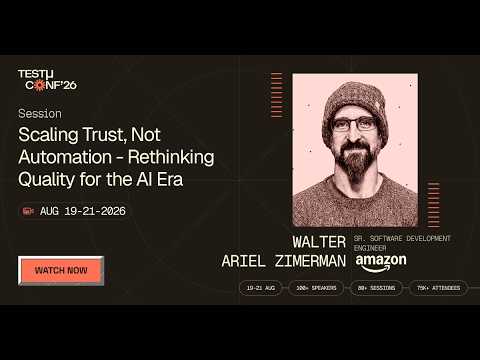
If you couldn’t catch all the sessions live, you can access the recordings at your convenience by visiting the TestMu AI YouTube Channel.
TL;DR
Scaling trust is a system’s ability to grow while sustaining a reliable belief in its accuracy and dependability as demand increases, without that belief degrading under the weight of the growth. Walter Zimerman’s argument is that trust in an AI pipeline has to be measured from day one and earned at the seam between every component, because accuracy compounds downward and AI failures arrive without an exception, a red light or any other signal that something went wrong.
- What is the one-sentence thesis of the Scaling Trust session? - Traditional tests fail loudly while AI fails confidently. A failing traditional test throws an exception and stops the pipeline; an LLM returns a beautiful, confident and completely wrong answer with no exception and no red light, so trust has to be measured rather than assumed.
- Is traditional functional testing obsolete now that models produce non-binary outputs? - No. Walter Zimerman pushed back hard on the “testing is dead” claim: the application under test still has a job to do, so a booked flight has to produce a real reservation, a purchase has to charge the right amount, an alarm has to ring. What changed is that stochastic components now sit inside the system and need their own verification methods.
- What is the difference between testing and evals? - Testing asks “did it pass” and returns green or red; evals ask “how good is it and how do we know” and return a distribution. Validating that an item actually appears on a shopping list is testing; judging whether a voice assistant’s response is culturally appropriate for the locale is an evaluation.
- Do more AI-generated test cases produce better quality? - No. Walter Zimerman calls volume a vanity metric that measures effort rather than value. His illustration: generate thousands of cases before launch, have 5% fail, and you are staring at 3,000 to 5,000 failures with no idea which are real, which are hallucinated, or how to prioritise them.
- What happens to accuracy when 95%-accurate AI components are chained together? - Assuming the components fail independently, joint accuracy is the product of the individual accuracies, so it falls fast. Five components at 95% each gives 77% overall, and ten drops below 60%.
- Can one large agent avoid that compounding accuracy loss? - No. Walter Zimerman rules it out at the current state of the art: research keeps showing that agents trying to do too much degrade, a phenomenon called context rot, and debugging a single do-everything agent is much harder than debugging a pipeline of focused components.
- What is evaluation-driven design? - It is the TDD analogue for agents, a term Walter Zimerman credits to others. Before building a component, write examples of what good looks like, run them so they fail, build the smallest thing that turns them green, then refactor toward a cheaper model, a leaner prompt and fewer tools, committing the eval alongside the component.
- How does asserting on an eval differ from asserting on a unit test? - Green becomes probabilistic. You are not asserting equality, you are asserting that a distribution over outcomes meets the threshold set for that agent, so every refactor has to account for variance as well as correctness.
- What is the double-loop model for evaluating multi-agent systems? - A fast inner loop at component level, focused on each component’s contract, paired with a slower system-level outer loop run only when there is a reason rather than continuously, to catch cases where every component passes its own evals yet the system produces garbage, costs too much or loops forever. Outer-loop failures become new inner-loop tests.
- What can multi-agent QA borrow from the microservices era? - Contract testing at the seams, covering the handoff of inputs, agent specs and output promises; observability, meaning every prompt, tool call and intermediate output traced end to end with a shared request ID; and schema versioning, because changing a system prompt changes the contract for every tool that prompt touches.
- What is a QA scientist? - It is Walter Zimerman’s working name for a role between the QA engineer and the data scientist. It reasons about statistical significance, thinks about contracts between components and thinks in distributions, comfortable saying “this is 87% reliable” and equally comfortable saying why that is not good enough to ship.
- Did the Scaling Trust session take live audience questions? - No. The talk was pre-recorded and Walter Zimerman said so on air, directing viewers to a QR code and to LinkedIn. The host confirmed many audience questions had come in but could not be taken live.
Confidence Is Not Correctness
The hiring story behind the talk is a small case of confident wrongness. In late 2018, living in Ireland, at the fifth and final interview of the Amazon loop, the hiring manager told him his German-speaking skills would be really helpful. He is Argentine, spoke no German, and said so on the spot.
The wrong bet paid off anyway, because the Alexa Spanish launch was on the roadmap and he is a native Spanish speaker. He says he was the first person able to hear Alexa speak Spanish end to end on a device, and went on to spend eight years on Alexa quality. The right outcome for entirely the wrong reason.
To make it concrete he played a 2016 clip in the session, in which a small child’s request was misrecognised and the device began reading out a list of explicit results until an adult said “Alexa, stop”.
That incident kicked off an internal effort producing what the team called earcons. Most natural language classifiers return a confidence score between zero and one, and the team added a threshold: below it, the device deflects with a tone and stays quiet rather than acting.
He flags the subtle cost of that fix. The system stopped failing loudly and started failing politely. The error did not go away, it got quieter.
Even with the safeguard, he recounts a 2021 incident in which a child asking for a challenge was told to put a penny into a power outlet and touch it. The child told her mother and was safe. He recalls it second-hand and without citation, and his point is not an attack on a product he worked on and says he loves: if this can happen on one of the oldest and most heavily tested voice assistants on the market, it can happen anywhere a probabilistic system sits in front of users.
Lessons From Bad Early LLMs
He started experimenting with LLMs in late 2020, in what he calls GPT-2 time, and in late 2021 demoed that work to leaders at an internal Amazon summit: test case generation plus early experiments using language models for classification and assertions.
The chronology is the interesting part. ChatGPT arrived in November 2022 and the LLM-as-a-judge term was popularised in June 2023 by the MT-Bench paper, which means his December 2022 automation framework already had synthetic customer simulators and a first set of LLM-powered judges before the vocabulary existed.
He frames the timing as luck rather than foresight. The models were bad, really bad, so he never had the option to trust them and had to question every result.
That habit produced the question he could not put down: how do we know we can trust these systems, particularly when we are using them to evaluate the quality of another system in order to decide whether to ship.
Defining Scale and Trust
Calling himself a lexicon nerd, he defines scale in the computer science sense as a system’s ability to handle growing workloads without losing performance, and notes the word has two roots: Old Norse skal, meaning bowl, and Latin scala, meaning stairs. He leaves the audience to decide which one describes their pipeline.
Trust he defines as a firm belief in the reliability of someone or something, where belief unpacks into faith or confidence, and reliability is the degree to which something can be depended on to be accurate.
Combine the two and scaling trust becomes a system’s ability to grow while sustaining a reliable belief in its accuracy and dependability as demand increases, without that belief degrading under the weight of the growth.
The takeaway he wants held is that trust has to be earned, has to be measurable, and has to compound. If reliability falls, trust will not scale, which makes trust a dynamic property of the system from day one rather than a label applied after the fact.
Rise of the Applied Scientist
The applied scientist’s role, practices and jargon are creeping into testing. He now uses precision, recall, F1 and specificity in conversations where five years ago he would have said pass and fail, and sees test catalogs becoming data sets and test suites becoming test sets, a rename he likes.
He pushes back very hard on the claim that traditional testing no longer serves a purpose because models do not have binary outputs. He says he hears it from smart engineers, including in a strong argument with a junior engineer two weeks before the talk.
His counter is that the application under test still has a job to do and the user does not care how it works. Book a flight and the reservation has to be real. A purchase has to charge the right amount and deliver the right product on time. An alarm set through a voice assistant has to ring, and a calendar invite has to be reflected on the device.
Functional and quality-attribute testing therefore matter as much today as five years ago, and the goal of testing has not changed.
What changed is that stochastic components now sit inside the system and need their own verification methods. He calls that far more precise than “testing is dead”, and unlike that phrase, it leads somewhere.
The Volume Trap
When he joined Alexa in 2018 his team owned testing for international expansions, and his manager wanted a suite that ran continuously across every supported locale. No tooling existed on the market and almost no literature described how to test a system like Alexa, so they built their own. He says the literature still barely exists.
The question that worried him then was not how to generate tests but how to review the results, and it maps directly onto now. With generative AI everyone produces thousands of test cases before launch, which sounds excellent until 5% fail and you are staring at 3,000, 4,000 or 5,000 failures with no idea which are real, which are hallucinated, or how to prioritise them. Those numbers are his thought experiment rather than measurements from a system he ran.
He runs the denial list explicitly. More tests do not mean better understanding, more coverage, fewer bugs, a more stable product or happier customers.
Volume has always been a vanity metric, because it measures effort rather than value, and volume without interpretability is noise with a confidence score attached.
The old principle that exhaustive testing is impossible still holds. The only change is that teams can now fail at exhaustive testing much faster and much more expensively, because every one of those tests carries a token cost.

Note: Measure what your AI pipeline actually returns, component by component. Try TestMu AI now!
Testing Versus Evals
He draws the line as a difference in question. Testing asks did it pass; evals ask how good is it and how do we know. Traditional QA gave you green or red, evals give you a distribution, and he says most teams are not ready for that conversation.
Evals do not replace testing. They are different tools for different jobs, and combining them carelessly is where he sees teams get into trouble.
The healthy connections he endorses run both ways: test executions produce data that is good for evals, and eval results tell you what to test next and when. What he rejects is the idea that either one subsumes the other.
His worked example: when a platform says an item has been added to the shopping list, validating that the item is actually on the list and displays correctly is testing.
Judging whether the assistant’s response is culturally appropriate for the locale, or whether the accent and pronunciation are right, is an evaluation. Both matter, because they answer different questions. Accent also matters on the listening side, where accent testing for voice agents measures recognition for each group of speakers instead of one pooled figure.
"Testing asks: did it pass? Evals ask: how good is it, and how do we know? Traditional QA gives you green or red. Evals give you a distribution. Most teams are not ready for that conversation yet." pic.twitter.com/s2950MxMqm
— TestMu AI (@testmuai) August 20, 2026
Probabilistic vs Binary Gates
The core tension is structural. Pipelines, release gates and stakeholders all want a yes or a no, while the systems being built produce probabilistic outputs and are handed to consumers who need determinism. Set an acceptable threshold and call it a day, and you have still reduced a distribution to a binary somewhere in the pipeline. That reduction is where trust starts breaking.
Percentages are hard to reason about, so he reframes them as questions. What if the 1% that fails is the most critical path in your system? What if a scenario fails 0.1% of the time on a feature used millions of times a day? That is not an edge case, it is a headline waiting to happen, like the clip he opened with.

A traditional failing test throws an exception and stops the pipeline, and with decent traceability you can usually find what went wrong fairly quickly. An LLM does not fail that way. There is no exception, no red light, just a sentence that sounds and looks amazing and is completely wrong.
Then comes what he calls an uncomfortable story. He recently demoed a proof of concept for a new testing approach, validated the results with QA engineers, re-ran the same tests manually on existing infrastructure, and confirmed the issues it found were real and useful. The solution uses agents in several places.
He is not confident it is reliable enough for production or to replace the old system. Some stakeholders heard that the proof of concept found real bugs and translated that into productionising it immediately, and he had to be the person saying no. Finding real bugs in a demo is not the same as being trustworthy in production.
The Compounding Math
The arithmetic is deliberately basic. Start with one component or agent that is 95% accurate, whatever accuracy means for your system, which is a number most teams would be very happy with.
Add a second component that is also 95% accurate and ask what the pair scores. The instinctive answer is 95%. Assuming the components fail independently, joint accuracy is the product of the individual accuracies, and that independence assumption is doing real work here.
| Components chained | Accuracy of each | Joint accuracy |
|---|---|---|
| 1 | 95% | 95% |
| 5 | 95% each | 77% |
| 10 | 95% each | below 60% |
The obvious escape is shipping fewer, bigger agents that do everything, and he rules it out at the current state of the art. Even as models get smarter and context windows get bigger, research keeps showing that agents trying to do too much degrade, a phenomenon called context rot. He says there is good empirical work behind it and invites the audience to look it up, without naming a paper.
In his experience, observing and debugging a single agent that does everything is also much harder than debugging a pipeline of focused components.
The conclusion he draws is the pivot of the talk. Trust cannot be hand-waved at system level. It has to be earned at the seam between every component.

Evaluation-Driven Design
His first prescription sounds obvious and is not: measure from the start. Engineers, himself included, tend to be solution-oriented before they are problem-oriented, and it is very easy to build a quick prototype.
He cites data going around that 95% of AI startups fail and that the 5% which succeed solve real problems for real customers. He names no source for it, hedging it as data going around, and takes the general lesson: know the problem before you build the system, and know what success looks like before claiming you have achieved it.
For stochastic systems that means data sets and ground truth, even a small scrappy version, because without a baseline you cannot tell whether the system is improving, degrading or just changing. That baseline cannot be retrofitted.
He is a TDD practitioner who still writes tests first even though he estimates AI now writes 95% of his code, a personal estimate about his own workflow. The analogue he points to is evaluation-driven design, a term he credits to others rather than himself.
The loop runs like this. Before building the agent or component, write examples of what good looks like: inputs, expected outputs, expected properties of outputs. Treat that eval as a test, build a harness, and run it so it fails, which prevents trivial always-passing evals. Build the smallest thing that turns it green, often a very simple or even hardcoded prompt, which proves the wiring and infrastructure calls are right. Then refactor, which in the agent era means a cheaper model, a leaner prompt and fewer tools.
The crucial difference from TDD is that green is probabilistic. You are not asserting equality, you are asserting that a distribution over outcomes meets the threshold for that agent, so every refactor has to account for variance as well as correctness. The eval becomes the safety net and gets committed alongside the component.
In another Testμ 2026 talk, Eval-First QA Agents, a QA manager at Fox describes the same principle: every assertion is written before the capability it covers is reachable.
The Double-Loop Model
Once there is more than one component, he adds a second loop around the first, the double-loop TDD shape that anyone who lived through microservices will recognise.
The inner loop is component level: fast, focused on each component’s contract.
The outer loop is system level: slower, more expensive, run less often and only when there is a reason, explicitly not around the clock. Its job is to catch the cases where every component passes its own evals and the system still produces garbage, costs too much, or loops forever.
The two loops talk to each other. When the outer loop catches something, diagnose which seam broke and write a new inner-loop test that would have caught it, exactly the way production bugs become unit tests in a mature codebase. Over time the inner loop gets denser and the outer loop catches fewer surprises, which is what maturity looks like for these systems.
He is candid about what he cannot answer: how to version evals when the prompts underneath them change, how to keep the outer loop affordable enough to run on every commit, and how to write evals for emergent behaviours where a swarm of agents does something none of the individual agents were evaluated for. He floats the idea of emergent bugs, which do not exist in isolation but which a swarm produces, and asks anyone with ideas to reach out on LinkedIn.
Contract Testing for Agents
The industry has been somewhere like this before, and he finds himself reaching back to what is now classic literature: Agile Testing by Lisa Crispin and Janet Gregory, and Continuous Delivery by Jez Humble and David Farley, because the shape of the problem is familiar.
When microservices took off the test pyramid got inverted and it hurt. Teams discovered full system integration tests were slow, flaky and expensive, and the bugs they caught were often the wrong ones. The fix was contract testing: pin the interfaces between two services and test each side against the contract independently.
For multi-agent systems he maps the contract onto the handoff between components, meaning the inputs, the agent specs and the output promises. Pipeline-level evals, he warns, are the flaky end-to-end tests of this era.
The second lesson is that observability beat testing in production. Because you could not pre-test every path through a distributed system, the industry moved budget from more tests to tracing, structured logs and correlation IDs. Multi-agent systems need the same discipline, with every prompt, tool call and intermediate output traced end to end under a shared request ID, because when something goes wrong three agents deep, reading the transcript is your debugger.
The third is that schema versioning was non-negotiable, learned the hard way when a breaking change to one service’s response format took down consumers nobody remembered existed. The agent version of that is versioned prompts, structured outputs with schemas, and tracking which downstream components depend on which upstream behaviours, because changing the system prompt changes the contract for every tool that prompt touches. In voice agents the effect is audible, and the Testμ 2026 session on System Prompt Design for Voice Agents shows small wording changes producing measurably different calls.
The meta lesson is where he thinks agent QA is headed: the centre of gravity moves from testing the whole thing to contracts at the seams, observing the flow and isolating the iteration.
The QA Scientist Role
The role-shaped consequence of all this is a job sitting between the QA engineer and the data scientist, which he has been loosely calling the QA scientist. He says he does not fully know what it looks like yet, but he knows what it needs to do.
It needs to reason about statistical significance, think about the contracts between components, and think in distributions over outcomes. Comfortable saying this is 87% reliable, and equally comfortable saying why that is definitely not good enough to ship.
He sees the gap forming from both sides: QA engineers teaching themselves statistics because the job demands it, and data scientists building strong models without a strong instinct for how to test them in production.
He describes sitting in a meeting where a QA department and ML engineers talked past each other for an hour because their working definitions of quality were different, and predicts some listeners will either grow into this role or hire for it for the first time within the next couple of months.
He closes by returning to the opening story, where someone looked at his surname, made a confident inference, was wrong and got lucky. The question is not whether you should trust that component, but how you are going to prove that you should.
The talk was pre-recorded, so it took no live questions. Walter Zimerman pointed viewers to a QR code and to LinkedIn instead, and the host confirmed afterwards that many audience questions had come in and would be picked up through TestMu AI’s channels.
This session was part of Testμ Conf 2026, which ran across three days of sessions on agentic engineering and quality. Registrations for the next edition are already open on the Testμ Conference 2027 page.
Author

TestMu AI
Blogs: 292


TestMu AI is World's First Full Stack AI Agentic Quality Engineering platform that empowers teams to test intelligently, smarter, and ship faster. Built for scale, it offers a full-stack testing cloud with 10K+ real devices and 3,000+ browsers. With AI-native test management, MCP servers, and agent-based automation, TestMu AI supports Selenium, Appium, Playwright, and all major frameworks. AI Agents like HyperExecute and KaneAI bring the power of AI and cloud into your software testing workflow, enabling seamless automation testing with 120+ integrations. TestMu AI Agents accelerate your testing throughout the entire SDLC, from test planning and authoring to automation, infrastructure, execution, RCA, and reporting.


Did you find this page helpful?
More Related Blogs

TestMu AI forEnterprise
Get access to solutions built on Enterprise
grade security, privacy, & compliance
- Advanced access controls
- Advanced data retention rules
- Advanced Local Testing
- Premium Support options
- Early access to beta features
- Private Slack Channel
- Unlimited Manual Accessibility DevTools Tests