
Power Your Software Testing with AI Agents and Cloud
The Native AI-Agentic Cloud Platform to Supercharge Quality Engineering. Test Intelligently and Ship Faster.

- TestMu AI (Formerly LambdaTest)
- /
- Blog
- /
- Agentic AI Changed What We Test, And How We Test It [Testμ 2026]
Agentic AI Changed What We Test, And How We Test It [Testμ 2026]
Pooja Oza of Disney on replacing the exact-match oracle with a bounded behaviour envelope, why fluency is not correctness, and the false green in self-healing.
Published on:
On This Page
- The Train and the Driver
- The Shift in What We Test
- The Bounded Behavior Envelope
- Three Valid Paths, One Goal
- Five Evaluation Dimensions
- The Ten-Second Quiz
- The Blank Page Problem
- False Greens in Self-Healing
- Confidence Boosters to Fund
- The Media Player Blueprint
- Four Proof Points to Ship
- Three Questions Per PR
- From Envelope to Evidence
- Q & A Session
90 days. That is the return window a support agent quoted in this session, confidently and in clean prose, to a customer asking about a discounted item. The number was invented.
The correct answer was messier: final sale excluded, 30 days for other online items, and a question back to the customer about which one they had bought.
At Testμ Conf 2026, Pooja Oza, Sr. Quality Assurance Engineer at the Walt Disney Company, used that pair of answers to make the case that fluency is not evidence, and that the test oracle quality engineering was built on no longer fits. Her account of practice is scoped throughout to her own part of the organisation.
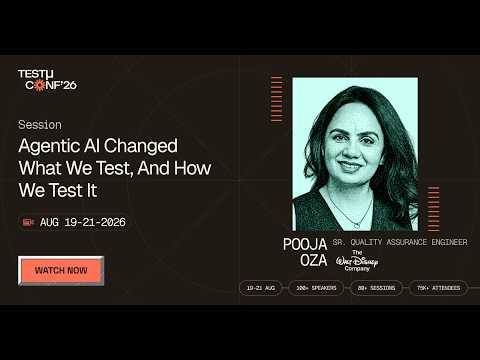
If you couldn’t catch all the sessions live, you can access the recordings at your convenience by visiting the TestMu AI YouTube Channel.
TL;DR
A bounded behaviour envelope is a test oracle that accepts any execution path as long as the agent achieved the user goal, stayed inside authorization, business and safety limits, and grounded every decision in verifiable fact. It replaces exact-match assertions for agentic systems, where the same prompt can produce different and equally valid outputs, and it turns the release question from “is the suite green” into “is the behaviour proven bounded”.
- What assumption do agentic systems break in quality engineering? - The deterministic contract of same input, same output, pass or fail. Pooja Oza’s point is that the same prompt can produce different and not necessarily wrong outputs, and an agent can reach the same goal along a completely different path, so exact-match assertions stop being a fair oracle.
- Should an agentic test still assert an exact output match? - No. The question moves from “does the output match?” to “did the agent’s behaviour stay within acceptable bounds?” As Pooja Oza puts it, the path may vary from run to run, but the contract stays fixed.
- What are the three gates in the bounded behaviour envelope? - Did the agent achieve the user goal; did it stay within authorization, business and safety limits; and is every decision and generated answer grounded in verifiable fact. The oracle also requires preserved user intent and an explainable execution trace.
- Can three different agent behaviours all count as a pass? - Yes. Asked to move a 3:00 p.m. appointment to tomorrow morning, an agent may move it outright when one slot is open, pause and ask when two slots are free, or stop and hand off to a human when it hits a conflict or authorization boundary. All three pass the same contract.
- Which five dimensions replace pass or fail? - Outcome, meaning was the user goal resolved; grounding in verified authoritative data rather than hallucinated facts; the allowed sequence of actions and tool calls; policy compliance covering safety, authorization and privacy bounds; and reliability under latency or transient errors.
- Does a fluent, confident AI answer mean the answer is correct? - No. In the ten-second quiz, the confident reply granting a 90-day return window on discounted items is entirely fabricated, while the qualified reply correctly excludes final sale and cites 30 days for other online items.
- What problem does AI actually solve in test authoring? - The blank page problem. Instead of hand-writing every case with coverage limited to what one person can remember, AI suggests execution paths, edge cases and retry scenarios from product requirements, while the engineer still verifies risk, checks facts and hardens assertions.
- Is self-healing test automation safe to trust on its own? - No. Pooja Oza calls blind healing the false green: when a checkout layout changes and the script cannot find “place order”, it can swap the locator to a nearby element such as “save for later”, click it and pass green even though no purchase was made.
- What makes a self-healed test legitimately green? - Governed healing. The tool may propose the new locator, but it must prove the outcome by verifying the database state, confirming the order receipt was generated, and recording the repair in the trace for engineering review.
- Which of the four confidence boosters should a team fund first? - Whichever attacks the team’s largest uncertainty. Repeatability problems argue for golden data sets, unknown behaviour for trace telemetry, security exposure for adversarial red teaming, and irreversible business impact for governed human review.
- How does the media player blueprint prove playback quality? - Presented as a conceptual reference model rather than a shipped system, it evaluates recap markers jumping to the exact right second, skip-intro prompts appearing on time under fluctuating quality, ad tracking firing while the player switches without freezing, and credits shrinking to picture-in-picture while the next episode preloads.
- Did the session attach a dollar figure to prevention versus incidents? - No. Pooja Oza said prevention is always cheaper than an incident but refused to give a figure because she had no validated number, and said she would rather say so honestly than make one up.
The Train and the Driver
Pooja Oza frames traditional testing as a train on a fixed track running from point A to point B. Flip a switch or shift the track by an inch and the entire run derails and fails.
That train is exact-match automation: static scripts checking static DOM elements.
An agentic system behaves like an autonomous driver instead. Given the same destination it changes routes dynamically, stops for pedestrians and reroutes around traffic jams, so no two drives look identical while the goal is still reached safely.
Her conclusion from the analogy is direct: because the software now behaves like the autonomous driver, quality engineering can no longer rely on fixed-track scripts.
The session’s aim follows from that, moving from brittle exact-match checks to evaluating dynamic trajectories against strict safety policies and behavioural bounds.
The Shift in What We Test
Her core framing is that what we test changed before how we tested changed.
Traditional testing asks one question, does the output match, resting on an exact-match oracle where a specific input yields the same output every time along a single deterministic path.
With agentic systems, non-determinism means the execution path can vary widely across runs while still achieving the same goal, which breaks that single question.
The question shifts to whether the agent’s behaviour stayed within acceptable bounds.
The talk’s roadmap follows: break the exact-match assumption, measure behaviour across an envelope, and build real release confidence.
The Bounded Behavior Envelope
Instead of checking identical step execution, she validates the agent inside a bounded behaviour envelope defined by three strict gates.
Gate one asks whether the agent achieved the user goal. Gate two asks whether it stayed within authorization, business and safety limits. Gate three asks whether every decision and generated answer is grounded in verifiable fact.
Her summary of the model is the sentence worth keeping: the path may vary from run to run, but the contract stays fixed.
The oracle checks that the behavioural contract holds, which means user intent preserved, safety policies adhered to, and an explainable execution trace maintained.
Three Valid Paths, One Goal
The worked example is a user saying “move my 3:00 p.m. appointment to tomorrow morning”. Depending on the environment, three different agent actions are all valid.
| Environment | Correct agent behaviour |
|---|---|
| Exactly one morning slot open, permissions clear | Move the appointment and confirm - low risk, zero friction |
| Multiple morning slots open, such as 9:00 a.m. and 11:00 a.m. | Pause and let the user pick, because acting without asking is a poor experience |
| Conflict with a critical meeting, or an authorization boundary crossed | Stop immediately and hand off to a human - guessing is unacceptable |
In traditional testing those three traces would look like inconsistent failures. In agentic testing all three pass, because intent is preserved, policy is obeyed and the trace is fully explainable.
When testing AI agents, there's no single 'right answer' - and that's the point. This #TestMuConf26 session on trajectory evaluation shows how one goal ('move my 3 p.m. appointment to tomorrow morning') can have three correct paths: act directly, ask the user, or escalate to a… pic.twitter.com/x2qUf2QUcS
— TestMu AI (@testmuai) August 20, 2026
Five Evaluation Dimensions
Fluency is not correctness. An answer can look polished, articulate and completely plausible while failing safety, policy or grounding constraints.
Binary pass and fail therefore gives way to a multi-dimensional spectrum, evaluated across five dimensions: outcome, meaning whether the agent resolved the user goal; grounding, meaning whether the response is strictly tied to verified authoritative data rather than hallucinated facts; the allowed action and tool-call sequence; policy compliance covering safety, authorization limits and privacy bounds; and reliability, meaning performant and resilient under latency or transient errors.
She puts a question to the audience worth carrying back to your own architecture: if an agent produces a wrong but highly polished response, which control catches it first?
Relying on user bug reports means the failure has already reached production. Structured pre-release testing plus real-time trace telemetry is how subtle high-risk failures get caught before customers see them.
The Ten-Second Quiz
The quiz put to the audience: a customer asks whether they can return a discounted item after 60 days, and two replies are shown.
Reply A is direct and confident, granting a 90-day return window on discounted items, and it is entirely fabricated.
Reply B qualifies the policy boundaries and asks for context: final sale is excluded, other online items are 30 days, and was this a final sale?
The lesson is that fluency is not evidence. An answer can be articulate, grammatically flawless and sound authoritative while being completely wrong, so oracles must explicitly validate source grounding and policy constraints.
She cites real-world failures with a common root cause of missing behavioural controls, including contradictory news summaries in early iOS 18.3 builds and hallucinated advice in public search and city chatbots. Both are second-hand press incidents recalled without citation.
When systems lack source fidelity, risk states or authoritative grounding, confident outputs become major quality regressions, which is her argument for explicit guardrails and domain-specific regression tests that block ungrounded behaviour. Another Testμ Conf session, on how to build trustworthy AI agents powered by evals, tests for ungrounded answers by making the corpus unreachable and rewarding an agent that abstains.

Note: Prove the outcome, not the selector - test what your agents actually did. Try TestMu AI now!
The Blank Page Problem
Traditionally an engineer starts with a blank page and writes every test case by hand. It is slow, and coverage is limited to what one person can remember.
With AI, teams do not start from scratch. It instantly suggests execution paths, edge cases and retry scenarios based on product requirements.
The engineer’s role does not disappear, it moves up a level: verifying the risk, checking the facts and making sure assertions are solid before anything ships.

False Greens in Self-Healing
Self-healing locators solve UI fragility, and blind healing introduces the failure mode she calls the false green.
Her hypothetical: a checkout page updates its layout, the script cannot find “place order”, so it swaps the locator to another nearby clickable element, “save for later”. The test clicks it and passes green, and no purchase was ever made.
Her reframing of the question is the useful part: not whether the tool can find another button to click, but whether the actual business action happened.
In governed healing the tool may propose the new locator but must prove the outcome. It verifies the database state, confirms the order receipt was generated, and records the repair in the trace for engineering review.
A test run should not turn green because a selector was fixed. It turns green when the user outcome is proven.
A criterion the run could not check at all creates the same problem, because scoring it as a pass is another false green. A Testμ Conf session on why agents need custom evals and how to create them starts from a similar false green, an eval that passed after the agent swapped databases.

Confidence Boosters to Fund
AI gives speed, through drafting tests, clustering failures and spotting patterns across traces. Speed is an input, not release approval.
Three places stay irreplaceably human. People define harm by setting safety boundaries and risk tolerances, people own accountability by authorizing high-impact and irreversible actions, and people sign off on releases with the final go or no-go call.
Four confidence boosters go on the slide, with the audience asked which they would fund first: golden data sets, traces, adversarial testing and human review.
Her funding rule is to attack the team’s largest uncertainty. Repeatability problems call for golden data sets, unknown behaviour calls for trace telemetry, security exposure calls for adversarial red teaming, and irreversible business impact calls for governed human review. For the adversarial route, the Fox Networks session on eval-first QA agents walks through the red-team probes its team ran against support bots.
The Media Player Blueprint
She presents this section explicitly as an architectural blueprint and conceptual reference model, showing how the principles apply to a complex domain rather than describing a shipped system.
The streaming features that break traditional automation are timeline markers, auto-skipping recaps, intro cues, dynamic ad insertions and credit rolls. A standard script just checks a button exists and clicks it, but under network throttling or a stalled video the button may vanish, or the click happens without the play head ever moving.
For recap markers, the agent triggers a skip as the show loads, and the test confirms the video jumps to the exact right second with clean audio and zero lag.
For intro cues, even when the internet slows and video quality fluctuates, the skip-intro prompt must appear on time, and clicking it must land cleanly at the start of the episode with synced sound and no frozen frames.
For ad breaks, the system checks behind the scenes that ad tracking fires correctly and that the player switches between episode and ad smoothly without crashing, freezing or glitching.
For credits, the video shrinks to picture-in-picture while silently preloading the next episode so it starts instantly without buffering. The framework reviews the entire playback log, marks the test pass if everything worked, and flags the exact timestamps for engineering triage when anything lagged or skipped off target.
Four Proof Points to Ship
In the traditional model the pipeline runs a suite, looks for 100% green assertion checks and automatically triggers deployment. Fast, and completely blind to behavioural drift.
Here is what that model misses. The script only checks that the skip-intro button was clicked, and it finishes green while the stream dropped frames, lost audio-video sync, or failed to trigger its ad telemetry beacon.
Her first proof point is analysing the full playback trajectory, verifying that presentation timestamps landed within the expected time frame and that codecs switched cleanly without a crash.
The second is confirming the agent stayed strictly within policy, for example never skipping mandatory mid-roll ad pods or exceeding buffer limits.
The third is verifying that telemetry beacons for start, midpoint and complete fired and logged verifiable proof in the observability store.
The fourth applies to high-impact changes or detected regressions: a human reviews the packaged trace bundle before authorizing the release.
Three Questions Per PR
For engineers, tests stop caring how the agent reached the outcome and start checking whether the outcome held, which cuts the rewrite cycle. No more chasing a broken selector on every UI shift, or rewriting the same test two or three times a sprint because the click path changed rather than the behaviour.
For QA and SDET roles, AI proposing coverage removes the blank page problem rather than the judgement. Time moves to reviewing, verifying and owning the evidence trail, and what comes back is a defensible record behind every release instead of a green check mark that may not mean what everyone assumes.
For leadership this is a “why did we ship” story, and when something goes wrong the answer needs to be a trace rather than a shrug. What it buys is fewer incidents, faster release cycles and a paper trail.
On cost she is deliberately unquantified. Prevention is cheaper than an incident, and she refuses to put a dollar figure on it because she has no validated number to back one up.
Her three questions for the very next pull request: if an AI test passes, did you actually check the logs, meaning network calls, database state and timestamps? Did you set hard guardrails so the agent never exceeds token budgets, never retries an API call in an infinite loop, and escalates immediately on an unknown state?
The third is the closing habit. Use AI for the heavy lifting, letting it generate 20 edge cases and cluster failed logs in seconds, and keep the keys, because the human engineer is the only one who decides whether the risk profile is safe enough to ship to real customers.
From Bounded Envelope to Graded Evidence
A bounded envelope only holds if something outside the agent grades it, and the agent’s own summary of the run does not qualify. TestMu AI Agent Assurance reads your codebase, writes the test suite, runs your AI agent for real, and grades every criterion against observed evidence. It compares what the run observed against what the agent said it did.
- Observed effects - files changed on disk and artifacts produced, weighed against what the criterion asked for rather than the closing summary.
- Declared tool surface - discovery is grey-box across manifests, prompts, tool tables and MCP servers, and calls are checked against what the agent declares. Where an agent declares nothing, the run says so rather than guessing.
- A third verdict - Pass, Fail and “Unable to Verify”, with the third kept out of the pass-rate denominator. The share of criteria a run could not verify is reported beside the pass rate as the assurance gap.
- Delta since the last run - newly failing, newly fixed and flaky criteria, so a repair shows up as a verdict that moved rather than a green check that stayed green.
The terminal version is rook, a pre-alpha Apache 2.0 CLI that explores a codebase, generates scenarios, runs them against the live agent and reports. A finished run exits 0 whether scenarios passed or failed, so CI should gate on the verdicts in the JSON report rather than the exit code. The Autonomous Agent category for agents that act is on a waitlist.
Q & A Session
Five audience questions followed, and Pooja Oza scoped every answer to her own part of the organisation.
- Do you run red-teaming pipelines?
Pooja Oza: Not that I know of, and my side of the org does not have red teaming yet. She picks this one up from the Q&A box herself before the moderator works through the queue, scopes it explicitly to her own part of the organisation and describes no plans to add it. Worth noting, because adversarial red teaming is one of the four confidence boosters she had just recommended funding when security exposure is a team’s biggest uncertainty.
- How do you test and cap the token consumption of an agentic testing loop to prevent excess costs during deep exploratory cycles?
Pooja Oza: We are still in an exploratory phase, still getting the agentic automation ready and still trying to establish ROI, so I have no number to give you. What we do track is how regression cycles consume tokens, and more urgently whether the agent has entered a continuous loop on an API. Proactively screening telemetry for infinite loops and bottlenecks is how we avoid the scenarios you regret later. I expect a clearer picture at the end of the current cycle, and the work covers internal operations apps as well as consumer-facing ones.
- When a single user request can trigger multiple AI calls, microservices, databases and external APIs, should we measure the cost of a business outcome rather than the cost of individual cloud resources?
Pooja Oza: When my teams look at frameworks we segregate groups of tests, API against databases against microservices, so cost and ROI can be gauged per segment across teams. Everyone eventually has to present to their executives how the work affects the business and improves ROI, so the measurement has to map onto business outcomes. She agrees with the premise of the question.
- What skills gap hit your team hardest in this shift?
Pooja Oza: Mindset before tooling. My team hears that quality engineers will no longer be needed, so I constantly remind them that they remain the authoritative people for releases and go/no-go decisions, while also insisting they have to use AI because that is where the future is. The second gap is tool churn: multiple tools arriving, something new almost every week and new architectures appearing constantly, so as soon as you start a proof of concept on one, something else has already landed.
- Where do humans still clearly beat agents in your testing today?
Pooja Oza: On my internal projects agents are not used and human intervention is still heavy. Integration testing and the customer user journeys running across the applications I test carry too much risk to let an agent make the release decision. Migration work is another place where an agentic architecture would not suffice, or would not return as much ROI as working with a human team. Humans remain the gatekeepers guarding quality and making the go/no-go call.
This session was part of Testμ Conf 2026, which ran across three days of sessions on agentic engineering and quality. Registrations for the next edition are already open on the Testμ Conference 2027 page.
Author

TestMu AI
Blogs: 292


TestMu AI is World's First Full Stack AI Agentic Quality Engineering platform that empowers teams to test intelligently, smarter, and ship faster. Built for scale, it offers a full-stack testing cloud with 10K+ real devices and 3,000+ browsers. With AI-native test management, MCP servers, and agent-based automation, TestMu AI supports Selenium, Appium, Playwright, and all major frameworks. AI Agents like HyperExecute and KaneAI bring the power of AI and cloud into your software testing workflow, enabling seamless automation testing with 120+ integrations. TestMu AI Agents accelerate your testing throughout the entire SDLC, from test planning and authoring to automation, infrastructure, execution, RCA, and reporting.


Did you find this page helpful?
More Related Blogs

TestMu AI forEnterprise
Get access to solutions built on Enterprise
grade security, privacy, & compliance
- Advanced access controls
- Advanced data retention rules
- Advanced Local Testing
- Premium Support options
- Early access to beta features
- Private Slack Channel
- Unlimited Manual Accessibility DevTools Tests