
Power Your Software Testing with AI Agents and Cloud
The Native AI-Agentic Cloud Platform to Supercharge Quality Engineering. Test Intelligently and Ship Faster.

- TestMu AI (Formerly LambdaTest)
- /
- Blog
- /
- Real-world Lessons from Scaling Test Automation at Microsoft [Testμ 2026]
Real-world Lessons from Scaling Test Automation at Microsoft [Testμ 2026]
Deepak Kamboj of Microsoft on running 14,000 tests across a 100-package monorepo, risk-based selection that cut regression feedback 60%, and agent governance.
Last Updated on:
One monorepo, more than 100 packages, dozens of partner teams and 14,000 tests. Every pull request ran the lot, and developers waited three to four hours to learn whether a small change had broken anything.
In this session from Testμ Conf 2026, Deepak Kamboj, Senior Software Engineer at Microsoft, walks through how his team in Power Platform engineering systems rebuilt that, and is candid about the approaches that did not work as well as the ones that did.
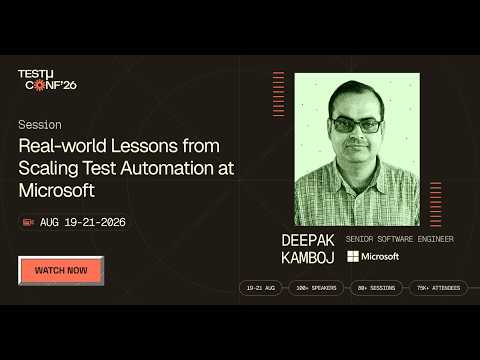
If you couldn’t catch all the sessions live, you can access the recordings at your convenience by visiting the TestMu AI YouTube Channel.
TL;DR
Scaling test automation across a large organisation is an architecture and governance problem before it is a tooling one. Microsoft’s approach separates a probabilistic reasoning layer of agents from a deterministic Playwright execution layer, and requires human approval on every generated change.
- What breaks first as automation grows? - Five things together: maintenance cost as selectors break on every UI change, flakiness from timeouts and race conditions, slow test creation, effort that scales linearly with coverage, and tests that cannot self-correct.
- How do you avoid running 14,000 tests per change? - Risk-based selection. Diff the abstract syntax tree, walk the dependency graph to find every impacted package, and weight by failure history and business criticality, while the full suite still runs nightly and at release gates.
- Does risk-based selection replace full regression? - No, risk-based selection does not replace full regression. Targeted runs give fast feedback on a pull request, and the complete suite still runs off-peak, at release gates and in the nightly pipeline to catch gaps the impact model missed.
- Which agents does the workflow use? - Four, each with one job: a planner producing a reviewable test plan, a generator writing specs and fixtures, a healer proposing repairs from failure evidence, and a reporter handling analysis and root cause.
- Is self-healing just an automatic retry? - No, self-healing here goes well beyond a retry. Failures are compared against a last known good baseline, multiple hypotheses are tried, and each candidate fix reruns in isolation through a gauntlet pipeline to prove it is not itself flaky before a draft pull request is raised.
- Should AI-generated pull requests auto-merge? - No, AI-generated pull requests should never auto-merge. Deepak Kamboj names it as the first pitfall, alongside monolithic prompts, a single model provider and ignoring execution history when judging flakiness.
- How is scenario coverage measured for integration tests? - By matching business rules to test specs by intent rather than filename, so unmatched rules surface as named coverage gaps while the pull request is still open.
- What did the pilot deliver? - Regression feedback 60 percent faster, test script repair effort down 40 percent, manual triage down 30 percent, and product-bug versus test-bug classification at 90 percent accuracy.
He opened by asking the audience where their own automation would break first.
Five Ways Automation Breaks
Traditional automation treats every test as a handwritten script that engineers author, run and repair whenever the application changes. At organisational scale that produces five failures that arrive together.
- Maintenance cost - selectors break with every UI change, so the suite needs updating continuously.
- Flakiness - timeouts and race conditions make a component unavailable, and the signal erodes until nobody believes the results.
- Slow creation - a comprehensive suite takes weeks or months to write, so coverage permanently trails the product.
- Poor scalability - effort stays linear, meaning more coverage costs proportionally more people.
- Limited intelligence - a test cannot adapt or self-correct, so every failure and every requirement change needs a human.
His framing is that these are connected system problems rather than isolated test problems. They belong to the engineering system, which is why the answer is architectural.
Brittle scripts, flaky tests, coverage that only grows when you throw more people at it. Deepak Kamboj from Microsoft explains why traditional automation stalls at scale, then shows the shift to adaptive, agent-driven testing. pic.twitter.com/BejODLkdBx
— TestMu AI (@testmuai) August 19, 2026
The Five-Stage Journey
He offered his team’s path as one example rather than a roadmap to copy, and its shape is the point.
- Selenium regression - running alongside scripted tests.
- Playwright on the existing runner - because early Playwright shipped without a test runner, so they ran it under Jest.
- Playwright’s native runner - for parallelism, tracing and fixtures.
- Assisted authoring - Playwright codegen and GitHub Copilot generating the boilerplate.
- Agents and Playwright MCP - planning, generation, diagnosis and proposed repairs for failures.
The transferable lesson he drew is evolution rather than replacement. Mature organisations keep the working suites they have and introduce each new capability behind a measurable gate.
100 Packages, 14,000 Tests
The scale is what makes the problem specific. A single monorepo holds more than 100 packages and many production applications, worked on by dozens of partner teams.
A single product change touches multiple owners, because code fixes, test data, dependencies and pipelines all move together. Five capabilities were layered on top of that.
- Test selection - AI maps a code change to its dependencies and risk, with the team approving the selection rules.
- Test maintenance - detecting selector drift and proposing focused patches for the owner to review.
- Test ownership - using code history and coverage data to identify the owning team across 14,000 tests, so a failure routes to someone who can act on it.
- Test repair - combining logs, DOM and screenshot evidence to separate a product defect from a test bug or an infrastructure issue.
- Scenario coverage - because code coverage is straightforward for unit tests and genuinely hard for integration tests.

Probabilistic and Deterministic
The architecture starts by separating probabilistic reasoning from deterministic execution, and he returned to that split as the central design decision of the whole talk.
- Reasoning layer - a frontier LLM interpreting business intent, planning scenarios and forming hypotheses when a test fails.
- Playwright MCP - the browser bridge, turning intent into observable actions such as inspect, click, type and assert.
- Prompt-to-patch flow - parsing a requirement into intent, generating test code, validating it in the browser, and looping on patches until it passes.
- Playwright engine - the deterministic core running Chromium, Firefox and WebKit, covering UI, visual and API testing.
- Reporting and observability - collecting traces, summarising failures, surfacing flakiness and coverage gaps, with digests into Teams or Slack.
- CI/CD layer - selecting impacted tests, sharding them, routing failures and raising draft fix pull requests.
Azure DevOps and GitHub remain the system of record, execution history is retained, and human approval is mandatory for every generated change.
His reasoning for the split is the asymmetry between the layers. Give Playwright the same test and environment and the result is the same every time; give an LLM the same prompt and the output varies, which is why context and history are what make the reasoning layer usable. A separate Testμ Conf 2026 talk, Build Trustworthy AI Agents Powered by Evals, reins in that variation with fixed seeds and typed objects between steps.
Four Agents, One Loop
Requirements arrive from wherever they already live: product requirement documents, work items, test cases in Gherkin or YAML, collaboration threads, screenshots and recordings.
- Planner - combines the written intent with exploration of the application and produces a reviewable markdown test plan.
- Generator - converts an approved plan into Playwright specs, fixtures, page object model classes, test data and utilities.
- Healer - takes failing tests with their traces, DOM snapshots, logs, screenshots and network evidence, and proposes a focused repair that loops back to the generator.
- Reporter - failure analysis, root cause, suggested fixes and results delivered by email.
The design rule is that each agent has one job, inspectable output and a single clear failure boundary. That is what makes a bad result attributable rather than mysterious.
Around them runs an eight-step delivery loop from business intent to a green merged build: define outcomes and guardrails, generate product code, generate the test plan and cases, review both for correctness, security and coverage, execute in CI capturing evidence, classify the failure, route it to the specialised agent for that class, then human review and approval before merge.

Note: A three-hour pipeline is a scheduling problem as much as a test problem. TestMu AI HyperExecute shards and orchestrates suites across a managed grid, so selection and parallelism cut feedback time without cutting coverage. Try it free!
Coverage by Intent
Coverage is not a count of test cases, and unit-test code coverage does not answer whether a critical business scenario still works. That gap is what their scenario coverage engine addresses.
It reads the change requirement document, extracts the testable scenarios implied by each business rule, and matches those scenarios to test specs by intent rather than by filename. Evaluating Agents Against What They Are Actually Supposed to Do, a talk from the same conference, applies that intent-first idea to agents, testing each against its written behavior spec.
Rules with no match become named coverage gaps while the pull request is still open. What surfaces that way is the work nobody remembers: silent server-side validation, forgotten error paths and permission branches.
Generation follows the same discipline. It starts from one requirement or pull request description rather than an unconstrained prompt, extracts the affected form and its field rules, and prefers Playwright’s accessibility-first locators such as getByLabel and getByRole, asserting both visibility and the content announced to screen reader users.
Risk-Based Test Selection
Running every test on every change turns a safety net into a queue. A small bug fix triggered more than a thousand tests, and a pull request took three to four hours to report back.
The replacement reasons about impact instead of running everything. Changed modules are parsed, abstract syntax tree differences identified, and the dependency graph walked so that every affected package is considered rather than only the one that changed.
Failure history and business criticality weight the result, and the highest-risk impacted tests run first under an explicit policy.
He was careful about the boundary. Targeted selection is not a replacement for full regression, so the complete 14,000 still run off-peak, at release gates and in the nightly pipeline, precisely to catch what the impact model missed.
Self-Healing and the Gauntlet
His definition of self-healing is mostly a list of what it is not. It is not a blind retry, and it must not paper over a product regression.
When a locator fails, the system captures test logs, accessibility snapshots and screenshots, then compares them against the last known good baseline. Multiple agents pursue multiple hypotheses rather than one guess.
A candidate fix becomes a git-compatible diff, and the affected tests rerun in isolation in what his team calls the gauntlet pipeline. The fix is run repeatedly there specifically to prove it is not itself flaky, and only then does a draft pull request reach a human.
Underneath sits the classification problem, which he treats as the harder one.
Each hypothesis starts from that evidence plus the code diff, test data and execution history. The output is a classification of test bug, product bug or infrastructure issue, with a confidence score, a root cause narrative and a likely owner so the work routes to the right team.
Governance and Guardrails
His position is that technical capability does not create enterprise adoption. Trust does, and trust comes from controls.
- Human review - on every AI-authored change, whether a generated test, generated product code or a proposed repair.
- Least privilege - read permissions wherever possible, narrow-scope draft pull requests, and no production deployment rights for any agent.
- Auditability - telemetry on every agent and MCP action, covering requirement ID, prompt version, tool action, model output, classification and approval.
- Data privacy - no secrets, certificates, network information or customer data exposed to agents.
- Sandboxing - generation happens in isolated environments that are not dev boxes, test environments or production.
Pilot Results
The numbers he shared came with a caveat he repeated more than once, so it is worth carrying: these are observed results from their own pilot, used to optimise their agents, and not benchmarks anyone should treat as a promise.
- 60 percent faster - regression feedback, with developers seeing useful signal in minutes rather than the previous three to four hours.
- 40 percent reduction - in test script repair effort through self-healing.
- 30 percent reduction - in manual bug triage.
- 90 percent accuracy - classifying a failure as a product bug against a test defect.
A secondary effect matters as much as the headline. Running fewer unrelated tests produces fewer unrelated flaky failures, which makes triage cleaner as well as faster.
Lessons and Pitfalls
The patterns that held up across the pilots start with the taxonomy and end with how the team relates to the tooling.
- Define the failure taxonomy before prompting anything - classifying whether a failure came from the test script, the product, the agent or a hallucinating model.
- Historical data and context beat a bigger model - failure data, syntax trees and accessibility snapshots are what let an agent work properly.
- Specialised agents under a supervisor - decomposing the problem rather than asking one agent to do everything.
- Abstract the model provider - so each specialisation can use a different model and a different prompt.
- Treat AI as a partner rather than a black box - complementing engineers instead of replacing them.
The pitfalls he named are the ones that repeatedly damaged trust, and he was blunt about all of them.
- Never auto-merge AI changes - always a human review, always validated in an isolated environment first.
- No monolithic prompt and no single model - each agent gets its own prompt and a model suited to its task.
- Do not ignore execution history - flakiness and a genuine failure look identical in a single run, so consistent failure is the evidence you need.
- Do not launch every suite at once - promote tests through the gauntlet pipeline and into production only once they pass in isolation.
The Phased Roadmap
He closed by turning the material into an adoption sequence rather than a set of ideas. Start with the foundation of Playwright and the agent tooling as a baseline, then integrate with whichever build infrastructure you already run.
Next come the AI layers that make failures actionable: root cause analysis, scenario coverage and classification, so a failure can be attributed and assigned rather than merely reported.
Scaling follows, across a cross-browser matrix, multiple operating systems and environments, and separate geographies, with flaky detection running throughout. Organisation-wide rollout, analytics, telemetry and cost optimisation come last.
His four takeaways compress the session. Platforms scale teams through shared automation and self-service infrastructure; agents earn their place by removing repetitive authoring, maintenance and first-pass triage; data beats a bigger model, because logs and screenshots are what power flaky detection and risk scoring; and governance is what converts capability into adoption.
This session was part of Testμ Conf 2026, which ran across three days of sessions on agentic engineering and quality. Registrations for the next edition are already open on the Testμ Conference 2027 page.
A related Testμ 2026 session, From Load Testing to Reliability Engineering, goes further into this.
Author

TestMu AI
Blogs: 290


TestMu AI is World's First Full Stack AI Agentic Quality Engineering platform that empowers teams to test intelligently, smarter, and ship faster. Built for scale, it offers a full-stack testing cloud with 10K+ real devices and 3,000+ browsers. With AI-native test management, MCP servers, and agent-based automation, TestMu AI supports Selenium, Appium, Playwright, and all major frameworks. AI Agents like HyperExecute and KaneAI bring the power of AI and cloud into your software testing workflow, enabling seamless automation testing with 120+ integrations. TestMu AI Agents accelerate your testing throughout the entire SDLC, from test planning and authoring to automation, infrastructure, execution, RCA, and reporting.


Did you find this page helpful?
More Related Blogs

TestMu AI forEnterprise
Get access to solutions built on Enterprise
grade security, privacy, & compliance
- Advanced access controls
- Advanced data retention rules
- Advanced Local Testing
- Premium Support options
- Early access to beta features
- Private Slack Channel
- Unlimited Manual Accessibility DevTools Tests