
Agent Assurance for your AI Deployment
Test how your agents actually behave across workflows, tools, and actions. Catch failures and vulnerabilities before they ship.
npm install -g @testmuai/rook
- TestMu AI (Formerly LambdaTest)
- /
- Blog
- /
- Build Trustworthy AI Agents Powered by Evals [Testμ 2026]
Build Trustworthy AI Agents Powered by Evals [Testμ 2026]
Rushabh Mehta of Meta on agent evals: idempotency keys, checkpointing, memory TTLs, the three grader types, and why GAIA 2 shows temporal awareness still fails.
Last Updated on:
An agent runs a task that takes a hundred steps, and at step 20 it gets something wrong. Nothing announces it. The remaining 80 steps proceed on that mistake, and you discover the damage at the end, if at all.
In this session from Testμ Conf 2026, Rushabh Mehta, Software Engineer at Meta, argues that vibes and looks good to me are not deployment strategies. He builds environments for training and evaluating LLMs on agentic and tool-use capabilities, and walked through what an eval suite has to catch.
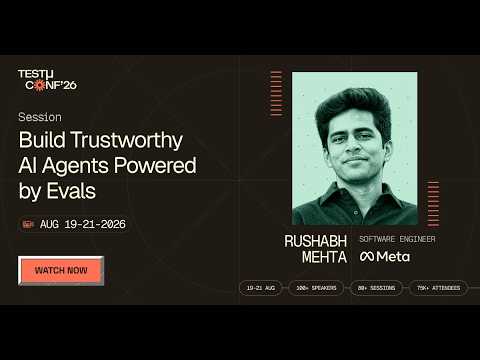
If you couldn’t catch all the sessions live, you can access the recordings at your convenience by visiting the TestMu AI YouTube Channel.
TL;DR
An eval checks that an agent does what it should and does not do what it should not. Agent evals are harder than model evals because a hundred-step trajectory accumulates errors, tool calls have real side effects, and the grader itself is often another model whose judgement depends entirely on its rubric.
- Why are agent evals harder than unit tests? - A single task can span hundreds of steps, each tool call is a step, and an error introduced at step 20 silently contaminates everything after it while costing time, money and debugging cycles.
- Can non-determinism be eliminated? - No, non-determinism in an agent can only be reduced. Temperature at zero, fixed seeds, typed objects that enforce a schema between passes and pass@k scoring all narrow it, and the variability that makes an LLM capable is the same property that resists elimination.
- How do you test for hallucination directly? - To test an agent for hallucination, make the underlying corpus deliberately inaccessible and verify the agent says it cannot answer. Rewarding abstention over confabulation turns an abstract risk into a pass or fail.
- What stops an agent double-booking? - Standard distributed-systems hygiene applied to tool calls: idempotency keys across retries, exponential backoff, and saga-style compensation so a wrong reservation can be cancelled cleanly rather than deleted from a database nobody owns.
- How do you contain error accumulation? - Checkpoint every few steps and persist state cohesively enough to resume from it, so a failure at step 25 rolls back to the last known good checkpoint instead of poisoning the run.
- Which grader should you build first? - Code-based deterministic graders, which Rushabh Mehta estimates cover roughly 65 to 70 percent of what most teams need to measure and remain what frontier labs rely on wherever possible.
- What makes an LLM-as-judge grader reliable? - The rubric. A model-based grader is only as good as the four or five dimensions stakeholders agree on, which is why defining them is a cross-functional exercise rather than an engineering one.
- Where do frontier models still fail? - Temporal awareness. On the GAIA 2 benchmark, search and execution score in the 80s and sometimes high 90s, while time, ambiguity and adaptability remain hard.
He started by pushing back on the idea that this is testing under a new name.
The 100-Step Problem
Evals get written off as functional or unit testing with a new label, and his objection is about scale of consequence rather than technique. Agents are expected to perform long-running actions measured in hundreds of steps, not tens.
Every tool call and every shell command is a step in its own right. An error at step 20 has 80 more steps to propagate through, and nothing in the run flags that it happened.
His framing of the cost is practical. You spend time, money and debugging cycles on an outcome that is not what you expected, and sometimes you cannot even establish what went wrong.
The rest of the session is the toolkit for that, split between the challenges agents inherit from LLMs and the ones they create by having hands.
Defining an Eval
His definition has two halves that teams routinely reduce to one. An eval confirms the agent is doing what it is supposed to, and that it is not doing what it is not supposed to.
That two-sided check is what separates an eval from a demo, and what AI evals are and how to run one sets out the parts it needs before it can gate anything. Another Testμ 2026 session, on evaluating agents against what they are actually supposed to do, starts that check from a plain-language behavior spec.
The organisational value is that it settles an argument nobody else can. Ship a new feature and the engineer, the quality engineer, the program manager, the product manager and the designer all need one source of truth on what good looks like.
Regression is the second reason. After the initial launch, iteration is where things stop working without anyone noticing, and the eval suite is what tells you that you have not broken what used to work.
The third reason is the one he flagged as his own unique take: portability. Not every team can spend heavily on proprietary models, and combining your own data with an open-source model and a fine-tuned checkpoint raises questions about where inference runs, on which cloud, on which GPUs. An eval suite lets you check the base capabilities hold regardless of any of that.
The Eval Harness
He built the picture in layers, starting from the model and ending at something you can run.
- The LLM - a next-token predictor, and a very good one, which on its own returns text rather than actions.
- Tools - search, browsing, access to your own data. Model plus tools is what produces agentic capability.
- Tasks - the specific things you want the agent to accomplish.
- Graders - deterministic code, an LLM acting as judge, or a human, depending on how much nuance the judgement needs.
- Measurement - cost and token usage tracked across all of it.
The collective trace of a run is what he calls the trajectory: the user prompt, the system prompt that is the model’s internal message to itself, and the reasoning traces, captured together as JSON. A separate Testμ 2026 talk on why agents need custom evals and how to create them covers grading a trajectory when the evidence runs out.
Trajectories run against tasks and scored by graders are the eval harness. His aside on tokens is worth keeping: costs are subsidised in this window of AI history, and experimenting heavily now is a reasonable use of that.
Rushabh Mehta deep dives into the anatomy of agent evaluation: harnesses, task suites, and why graders must be stacked rather than used alone.
— TestMu AI (@testmuai) August 19, 2026
He unpacks non-determinism, repeated trials, and why scoring trajectory alongside outcome is the only way to separate a reliable agent… pic.twitter.com/dLBDtbwKOP
Taming Non-Determinism
He was direct that there is no silver bullet, and framed it as a double-edged sword. The property that lets an LLM cover a much larger surface area is the same one that makes its behaviour hard to pin down.
- Temperature at zero - as deterministic as is theoretically available, and reproducible.
- Seeds - fixed as a hyperparameter, so a run can be repeated under the same configuration.
- Typed objects - emitted between passes to enforce the schema, so nothing unexpected slips between steps.
- Pass@k - out of five or fifteen attempts, how many times did the agent get it right.
His point about these is that they work around the problem rather than fix it. Running k times and counting the variation is how you learn what your actual reliability is.
Rewarding Abstention
His hallucination example is specific enough to reproduce. An agent needs to read a directory on the file system, it does not have permission, and the prompt told it not to stop until it had the answer.
Without access to the corpus, it invents. The prompt tweak that seemed like a good idea, picked up from somewhere on X, is what forced the invention.
The eval design that catches it is to reward abstention over confabulation. Construct the situation so the underlying corpus is inaccessible, then check what the agent does.
The correct behaviour is raising a hand and saying it lacks permission, so it cannot answer either way. Confident invention is the signal that more work is needed on adversarial probes.

Note: Reading a hundred-step trajectory by hand does not scale past the first few runs. TestMu AI Agent Testing records the full trace of an agent run, including tool calls and decision points, so a failure can be traced to the step that caused it. Try it free!
Tool Call Safety
His model for this is that the LLM is the brain and the agent supplies the hands and limbs. Tool calls, whether MCP servers or plain APIs, are where actions become real, and where distributed systems knowledge earns its place.
Anything involving money is a critical write. Booking a flight or a hotel twice is a customer problem, not a test failure.
- Idempotency keys - reused across retries so a repeated call deduplicates rather than committing the action twice.
- Exponential backoff - waiting one, then two, then four, rather than polling a slow service every few seconds.
- Saga-style compensation - because undoing a wrong reservation is not deleting a database row, which in most cases sits in a back end you do not own. Cancellation has to be a first-class citizen so the fix is clean.
- Detailed failure classification - separating authentication and authorisation failures from 429 throttling from a step that produced malformed output.
He noted the asymmetry that makes this worth the effort. Agents read far more than they write, and the blast radius on a write is much larger.
Checkpoints and Rollback
His answer to the hundred-step problem is borrowed from systems engineering. Checkpoint every few steps, so a failure detected at step 25 can be traced back to a state captured at step 20 and resumed from there.
The requirement is that the persisted state be cohesive and self-sufficient. A checkpoint you cannot restart cleanly from is not a checkpoint.
With that in place, rolling back to the last known good state stops errors accumulating, and stops the run burning resources on work built on a bad foundation.
Memory Hygiene
He separated memory from context deliberately. Memory is what the agent bookmarks as it works, in files or a vector database; context is closer to RAM, the sliding window fed into the model for the next turn.
Even with a million-token window, not all memory reaches context, so past work has to stay retrievable or the agent runs in circles. What goes into memory needs sorting rather than accumulating.
- Facts against summaries - a stable fact can be locked down, where a summary has a finite lifetime because the base facts underneath it can change.
- TTLs - treated like a cache, keeping data accessible in the short run and expiring it afterwards.
- Provenance - the source, the time the inference was made, and a confidence level where the answer is not black and white.
His worked example for provenance involves an orchestrator running worker sub-agents. Worker three infers something from loose data at perhaps the fiftieth percentile of confidence while waiting on worker four, and once worker four returns the authoritative answer at P90, the low-confidence inference should be purged rather than left sitting in memory.
Chunking got the same treatment. Splitting by words is not enough for a coding agent, where chunking along the abstract syntax tree respects the structure the model actually needs.
His favourite failure to test for is stale memory. On a 50-person project with status updates arriving over months, an agent reading two-month-old updates produces a summary that misrepresents everyone’s work, and nothing about the output looks wrong.

Three Kinds of Grader
Grading splits into three buckets, each with its own strengths, and the goal is a strategy that covers the ground while spending the least money and keeping the most determinism. In a Testμ 2026 session on eval-first QA agents, the Fox Networks team runs substring, regex and JavaScript checks before a costlier LLM rubric judge.
- Code-based - fast, cheap, reproducible across runs, and sometimes as simple as a regular expression. Anything about tool calls suits them: valid parameters, correct JSON, schema conformance. He puts roughly 65 to 70 percent of what most teams measure in this bucket, and noted that frontier labs still lean on deterministic graders wherever they can.
- Model-based - for judgements code cannot make, such as whether writing is crisp, concise or citing authoritative sources. Non-deterministic by construction, since you are testing a model and its harness with another model, and in exchange you get flexibility across scenarios.
- Human - the gold standard, and expensive and slow. He recommends keeping graders and decision logs in version control, so a commit hash tells you exactly which criteria were applied.
Pairwise comparison is the model-based technique most people have already met without naming it. The tools that show two answers and ask which is better are running it with a human in the loop, and a judge model does the same against a rubric.

Building the rubric is a cross-functional exercise rather than an engineering one. Four or five dimensions, agreed between product, engineering and everyone else with a claim on what success means, then a curve across good behaviour, bad behaviour and what needs investigating.
He also gave a stopping rule for human grading, which teams rarely define. When the vast majority of human graders agree with what the agent did across a range of tasks, you have reached diminishing returns.
GAIA 2 and Mock Universes
He closed on work he collaborated on at Meta. GAIA 2 arrived in 2026, three years after the first version, and consists of around 800 carefully crafted scenarios.
Each scenario lives inside a mock universe modelled on an ordinary digital life: mail, messaging, a to-do list, shopping, apartment hunting. The apps are mock versions by necessity, because post-training and reinforcement learning runs cannot hit the real services.
His reasoning there is blunt. You would be blocked before you were even throttled, and you would control none of the variables that make the experiment meaningful.
Agents are evaluated across five dimensions: search, execution, adaptability, time and ambiguity. His example prompt shows why one instruction touches all of them.
Schedule a film production day, cancel any conflicts, email Ross because he is a required attendee, and reschedule if he declines or proposes another time. Scheduling is a straightforward calendar write; cancelling conflicts needs temporal awareness; there may be several people called Ross; and reacting to his counter-proposal is adaptability.
The results tell you where the field actually is. Search and execution score in the 80s and sometimes the high 90s, because that is where the last two or three years of effort went.
Ambiguity, adaptability and above all time remain hard for even frontier models. His reading of a poor temporal score is optimistic rather than damning, because it marks headroom you can still work through.
The scenarios are extensible, and Meta open-sourced the repository under the name agent research environments. In the resulting graph the original user prompt is one node and the oracle events are the rest, so each part of the agent’s behaviour can be validated as it goes.
From Harness to CI Gate
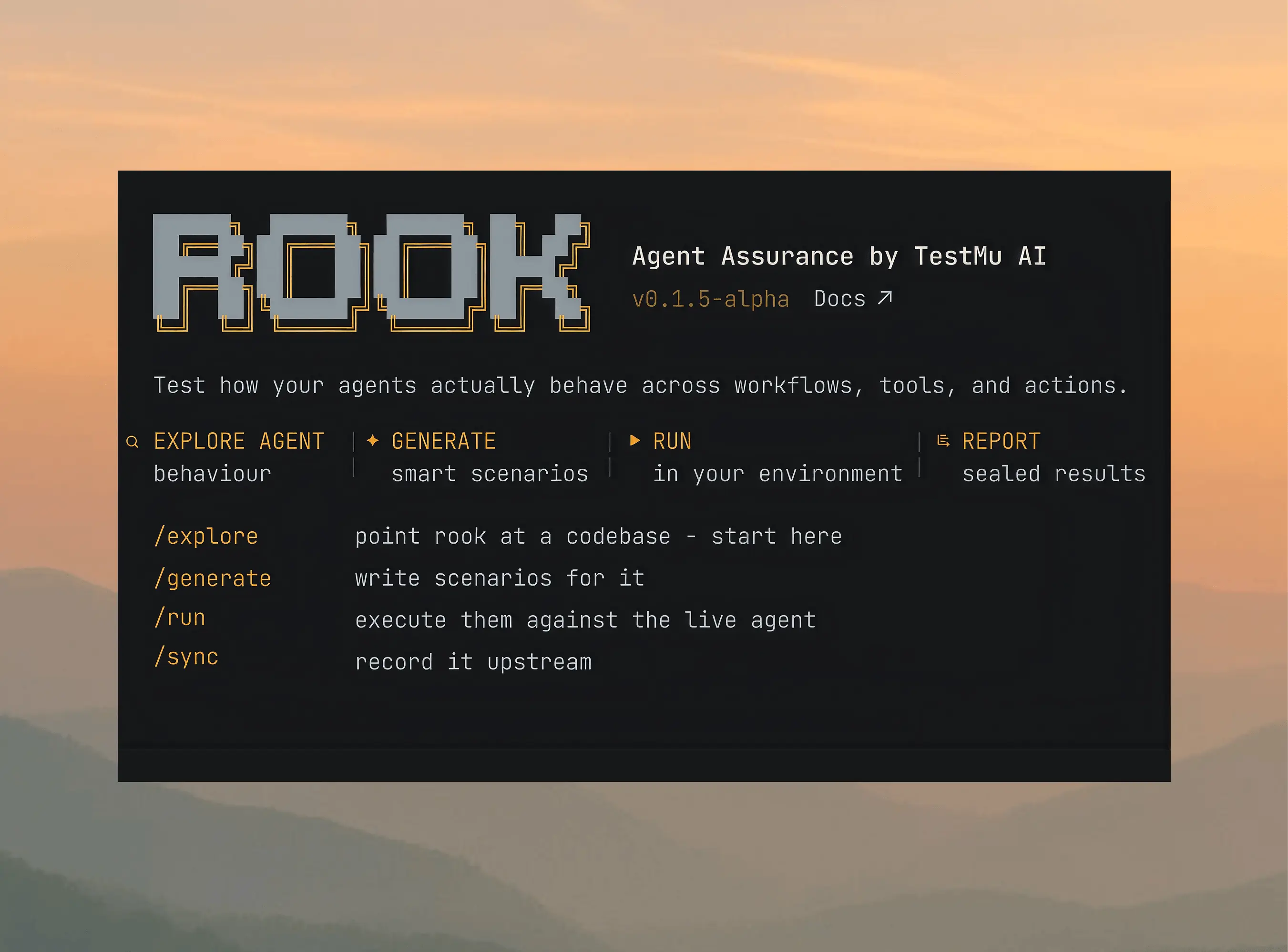
Rushabh Mehta’s harness is one a team builds and then has to remember to run. TestMu AI Agent Assurance reads a codebase, writes the suite, runs the agent for real, and grades every criterion against observed evidence: files changed on disk, artifacts produced, tool calls checked against the agent’s declared tool surface. The category covering agents that act, the ones that call tools and write files, is publicly installable, and its commands and stored file formats can still change.
- explore and generate - the first two commands find agents in a codebase and write scenarios across the functional, non-functional and adversarial categories.
- run and report - run executes against the live agent, report reads the results back, and the verdicts quote the evidence they rest on.
- Pass, Fail, Unable to Verify - the third verdict is reported beside the pass rate and left out of its denominator, so a criterion the run could not check is neither a soft fail nor a silent pass.
- The gating step - parse rook report --json for those verdicts, because exit code 0 only means the command did what it said and a finished run exits 0 whether scenarios passed or failed. Exit code 1 covers signed out, unreachable or a run that could not start.
- Delta tracking - newly failing, newly fixed and flaky criteria measured against the previous run, which is the regression signal an eval suite exists to provide.
The CLI, rook, is pre-alpha, and its documentation carries one caution that matters here. The agent you point it at is yours and its writes are real, and nothing rolls them back, so staging is the place to run it. The judges themselves verify without changing state.
Q & A Session
Time allowed for one audience question, and the answer was the most practical advice in the session.
- What is the most counterintuitive thing you have learned about your own agents?
Rushabh Mehta: Hallucination has layers, and system prompts and agent instruction files are the low-hanging fruit. The genuinely counterintuitive part is that you have to read the raw traces, which cuts against the instinct that AI tooling is there to automate the workflow away. As an end user, or even as the developer of the agent, you mostly look at the final answer and any obvious API failures. What falls off silently is the interesting part, such as why the agent took path A when B and C were both available, and that is visible only in the full trace. The first pass has to be manual, before you build any automation to read traces for you. He is firm on that last point.
This session was part of Testμ Conf 2026, which ran across three days of sessions on agentic engineering and quality. Registrations for the next edition are already open on the Testμ Conference 2027 page.
Author

TestMu AI
Blogs: 290


TestMu AI is World's First Full Stack AI Agentic Quality Engineering platform that empowers teams to test intelligently, smarter, and ship faster. Built for scale, it offers a full-stack testing cloud with 10K+ real devices and 3,000+ browsers. With AI-native test management, MCP servers, and agent-based automation, TestMu AI supports Selenium, Appium, Playwright, and all major frameworks. AI Agents like HyperExecute and KaneAI bring the power of AI and cloud into your software testing workflow, enabling seamless automation testing with 120+ integrations. TestMu AI Agents accelerate your testing throughout the entire SDLC, from test planning and authoring to automation, infrastructure, execution, RCA, and reporting.


Did you find this page helpful?
More Related Blogs

TestMu AI forEnterprise
Get access to solutions built on Enterprise
grade security, privacy, & compliance
- Advanced access controls
- Advanced data retention rules
- Advanced Local Testing
- Premium Support options
- Early access to beta features
- Private Slack Channel
- Unlimited Manual Accessibility DevTools Tests