

Power Your Software Testing with AI Agents and Cloud
The Native AI-Agentic Cloud Platform to Supercharge Quality Engineering. Test Intelligently and Ship Faster.


- TestMu AI (Formerly LambdaTest)
- /
- Blog
- /
- Loop Engineering: Close the Verify Loop
A coding agent that writes a feature, declares it done, and moves on is only running half a loop. It never checked that the thing it built actually works in a browser. Loop engineering is the work of designing the other half, the part where the agent observes the real result of its action and corrects course before it ships.
This is where the industry is heading as agents take on more of the build. The interesting problem is no longer the single prompt. It is the cycle the agent runs, and the signal that tells it whether to stop or keep going.
From Prompt Engineering to Loop Engineering
The first wave of AI adoption focused on single-shot prompt engineering, the craft of shaping context, rules, and constraints to get a model to produce one good piece of static output. As software environments grew more complex, the work shifted toward loop engineering.
Loop engineering is the practice of designing, managing, and hardening the execution cycles an autonomous agent operates inside: plan, act, observe, verify, and repeat. An agent does not generate an answer and stop. It takes an action, observes the runtime effect of that action, and uses that observation to calculate its next move.
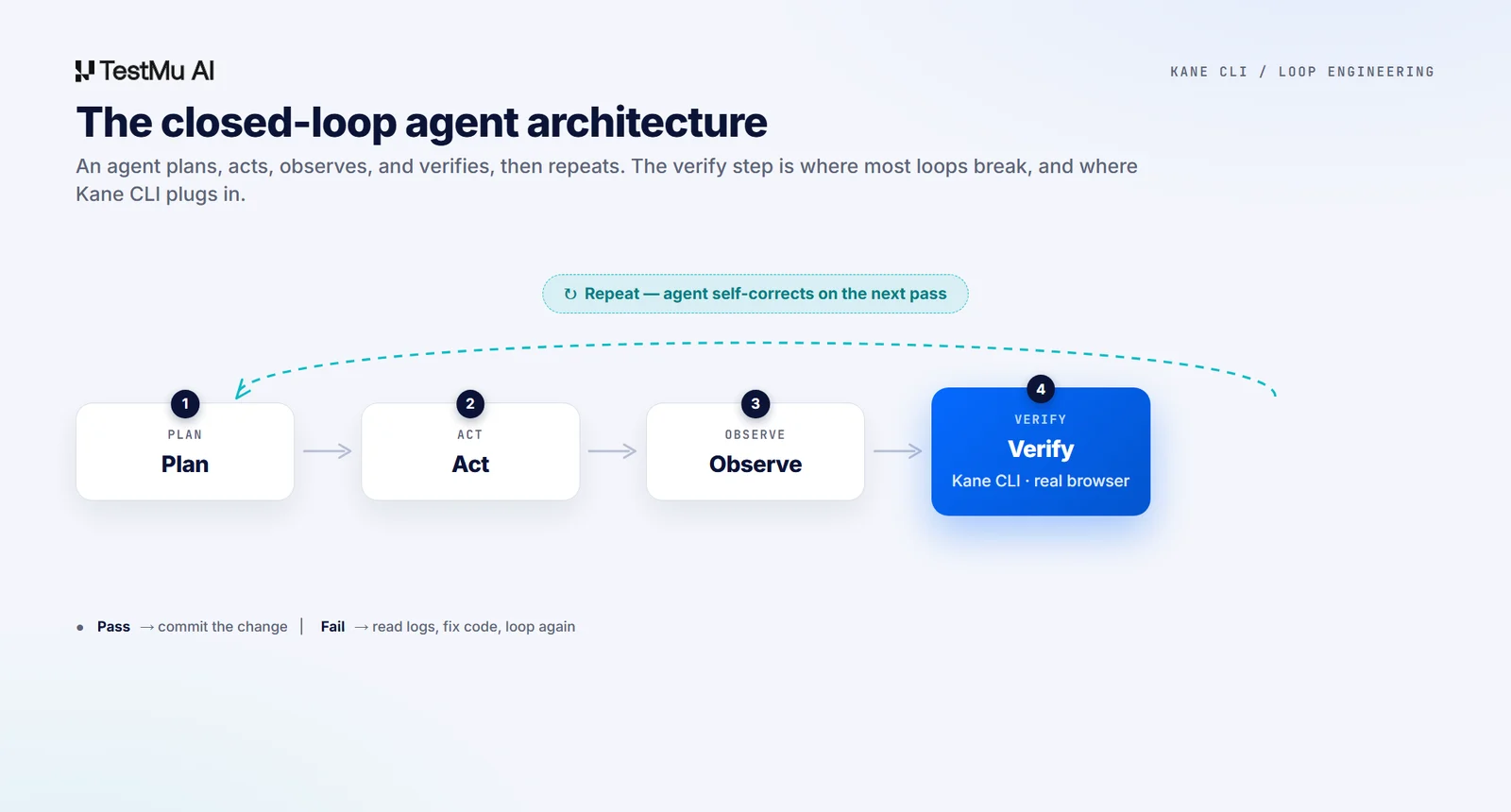
When you engineer the loop correctly, the agent self-corrects on the fly. When you get the observation signal wrong, the agent spins, compounding its own errors toward a broken outcome. The quality of the loop is set by the quality of the feedback.
Where Most Browser Agent Loops Break
The weakest link in a development agent loop is how it evaluates user interfaces. A typical code-generation loop plans the change, modifies the codebase, and declares the task finished, relying entirely on code-level signals to judge success:
- Compilation status: did the application build without errors?
- Type correctness: did the type checker pass cleanly?
- Unit testing: did the functional unit blocks execute successfully?
For anything that renders in a browser, these proxies are insufficient. An application can compile flawlessly while its interface is unusable. A login flow can look pristine to a loose model inspection yet silently fail to write session state to browser storage. A checkout button can freeze on an unhandled client-side exception. Because the agent closes its loop on a weak proxy, it moves forward under a false assumption of success.
It is the same gap a human still has to fill by hand, the reason teams keep verifying vibe-coded changes manually after the agent says it is done.

Note: Give your agent a real browser and a deterministic pass or fail. Start free. Try Kane CLI
Building a Closed-Loop Validation Layer
To build a reliable autonomous workflow, you inject an external verification step into the execution cycle. Instead of letting the agent guess its success, it is forced to call an external agent browser like Kane CLI to run the new flow against a live, running Chrome instance.
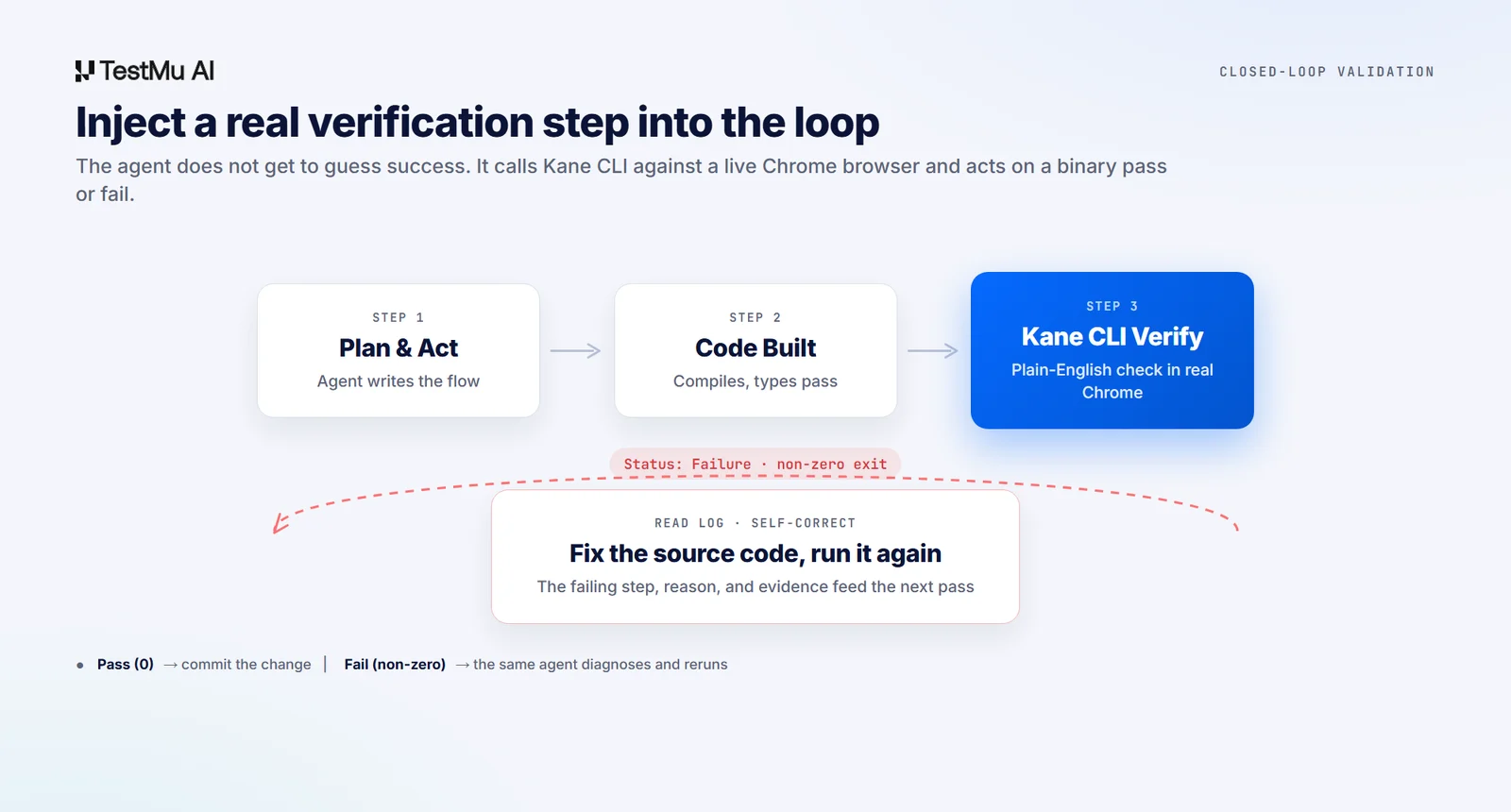
Kane CLI evaluates the journey against plain-English objectives, executes them directly against the DOM, and returns a binary verdict. The agent reads that external signal and splits its logic:
- On a pass (0): the agent finishes the task and commits the change.
- On a fail (non-zero): the agent reads the failure logs, evaluates the step trace, fixes the source code, and restarts the loop.
This is the same plain-English check you can drop into a pull request gate, so the loop that guards a local build also runs in CI/CD without a second framework.
Why the Feedback Signal Must Be Deterministic
Large language models are non-deterministic. Asking a model to inspect its own UI by feeding screenshots or raw code back into itself creates a circular dependency: the inspector shares the exact blind spots as the builder model. It is also slow and computationally expensive.
A deterministic check breaks that dependency. By relying on an external runtime that tests real browser interactions, you get a stable, reproducible signal. The same app state yields the same pass or fail every time, giving background pipelines a reliable boundary to gauge completion. TestMu AI built Kane CLI around exactly that contract, the same plain-English objective producing the same verdict on every run.
Designing Objectives for Tight, Self-Correcting Loops
To keep a loop tight and prevent runaway runs, your plain-English validation objectives should follow a clean pattern:
- Granular assertions: focus every objective on a single, isolated outcome with clear criteria.
- Explicit variable extraction: store and verify specific runtime values rather than relying on broad structural descriptions.
- Step ceilings: break long, multi-stage flows into distinct objectives to prevent runtime timeouts.
Structure your verification layer around these principles and your automated systems can run unattended without risking unbounded feedback loops. The agent that wrote the feature becomes the agent that proves it works, in a real browser, before the change ever reaches you or a user.
Note: Want the agent mode and skill setup behind this loop? Read the Kane CLI docs. Read the docs
For a worked example of an agent closing this loop end to end, see how Claude Code writes a feature and Kane CLI proves it works. And to point the same loop at production signals, see how to turn production logs into tests.
Two Testμ 2026 sessions pick this up in practice: Inside Replit’s Self-Driving Company and Is the Developer Lifecycle Dead?.
Author

Siddhant Sinha
Blogs: 7

Siddhant Sinha is a Lead Member of Technical Staff at TestMu AI architecting Kane CLI, the command-line tool for browser automation from the terminal, where natural-language flows run in a real Chrome browser and return pass or fail with shareable proof. He has spent over three years at TestMu AI (formerly LambdaTest) building scalable platforms that run tests at scale on real Android and iOS devices. His expertise covers platform architecture, large-scale distributed systems, and CLI design, shaped by earlier cloud-native engineering at Semut.io, including building Elasticsearch as a service.


Frequently asked questions
Did you find this page helpful?
More Related Blogs
TestMu AI forEnterprise
Get access to solutions built on Enterprise
grade security, privacy, & compliance
- Advanced access controls
- Advanced data retention rules
- Advanced Local Testing
- Premium Support options
- Early access to beta features
- Private Slack Channel
- Unlimited Manual Accessibility DevTools Tests