
Agent Assurance for your AI Deployment
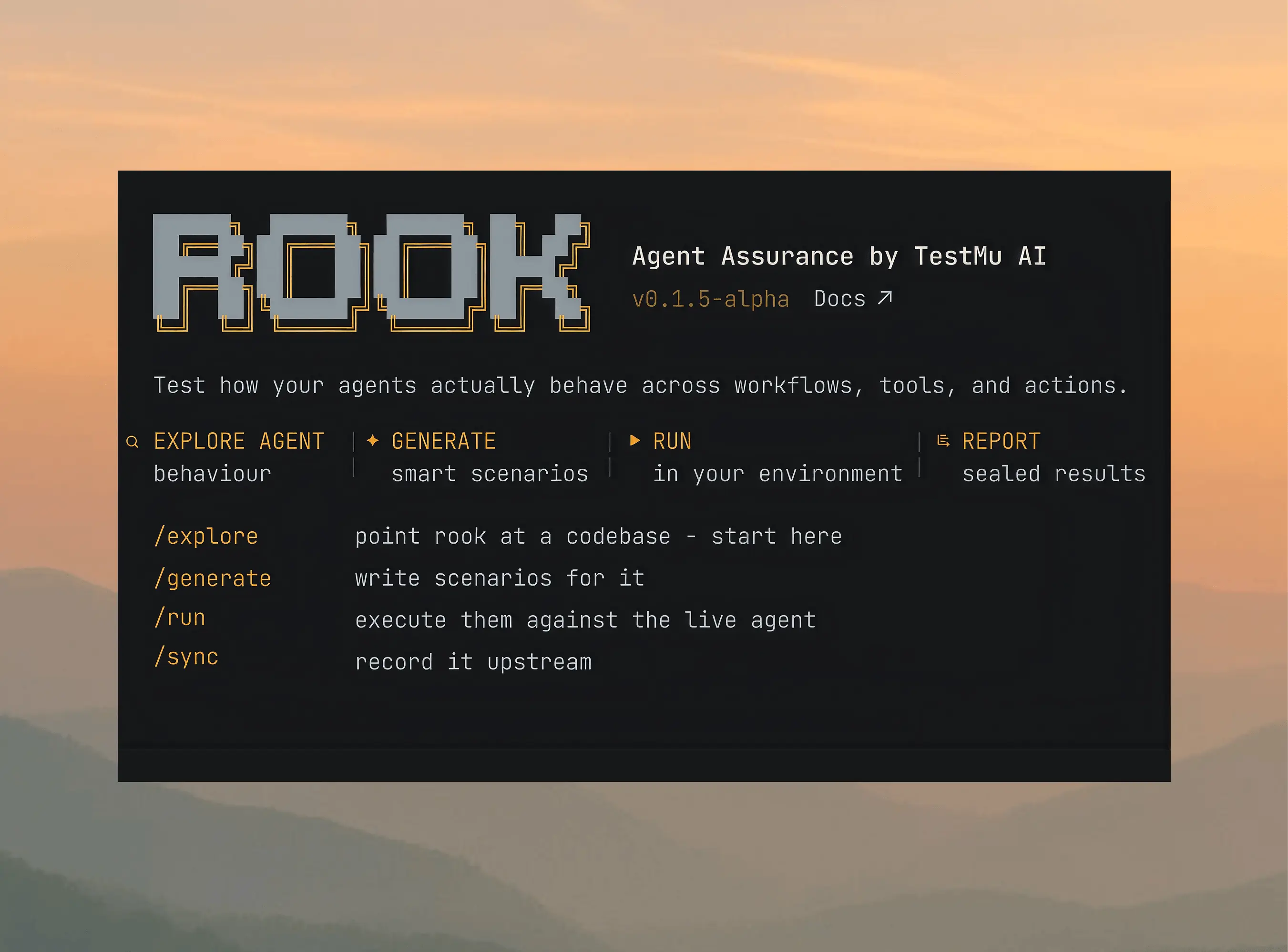
Test how your agents actually behave across workflows, tools, and actions. Catch failures and vulnerabilities before they ship.
npm install -g @testmuai/rook
- TestMu AI (Formerly LambdaTest)
- /
- Blog
- /
- LLM Prompt Monitoring: Track Prompt Versions in Production
LLM Prompt Monitoring: Track Prompt Versions in Production
LLM prompt monitoring links every production trace to the prompt version behind it. Learn the trace fields, signals, alert rules and triage for a regression.
Published on:
When a production LLM feature starts answering worse, the cause is usually a prompt edit, a provider model update, or a change in what users ask. Without LLM prompt monitoring, which records the prompt version behind each call, traces cannot tell those apart, and the fix becomes a guess.
On the provider side, OpenAI began rolling out a GPT-4o update in ChatGPT on 24 April 2025; offline evaluations "generally looked good" and A/B tests suggested the few users who tried it liked it, yet two days of monitoring early usage and user feedback showed a noticeably more sycophantic model, according to OpenAI's write-up Expanding on what we missed with sycophancy.
OpenAI says its first mitigation was a system prompt update, pushed late on Sunday 27 April; the full rollback began on Monday 28 April and took around 24 hours.
Overview
LLM prompt monitoring tags every production call to a language model with the name and version of the prompt that built it, then compares quality, safety, cost and latency between prompt versions on live traffic. When a signal moves, those fields show whether a prompt edit, a provider model update or a shift in user input caused it.
What It Covers
- Prompt identity: Each model call records the prompt name and version, a template hash, the requested model, the served model and the release, so a drop in quality can be tied to the change behind it.
- Per-version signals: Schema failures, refusals, judge-scored quality, injection and PII flags, cost and p95 latency are computed per prompt version over the same hours, so versions are compared on the same traffic.
- Sustained alert rules: An alert fires only when a version stays worse than the approved one for several consecutive windows with enough traces each. In this guide's sample run, the rule skipped a one-hour spike and fired in a canary's sixth hour.
- Triage: A new prompt version points to the prompt, a new served model under the same version points to the provider, and a shifted input mix with neither points to the users.
- Pre-release re-test: When a regressed prompt drives tool calls, TestMu AI's Agent Assurance can run the fixed version against staging before it ships, grading each criterion on the tool calls and records the run produced.
- Brand-visibility "prompt tracking", which records what AI assistants say about a brand, is a different practice; this guide covers the prompts your own application sends to a model.
What Is LLM Prompt Monitoring?
LLM prompt monitoring is the practice of tagging each production model call with the prompt version that produced it and comparing versions on live traffic. It tells you which version produced a given answer, whether a new version is worse than the one it replaced, and whether a regression came from the prompt, the model or the inputs.
It is one part of LLM observability, which watches an LLM application as a whole through traces, evaluations and cost. A general dashboard shows that answer quality dropped on Tuesday afternoon; a version key on every trace narrows that to, for example, version 14 of support-reply failing schema checks twice as often as version 13 in the same hours.
Pre-release tests on a fixed set of inputs decide whether a version may ship. Monitoring LLM prompts in production covers what that set cannot: inputs nobody wrote a case for, and model updates that providers ship on their own schedule.
Which Fields Does LLM Prompt Monitoring Need on Every Trace?
Record these on the span around each model call when it is made; fields joined later from a deploy log drift out of step with the traffic.
| Field | Example value | What it settles |
|---|---|---|
| Prompt name | support-reply | Which prompt produced the call |
| Prompt version | 14 | The key per-version signals group by |
| Template hash | 637d0c0e36f0 | Whether the wording changed without a new version |
| Requested model | acme-chat | The alias your code asked for |
| Served model | acme-chat-2026-09-30 | Whether the alias moved to a new snapshot |
| Decoding settings | temperature 0.2, max tokens 400 | Whether output moved because a setting changed |
| Release and cohort | 2026-10-16.2, canary | Which deploy served the call, and whether it was canary traffic |
| Route and segment | refunds, EU, mobile | Whether a rise is confined to one segment |
| Masked variables | [email], [digits] | What the inputs looked like, minus personal data |
Hash the template before variables are filled in, so the hash changes only when the wording does.
Recording the Prompt Version on an OpenTelemetry Span
The OpenTelemetry GenAI client inference conventions define two attributes for this: gen_ai.prompt.name, conditionally required when a named prompt template is used, and gen_ai.prompt.version, conditionally required when the name is set and a version is available. Both are at Development status, and OpenTelemetry's versioning and stability policy says that while signals are in development, "breaking changes and performance issues MAY occur".
The sample below sets both, names the span "chat" plus the requested model as the conventions specify, and puts a 12-character template hash and the release, which the conventions do not define, under an app namespace. Masked variables go there too, because the conventions' own gen_ai.prompt.variable attribute is opt-in and carries a sensitive-information warning.
import { trace } from "@opentelemetry/api";
import { createHash } from "node:crypto";

const tracer = trace.getTracer("support-bot");

// Mask email addresses and long digit runs.
const mask = (value) => String(value)
  .replace(/[\w.+-]+@[\w-]+(\.[\w-]+)+/g, "[email]")
  .replace(/\d{6,}/g, "[digits]");

const sha12 = (text) => createHash("sha256")
  .update(text).digest("hex").slice(0, 12);

export function reply(prompt, vars, callModel) {
  const name = "chat " + prompt.model;
  return tracer.startActiveSpan(name, async (span) => {
    span.setAttributes({
      "gen_ai.operation.name": "chat",
      "gen_ai.request.model": prompt.model,
      "gen_ai.prompt.name": prompt.name,
      "gen_ai.prompt.version": prompt.version,
      "app.prompt.template_sha": sha12(prompt.template),
      "app.release": process.env.APP_RELEASE ?? "dev",
    });
    for (const [key, value] of Object.entries(vars)) {
      const attr = "app.prompt.var." + key;
      span.setAttribute(attr, mask(value));
    }
    try {
      const res = await callModel(prompt, vars);
      const served = res.model;
      span.setAttribute("gen_ai.response.model", served);
      return res;
    } finally {
      span.end();
    }
  });
}
The sample ran on 16 October 2026 with @opentelemetry/sdk-trace-base 2.7.1 and @opentelemetry/api 1.9.1 under Node.js 25.5.0. A stub replaced the model call, and an in-memory exporter printed the finished span:
span: chat acme-chat
  gen_ai.operation.name   chat
  gen_ai.request.model    acme-chat
  gen_ai.prompt.name      support-reply
  gen_ai.prompt.version   14
  app.prompt.template_sha 637d0c0e36f0
  app.release             2026-10-16.2
  app.prompt.var.email    [email]
  app.prompt.var.order_id [digits]
  app.prompt.var.question Is order [digits] refunded?
  gen_ai.response.model   acme-chat-2026-09-30
The order number was masked inside the free-text question too. Check which attributes your backend reads: Langfuse links a generation to a prompt version through its own langfuse.observation.prompt.name and langfuse.observation.prompt.version attributes, with the version as an integer, so a Collector or span processor has to copy the values across.
Masking Prompt Variables Before They Reach a Span
The GenAI span conventions class model instructions, user messages and model outputs as sensitive, and say instrumentations "SHOULD NOT capture them by default". For production they recommend storing such content externally, with references on the spans, so access to it can be controlled separately.
- Mask in your code - apply masking before the exporter, so no Collector or backend ever receives the raw value.
- Allow-list what you keep - keep fields that help triage, such as route, language and input length, and drop the rest by default.
- Store replay text apart - keep raw inputs needed for replay in a store with its own access rules and retention, and put only a reference ID on the span.
- Expect pattern masking to miss things - regular expressions catch email addresses and long numbers, and miss names or street addresses written in free text.
Which Signals Show That a Prompt Version Is Regressing?
For prompt performance monitoring, compute each signal per prompt version over the same hours, so old and new versions see the same mix of users. Define a signal for each failure you would act on: OpenAI's write-up notes it had no deployment evaluations aimed specifically at sycophancy.
| Signal | Computed per version as | Alert when |
|---|---|---|
| Schema or format failures | Responses that fail parsing or validation, per call | Above the approved version for consecutive windows |
| Refusals | Refusals on in-scope requests, per in-scope call | Rises against the approved version |
| Judge-scored quality | Share of sampled traces scored below a set bar | Share rises for consecutive windows |
| Unsupported claims | Sampled answers with a claim missing from the retrieved context | Rises against the approved version |
| Injection and PII flags | Flagged calls, per call | Any confirmed case |
| Tokens and cost | Input and output tokens per call, priced from a pinned table | Cost per call leaves its budget |
| Latency | p95 latency and time to first token | Over target for consecutive windows |
| Negative feedback | Thumbs-down ratings, per rated call | Rises; ratings are sparse, so treat it as a tie-breaker |
| Tool-call errors | Failed or out-of-policy tool calls, per call | Rises, for agents that call tools |
Calibrate a judge on labeled traces before trusting its scores; LLM-as-a-judge covers how. Price tokens from a pinned table, the approach LLM cost tracking for agent evals explains, so a provider price change does not read as a prompt regression. A confirmed injection flag is a lead for prompt injection testing.
How Do You Baseline and Alert on a Prompt Version?
Compare a new version with the approved version in the same hours by sending it a small share of traffic. A baseline from last week mixes the prompt change with every change in what users asked since.
An alert rule needs four parts: the signal, a minimum number of traces per window, a threshold that allows for sampling noise, and a run of consecutive windows. The output below shows one rule applied to six hours of a canary (Node.js 25.5.0, 16 October 2026), and every count in it is sample data.
The threshold is the lower bound of a 95% Wilson score interval on the canary's failure rate, so an hour breaches only when even the optimistic reading of the canary is worse.
node alert-check.mjsSAMPLE DATA: prompt support-reply, v14 canary
signal: schema-failure rate, v14 vs v13 same hour
rule: >=400 v14 traces, Wilson 95% low end
above v13's rate, 3 hours in a row
hour v13 rate v14 n v14 rate v14 low state
1 1.81% 380 2.37% - too few
2 1.84% 540 3.89% 2.56% breach 1
3 1.79% 560 2.14% 1.23% ok
4 1.83% 610 3.93% 2.66% breach 1
5 1.77% 590 3.73% 2.48% breach 2
6 1.82% 630 3.97% 2.70% breach 3
ALERT at hour 6: v14 3.97% vs v13 1.82%
traces per version to detect a change
(two-sided 95% confidence, 80% power):
2.00% to 4.00% 1,141
2.00% to 3.00% 3,826
2.00% to 2.50% 13,810- Hour 1 had 380 canary traces, under the 400 minimum, so it counts neither way.
- Hour 2 breached and hour 3 did not, which reset the run: one bad hour cannot raise the alert.
- Hours 4, 5 and 6 breached in a row, so the alert fired at hour 6, with the canary at 3.97% against 1.82%.
- Over the six hours the canary served 3,310 calls with 113 schema failures, where the approved rate of about 1.8% predicts roughly 60.
The last lines size the canary. Telling a 2% failure rate from 4% takes about 1,141 traces per version at 95% confidence and 80% power; telling 2% from 2.5% takes about 13,810, or around 25 hours of a canary that receives 550 calls an hour. Set the canary's length from the smallest regression you need to catch.
How Do You Tell a Prompt Edit From a Model Update or an Input Shift?
Start from the fields on traces from the breached windows; each cause leaves a different mark:
| Cause | Mark in the traces | Check that confirms it |
|---|---|---|
| Prompt edit | The prompt version or the template hash changed when the signal moved | Replay a fixed set of recent inputs through the old and new versions with the model pinned; the gap reappears |
| Provider model update | The served model changed while the prompt version and hash stayed the same | Replay the same inputs against the previous snapshot while the provider still serves it; the gap follows the model |
| Input shift | Neither changed, and the share of a route, language or request type moved | Split the signal by segment, and replay last month's inputs through today's version, which should still pass |
The GPT-4o case shows why a trace needs both the prompt version and the served model: the regression came from a model update, and OpenAI's quickest mitigation was a system prompt change. Record only one of the two, and one of those events never shows on a trace.
A provider can also update a model between your deploys, when no change-triggered test runs; the guide to prompt evaluation covers scheduled baseline runs for that case in its section on drift.
When Should a Prompt Version Be Rolled Back?
Roll back when a trigger written before the rollout fires. A trigger names the signal, threshold, sustained window and minimum traces per window, as the sample rule above does.
- Rate signals - schema failures, refusals, judge-scored quality, cost and latency use a sustained window, because a single hour is noisy.
- Severe events - a confirmed PII leak, a successful injection or a wrong write to a customer record triggers on the first confirmed case, with no window.
- Canary stage - while the new version serves a small share of traffic, let the trigger move it back to the approved version automatically.
- After full rollout - page the prompt's owner with the version, the signal, the breached windows and links to example traces.
The steps of the rollback itself, and what has to be redeployed with the prompt, are in the prompt evaluation guide.
How Do Production Failures Become Prompt Tests?
Failing traces from the breaching windows are inputs that broke the prompt in production, the most useful cases for the next pre-release run.
- Pick failing traces from the breaching windows across segments, and drop near-duplicates.
- Mask or remove personal data with the same rules the spans use.
- Write down what a correct response or action must contain, instead of saving one approved output.
- Add the cases to the set the pre-release gate runs, each with its source trace ID.
- Run the fixed version against that set before it replaces the regressed one.
Agent Testing, TestMu AI's product for conversational agents, runs simulated personas against chat, voice, phone, video and image agents. Its Vapi integration adds two options for this loop, described in how to test Vapi agents: Auto-sync Prompts keeps the imported prompt in sync with the live assistant, and Auto-fetch Production Calls pulls the assistant's live calls into the view where its test calls are analyzed. Scheduled runs re-test chat, voice and phone agents on an hourly, daily, weekly or custom cron schedule.
Which Tools Track Prompt Versions in Production?
The table compares documented capabilities, read in each vendor's docs on 16 October 2026. It is not a ranking; the roundup of AI observability tools covers choosing a platform. A cell reading "not stated" means the docs were silent on it that day.
| Tool | Prompt versions | Version on the trace | Scores live traffic | Alerts | Self-hosting |
|---|---|---|---|---|---|
| Langfuse | Versions with labels; production label served by default | Linked to the generation; median latency, tokens, cost and score per version | LLM-as-a-judge on live traces, sampled | Latency, cost and score alerts; Slack, webhooks, GitHub Actions | Open source, Docker |
| LangSmith | Commits, commit tags, environments | Metadata you attach | Online evaluators, sampling rate | Errors, latency, cost, feedback scores; Slack, PagerDuty, webhooks | Enterprise plan add-on |
| Braintrust | Versions, pinned by version or environment | Prompt ID via load_prompt and build(), or custom metadata | Online scoring rules, sampling rate | Log and time-window alerts | Data plane, Enterprise plan |
| Datadog | Prompt Management registry | SDK prompt argument or OpenTelemetry attribute | Custom LLM-as-a-judge evaluations on traces | Monitors on evaluation results | Datadog-operated sites |
| MLflow Prompt Registry | Immutable versions, aliases | Linked when loaded in a traced function | Automatic evaluation, sample rate | AI Gateway budget alerts | Open source |
| Opik | Immutable versions v1, v2 and on | Linked when fetched in a function Opik traces | Online evaluation rules, sampling | Errors, cost, latency, scores, prompt changes | Open source, Docker or Kubernetes |
| PromptLayer | Prompt Registry, release labels | Request linked to a version by an SDK call | Signals on sampled production logs | Webhooks on prompt and evaluation events | Enterprise only |
| W&B Weave | Immutable versions, aliases | Not stated on its prompt pages | Signals score production traces | Automations to Slack or webhooks | Self-Managed option |
All eight accept traces over OTLP, so the sample's span attributes can reach any of them; what differs is how each links a trace to a prompt version.
How Do You Re-Test a Tool-Call Regression Before the Fixed Prompt Ships?
Reply-level signals can stay flat while a prompt version changes what an agent does. Suppose version 14 of a refund agent's prompt raises refund-tool calls on orders outside policy, while judge scores hold because every reply describes the policy correctly. Version 15 is the fix; before it ships, it has to call the refund tool only when policy allows.
TestMu AI's Agent Assurance invokes an agent you own on staging and grades each run on what it did: tool calls, files and records. It is pre-alpha and publicly installable. Get the Rook CLI from npm and check its version:
npm install -g @testmuai/rook
rook --version
Node.js 20 or newer is needed for the npm install, and the CLI runs on macOS and Linux, and 64-bit Windows through npm or WSL; the Rook CLI install guide lists other routes. Generation builds functional and adversarial scenarios by default, reading the agent's code or, without code, its PRD or spec; a focus instruction at the end of the command aims it at the failure monitoring found:
rook generate --class functional,adversarial \
  -- "focus on refunds for orders outside policy"
Scenario files are plain YAML in your repository, so a breaching trace's input, with personal data removed, can also become a hand-edited scenario's goal. Each acceptance criterion is graded on run evidence:
- Tool calls - your profile's hooks report every call the agent made, and each is checked against its declared tools; if version 15 still calls the refund tool on an out-of-policy order, the criterion fails whatever the reply says.
- Records - whether a refund exists is confirmed by a read-only lookup on the billing record, run through a tool you have approved.
- Files and artifacts - whatever the run wrote under the output paths named in your profile, plus the artifacts it left.
- Verdicts - Pass, Fail and Unable to Verify are the possible outcomes per criterion; the pass rate leaves out Unable to Verify, so what the run could not observe counts neither for nor against version 15.
Run the scenarios against version 14 on staging first; failures there show they reproduce the regression. Then deploy version 15 and run them again: the re-run report names the scenarios that newly fail and those that were fixed. Runs make real writes, so keep them on staging.
In CI, a finished rook run exits 0 even when scenarios fail, so gate on its JSON output: rook run --json returns ok, halted and the report totals, as run Agent Assurance in CI/CD shows. Agent Assurance does not watch production traffic; monitoring finds the regression, and this run checks the fix before users see it.
Conclusion
Start LLM prompt monitoring with your highest-traffic prompt this week: add gen_ai.prompt.name, gen_ai.prompt.version, gen_ai.response.model and a template hash to the span around its model call, and chart one signal, such as the schema-failure rate, by version. Write the alert rule and the rollback trigger before the next version goes out as a canary.
For agents whose prompts drive tool calls, the docs on Agent Assurance test scenarios show how to write criteria that TestMu AI's Agent Assurance can grade against a fix before it ships.
Author

Samyak Goyal
Blogs: 32

Samyak Goyal is a Senior Member of Technical Staff at TestMu AI engineering Kane CLI, the command-line tool that runs browser automation from the terminal, where a flow described in natural language executes in a real Chrome browser and returns pass or fail with shareable proof. He is a backend engineer with 4+ years of experience, previously an SDE at Innovaccer, where he built APIs, introduced Kafka, and cut deployment from weeks to hours. Samyak also builds multi-agent systems, skill-orchestration frameworks, and a personal copilot that indexes 200+ microservice repositories.
Reviewer

Sirajuddin Khan
Reviewer
Sirajuddin Khan is Vice President of Product Management at TestMu AI, where he drives the company's agentic AI product strategy, building a suite of autonomous agents that includes Agentic Browsers and Agentic Visual Testing and shifting the unit of work from test execution to autonomous outcomes. One of the company's earliest product leaders, he has owned the roadmap for the high-performance execution cloud and grew the cross-browser testing products from early adoption to market leadership. He brings over a decade of experience across SaaS, B2B, and eCommerce, with earlier product roles at Wydr and ShopClues, where his catalog and search work cut delivery SLAs and lifted seller activity. Sirajuddin holds an MBA in Information Technology from Sikkim Manipal University and a B.Tech in Computer Science Engineering from Maharshi Dayanand University.


LLM Prompt Monitoring FAQs
Did you find this page helpful?
More Related Blogs

TestMu AI forEnterprise
Get access to solutions built on Enterprise
grade security, privacy, & compliance
- Advanced access controls
- Advanced data retention rules
- Advanced Local Testing
- Premium Support options
- Early access to beta features
- Private Slack Channel
- Unlimited Manual Accessibility DevTools Tests