
Power Your Software Testing with AI Agents and Cloud
The Native AI-Agentic Cloud Platform to Supercharge Quality Engineering. Test Intelligently and Ship Faster.

- TestMu AI (Formerly LambdaTest)
- /
- Blog
- /
- Going Past the Vibes: How to Build Real Apps [Testμ 2026]
Going Past the Vibes: How to Build Real Apps [Testμ 2026]
Lazar Jovanovic of Lovable on going way past vibes: skills instead of prompts, design systems, project knowledge, managed secrets, MCP both ways, and shipping.
Published on:
358 days building in one tool. 233 of them without stopping. Over 100 edits a day on average, and 37,385 edits in total.
The conclusion that came out of those numbers was not a productivity tip. It was that the name is wrong.
In this session from Testμ Conf 2026, Lazar Jovanovic, Vibe Coding Engineer at Lovable and the first person hired into that role, took vibe coding past the thirty-second demo. He has built over 500 production-ready apps, mostly internal tooling for Lovable’s own go-to-market team, and he structured the talk as twelve examples, one for each letter of the phrase he thinks replaces the old one.
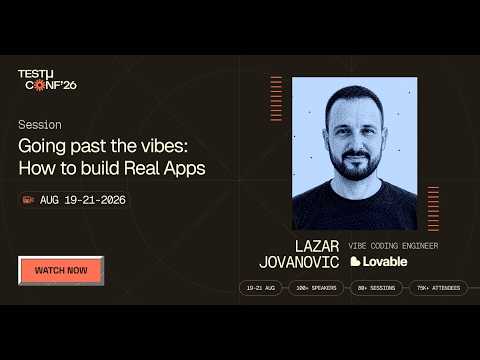
If you couldn’t catch all the sessions live, you can access the recordings at your convenience by visiting the TestMu AI YouTube Channel.
TL;DR
To build real apps with AI rather than demos, replace prompting with process. That is the argument Lazar Jovanovic, Vibe Coding Engineer at Lovable, makes across twelve capabilities that take AI app building way past vibes and closer to ordinary engineering.
- What did 37,385 edits teach Lazar Jovanovic? - After 37,385 edits, Lazar Jovanovic concluded he should stop calling it vibe coding, because security reviews, drafts against production and enterprise policy put the practice much closer to engineering.
- What replaces re-prompting in Lovable? - Reusable skills replace re-prompting in Lovable. A skill is a file or set of files an agent takes as input without being prompted, and any job done more than twice deserves one.
- How do you make a visual change in Lovable? - Developers draw on-screen annotations rather than describing changes in text. A circle or a cross becomes a screenshot the agent works from, and text edits through the visual editor consume zero credits.
- What stops off-brand AI output? - A design system used as the source of truth stops it. Lovable builds one by browsing your existing site and taking screenshots, producing colours, typography, iconography and reusable components you attach to new work.
- How do you stop re-pasting context every session? - Project knowledge and memory carry decisions and constraints forward between sessions. Lazar Jovanovic confirms it is live by instructing the agent to say back a fixed phrase before every response.
- Where do API keys belong? - API keys belong in managed secrets and connectors, never in the chat. Lovable ships over 140 connectors out of the box, and restricted connectors stop workspace collaborators seeing data they should not.
- Does Lovable include a backend? - Yes, Lovable includes a built-in backend. Lovable Cloud and the Lovable AI Gateway provide storage, database, AI models, image generation and social authentication from a prompt rather than across four dashboards and three bills.
- How do you edit a live app safely? - Drafts make it safe, working like git branching. Two agents run in parallel on one project, one on main and one on the draft, and Lovable resolves the merge conflicts when the draft lands.
- Can you drive Lovable from outside Lovable? - Yes, Lovable can be driven from an editor, terminal or chat over MCP. Connected to Claude, Claude acts as an orchestrator that writes the prompt and sends it into the Lovable chat rather than building anything itself.
- Can your own app become an MCP server? - Yes, a published Lovable app can become an MCP server. Agent integrations expose tools you define, so the app you built is reachable from any chat rather than only from inside the builder.
- What finds bugs overnight? - Project monitoring, in beta, checks code changes and recent error logs on a schedule you set and emails what it finds. Lovable calls it a heartbeat internally.
- Is Lovable enterprise ready? - Yes, Lovable is enterprise ready on Business and Enterprise plans, through workspace and project restrictions, auto-fixed security issues, PII detection, audit logs, secret review and usage limits. Lovable states it is the first AI coding agent platform certified against AIUC-1.
- What does Lovable handle after you ship? - Lovable handles domains, payments through Stripe or Paddle, email from your own domain, a Semrush-powered SEO integration and built-in analytics, all from the same place you built the app.
He opened with the number, and with what it changed his mind about.

The Twelve Letters
The talk is built as an acronym. Seven letters spell WAY PAST, five spell VIBES, and each one names a habit from the prototyping era alongside the thing that replaces it.
| Letter | The old habit | What replaces it |
|---|---|---|
| W | Writing the same prompt from scratch and praying it lands | Write a skill once and invoke it |
| A | Attempting to describe a visual change in three paragraphs | Annotate, draw and send |
| Y | Yet another off button in yet another off-brand shade | A design system as the source of truth |
| P | Pouring the same context back in at the start of every session | Project knowledge and memory |
| A | API keys pasted into files, hoping nobody looks | Managed secrets and free security scans |
| S | Stitching a backend together across four dashboards and three bills | Storage, database, AI and auth by default |
| T | Editing in production while users watch | Drafts, parallel agents and merges |
| V | One screen, one surface, no way in from outside | MCP into your editor, terminal or chat |
| I | Integrations as specialist work | Publishing your own app as an MCP server |
| B | A customer finding the bug on a Sunday afternoon | Scheduled background monitoring |
| E | Trust bolted on at procurement time | Workspace policy, PII detection and audit logs |
| S | Shipping, then assembling a stack to run the business | Domains, payments, email, SEO and analytics |
W: Write the Skill Once
His example of the habit is one most people will recognise. He would type “redesign the dashboard” and then improvise the rest of the prompt, every time.
The rule he arrived at is a frequency threshold. Anything you do more than twice deserves a skill, and redesigning qualifies.
A skill is a file or a set of files carrying instructions that the agent takes as input when you invoke it, without you prompting for them. In Lovable they live under settings, in the customizations menu, and can be scoped to a whole workspace or to one person. You can import them from GitHub or write them from scratch, and a skill needs only a name, a description and content describing how it works.
Invoking his redesign skill produced several design options rather than one, on brand and consistent with the rest of the application. He also recommended building slide decks this way, calling it an easy use case to understand and one that resonates.
A: Draw the Change
He is direct about the reason this letter exists. He describes himself as a bad designer who still struggles to put visual changes into words, and assumes most of the audience is in the same position.
The alternative is to stop writing and start drawing. Circle an element to change it, put a cross through it to remove it, undo if the drawing goes wrong.
The annotation is rendered as a screenshot, so the agent works from a snapshot of what you drew rather than from your description of it. In the demo the change landed live on screen, driven by the drawing rather than the prompt.
Text is handled the same way, by clicking into the app as though it were a Word document and editing in place. Those visual text edits are free, showing zero credits used.
Y: Your Design System
The problem this letter names is the one people mean by AI slop: yet another off button in yet another off-brand shade, on every screen the model touches.
The answer he demonstrated shipped the day before the session, on Pro and Business plans. You can create a design system and use it as the source of truth for everything built afterwards.
Building one can start from your existing app. While preparing the talk he pointed it at a site and watched it browse the pages, take screenshots and generate colours, typography, iconography and reusable components from what it found. An image works as a starting point too, as do NPM or NPX packages for teams who want to bring their own.
Using it afterwards is a release and an attach. You release a version, click the plus icon, attach the design system, and subsequent work uses those tokens.
His framing of why this matters is about model behaviour rather than about design. AI is creative, likes to deviate and likes to do things its own way, and a design system is the constraint that keeps output on brand anyway.
P: Project Knowledge
Every new chat, every new project, every restart, you re-explain who you are and what the project is. Project knowledge and memory exist to carry decisions and constraints forward instead.
The most reusable thing in this section is not the feature, it is his verification trick. He writes into project knowledge: before any response, say back to me that we are using knowledge.
If the reply opens with that sentence, the agent is reading the file. If it does not, he knows before wasting a build. In the demo, a request to add an about section came back with the phrase, followed by exactly the three things he had specified: what changed, how to test it and what to build next.
Alongside project knowledge there is a memory of you, covering who you are and how you build, and it is editable rather than opaque.
A: API Keys and Secrets
He makes the case from his own starting point rather than from a security team’s. He had never written software before Lovable and barely knew what an API was, so managed secrets were not a preference, they were the only thing standing between him and a leaked key on GitHub.
Lovable ships over 140 connectors out of the box, and custom ones can be added. Connecting the demo app to HubSpot meant entering a client ID, client secret or service key into secure storage rather than into the chat, then approving the connector when it is needed.
Some connectors are restricted by design, so a collaborator inside the same workspace cannot see data they are not meant to.
On top of that, every code change triggers a basic security scan across the code and its dependencies, deeper scans can be run on demand, and the security memory can be edited to emphasise what matters to you. Both the scans and the fixes are free, which is the whole of his answer when the question comes up again in the Q&A.
Security is a major challenge in vibe coding! Well, Loveable has it all covered, as it takes care of automatic security reviews and managed secrets on every build.
— TestMu AI (@testmuai) August 20, 2026
No more accidental leaking of keys, when you are vibe coding your app with Loveable! pic.twitter.com/5ZaybCtlsx
S: Backend Out of the Box
The anecdote here is the sharpest illustration of the old way in the whole talk. When he started, free-tier limits meant one or two projects per account, so he ended up managing and paying for twenty or thirty separate backend accounts.
Storage, database, AI models and image generation now come switched on by default. Lovable Cloud moves state out of the browser and into storage that persists, and the Lovable AI Gateway covers text generation, analysis, research and image generation when a project needs them.
Social authentication lands in the same prompt. He contrasts it with the older path of opening the Google console and building an API key by hand, then shows a single prompt producing a database, an AI model and Google login together.
The demo ran against a real HubSpot instance, scoring a real lead for likelihood to close. Signed-up users, their sign-up methods, managed secrets and usage in run credits were all visible from the same place, which is the point he draws out: the tool is where you run the thing, not only where you build it.

Note: Author tests in plain English and run them across 3000+ real browsers and devices. Try TestMu AI now!
T: Editing in Production
On most vibe coding platforms, editing a launched project means editing it while users are looking at it. He calls that scary, and it is the letter he says was always the painful one.
Drafts are the answer, still in beta at the time of the session and described as working like branching for anyone who knows git. They currently cover UI changes.
What that buys is genuine parallelism. Two agents run in the same project without interrupting each other, one on main and one on the draft, and he dictates his side of it by voice rather than typing.
When the draft is ready it merges, with Lovable resolving conflicts, and nothing on main is affected until that happens. His demo case was adding light and dark mode, which is exactly the kind of change you would not want to make live.
V: Lovable Everywhere
Here the acronym crosses over. Seven letters are spent, the remaining five spell vibes, and the first constraint he takes on is that building in Lovable used to mean being in Lovable.
Over MCP it now reaches your editor, terminal or chat. He found Lovable among the top connectors in the Claude marketplace, connected his account, and set the permissions, noting that he gives orchestrating agents full permissions so they can work without interruption.
The detail worth keeping is what Claude does and does not do in that setup. It does not build the project. It writes a prompt and sends it into the Lovable chat, and Lovable does the work.
He uses it as an intelligent orchestrator for brainstorming and planning, and pointed out on screen that the prompt which arrived in Lovable had been written entirely by Claude, not by him.
I: Your App as an MCP
He draws a line between two things that sound similar. Using the Lovable MCP is one thing. Turning the app you built into an MCP server is something else.
The agent integrations menu is where that happens. You enable agent integrations, define the MCP tools your app exposes, and publish, since an app has to be published for its MCP to work. Hosting comes with it, on a custom domain or a lovable.app one.
From there you take the MCP link, follow the generated connection instructions, and complete a single OAuth step to connect it to Claude.
His demo app, an agency tool called LaunchLine Studio that scans websites, then answered questions from inside Claude, including requests for its latest audit results. The consequence he draws is the one that matters for teams: not just Lovable, but the app you built on it, usable from any chat.
B: Bugs While You Sleep
He is unsentimental about the models doing the building. AI is still AI, some people call it average intelligence, and he agrees that sometimes it is quite average.
Which sets up the failure he wants to avoid: a bug surfaced on a Sunday afternoon by a customer.
Project monitoring, also in beta, checks code changes and recent error logs on a schedule you set, daily or triggered by an edit. Run history is visible, showing which days it ran and how many issues it found, and it emails what it finds. He showed a real email from an internal Lovable project flagging a problem nobody on the team knew about.
Internally the team calls it a heartbeat. His own description of it is a QA engineer running all night, clicking everywhere, trying to break the application.
E: Enterprise Trust
He named Uber, Nvidia and T-Mobile among the enterprises building on the platform, and framed trust as something that has to be present from day one rather than added when procurement asks.
On Business and Enterprise plans the controls sit at project or workspace level: blocking phishing, auto-fixing security issues, and sensitive data scanning that detects personally identifiable information and can block someone pasting in what they should not.
A workspace owner gets security insights and code analysis, can review secrets, can stop a sensitive project from publishing, and can read an audit log of who did what. Usage controls cover credits consumed for both building and running applications.
He also stated that Lovable recently became the first AI coding agent platform certified against AIUC-1, a standard for AI agents covering data and privacy, security, safety, reliability, accountability and societal risk, with the report downloadable from their site.
S: After You Ship
The final letter answers the question he says always comes: you have shown us how to build, what about afterwards.
Payments come first, through Stripe, Paddle or another provider depending on what is available in your country, with pay-as-you-go pricing and tax and compliance handling. Setup needs an email address, a business or personal name and a supported country, and a sandbox environment comes with it.
His comparison is the one that lands hardest. He once spent six months migrating between payment vendors with a team of ten engineers. The equivalent in the demo was three prompts.
Email follows the same shape, with no API keys and a guided process to bring in or buy a domain and set up a mailbox. Discovery is covered by a Semrush-powered integration that finds and fixes SEO issues, and analytics are built in rather than bolted on with a separate script.
He closed with an Easter egg: the presentation itself is a Lovable app at waypastvibes.lovable.app, and clicking the letter S gives you the brief to build your own version of it.
Q & A Session
Questions went into the Q&A box through the talk, and four made it into the time remaining.
- What is the most challenging feature or function to accurately vibe code?
Lazar Jovanovic: Not a feature. Everything is buildable if you can describe it, and the difficulty with natural language is that people are not very good at natural language. The concrete failure is expecting something complex to land in one prompt, because a long prompt is not the same as a complete one. Every agent is constrained by the same finite resource, so the skill is estimating how much work fits inside the token budget you have. An about page is one prompt. A clone of Stripe needs planning, specs and perhaps fifteen PRDs supporting a larger piece of work. The real challenge is knowing when to vibe and when not to, and when to prompt versus when to plan.
- What strategies do you use to ensure a vibe-coded app meets security requirements?
Lazar Jovanovic: I have no strategy. Every code edit triggers a scan for anything the agent may have exposed, and projects are blocked from publishing until major vulnerabilities are addressed. Since both the scans and the fixes are free, there is nothing to strategise about. Over 500 apps in, I have had no security problems so far. He means that as an argument rather than a shrug.
- How will vibe coding differ in 2027 versus 2026?
Lazar Jovanovic: When Andrej Karpathy described giving in to the vibes in February 2025, that was an accurate account of the experience, and you did have to release control. Security controls, security reviews and a separation between production and development have moved it since. Find me an engineer today not using AI for most of their code. For 2027 I expect less typing and more voice, more agents running in the background from a script or a set of skills, and a job that narrows to judging what should be built in the first place. That is rewarding, because judgement is what humans are for.
- What automated eval framework verifies that an agent-built app is truly production ready?
Lazar Jovanovic: I am not an engineer by background and I do not go deep into methodology. My approach is to ask Lovable to run an end-to-end test using whatever evaluation approach I ask for, since it can build Playwright tooling, browse its own app, click through it and sign up as fake users. Users do not care about the methodology, only whether the thing works, and a bug reported by a user can be fixed and shipped in five minutes. He is candid about the gap.
That last answer is a fair account of where the practice has got to, and also where the gap still sits. Asking a builder to test its own output catches what it thinks to check, and the failures that reach production tend to be the ones nobody thought to describe.
This session was part of Testμ Conf 2026, which ran across three days of sessions on agentic engineering and quality. Registrations for the next edition are already open on the Testμ Conference 2027 page.
Author

TestMu AI
Blogs: 292


TestMu AI is World's First Full Stack AI Agentic Quality Engineering platform that empowers teams to test intelligently, smarter, and ship faster. Built for scale, it offers a full-stack testing cloud with 10K+ real devices and 3,000+ browsers. With AI-native test management, MCP servers, and agent-based automation, TestMu AI supports Selenium, Appium, Playwright, and all major frameworks. AI Agents like HyperExecute and KaneAI bring the power of AI and cloud into your software testing workflow, enabling seamless automation testing with 120+ integrations. TestMu AI Agents accelerate your testing throughout the entire SDLC, from test planning and authoring to automation, infrastructure, execution, RCA, and reporting.


Did you find this page helpful?
More Related Blogs

TestMu AI forEnterprise
Get access to solutions built on Enterprise
grade security, privacy, & compliance
- Advanced access controls
- Advanced data retention rules
- Advanced Local Testing
- Premium Support options
- Early access to beta features
- Private Slack Channel
- Unlimited Manual Accessibility DevTools Tests