
Power Your Software Testing with AI Agents and Cloud
The Native AI-Agentic Cloud Platform to Supercharge Quality Engineering. Test Intelligently and Ship Faster.

- TestMu AI (Formerly LambdaTest)
- /
- Blog
- /
- Choosing the Right JavaScript Frameworks for Your Project
Choosing the Right JavaScript Frameworks for Your Project
Choosing the right JavaScript frameworks starts with your project. Compare React, Vue, Ember, Preact, Polymer, and Storybook on rendering, support, and testing.

Last Updated on:
Choosing the right JavaScript frameworks starts with four project facts: your rendering model, your hiring pool, the framework's support status, and your testing setup.
Support status settles the shortlist faster than preference: Vue 2 reached end of life on December 31, 2023, and the Polymer library now sits in maintenance mode with Lit as its recommended replacement. This guide walks through React, Ember.js, Vue.js, Polymer, Preact, and Storybook against those four facts, then covers how AI coding assistants change the decision.

TL;DR
The right JavaScript framework is the one that fits your project's rendering model, hiring pool, support status, and testing setup, not the most popular one. For most new projects that means React 19 or Vue 3, because Vue 2 has reached end of life and the Polymer library is in maintenance mode.
- Best for complex, fast-changing UIs: React - Meta maintains React, version 19.3 is the current release, and pairing it with Next.js adds server rendering.
- Best for structure without heavy setup: Vue 3 - Vue ships official routing and the Pinia state library, and Vue 2 reached end of life on December 31, 2023.
- Best for small bundles: Preact - a 3kB alternative to React with the same modern API, and its preact/compat alias runs existing React components.
- Best for Web Components: Lit - the Polymer Project recommends Lit for new development because the Polymer library is in maintenance mode.
- Best for AI-assisted coding: Svelte - Svelte publishes an llms.txt documentation index and hosts an official MCP server that checks the code an assistant generates.
Whichever framework you choose, TestMu AI runs the resulting Selenium, Cypress, or Playwright suite across 3,000+ browser and OS combinations.
Framework or Library?
A framework sets the structure and calls your code inside its rules, while a library hands you functions that your own code calls when it needs them. Both are JavaScript, so the practical difference is which side controls the flow of the application.
React calls itself a library and Angular and Ember.js are full frameworks, yet teams compare them as equals because each one decides how components, routing, and state fit together. Treat the label as less important than how much structure the tool imposes on your codebase.
Isomorphic JavaScript Frameworks
An isomorphic framework, also called a universal framework, runs the same components on the server and in the browser. Earlier stacks split the work: JavaScript handled the client while Python or PHP rendered pages on the server.
Sharing one set of components removes that split, shortens the time to first render, and keeps the JavaScript bundle smaller than shipping two frameworks. Next.js for React and Nuxt for Vue are the common choices when server rendering is a requirement.
React
Meta maintains React, which powers Facebook and Instagram, and the npm registry lists version 19.3.0, published in September 2026, as the latest release. React builds complex interfaces from encapsulated components that manage their own state, and its declarative view keeps rendering predictable and easier to debug.
React renders efficiently when a complicated component changes its UI frequently, which suits dashboards and feeds. Pair it with Next.js when you need server rendering, because React alone leaves routing and data fetching to you.
Testing React applications takes more setup than testing a template-driven framework, since you choose the test runner and rendering utilities yourself. Learn how to perform React testing for web and native applications.

Note: Run tests for apps built on any JavaScript framework across 3,000+ browser and OS combinations. Try TestMu AI Now!
Ember.js
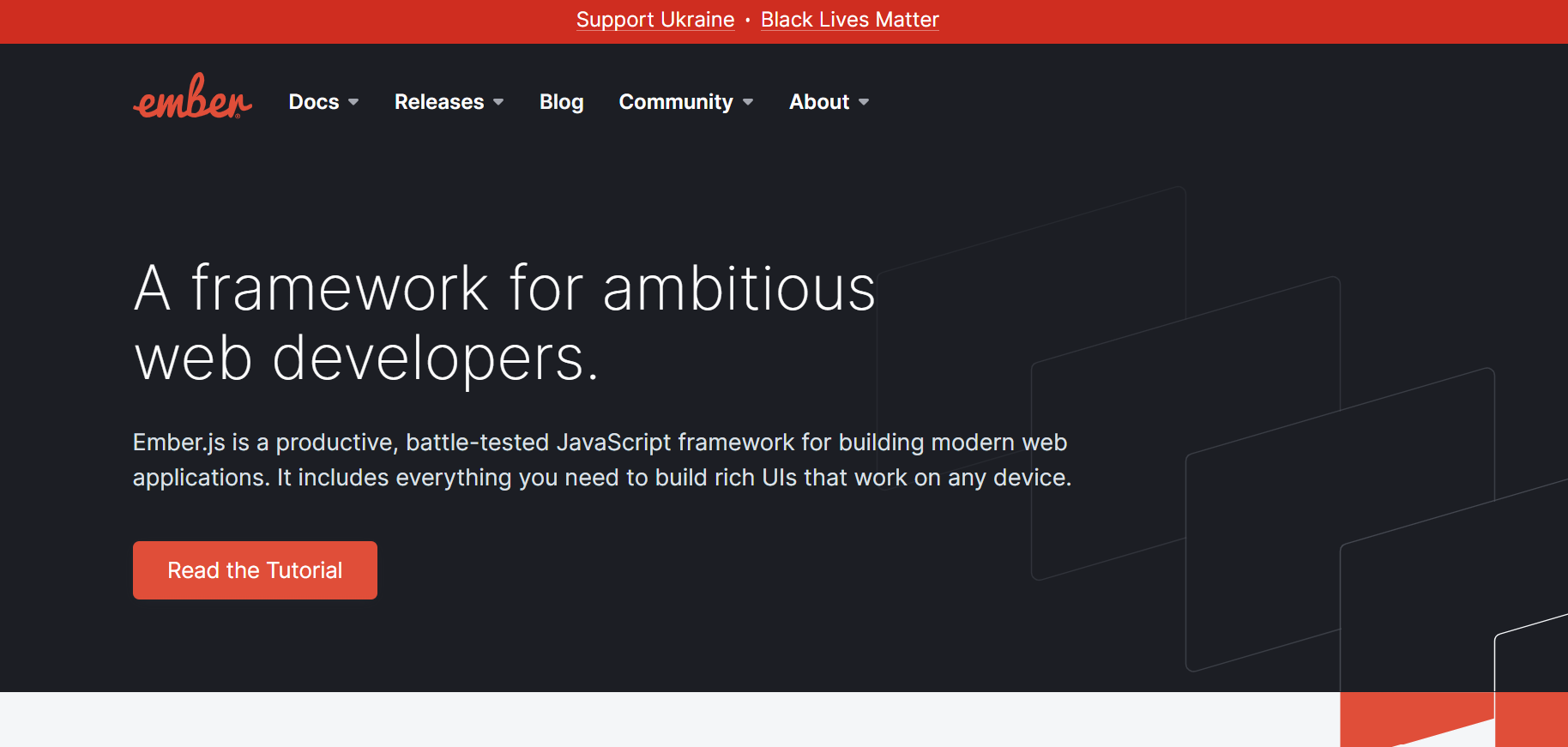
Ember.js is an open-source framework for building scalable single-page applications, and it describes itself as "a framework for ambitious web developers." It started life as SproutCore 2.0 before Yehuda Katz, known for his work on jQuery, renamed it.
Ember's command-line tool generates components, routes, and tests to one convention, which keeps large codebases consistent across teams. The Ember.js homepage lists Netflix, Microsoft, Apple, LinkedIn, and Square among its users, so it remains a safe pick for long-lived business applications.
Vue.js
Vue sits between Angular's fixed conventions and React's open choices: it ships templates, routing, and state as official packages but lets you adopt them one at a time. Evan You created Vue after working at Google, and Vue supports both JavaScript and TypeScript.
Start any new project on Vue 3, because Vue 2 reached end of life on December 31, 2023 and no longer receives features, updates, or fixes. The Vuex documentation now names Pinia as the official state library, and Vuex stays in maintenance without new functionality.
A Vue 3 stack with server rendering through Nuxt, a Pinia store, and a GraphQL client such as Apollo stays light while giving developers a clear structure. For test setup, see this guide to Vue.js testing.
Polymer
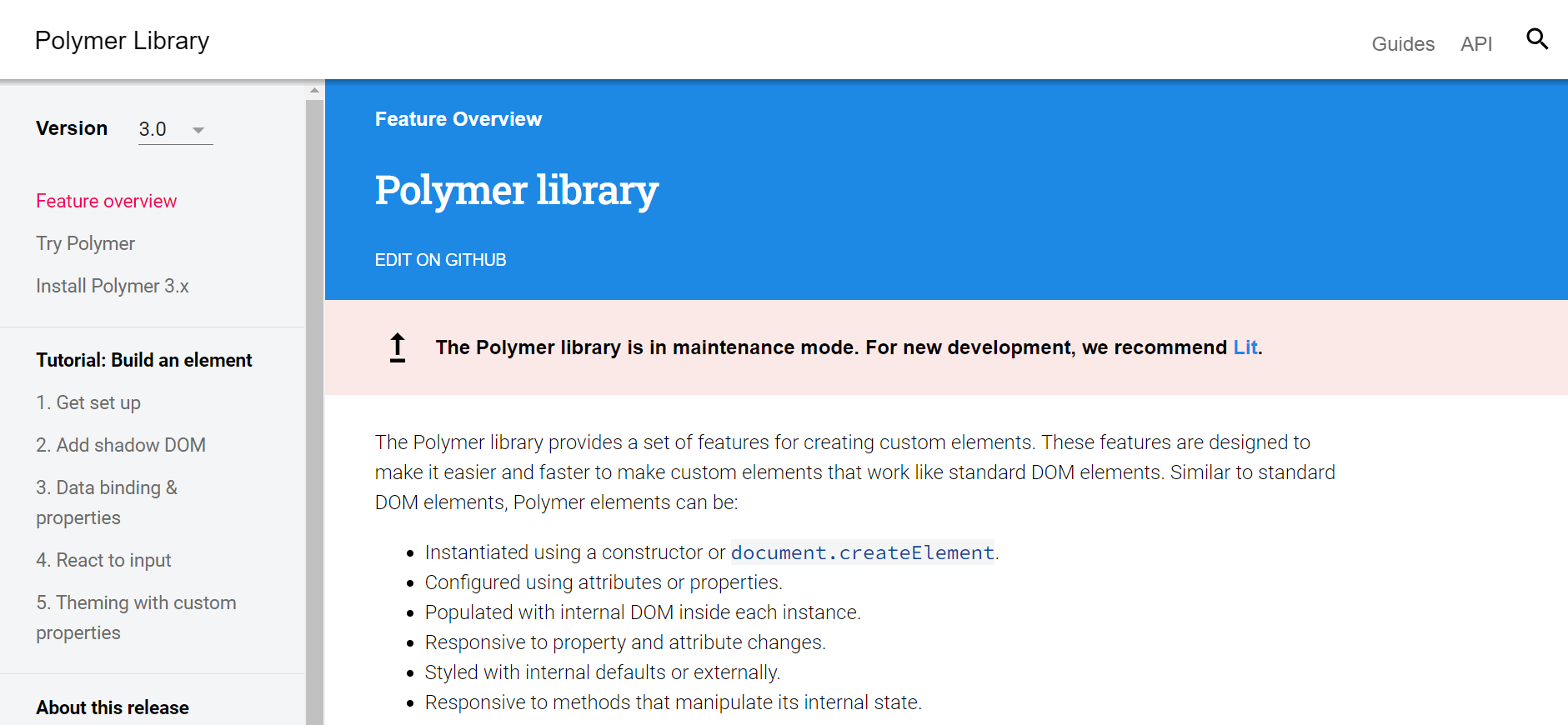
Google introduced Polymer to help developers build reusable custom elements that work alongside the browser's built-in elements. Polymer 3 improved the data system, which made debugging data flow between elements easier, and it moved from Bower to npm.
The Polymer App Toolbox added a component-based architecture, responsive layouts, a modular router, localization, offline caching through Service Workers, and unbundled delivery over HTTP/2 for progressive web apps.
The Polymer library now sits in maintenance mode, and the Polymer Project recommends Lit for new development. Lit keeps the same Web Components foundation, ships a smaller runtime, and uses standard JavaScript template literals in place of Polymer HTML templates, so treat Polymer as code you maintain and start new custom elements on Lit.
Preact
The Preact homepage describes it as a "fast 3kB alternative to React with the same modern API," which makes it a common choice for mobile web pages where download size matters. Preact 11 is the current major release on npm.
An existing React app can switch by aliasing react and react-dom to preact/compat in the bundler, and Vite handles that alias automatically through @preact/preset-vite. Testing needs attention after the swap: Enzyme ships official adapters only up to React 16, so test Preact components with Preact Testing Library instead.
Storybook
Storybook is a free, open-source tool for building and testing UI components in isolation. It builds a catalog of components that you can interact with in a live environment, which makes issues easier to spot and fix, and teams use it for UI development, testing, and documentation.
Storybook 10, published on October 28, 2025, made Storybook ESM only and cut install size by 29 percent, so confirm that your bundler and Node setup handle ES modules before you upgrade.
The Storybook releases page on GitHub lists 10.6.1 as the latest stable version, with Storybook 11 in alpha.
Read the guide on Storybook testing to start testing Storybook components, and compare more options in this list of best JavaScript frameworks for test automation.
How Do AI Coding Assistants Change Your Framework Choice?
Add one question to your checklist: does the framework publish machine readable documentation and an official Model Context Protocol (MCP) server? An assistant answers from training data, so it reproduces the API that was common when that data was collected, not the API in the release you installed.
Several projects close that gap with an llms.txt file, a plain text index that points an assistant at the Markdown source of each documentation page. React, Vue, Next.js, Nuxt, Svelte, and Preact each serve one. Nuxt also serves every documentation, blog, and deploy page as Markdown when you append .md to the URL, and the Next.js file names the documentation version it covers.
Two projects go further and run a server the assistant can call. Svelte hosts an MCP server at mcp.svelte.dev and ships the same server as the @sveltejs/mcp npm package; it returns the documentation the task needs and statically analyses the Svelte code the agent produced. The Angular CLI starts its own server with npx @angular/cli mcp, its default tools include search_documentation, get_best_practices, list_projects, run_target, and onpush_zoneless_migration, and the --read-only and --local-only flags limit what the agent can do.
Weigh this alongside the rendering model, hiring pool, and support status. A framework with an llms.txt index and an official MCP server leaves your reviewers less generated code to correct, while a framework with neither pushes that correction work back onto people.
Svelte and Solid
Two compile-first options belong on the shortlist. The Svelte documentation describes Svelte as a framework that uses a compiler to turn declarative components into lean, tightly optimized JavaScript, and Solid states that instead of using a Virtual DOM, it compiles its templates to real DOM nodes and updates them with fine-grained reactions.
Judge that smaller runtime against the same four facts. A smaller hiring pool than React or Vue is the usual trade-off, so confirm your team can staff the choice before you commit. For a side-by-side of the three largest options, see Angular vs React vs Vue.
Conclusion
Score your top two candidates on rendering model, hiring pool, support status, and testing setup, and drop any that fail support status, such as Vue 2 or new Polymer work. Server-rendered pages point to React with Next.js or Vue with Nuxt, while an internal dashboard can stay a client-side single-page app.
Then run the app's existing Selenium, Cypress, Playwright, or Puppeteer suite on TestMu AI's Automation Cloud, which executes it across 3,000+ real browser and OS combinations in parallel. The Playwright testing docs show the setup for a JavaScript project.
Author


Reviewer

Isha Vyas
Reviewer
Isha Vyas is a Lead Member of Technical Staff at TestMu AI, building the frontend of the quality engineering platform. She works across React.js, responsive web design, and jQuery to ship and maintain the platform's user-facing web interfaces. She brings nearly seven years of frontend engineering experience at the company, with earlier work as a Software Developer at Mantra Labs. Isha holds a B.Tech in Computer Science from Swami Keshwanand Institute of Technology, Management and Gramothan, Jaipur.


JavaScript Framework Selection FAQs
Did you find this page helpful?
More Related Blogs

TestMu AI forEnterprise
Get access to solutions built on Enterprise
grade security, privacy, & compliance
- Advanced access controls
- Advanced data retention rules
- Advanced Local Testing
- Premium Support options
- Early access to beta features
- Private Slack Channel
- Unlimited Manual Accessibility DevTools Tests