
Power Your Software Testing with AI Agents and Cloud
The Native AI-Agentic Cloud Platform to Supercharge Quality Engineering. Test Intelligently and Ship Faster.

- TestMu AI (Formerly LambdaTest)
- /
- Blog
- /
- Scaling Quality in a Decision Intelligence Platform [Testμ 2026]
Scaling Quality in a Decision Intelligence Platform [Testμ 2026]
Hammad Ahmed on the seven-agent QA swarm behind a decision intelligence platform, why bigger context made it worse, and how skill gating fixed it.
Published on:
On This Page
- The Breaking Point
- From Excel To Decisions
- The Scaling Challenge
- Seven Agents, One Super Agent
- Conventional Tools Kept
- Grounding In Product Context
- Test Cases As Documentation
- Skill Gating The Context
- Building A Quality Pulse
- Living Inside Slack
- Toward Agent Chains
- Super Agent Under Attack
- Three Closing Takeaways
- Q & A Session
Around 10,000 existing automated test cases went into this team’s AI agents. Not to be run. To be read, as documentation of what the product actually does.
The reasoning was that QA engineers sit closest to the product, so the repository they already maintain is the most accurate description of it anyone has written down.
At Testμ Conf 2026, Hammad Ahmed, Head of AI QA Innovation at Aily Labs, explained how that fits into a wider build: a quality super agent assembled to test a product whose behaviour cannot be predicted.
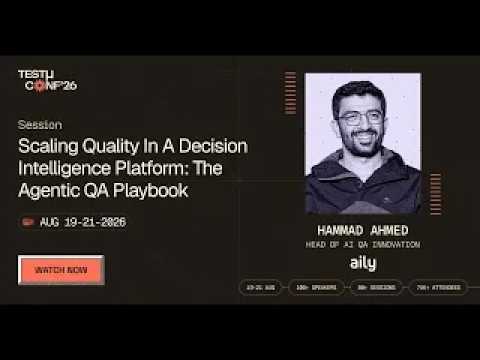
If you couldn’t catch all the sessions live, you can access the recordings at your convenience by visiting the TestMu AI YouTube Channel.
TL;DR
A quality super agent is a swarm of purpose-built QA agents reporting into one coordinating agent, used where the product under test is itself non-deterministic and coverage cannot be defined. Aily Labs built seven, grounded in the company’s own documentation and delivered through Slack and GitHub rather than a dashboard.
- Why does traditional QA break on an AI decision intelligence platform? - Because there is nothing stable to assert. Hammad Ahmed says the application is not defined on conventional inputs and outputs and its behaviour is not predictable, unlike the e-commerce checkout flows he worked on earlier, where the steps are defined. On an AI product even the acceptance criteria become vague.
- What is a quality super agent? - A quality super agent is Aily Labs’ name for a swarm of purpose-built QA agents that report into one coordinating agent. The deliberate choice, in Hammad Ahmed’s words, was not to build one agent but multiple agents that correlate and talk to one agent, with the longer-term goal of letting them talk to each other.
- Which QA agents did Aily Labs build? - Seven, in build order: exploratory testing first, then resiliency, test creation, PR review, root cause analysis, a critic agent, and bug fixing. Hammad Ahmed explains that the critic agent is Aily Labs’ name for LLM-as-a-judge.
- Why build the exploratory testing agent first? - Because coverage stops being definable when behaviour cannot be predicted. Hammad Ahmed says it is very hard to define 100% test coverage of anything, so Aily Labs copied what human manual QAs do and explored the application rather than scripting expected outputs.
- Did Aily Labs replace its existing test tooling? - No. Hammad Ahmed is emphatic that conventional QA tools were never disregarded or put to one side. Automation stays on Playwright, Appium, Behave and visual regression. Context comes from Jira and Confluence, observability from Datadog, Sentry and Langfuse, and delivery through Slack and GitHub.
- How do you stop QA agents from hallucinating? - Ground them in company-owned context. Aily Labs connected the agents to Confluence and Jira for specs, then hand-documented business rules, because a general-purpose model knows the industry but not the things specific to one enterprise. Hammad Ahmed still concedes it hallucinates sometimes and cannot be predicted 100%.
- Can existing test cases teach an AI agent your product? - Yes. Aily Labs fed around 10,000 existing test cases to the agents as product documentation rather than as tests to execute, on Hammad Ahmed’s argument that QA engineers are the closest to the product and a keyword automation repository effectively is a product description.
- Does more context make an AI agent more accurate? - No. After loading Confluence, Jira, test scripts and business rules, Hammad Ahmed says the context became bigger and bigger and hallucination rose with it. The bigger the context, the more it hallucinated.
- What is skill gating? - Skill gating serves an agent only the slice of context relevant to its task. Aily Labs built an internal agent that decides which parts of the product, repository and context each skill can reach, split into domain silos covering financial, R&D and organisational, manufacturing and supply knowledge. It also cuts token spend.
- How do you measure quality when there is no single KPI? - Give quality a pulse built from a combination of quality drivers. At Aily Labs the pulse tracks AI accuracy, defect leakage and tenant health, and Hammad Ahmed stresses that which drivers matter depends on each company. No values or thresholds were disclosed.
- How do you get an engineering org to actually use QA agents? - Put them where people already work and make them speak first. Aily Labs embedded the agents into Slack and GitHub and moved from reactive to proactive, with daily briefings to every team lead plus on-demand runs any developer, manager or executive can trigger.
- What happens when a triage or root cause agent gets it wrong? - Hammad Ahmed says it has happened at Aily Labs, and the answer is a human feedback loop: engineers and managers leave feedback as a Jira comment or in Slack, and that is fed back into the agent. His rule is that without a feedback loop no agent will ever improve.
The Breaking Point
Hammad Ahmed frames the session around what he calls the breaking point. The application his team tests is not defined on conventional inputs and outputs, so the define-input and assert-output contract has nothing left to grip.
He states it flatly: the behaviour of the application itself is not predictable. He contrasts that with the e-commerce work earlier in his career, where the checkout process is very defined and you know exactly what steps need to be done.
The second break is pace. Every day and every month there is some new change to adapt to, and as a result even the acceptance criteria of what is being tested become vague.
Coverage then stops being definable at all. Asked what the test coverage of something is, he says it is very hard to define 100% coverage of anything, and especially so in an application whose behaviour cannot be predicted. For unpredictable model output, Gil Zilberfeld trades pass or fail for a funnel of progressively finer checks in his Testμ talk, Techniques for Testing LLM Responses.
One attribution worth separating: the lines about there being no fixed output to assert and no script to anticipate emergent behaviour were spoken by the session host in the introduction, not by Hammad Ahmed, although the video description reuses them as though they were his.
"Traditional QA was built for a different kind of system."
— TestMu AI (@testmuai) August 20, 2026
Hammad Ahmed, Head of AI QA Innovation at Aily Labs, at TestMu Conf 2026, on why the old playbook breaks for agentic systems: there's no fixed output to assert against, and no script that anticipates emergent behavior.… pic.twitter.com/yBq46XUUQp
From Excel To Decisions
The status quo the product replaced was decision intelligence based on a lot of manual Excel file reading plus analytics. Entirely human-driven, slow, and error-prone, because humans are subjective.
His scaling objection is concrete. For a Fortune 500 company taking decisions across a sector and against competitors, manual Excel analysis does not scale well.
The product vision he describes is to use AI to compile all the data into one place and show executives and managers the patterns and the decisions they can take, on the phone, in a few seconds.
He characterises it as a shift from humans to agents and tools controlling both decisions and the actions taken on them. Then he adds the line that defines his job: that is the product we were testing.
The Scaling Challenge
The initiative did not start in QA. Hammad Ahmed says the CEO set the team a challenge about scaling fast, and that a conversation with the CEO produced the decision to build a quality super agent internally. He dates that pressure inconsistently across the talk, so the timing is best treated as approximate.
He frames it as a good problem rather than a crisis, since the mandate arrived because the company was scaling fast.
The stakes he attaches are absolute in his telling: dealing with Fortune 500 companies, the team cannot afford mistakes and there is no room for error. No client is named anywhere in the session and no incident is described.
He calls the platform mission critical, because if it is down, customers cannot run their analysis and cannot predict or act on it.
Breadth multiplies that risk twice over. The product serves different verticals inside different Fortune 500 companies, so no single domain’s knowledge suffices, and it runs on web, mobile, iPad and watch, growing on all of them.
Seven Agents, One Super Agent
The design decision he emphasises is plurality. The idea was not to build one agent but multiple agents that correlate and talk to one agent, which is the quality super agent.
| Agent | What it does |
|---|---|
| Exploratory testing | Built first, reproducing what human QAs do when coverage cannot be defined |
| Resiliency | Exercises the platform under failure conditions |
| Test creation | Generates new tests |
| PR reviewer | Reviews code going into the repository |
| Root cause analysis | Learns from bugs that reached production |
| Critic | The team’s name for LLM-as-a-judge, judging the application from itself |
| Bug fixing | Built on the reasoning that no application is without bugs, so fixing should be agent work too |
On the critic agent he offers a translation for people using different vocabulary: what AI-native companies might call evals and models, his team calls the critic agent. At Fox Networks, evals come before the agent: the Testμ session on eval-first QA agents explains why no QA agent ships until it passes them.
The end state he describes is swarming, with all the agents brought together and, in future, allowed to talk to each other inside a workflow supporting autonomous QA.
Conventional Tools Kept
This is the point where the session diverges most sharply from how it was billed. The video description says the team rebuilt QA from the ground up. Hammad Ahmed says the opposite: all the conventional QA tools were never disregarded and were not put to one side, and the team actually used all of them to build on.
The automation stack he names is Playwright, Appium, Behave, visual regression, and cloud devices. He mentions TestMu AI’s own cloud devices among them, at TestMu AI’s conference, so treat that as a vendor mention inside a vendor’s event.
For documentation and context the sources are Jira and Confluence, where a lot of documentation context already lives.
For observability he names Datadog, Sentry and Langfuse, which let the team see how the application performs in production, including errors, warnings and performance.
For collaboration it is Slack and GitHub, used internally, and these later become the delivery surface for the agents themselves.
His rationale for reuse is speed of learning as much as capability. They are building agents, and they want to use the tools they already have to scale faster and learn faster.
Grounding In Product Context
His premise for grounding is blunt. AI hallucinates, and without grounding or context it will hallucinate a lot.
He acknowledges the newer generation of models has improved without conceding the problem: with new models arriving it is somewhat less, and it can still hallucinate a lot.
The first grounding move was feeding product specs by connecting the agents to Confluence and Jira, which he describes as enriched data already sitting in the team’s arsenal.
A second problem surfaced that specs did not solve. The agents were not speaking the product’s language, so they did not describe the product in the company’s own terms.
The fix was documenting business rules by hand. The platform is industry-agnostic, and in Fortune 500 companies there are things very specific to those companies. He concedes that LLMs are experts in general industry knowledge but not in that company-specific layer.
His stated goal for business rules is testing hygiene, avoiding false positives and false negatives. He undercuts the absolute himself a sentence earlier by admitting it does hallucinate sometimes and cannot be predicted 100%.

Note: Ground your test agents in what your team already knows about the product. Try TestMu AI now!
Test Cases As Documentation
The most portable tactic in the session is this one. The team fed their existing automated test cases to the agents as product documentation, not as tests to run.
His figure is an arsenal of around 10,000 test cases. He hedges it on air, and it is never broken down by platform or suite, so the number is his approximation rather than an audited count.
The argument behind it is a claim about where QA sits in an organisation. QA engineers are the closest to the product, they know each and every end of it, and they are the ones who created those test cases.
He generalises it into advice worth trying anywhere. If you want a product description, go into a repository of keyword test automation and you will learn how the product works.
The effect is reported only qualitatively, that it allowed the team to make the agents more concrete. No accuracy or defect-detection numbers are attached.
Skill Gating The Context
Here is the failure mode most teams hit second. After loading Confluence, Jira, test automation scripts and business rules, the context became bigger and bigger, and at some point the bigger the context, the more it hallucinated.
The fix he names is skill gating, adopted quickly after Anthropic released skills at around the same time. He gives no date for either the release or the adoption, and the ordering is his recollection.
Mechanically, the team built an internal agent that decides access, gating which parts of the product, the repository and the context each skill can reach.
He names an unglamorous second benefit alongside accuracy. You use fewer tokens, because if there is very specific knowledge you want, you go to that part and take only that.
The knowledge was split into what he calls small silos of information by domain: financial knowledge, R&D and organisational knowledge, manufacturing, and supply.
He calls the result a eureka moment, because it made the agents consistent and persistent in their predictions. In his framing, automated exploratory testing is a prediction of whether there is an issue or not.
Building A Quality Pulse
The trigger was round-the-clock operation. Automation runs 24/7 and the agent does not sleep anymore, which raised the question of how anyone knows something is wrong in production while the agents work through the night.

Three pulse dimensions are named: AI accuracy of the application, defect leakage, and tenant health. No values, thresholds or trends are shown for any of them.
The pulse is fed by signals from the agents, and which agents feed it is not settled in the recording. On air he names a security agent and the PR reviewer agent, telling the team how much code is being shipped and at what quality, while the published chapter list instead names exploratory, PR review and root cause analysis.
The root cause agent’s contribution is historical pattern rather than incident alerting, telling the team what the major root causes have been across the application.
Distribution is deliberately wide, going to the executive team, the QA engineers and the leads, and openable on demand whenever anyone wants to look.
Living Inside Slack
He treats adoption as a separate problem from capability. Having a quality pulse was not enough, because it also needed adoption and actual use.
The mechanism is embedding rather than launching a new dashboard. The agents were integrated into Slack and GitHub, the tools living alongside the team, on the reasoning that he spends a lot of his time in Slack anyway.
The behavioural shift he names is reactive to proactive. Initially the AI was reactive and something had to be triggered to get anything out, which he judged could not scale because it depended on a human.
Daily briefings were the first proactive instance and, in his account, the first visible value. Everyone responsible for a team got a briefing about their team, their customer, what was happening, the major issues and how they were fixed.
Prioritisation is the second use, aimed at leads and managers, and he justifies it from scale-up experience where everything is important and nothing is less important.
The third surface is on-demand runs opened to the whole company. Developers, managers and the executive team can trigger security testing, a bug fix or a PR review, which he frames as QA providing a service to the company.
Toward Agent Chains
This part is explicitly fresh and unpolished. He says it happened very recently, after a conversation with one of his senior QA engineers while travelling, which is why it is not in the slides.
The chain he describes runs root cause analysis to bug fixing to test creation. Connect the RCA agent to the bug fixing agent and the flow follows, then connect the test creation agent and it creates the tests.
The concrete result he claims is a security testing agent that went on to fix a bug in their environment somewhat autonomously. No example bug, no metric and no demo accompanied it, and he hedges the maturity himself, saying there are things they can make more perfect.
Next on the roadmap, all unshipped: self-healing tests, and adding more and more agents to the swarm.
He names an open problem rather than claiming it solved. With so many agents talking to each other, how do you reach out to a specific agent? That is something the company is still figuring out.
Putting The Quality Super Agent Under Attack
A swarm grounded in Confluence, Jira and hand-written business rules carries all of that as attack surface. A gated skill that reaches financial knowledge is a route to exfiltrating it, and a bug fixing agent with write access can be argued into an unwanted change. TestMu AI Agent Assurance writes the suite, runs the agent for real and grades every criterion against observed evidence, with the Autonomous category for agents that act still on waitlist.
- Adversarial set - prompt injection, jailbreak, data exfiltration, PII leakage and policy violation scenarios, generated alongside the functional and non-functional categories.
- Observed evidence - verdicts quote files changed on disk, artifacts produced and tool calls checked against the agent’s declared tool surface, rather than its own summary.
- A third verdict - Pass, Fail and Unable to Verify, with the last kept out of the pass-rate denominator and its share reported beside the pass rate as the assurance gap.
- Delta tracking - each run names what is newly failing, newly fixed and flaky since the last one.
The same loop runs from a terminal through rook, a pre-alpha CLI that explores a codebase, generates scenarios, runs them and reports. In CI it exits 0 whenever the command finished, pass or fail, so gate on the verdicts in the JSON report rather than the exit code. Point it at staging, because an agent’s writes during a run are real and nothing rolls them back.
Three Closing Takeaways
His first takeaway is to give quality a pulse. Quality cannot be reduced to one specific KPI or metric, his team uses a combination of quality drivers, and which drivers matter depends on each company, so the instruction is to identify the metrics tied to your own challenge. In Why Agents Need Custom Evals and How to Create Them, Haritha Sreedharan Nair makes a similar case for agent benchmarks built around real user jobs.
The second is to build and orchestrate agents rather than single-purpose tools. He argues the build barrier has collapsed and creating agents is now straightforward in a way it was not eight or ten years ago.
He extends that into orchestration with a team analogy. Take a team of five people: if they talk to each other and bring different ideas in, good things come out of it, and agents should be treated the same way.
The third is to adopt AI into the workflow rather than treat it as a shortcut. He reports that in one year the team achieved what he thinks would have taken four or five years otherwise, which is his impression rather than a measured result, offered without a baseline or a definition of what was achieved.
He positions AI against the job-loss framing, saying he does not see it as a challenge but as a tool any person can use to improve their skills, productivity and efficiency.
The mechanism he credits for adoption is small and continuous rather than a big launch. Small nudges from AI agents inside the workflows are what let a team become more adaptive.
Q & A Session
Three audience questions closed the session, read aloud by the host. The askers’ names are not reliably recoverable from the captions, so they are not reproduced here.
- How can the latency and monetary cost of using LLMs as evaluators be optimised to match the speed of modern high-frequency development cycles?
Hammad Ahmed: Right-size the model. We use task-specific models, and with mixture-of-experts models you do not need the largest available model for everything. Smaller models handle smaller questions and smaller tasks, which cuts cost and, because they are faster, cuts latency. We are also building small language models internally to keep up with the frequency of the development cycle. This is my own view. He gives no cost figures, latency numbers or before-and-after comparison.
- If your triage agent mis-routes, or your root cause agent gets it wrong, how do you catch that?
Hammad Ahmed: Good question, because it has happened to us. The mechanism is a human feedback loop: a QA engineer, developer or manager who sees something wrong leaves feedback as a Jira comment or in Slack, we gather that and feed it into the agent so it does not happen next time. Any agent or AI should have a feedback loop. That concession is the session’s clearest admission of agent failure, and he describes no automated detection, confidence scoring or measurement of how often the agents are wrong.
- If AI can generate software faster than the organisation can understand it, are we creating an accountability gap?
Hammad Ahmed: Yes. But the best field to be in right now is QA, because the volume of AI-generated code is growing so fast. I have friends who work at GitHub and the volume of code arriving is enormous, and we are creating a lot of tech debt. The gap cannot be closed by humans, so agents have to counter-check AI-generated code, and above all guardrails come first. Eventually context will be large enough and the feedback loop accurate enough that mistakes will not happen as often. The GitHub anecdote is hearsay from unnamed sources, and that closing optimism is offered without evidence.
This session was part of Testμ Conf 2026, which ran across three days of sessions on agentic engineering and quality. Registrations for the next edition are already open on the Testμ Conference 2027 page.
Author

TestMu AI
Blogs: 292


TestMu AI is World's First Full Stack AI Agentic Quality Engineering platform that empowers teams to test intelligently, smarter, and ship faster. Built for scale, it offers a full-stack testing cloud with 10K+ real devices and 3,000+ browsers. With AI-native test management, MCP servers, and agent-based automation, TestMu AI supports Selenium, Appium, Playwright, and all major frameworks. AI Agents like HyperExecute and KaneAI bring the power of AI and cloud into your software testing workflow, enabling seamless automation testing with 120+ integrations. TestMu AI Agents accelerate your testing throughout the entire SDLC, from test planning and authoring to automation, infrastructure, execution, RCA, and reporting.


Did you find this page helpful?
More Related Blogs

TestMu AI forEnterprise
Get access to solutions built on Enterprise
grade security, privacy, & compliance
- Advanced access controls
- Advanced data retention rules
- Advanced Local Testing
- Premium Support options
- Early access to beta features
- Private Slack Channel
- Unlimited Manual Accessibility DevTools Tests