
Test any web app in natural language no selectors, no scripts
Write tests as plain-English objectives. Kane CLI drives a real Chrome browser, resolves each step by intent, and returns a verified pass or fail with evidence. No selectors, no boilerplate. Free to install.
or read the documentation
What natural language browser testing means
Traditional browser suites make you spell out selectors, XPath, and framework boilerplate, then keep them alive as the UI shifts. The maintenance tax, not the testing, is what slows teams down.
Natural language browser testing flips that. You describe the objective the way a tester would say it out loud, and Kane CLI resolves the path in a real Chrome browser, anchoring each step to intent rather than a brittle selector.
Write what you want to happen, watch it run, and get a verified pass or fail backed by built-in assertions. The same objective works for you, for your AI coding agent, and in CI, with one syntax.
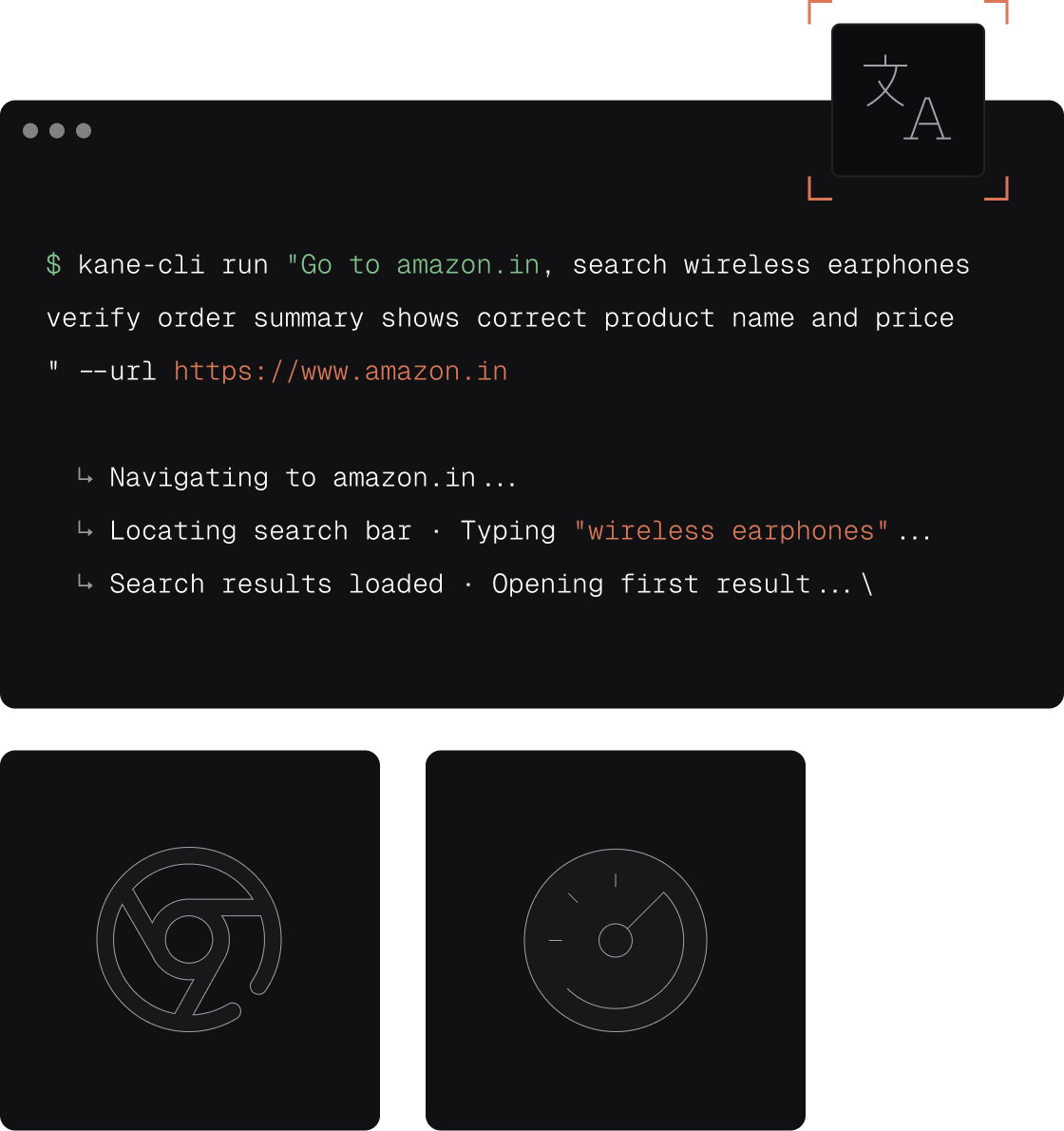
Natural language test automation, end to end
Write objectives in natural language and get verified results in a real browser.

Objectives in plain English
Write what you want to happen as a sentence, not a script: go to a page, click a button, confirm the result. Kane CLI reads the objective and resolves the path. No selectors, no XPath, no page objects to author or keep alive.

Action: drive the page
Imperative phrases move the browser. 'Go to the pricing page', 'click Start free trial', 'fill the email field with user@example.com'. Each verb maps to a real interaction a user could perform, in the order you wrote it.

Assertion: verify and fail loudly
State your expectation in words and the run fails if it is not met. 'Assert the page contains Order Confirmed' or 'confirm the Submit button is disabled' turns plain English into a hard pass-or-fail check, not a guess.

Extraction: read values out
Pull data off the page with explicit 'store X as name' phrasing, like 'store the order number as order_id'. The captured value lands in the run output so later steps or your pipeline can reuse it.

No selectors to maintain
Because every phrase anchors to user-facing intent rather than a CSS path, reworded labels and shifting layouts heal instead of breaking. The objective you wrote in English keeps working as the UI evolves.

One objective, every runner
The same plain-English objective runs at your terminal, inside an AI coding agent, and in CI without rewriting. Each run records evidence and uploads to Test Manager, so your library grows from the words you already wrote.
Build up confidence in every flow you ship
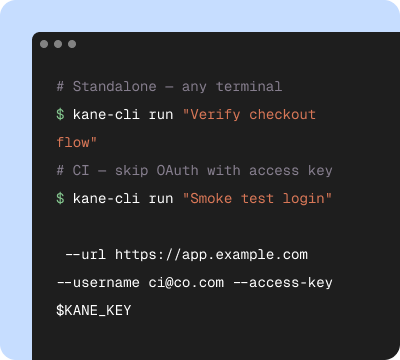
Start in your terminal
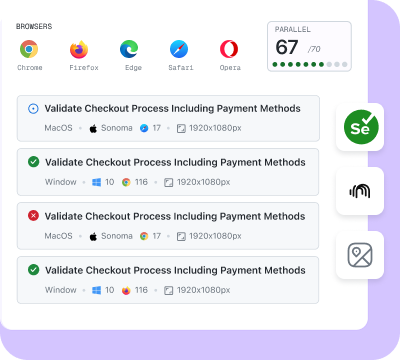
Validate on the cloud
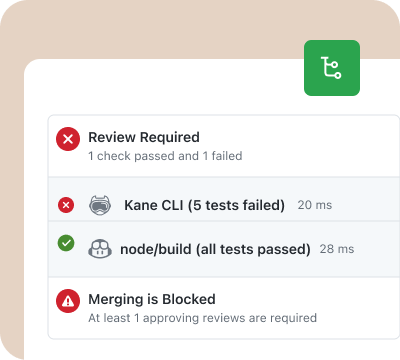
Release with confidence
Natural language in, real browser out
Kane CLI and KaneAI share the same automation engine and dashboard.
Plain English becomes browser actions
Type an objective the way a tester would say it, and Kane CLI translates each phrase into a real action in a real Chrome browser. Your words define the intent; the engine resolves the path and reports pass or fail.
The same objective everywhere
An objective you read aloud to a teammate runs unchanged at your terminal, inside your AI coding agent, and in CI. There is one plain-English syntax to learn, not a per-tool dialect to translate between.
Words in, evidence out
Each natural language run records a video, a step-by-step trace tied back to your phrasing, and a shareable link. Anyone can read the objective and watch exactly how the browser carried it out.
Run a natural language test in three steps
Install Kane CLI
Run npm install -g @testmuai/kane-cli and sign in with your TestMu AI account. Local Chrome is the only requirement, nothing to wire into your app or test suite.
Phrase what you want tested
Say it the way you would to a colleague: go to the page, click the button, fill the form, assert the result, store the value. Blend actions, assertions, and extractions into one plain-English objective.
Read the plain-English verdict
Kane CLI interprets each phrase, carries it out against the live UI, and answers with a pass or fail plus any values you asked it to store. Watch the recording or hand the same objective to your agent.
Get Started With Kane CLI
🎉 Launch offer: Bonus credits for the first 3 months on paid plans
Choose the right plan for you
Local test authoring via CLI
Auto-heal & vision
View test cases on UI
Test Manager

Free
$0
/month
200 Credits
Resets in every
30 days

Starter
$19
/month
2000 Credits
Launch: 4,000 Credits (+100%)
Bonus for first 3 months

Pro
$99
/month
10,000 Credits
Launch: 15,000 Credits (+50%)
Bonus for first 3 months

Enterprise
Get access to solutions built on Enterprise-Grade Security, Privacy, and Compliances.
Need more credits?
Got a bigger use case in mind?
Let’s talk
Choose the right plan for you
Free
$0
/month
200 Credits
Resets in every
30 days
Starter
$19
/month
2000 Credits
Launch: 4,000 Credits (+100%)
Bonus for first 3 months
Pro
$99
/month
10,000 Credits
Launch: 15,000 Credits (+50%)
Bonus for first 3 months
Enterprise
Get access to solutions built on Enterprise-Grade Security, Privacy, and Compliances.
Need more credits?
Got a bigger use case in mind?
Let’s talk
Get the technical rundown

Documentation
Everything you need to install, configure, and run Kane CLI in under 2 minutes.
Frequently asked questions
Natural language browser testing means you describe what to test in everyday words instead of writing selectors, XPath, or framework code. With Kane CLI you write an objective like "go to the pricing page, click 'Start free trial', and assert the signup form appears." The agent reads that objective, drives a real Chrome browser, resolves each element by intent, and returns a pass or fail with video evidence. No scripts, no page objects, no maintenance suite. You write what a tester would say out loud, and Kane CLI runs it in a real browser.
Objectives follow three patterns that combine freely. Action uses imperative verbs: "go to", "click the 'Add to Cart' button", "fill the email field with user@example.com". Assertion validates state and fails if the condition is not met: "assert the page contains 'Order Confirmed'", "confirm the Submit button is disabled". Extraction reads a value off the page with the explicit "store X as 'name'" syntax: "store the order number as 'order_id'". One objective can navigate, extract two values, assert a condition, perform an action, and assert the result. Be specific, name your extractions, and split flows longer than 15 steps.
No. There are no selectors, no XPath, and no framework boilerplate to write or maintain. Kane CLI anchors each step to the user-facing intent, "the Submit button", "the email field", not to a brittle CSS path. When a label is reworded, a class changes, or the layout shifts, autoheal re-resolves the target against the new page instead of failing. Confidence-scored matching rejects low-confidence matches up front, so cosmetic drift heals while a genuinely ambiguous change is surfaced rather than passed over. The selector-maintenance tax that dominates traditional browser suites disappears.
Yes. A natural language objective reads the same whether a person or an AI coding agent like Cursor, Claude Code, or Codex runs it. The agent invokes Kane CLI with the --agent --headless flags, so the plain-English flow comes back as structured NDJSON, one JSON object per line, ending in a run_end event carrying the pass or fail verdict and any values you stored. Install the Kane CLI skill once and the agent can write a feature, describe the check in everyday words, run it in a real browser, and fix the break before you ever see it. Point your agent at testmuai.com/kane-cli/agents.md to get started.
Yes. Store your TestMu AI username and access key as CI secrets, add --headless and --timeout, and let the pipeline read the exit code: 0 when the objective passes, 1 when an assertion you phrased fails, 2 on a setup or auth error, and 3 on timeout. The exact plain-English objective a developer runs on a laptop runs the same in GitHub Actions, GitLab CI, Jenkins, or Bitbucket. Each run also uploads to Test Manager, so the words you ship build your test library for you.
Installing and using the CLI costs nothing. Running an objective against your own local Chrome is free; running it on the TestMu AI cloud grid draws from your plan. Begin on the free tier with 100 credits and watch a plain-English objective pass or fail on a real web app in under five minutes, no credit card required.

Give your agent natural language browser tests
The same natural language objectives work for your AI coding agent. Point it at the Kane CLI guide and it will install, authenticate, and verify your flows in a real browser with the --agent flag, on its own.
 Point your agent to: testmuai.com/kane-cli/agents.md