
A smarter Puppeteer alternative for AI agents
Puppeteer gives you a Node API, selectors to maintain, and assertions to code yourself. Kane CLI takes a plain-English objective, drives a real Chrome browser, self-heals on UI changes, and returns a verified pass or fail. Free to install.
or read the documentation
Why teams move from Puppeteer to Kane CLI
Puppeteer is great low-level automation, but it leaves the hard parts to you. You scaffold a Node project, target elements with selectors, code your own waits, write every assertion, and build reporting from scratch.
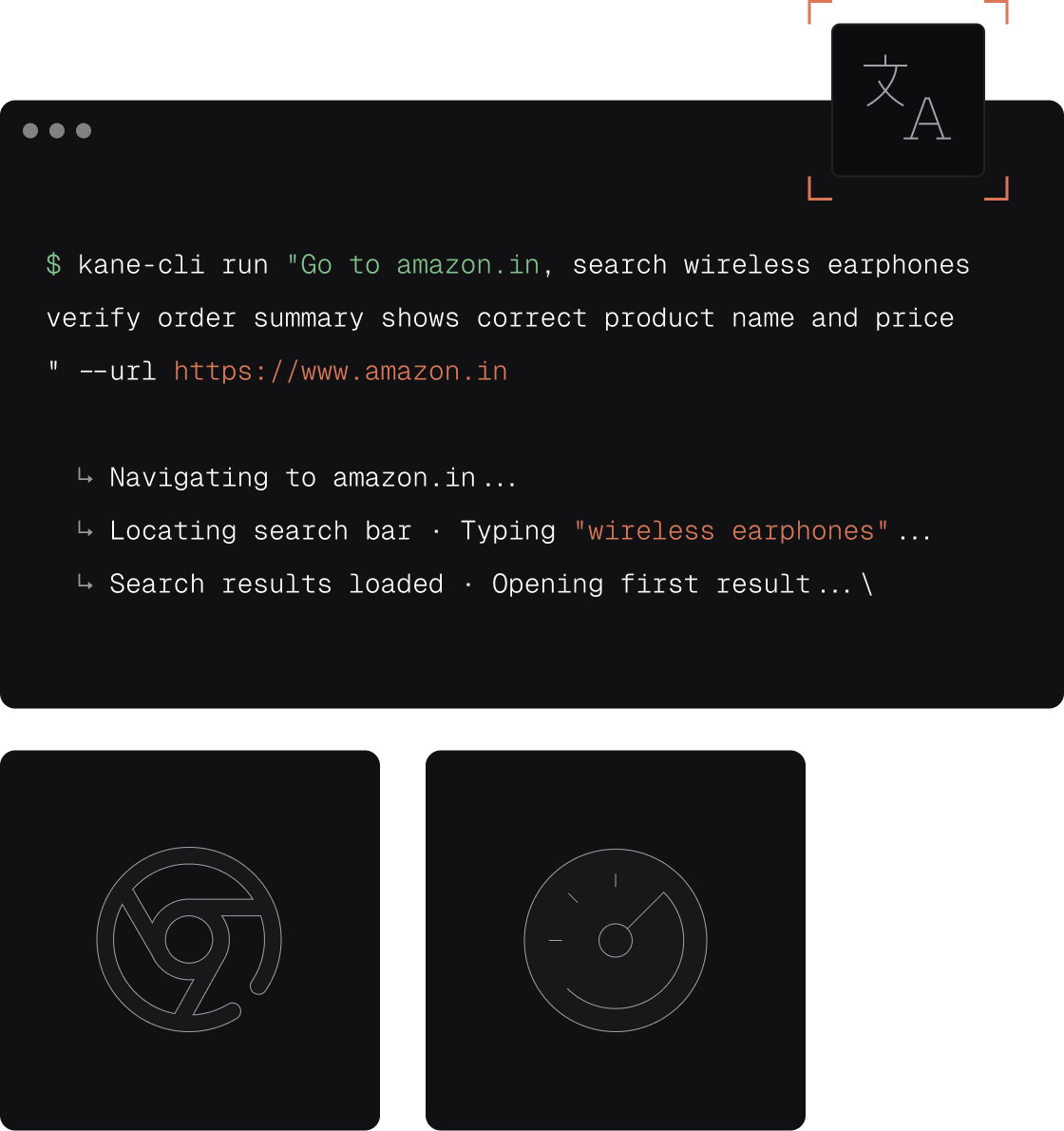
Kane CLI moves that work into the tool. You give it intent, not instructions. It drives a real Chrome browser, adapts when the UI shifts, asserts the result, and reports a verified pass or fail with video evidence.
You keep the escape hatch too: any flow exports to native Playwright with one command, so you are never locked out of the code underneath.
Kane CLI vs Puppeteer
The same Chrome, a very different contract with you and your agent.
| Capability | Kane CLI (TestMu AI) | Puppeteer |
|---|---|---|
| Authoring model | Plain-English objectives, no code | JavaScript / TypeScript you write and maintain |
| Element targeting | Natural-language intent, no selectors | CSS / XPath selectors you maintain |
| Resilience when the UI changes | Autoheals and retries up to 50 steps | |
| Verified pass or fail | Built-in assertions, returns pass or fail | You write every assertion in code |
| Waiting strategy | Vision-based, waits on the rendered screen | Manual waits and waitForSelector |
| Browser coverage | Chrome local, cross-browser and OS on the cloud | Chromium-focused (experimental Firefox) |
| Agent-native output | --agent emits structured NDJSON | |
| Evidence and reporting | Video, step trace, shareable links, dashboard | Console logs and screenshots you wire up |
| Test Manager sync | Every run syncs automatically | |
| Native Playwright export | One command to export Playwright code | n/a |
What you get with Kane CLI
Everything Puppeteer leaves to your code, handled by the tool.

Intent, not a Node script
Where Puppeteer asks you to scaffold a Node project and write JavaScript, Kane CLI takes the journey in plain English, plans the steps, and drives Chrome for you.

No selectors to maintain
Puppeteer pins every action to a CSS or XPath selector that breaks on the next UI change. Kane CLI targets elements by natural-language intent and pushes through up to 50 steps even as the frontend shifts.

Waits handled for you
Skip waitForSelector and the manual timeouts a Puppeteer script needs. Kane CLI watches the rendered screen and waits until each step is actually ready before acting.

Assertions built in
A Puppeteer run only fails where you coded a check. Kane CLI verifies every step itself and flags the exact point of failure, so you or your agent know what to fix.

Agent-native by design
Puppeteer leaves you to wire result parsing into your agent loop. The --agent flag emits structured NDJSON any AI coding agent reads directly, with screenshots on failure.

Beyond Chromium, no rewrite
Puppeteer is Chromium-focused. One Kane CLI flag scales the same flow to cross-browser and cross-OS cloud runs, and any validated flow exports to native Playwright when you want the code.
Build up confidence locally
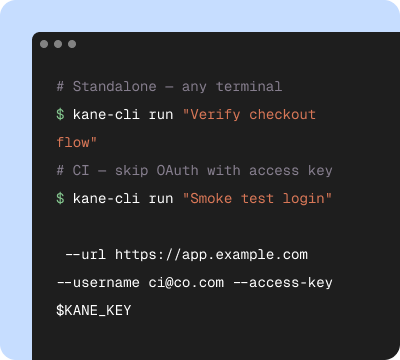
Start in your terminal
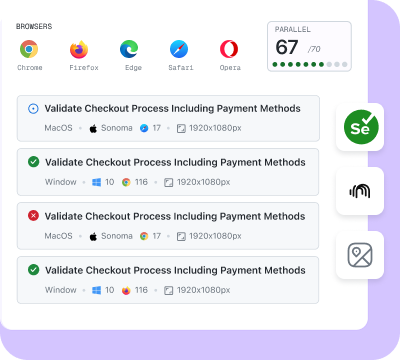
Validate on the cloud
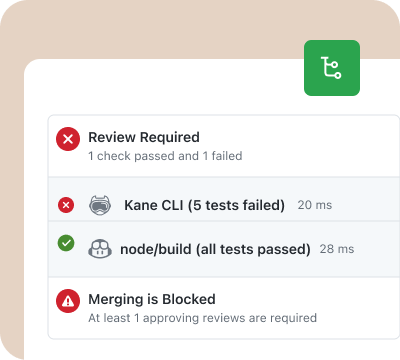
Release with confidence
Built for agents and humans, on one engine
Kane CLI and KaneAI share the same automation engine and dashboard.
Drop the Node project, keep the browser
Migrating off Puppeteer does not mean a rewrite. Kane CLI drives the same real Chrome, but you describe flows in the terminal instead of maintaining a JavaScript codebase, and runs sync to one dashboard.
Verify what your Puppeteer agent wrote
If an agent still emits Puppeteer code, run it through Kane CLI to confirm it works in a real browser before the PR, closing the gap between generated scripts and verified behavior.
Reporting Puppeteer makes you build
Instead of wiring up console logs and screenshot capture yourself, every Kane CLI run produces a persistent video, a step trace, and a replay link to drop into a PR or bug report.
Replace Puppeteer in three steps
Install
Run npm install -g @testmuai/kane-cli, then sign in with your TestMu AI account. No Puppeteer dependency, no Node project to scaffold.
Describe the flow
State the journey in plain English instead of writing JavaScript with CSS or XPath selectors and waitForSelector calls. Run it from the terminal or let your agent run it.
Run and verify
Each step is asserted automatically and you get a pass or fail with video evidence, no custom reporting code. Export the flow to native Playwright whenever you want to own the code.
Get Started With Kane CLI
🎉 Launch offer: Bonus credits for the first 3 months on paid plans
Choose the right plan for you
Local test authoring via CLI
Auto-heal & vision
View test cases on UI
Test Manager

Free
$0
/month
200 Credits
Resets in every
30 days

Starter
$19
/month
2000 Credits
Launch: 4,000 Credits (+100%)
Bonus for first 3 months

Pro
$99
/month
10,000 Credits
Launch: 15,000 Credits (+50%)
Bonus for first 3 months

Enterprise
Get access to solutions built on Enterprise-Grade Security, Privacy, and Compliances.
Need more credits?
Got a bigger use case in mind?
Let’s talk
Choose the right plan for you
Free
$0
/month
200 Credits
Resets in every
30 days
Starter
$19
/month
2000 Credits
Launch: 4,000 Credits (+100%)
Bonus for first 3 months
Pro
$99
/month
10,000 Credits
Launch: 15,000 Credits (+50%)
Bonus for first 3 months
Enterprise
Get access to solutions built on Enterprise-Grade Security, Privacy, and Compliances.
Need more credits?
Got a bigger use case in mind?
Let’s talk
Get the technical rundown

Documentation
Everything you need to install, configure, and run Kane CLI in under 2 minutes.
Frequently asked questions
Puppeteer is a Node.js library that drives Chrome through the DevTools Protocol. You write JavaScript, manage CSS and XPath selectors, and code your own waits, assertions, and reporting. Kane CLI takes a plain-English objective instead, drives a real Chrome browser, self-heals when the UI changes, verifies each step, and returns a pass or fail with video evidence. No Node script, no selectors, no manual waits.
Yes, especially for teams tired of repairing selectors after every UI change and for AI coding agents that need to verify their own work. Puppeteer is excellent low-level automation, but each frontend tweak can break a selector and every assertion is JavaScript you write. Kane CLI moves that work into the tool: describe the journey, and it adapts and retries up to 50 steps until the flow is verified.
Any validated Kane CLI flow exports to native Python Playwright with one command. So unlike a Puppeteer script you hand-maintain, you author in natural language first and still keep ownership of real automation code when you want to take a flow further. You are never locked in.
Yes. Where a Puppeteer suite needs custom plumbing to feed results back to a coding agent, every Kane CLI run supports an --agent flag that emits structured NDJSON. Any AI coding agent can parse the result, read a screenshot on failure, and decide what to do next. Point your agent at the published Kane CLI guide and it installs, authenticates, and drives the browser on its own.
Yes, and with no headless Chrome setup or Node toolchain to wire up first. Authenticate with your TestMu AI credentials, pass --headless and --timeout on each run, and branch on the exit code: 0 for a pass, 1 for a failed assertion, 2 for a setup or auth error, and 3 for a timeout. The same binary runs headed on your laptop and headless in any runner.
Like Puppeteer, the CLI is free to install and use, and local Chrome runs are free. Cloud runs on the TestMu AI grid, which give you the cross-browser and cross-OS coverage Puppeteer's Chromium focus does not, are billed against your TestMu AI plan. Start on the free tier and run end to end without a credit card.
Teach your agent the right skills
Point your AI coding agent at the Kane CLI guide and it will install, authenticate, and run verified browser flows on its own.
 Point your agent to: testmuai.com/kane-cli/agents.md