
Kane CLI vs Manus for verified runs
Manus is a general autonomous agent that returns conversational results. Kane CLI takes a plain-English objective, drives a real Chrome browser, self-heals on UI changes, and returns a deterministic pass or fail you can replay and trust. Free to install.
or read the documentation
Why teams choose Kane CLI over a general agent
Manus is a capable general-purpose agent: give it a broad task in chat and it works toward a result. For one-off exploration that is useful, but it does not give you a repeatable, verifiable signal that a specific flow works.
Kane CLI is built for exactly that. You give it intent, it drives a real Chrome browser, asserts each step, and returns a deterministic pass or fail with video evidence and standard CI exit codes.
Save a flow as test.md to replay it with no repeat LLM cost, run it in CI, and export it to native Playwright with one command when you want the code.
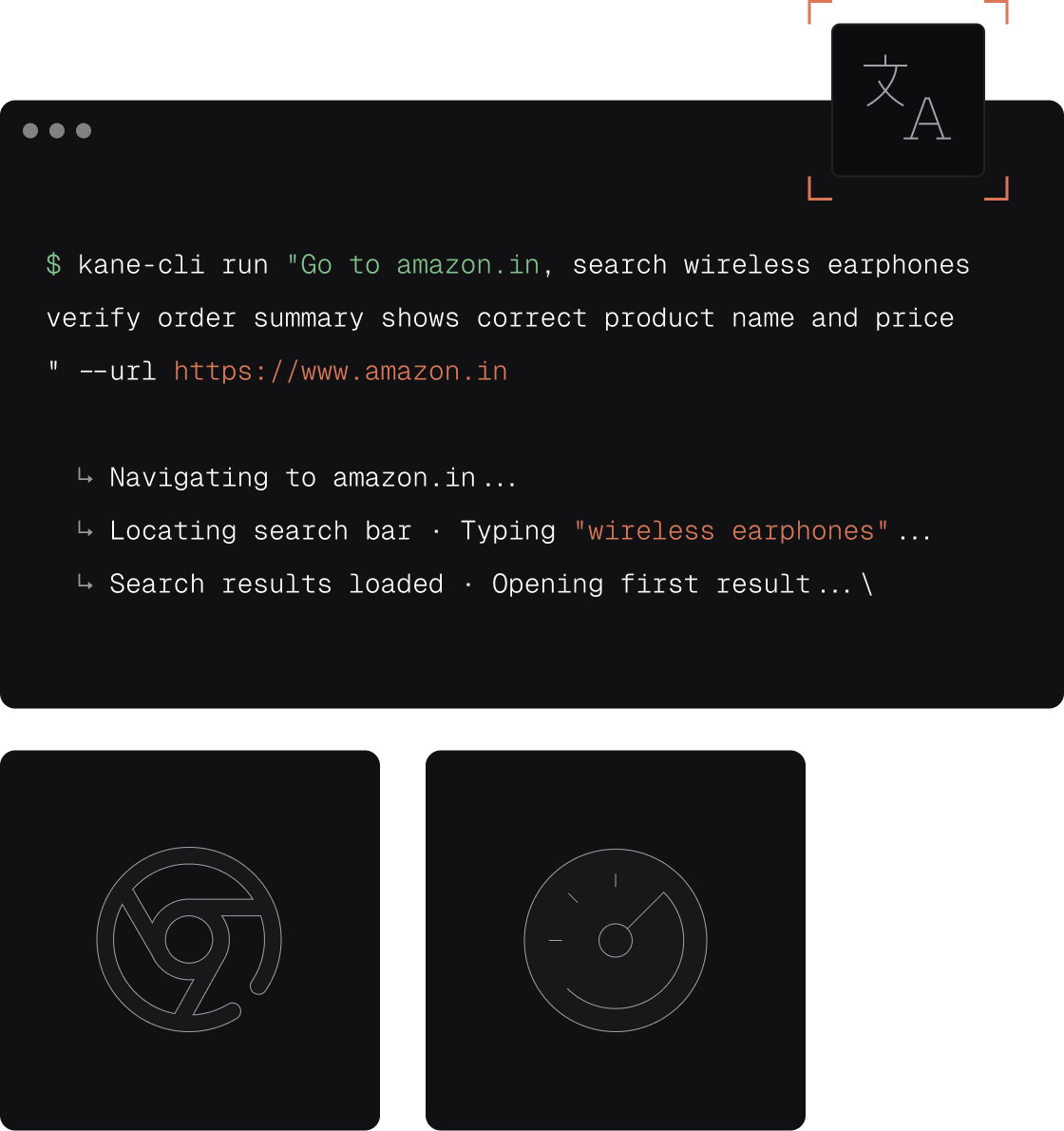
Kane CLI vs Manus
A general agent explores. Kane CLI returns a verified, repeatable result.
| Capability | Kane CLI (TestMu AI) | Manus |
|---|---|---|
| Primary purpose | Repeatable browser testing and automation | General-purpose autonomous agent |
| Result format | Deterministic pass or fail with evidence | Conversational task summaries |
| How you drive it | Plain-English objectives from any terminal | Chat and web app |
| Built-in assertions | Verifies each step, not just the end state | |
| Reproducible replay | test.md replays with no repeat LLM cost | |
| Agent-native output | --agent emits structured NDJSON | |
| CI exit codes | 0 pass, 1 fail, 2 error, 3 timeout | |
| Evidence and reporting | Video, step trace, shareable links, dashboard | Task output in the agent UI |
| Test Manager sync | Every run syncs automatically | |
| Native Playwright export | One command to export Playwright code |
What you get with Kane CLI
A test contract, reproducible replays, and evidence on every run.

A pass or fail, not a chat reply
Manus ends a task with a written summary. Kane CLI ends with a binary pass or fail backed by built-in assertions, so the result is a signal you can gate on.

Objectives that become tests
You describe the journey in plain English just like a Manus prompt, but Kane CLI turns it into a repeatable check it drives in real Chrome from your terminal.

Reproducible replay
A Manus run is not something you can rerun byte for byte. Save a Kane CLI flow as test.md and replay the exact same verification with no repeat LLM cost.

Built for coding agents
Manus answers in a chat UI. The --agent flag makes Kane CLI emit structured NDJSON your AI coding agent parses directly, with screenshots to read on failure.

CI-ready exit codes
A conversational agent has no pipeline contract. Kane CLI returns standard exit codes to gate any CI run: 0 pass, 1 fail, 2 error, 3 timeout.

Own the Playwright code
A Manus session leaves you nothing to maintain. Export any validated Kane CLI flow to native Playwright and own real automation code, no lock-in.
Build up confidence locally
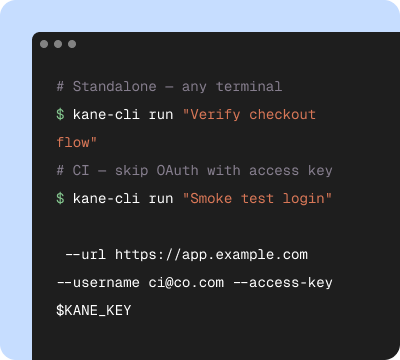
Start in your terminal
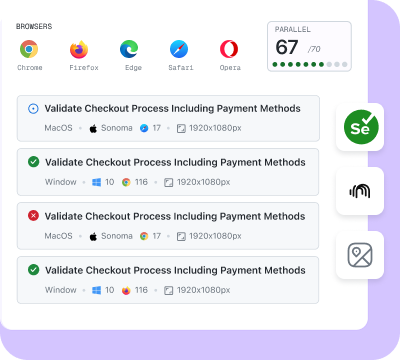
Validate on the cloud
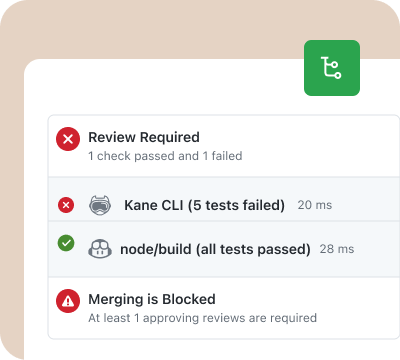
Release with confidence
Built for agents and humans, on one engine
Kane CLI and KaneAI share the same automation engine and dashboard.
Verification, not conversation
Manus reports back in chat that a task is done. Kane CLI asserts each step in a real browser and returns a binary pass or fail you can act on without rereading a summary.
Runs the same way every time
A Manus session is a fresh exploration each time you ask. Save a Kane CLI flow as test.md and the same checks run identically on every push, with no model drift.
Proof the rest of the team trusts
Instead of a conversational recap, every Kane CLI run leaves a video, a step trace, and a replay link you can paste straight into a PR or bug ticket.
Switch to Kane CLI in three steps
Install
Run npm install -g @testmuai/kane-cli, then sign in with your TestMu AI account. No chat workspace to set up.
Describe the flow
State the journey in plain English, the same way you would prompt Manus, but as a check you can save and rerun rather than a one-off request.
Run and verify
Where Manus narrates what it tried, Kane CLI asserts each step and returns a pass or fail with video evidence and a replay link.
Get Started With Kane CLI
🎉 Launch offer: Bonus credits for the first 3 months on paid plans
Choose the right plan for you
Local test authoring via CLI
Auto-heal & vision
View test cases on UI
Test Manager

Free
$0
/month
200 Credits
Resets in every
30 days

Starter
$19
/month
2000 Credits
Launch: 4,000 Credits (+100%)
Bonus for first 3 months

Pro
$99
/month
10,000 Credits
Launch: 15,000 Credits (+50%)
Bonus for first 3 months

Enterprise
Get access to solutions built on Enterprise-Grade Security, Privacy, and Compliances.
Need more credits?
Got a bigger use case in mind?
Let’s talk
Choose the right plan for you
Free
$0
/month
200 Credits
Resets in every
30 days
Starter
$19
/month
2000 Credits
Launch: 4,000 Credits (+100%)
Bonus for first 3 months
Pro
$99
/month
10,000 Credits
Launch: 15,000 Credits (+50%)
Bonus for first 3 months
Enterprise
Get access to solutions built on Enterprise-Grade Security, Privacy, and Compliances.
Need more credits?
Got a bigger use case in mind?
Let’s talk
Get the technical rundown

Documentation
Everything you need to install, configure, and run Kane CLI in under 2 minutes.
Frequently asked questions
Manus is a general autonomous AI agent that completes broad tasks from a chat interface and returns conversational results. Kane CLI is purpose-built for browser verification and automation: it takes a plain-English objective, drives a real Chrome browser, and returns a deterministic pass or fail backed by built-in assertions, with standard CI exit codes.
Yes, when you need repeatable, verifiable browser automation rather than a general-purpose agent. Manus is great for open-ended tasks. Kane CLI returns a binary pass or fail you can replay, run in CI, and export to Playwright.
Yes, and that is a key difference from Manus, which talks to a person through its chat UI. Every Kane CLI run supports an --agent flag that emits structured NDJSON, so Claude Code, Cursor, Codex, or Gemini can parse the result, read a screenshot on failure, and decide what to do next. Point your agent at the published Kane CLI guide and it installs, authenticates, and drives the browser on its own.
Yes. A Manus session leaves you nothing to maintain afterward; Kane CLI exports any validated flow to native Python Playwright with one command, so you author in natural language and still keep ownership of real automation code whenever you want it.
Yes. A general chat agent has no pipeline contract, but Kane CLI does: authenticate with your TestMu AI credentials, pass --headless and --timeout, and read the exit code in your pipeline: 0 passed, 1 failed an assertion, 2 hit a setup or auth error, and 3 timed out.
The CLI is free to install and use, with no chat subscription to start. Local Chrome runs are free; cloud runs on the TestMu AI grid are billed against your TestMu AI plan. Start on the free tier and run end to end without a credit card.
Teach your agent the right skills
Point your AI coding agent at the Kane CLI guide and it will install, authenticate, and run verified browser flows on its own.
 Point your agent to: testmuai.com/kane-cli/agents.md