
Test web apps built with Claude Code before the next edit ships
Claude Code edits real code and it compiles, but a green build is not a working web app. Kane CLI drives your running web app in a real browser, verifies each flow in plain English, and returns a clean pass or fail. Free to install.
or read the documentation
Why test web apps built with Claude Code
Claude Code, by Anthropic, is a terminal coding agent that edits real code in your repo and almost always compiles. It can drive a browser via its beta Chrome integration, but that is not headless, CI, or deterministic.
That is where these web apps break. An edit drifts a type, touches an out-of-scope file, or leaves a form that no longer submits, and the build stays green. The diff shows what moved, not whether the flow still works.
Kane CLI is the second pair of eyes, built for agents like Claude Code to drive. Describe the journey in plain English and it runs your live web app in real Chrome, clicks the flow, and reports the exact step that breaks.
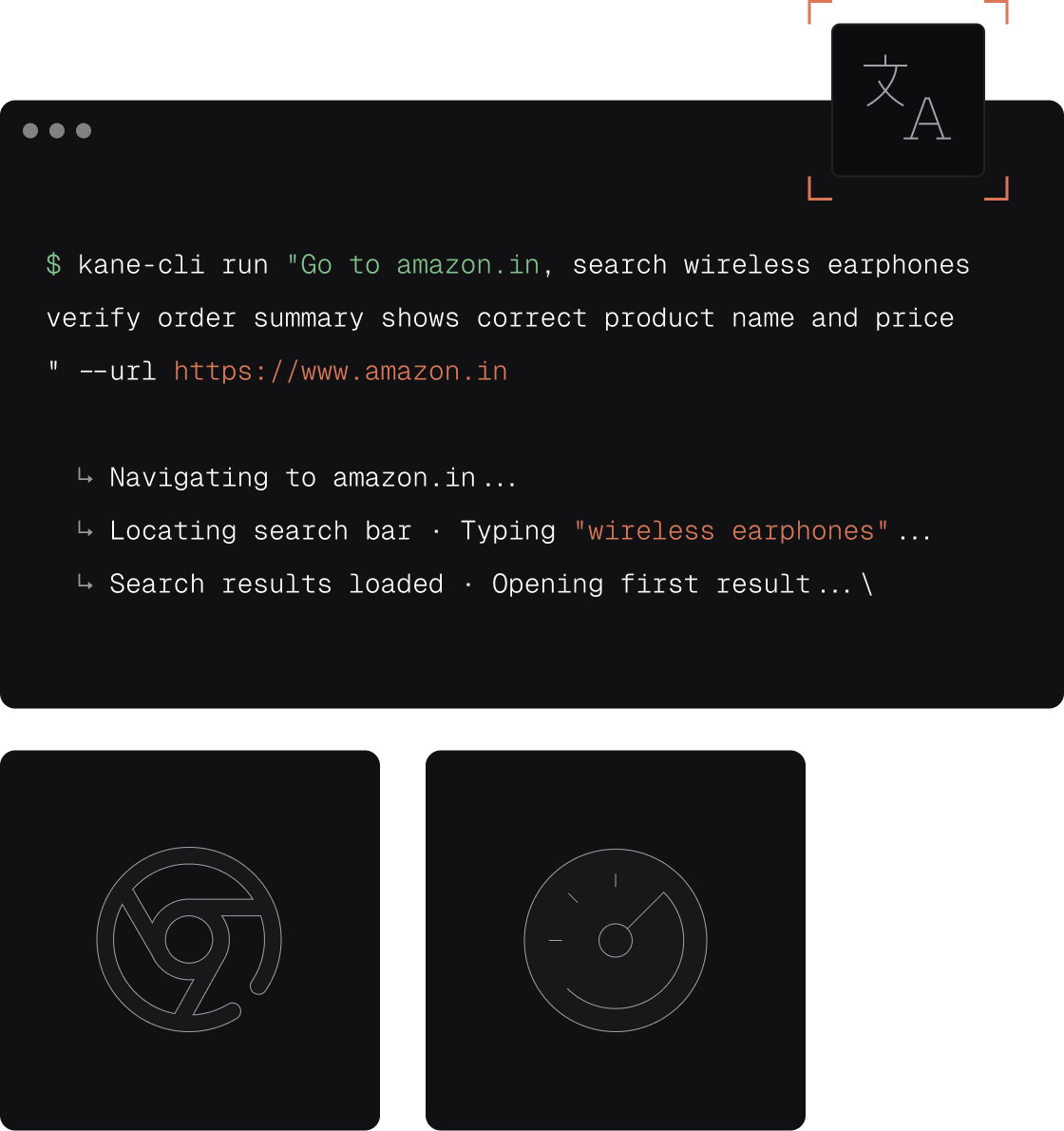
What Kane CLI tests in your Claude Code web app
The feature the agent just shipped, and every flow the next edit could break, verified in a real browser.

The feature the agent just built
Verify the exact journey tied to the change Claude Code made, from the click that triggers it to the result on screen, before the edit is committed. Confirm the new behavior runs, not just that the build passed.

Regression on the next edit
Claude Code edits across the whole repo and can touch files outside the scope you asked for. Lock in known-good journeys and re-run them so a refactor for one feature cannot silently break a route, button, or form that already worked.

Full-stack flow, frontend to API
Claude Code wires up the Next.js or React frontend and the API routes and backend behind it. Walk the request that crosses both, submit the form, and confirm the data round-trips, not just that the page renders.

Sign-in and protected pages
Log in, hold the session across navigation, and confirm protected routes and role-based pages behave for a real user, the part that only fails once the web app runs in a browser.

Console errors and hydration
Catch the runtime errors, hydration mismatches, and broken navigation a clean compile hides, the ones that surface only when the live web app loads in real Chrome.

A suite the agent maintains
Keep your critical journeys as plain-English checks Claude Code updates alongside the code, so verification stays in sync with a UI the next edit might change.
Build up confidence before you commit
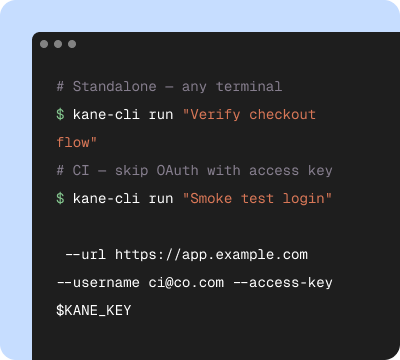
Start in your terminal
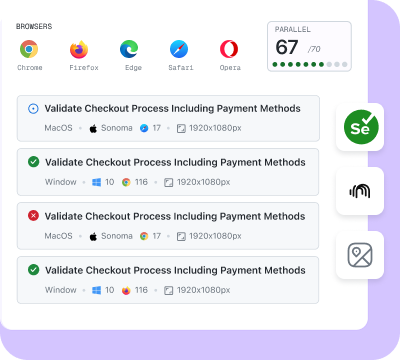
Validate on the cloud
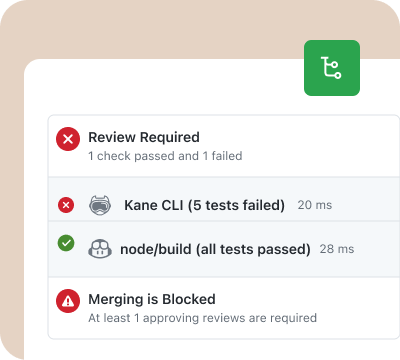
Release with confidence
Built for the build-verify-fix loop
Kane CLI and KaneAI share the same automation engine and dashboard.
Close the loop in one session
Claude Code already edits the code in your terminal. With the ready-made Kane CLI skill it verifies right after, drives the live web app through the --agent flag, reads the result, and fixes the regression, all without leaving the session or switching tools.
Run the web app, not just the diff
A clean diff and a green build are not proof the web app works. Kane CLI drives your dev server or deployed URL in a real Chrome browser and clicks the actual flow, so the agent verifies running behavior, the one thing it cannot confirm by reading its own code.
Evidence you can share
Every run produces a persistent video, step trace, and replay link you can drop into a PR, bug report, or message to your team, so a fix Claude Code claims is done comes with proof it works.
Test your Claude Code web app in three steps
Install Kane CLI
Run npm install -g @testmuai/kane-cli and sign in with your TestMu AI account. Nothing to wire into your repo or build config.
Add the skill, or run it yourself
Add the ready-made Kane CLI skill or point Claude Code at the agents.md guide so it verifies after every edit, or run flows from your terminal against your dev server or deployed URL.
Describe the flow and verify
Write the journey in plain English, like sign in, create a record, and confirm it persists after a refresh. Kane CLI drives a real browser, verifies each step, and returns a pass or fail with evidence.
Get Started With Kane CLI
🎉 Launch offer: Bonus credits for the first 3 months on paid plans
Choose the right plan for you
Local test authoring via CLI
Auto-heal & vision
View test cases on UI
Test Manager

Free
$0
/month
200 Credits
Resets in every
30 days

Starter
$19
/month
2000 Credits
Launch: 4,000 Credits (+100%)
Bonus for first 3 months

Pro
$99
/month
10,000 Credits
Launch: 15,000 Credits (+50%)
Bonus for first 3 months

Enterprise
Get access to solutions built on Enterprise-Grade Security, Privacy, and Compliances.
Need more credits?
Got a bigger use case in mind?
Let’s talk
Choose the right plan for you
Free
$0
/month
200 Credits
Resets in every
30 days
Starter
$19
/month
2000 Credits
Launch: 4,000 Credits (+100%)
Bonus for first 3 months
Pro
$99
/month
10,000 Credits
Launch: 15,000 Credits (+50%)
Bonus for first 3 months
Enterprise
Get access to solutions built on Enterprise-Grade Security, Privacy, and Compliances.
Need more credits?
Got a bigger use case in mind?
Let’s talk
Get the technical rundown

Documentation
Everything you need to install, configure, and run Kane CLI in under 2 minutes.
Frequently asked questions
Install Kane CLI, then describe the journey in plain English, for example "open the running web app, sign in, add a task, mark it done, and confirm it persists after a refresh." Kane CLI drives your dev server or deployed URL in a real Chrome browser, checks each step, and returns a clean pass or fail with video evidence. Better still, Claude Code can run it itself: there is a ready-made Kane CLI skill. Point Claude Code at the guide at testmuai.com/kane-cli/agents.md and after an edit it installs Kane CLI, runs the flow with the --agent flag, reads the result, and fixes the regression before you see it.
Claude Code edits real code across your repo, and it almost always compiles. Compiling is not the same as working. The documented failure mode is the agent touching files outside the scope you asked for, drifting TypeScript types across modules, and quietly breaking a route or button that worked an edit ago. Claude Code can drive a browser through its beta Chrome integration, but that runs in a visible Chrome window, is not available in CI, and returns no deterministic pass or fail, so a green build and clean diff still hide a broken sign-in or a form that no longer submits. Kane CLI runs the live web app headlessly in the same loop the change landed and returns a structured pass or fail, so the regression surfaces before the commit, not after a user reports it.
The exact flow tied to the feature Claude Code just built or refactored, end-to-end journeys across your Next.js or React frontend, the API routes and backend it wired up, forms and validation, sign-in and protected pages, and the absence of console errors, hydration warnings, or broken navigation. It checks each step, not just the final screen, and flags the precise point where the web app breaks so the agent knows which file to fix.
Yes, that is the point. Kane CLI is built for terminal coding agents, and there is a ready-made Kane CLI skill for Claude Code. Point Claude Code at the guide at testmuai.com/kane-cli/agents.md and it installs Kane CLI, runs flows with the --agent flag, reads the results, and fixes what failed before you see it. It is the same agent that made the edit, so build, verify, and fix happen in one session without switching tools.
Yes. Authenticate with your TestMu AI credentials, pass --headless and --timeout, and gate your pipeline on the exit code: 0 on pass, 1 on fail, 2 on setup or auth errors, and 3 on timeout. Lock your critical journeys into a suite Claude Code maintains alongside the code, and re-run them on every commit so the next edit cannot silently break a flow that already shipped.
The CLI is free to install and use. Local runs are free, and cloud runs on the TestMu AI grid are billed against your TestMu AI plan. Start on the free tier and verify your web app end to end without a credit card.
Teach Claude Code to test what it builds
Add the ready-made Kane CLI skill or point Claude Code at the guide, and after every edit it installs Kane CLI, runs the flow in a real browser, and fixes the regression before you see it.
 Point your agent to: testmuai.com/kane-cli/agents.md