
Power Your Software Testing with AI Agents and Cloud
The Native AI-Agentic Cloud Platform to Supercharge Quality Engineering. Test Intelligently and Ship Faster.

- TestMu AI (Formerly LambdaTest)
- /
- Blog
- /
- When Software Becomes Everyone's Job [Testμ 2026]
When Software Becomes Everyone's Job [Testμ 2026]
Gurleen Kaur and Keerthivasan Devaraj of Piramal Finance on going from zero to 947 business builders, 369 live apps, and why quality became a hard CI gate.
Published on:
Two years ago, the number of people outside engineering shipping live software at Piramal Finance was close to zero. Today the platform carries 947 builders, 1,306 projects, and 369 applications running in production.
In this session from Testμ Conf 2026, Gurleen Kaur and Keerthivasan Devaraj, both Senior AI Software Engineers at Piramal Finance, explain how that happened and what it did to quality ownership. Their talk the previous year covered developers shipping code without writing it; this one is about what changed once the rest of the organisation joined in.
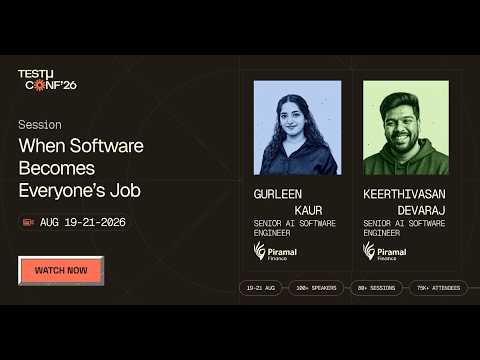
If you couldn’t catch all the sessions live, you can access the recordings at your convenience by visiting the TestMu AI YouTube Channel.
TL;DR
Piramal Finance built BYOT, a platform where business teams create and ship their own internal applications while engineering governs the environment. Deployment, secrets, authentication and testing are pre-wired as guardrails, so 947 non-engineer builders have shipped 369 live applications without learning infrastructure.
- What is BYOT? - BYOT, or Build Your Own Tech, is the Piramal Finance platform on which business teams build and ship their own internal applications. Business gets the ability to create, and engineering keeps the ability to govern.
- Do BYOT builders need coding or infrastructure skills? - No. The editor runs in the browser with no local installs, and authentication, databases, ports and secrets come pre-wired, so a builder describes the application and clicks once to deploy it.
- What was stopping business users before BYOT? - Business users at Piramal Finance built genuinely useful applications on their own. Deployment, secrets, ports and monitoring stopped them, and those are platform concerns rather than coding skills.
- How many applications has the platform shipped? - The BYOT platform carries 947 builders, 1,306 projects and 369 applications live in production, against close to zero non-engineer builders two years earlier.
- What is a shape note in KriyaOS? - KriyaOS is the Piramal Finance layer that wraps the rest of the lifecycle around BYOT, and a shape note is the one-page illustrated requirement it generates from a meeting or an idea. Nothing is coded until the shape note is approved, which cuts the token cost of iterating on generated code.
- Is quality optional on the BYOT platform? - No. Every application gets integration, regression and smoke tests generated automatically and enforced as a mandatory CI gate, and a failing test makes the system raise its own ticket, attempt a fix and re-run.
- How does the platform restrict third-party integrations? - Applications on BYOT can only call services in the approved API catalog, so when AI reached for an external messaging API the path did not exist. Rebuilt on the approved internal gateway, the feature shipped the same week.
- What does Piramal Finance keep away from AI? - Deciding what to build and why, setting the security and compliance policies the platform enforces, and architecting core systems all stay with people.
The speakers opened with a question for the audience about their own organisations.
From Zero to Many Builders
Count how many people outside your engineering team ship software today. Not spreadsheets or filtered dashboards, but live applications other people depend on.
At Piramal Finance two years ago the answer was near zero, and the session is the account of how that changed.
Their framing is that AI now touches the whole journey: imagining what to build, building it, validating it, and shipping it. The more consequential shift is not what AI does but who is now able to do it.
The person with the idea no longer waits for someone else to write the code, and the boundary between business, product, engineering and operations has blurred. In their reading, AI stopped being a developer tool and became a software creation layer.
The first phase was conventional enough. They rolled an AI coding assistant across the whole engineering organisation over roughly six months, and work that had taken months started taking weeks, then days.
The Tatkal Squad
People outside engineering noticed and asked the obvious question. If AI is writing the code, should technology not cost considerably less?
The response was an experiment squad named tatkal, after the Indian railway booking tier for urgent same-day tickets. The promise was that any feature handed to them would be in production within 48 hours.
The scope was deliberately bounded to ordinary systems needing CRUD operations and a few integrations rather than high-complexity work. Delivery went from months to hours, and business was delighted.
It worked well enough to become a problem. The squad turned into the most in-demand team in the organisation, which they were candid enough to call an anti-pattern.
The lesson they drew is that delivery speed was never the whole constraint. Demand for software is effectively infinite, so the bottleneck reappeared as the number of applications they could ship rather than the time each one took.
Build Your Own Tech
That pushed them toward a different question: where do engineers actually matter?
Their worked example is a daily reporting portal for frontline loan sales staff, replacing informal updates sent over chat and calls. It serves up to 5,000 people and amounts to straightforward CRUD.
A core system processing loans, carrying compliance obligations and handling sensitive data is a different matter, and engineers are unambiguously needed there. Separating those two cases is what opened the door.
The resulting idea is what they call BYOT, or Build Your Own Tech: a platform built by engineers on which business teams build and ship their own internal tools.
They were careful about what it is not. This is not handing everyone access to production systems, but a controlled environment where the person who understands the business problem can turn it into a working application.
Platform Problems, Not Coding Problems
Their first instinct was to teach business users to be developers. They explained front end, back end and APIs, installed Node.js on their laptops, and gave them access to an AI coding tool.
To their own surprise, it worked. The applications were not toy demos but genuinely useful tools, because the people building them understood the business better than engineering could.
Then they hit the wall. How does the app get deployed, where does it run, who owns the API, who manages secrets, and how does monitoring work?

Their illustration is port 3000, permanently occupied because everyone is developing, so apps drift to 3001, then 3002, then 3003. None of that is a coding problem.
Returning to first principles, they concluded that if business users could already build good applications, they should not have to learn deployment or hardware at all. So the platform absorbs it.
Setup was the first thing removed, with an editor running in the browser and no local installs or dependency management. Builders describe what they want, then click once to go live.
Underneath, authentication, databases, ports and secrets are pre-wired. Engineering standards are not relaxed; they are encoded as guardrails so the builder never needs to know the rules the platform is already following.
The Numbers
They admitted they had not expected the scale it reached.
- 947 builders - people across the organisation building on the platform.
- 1,306 projects - created on the platform in total.
- 369 applications - live in production and in real use.
They stressed that these are not prototypes or hackathon demos. They are applications people rely on, built by business but still governed by engineering.
That split is the part they credit for making the model scale. Business holds the capability to create, engineering retains the ability to govern, and neither role collapses into the other.

Note: When more people ship software, the quality gate has to hold on its own. TestMu AI Test Intelligence surfaces flaky tests and failure patterns across builds so a widening pipeline stays diagnosable. Try it free!
KriyaOS and the Loop
BYOT solved building and deployment, which still leaves most of a software lifecycle untouched. Requirements, design, sign-off, UAT and post-deployment monitoring had all remained engineering’s burden.
KriyaOS is their attempt to embed the rest of it, described as an operating system for software creation. The loop runs in six steps.
- Shape note - a one-page illustrated requirement generated from a meeting, transcript or idea, setting out the workflows the system will implement.
- Mockups - generated once the shape note is approved, filling the role a design team used to.
- Build - which begins only after the mockups are agreed.
- UAT - an ephemeral link with the app on one side and a chat interface on the other, where feedback becomes tickets in the platform automatically.
- One-click fix - the builder presses fix, and the change routes back to whoever raised the issue.
- RCA agent - after deployment it watches for error responses and log patterns, raising tickets that re-enter the same fix loop.
The sequencing carries a cost argument as well as a quality one. Building first invites long iteration loops, and changing a component repeatedly burns tokens that translate directly into spend.
So nothing is coded until the idea is agreed. Shifting the decision left lowers cost and improves what the model eventually produces.
The Engineering Layer Underneath
The obvious question, once business teams are building and shipping, is what engineers are doing. Their answer is that engineering moved up a layer rather than away.
- Skills repository - roughly 30 skills encoded from their own standards and patterns, so an AI session starts with the organisation’s way of building rather than a blank page.
- MCP integrations - connecting AI to the tools used for monitoring, deployment, project management and design, so it operates inside the engineering environment rather than only generating code.
- API catalog - internal APIs exposed as tools, so a business application needing something that already exists does not rebuild it, and the builder never sees the plumbing.
- Starter kits and secure defaults - authentication, secrets and port decisions made once by engineering and inherited automatically by everyone building.
The shift they describe is from solving a problem per application to solving it once and distributing it through the platform. Less code gets written by hand, and by their account there is more engineering than before, not less.
Engineering didn't go away. It moved a layer up. Instead of solving the same problems application by application, engineers now solve them once and the platform distributes the solution everywhere. pic.twitter.com/OrIHG6TVBm
— TestMu AI (@testmuai) August 19, 2026

Quality as a Wall
Building software in hours creates a problem for anything that used to take days. There is no room left for a quality process that runs at the old pace.
Their answer is a quality lifecycle that generates itself. Every application gets integration, regression and smoke tests automatically, rather than because a developer remembered to write them.
It runs as a mandatory CI gate, and the enforcement is automated end to end. A failing test makes the system raise its own ticket, identify the problem, attempt a fix, and re-run rather than waiting for someone to notice.
Their reasoning is symmetry. Code already ships at AI speed, so quality has to run on the same loop or it becomes the next bottleneck.
The Apps That Never Launched
The most useful part of the talk is the arithmetic they did not hide. Of 1,306 projects created, 369 went live, which leaves 937 that did not.
Allowing perhaps 200 still in progress, roughly 700 sit abandoned. First-time users experiment, duplicate projects, and take practice runs, and all of it consumes resources and tokens amounting to thousands of dollars.
Their defence of that spend is a specific case from the collections team. The first app disappointed them and was scrapped, the second likewise, and the third was an automation that reduced a recurring activity from 30 days to 5 minutes.
They were careful to call that an extreme case rather than the norm, and to point at improvements in the 20 to 30 percent range as the realistic pattern. Multiplied across 369 live applications, they argue the return covers the abandoned 700 comfortably.
The structural argument underneath is about the long tail. With roughly 20,000 people in the organisation, even a fraction having one idea a quarter generates thousands of ideas a year.
An idea that saves two people half a week each is genuinely valuable to them and will never survive prioritisation against organisation-wide work. Small ideas die, and the platform is what lets them get built anyway.
The Decisions That Stay Human
Their sharpest example of the platform earning its keep involves a feature it refused to build. The collections team wanted their live follow-up tracker to upload a customer list and send automated reminders.
AI drafted it in minutes and reached for a third-party messaging API. It could not proceed, and the reason matters: no engineer caught it in review and no security scanner flagged it.
Applications on the platform can only call services exposed through the approved API catalog, so the risky path does not exist to begin with. They describe this as closed by design rather than by luck.
The platform prevented a technical risk without making a business decision. The team still had to settle whether customer contact data should be used this way, what consent existed, and when and how any message should be sent.
Rebuilt on the approved internal gateway, the feature shipped the same week. Their reading is that the constraint shaped the feature rather than blocking it.
That leads to what they deliberately keep away from AI, on the grounds that speed is not the same thing as judgment:
- What to build and why - AI can help explore solutions, but choosing which customer problem deserves solving stays with people.
- The boundaries themselves - the platform enforces security and compliance rules, while deciding what those policies should be does not move.
- Core platforms and complex systems - writing a lot of code is not the same as architecting, and knowing when something works technically but should not ship is judgment AI does not supply.
Q & A Session
The session ran close to time, so one audience question was taken before the close.
- If software is everyone’s job, how do you prevent shadow AI or misuse of AI tools in the workflow?
Gurleen and Keerthivasan: It comes down to the guardrails built around whichever tool you adopt. Even general-purpose coding agents ship with limits, such as being unable to authenticate into a system on their own, and those exist for a reason. On their platform, secrets, deployment and authentication are never written by business users; they are pre-built into every application from the start. Layered on top is role-based access, so an engineer and someone from HR hold different permissions, which is what keeps shadow usage from taking hold.
Their closing lesson was about belief rather than tooling. Telling someone in business they can build an application themselves usually meets disbelief, because they have spent a career assuming that is what engineers are for.
So they started with tiny applications solving small real problems, one after another, letting each success change someone’s mental model. As they put it, you cannot install a mindset, you grow it one application at a time.
This session was part of Testμ Conf 2026, which ran across three days of sessions on agentic engineering and quality. Registrations for the next edition are already open on the Testμ Conference 2027 page.
Author

TestMu AI
Blogs: 290


TestMu AI is World's First Full Stack AI Agentic Quality Engineering platform that empowers teams to test intelligently, smarter, and ship faster. Built for scale, it offers a full-stack testing cloud with 10K+ real devices and 3,000+ browsers. With AI-native test management, MCP servers, and agent-based automation, TestMu AI supports Selenium, Appium, Playwright, and all major frameworks. AI Agents like HyperExecute and KaneAI bring the power of AI and cloud into your software testing workflow, enabling seamless automation testing with 120+ integrations. TestMu AI Agents accelerate your testing throughout the entire SDLC, from test planning and authoring to automation, infrastructure, execution, RCA, and reporting.


Did you find this page helpful?
More Related Blogs

TestMu AI forEnterprise
Get access to solutions built on Enterprise
grade security, privacy, & compliance
- Advanced access controls
- Advanced data retention rules
- Advanced Local Testing
- Premium Support options
- Early access to beta features
- Private Slack Channel
- Unlimited Manual Accessibility DevTools Tests