Hero Background

Next-Gen App & Browser Testing Cloud

Trusted by 2 Mn+ QAs & Devs to accelerate their release cycles

Next-Gen App & Browser Testing Cloud
Test Management

9 Best TestRail Alternatives for 2026

Looking for a TestRail alternative in 2026? Compare the 9 best TestRail alternatives for test case management, AI authoring, execution, and Jira sync.

Author

Bhavya Hada

Author

June 30, 2026

TestRail does one job well, storing and organizing test cases with mature run reporting. Teams start shopping for an alternative because of everything it leaves to other tools: AI authoring, native test execution, and a single view of manual plus automated coverage.

Which alternative fits depends on the gap you are closing, so the 9 options below run from leaner standalone tools to all-in-one platforms, each with the trade-off it makes.

TestRail Alternatives: Comparison Table

How the top alternatives compare with TestRail on the capabilities teams switch for. Confirm current pricing on each vendor's page:

ToolAI Test GenerationNative ExecutionManual + Automated ViewFree Plan
TestMu AIYes (KaneAI)Yes (cloud grid)Yes (unified)Yes
TestRailNoNoPartialTrial only
QaseLimitedNoVia integrationsYes
ZephyrLimitedNoPartialTrial only
XrayNoNoYesTrial only
TestmoNoNoYesNo
Kiwi TCMSNoNoPartialYes (open source)

The 9 Best TestRail Alternatives in 2026

Ranked by how much each adds over a standalone repository, with TestMu AI first as the all-in-one option.

1. TestMu AI (Formerly LambdaTest)

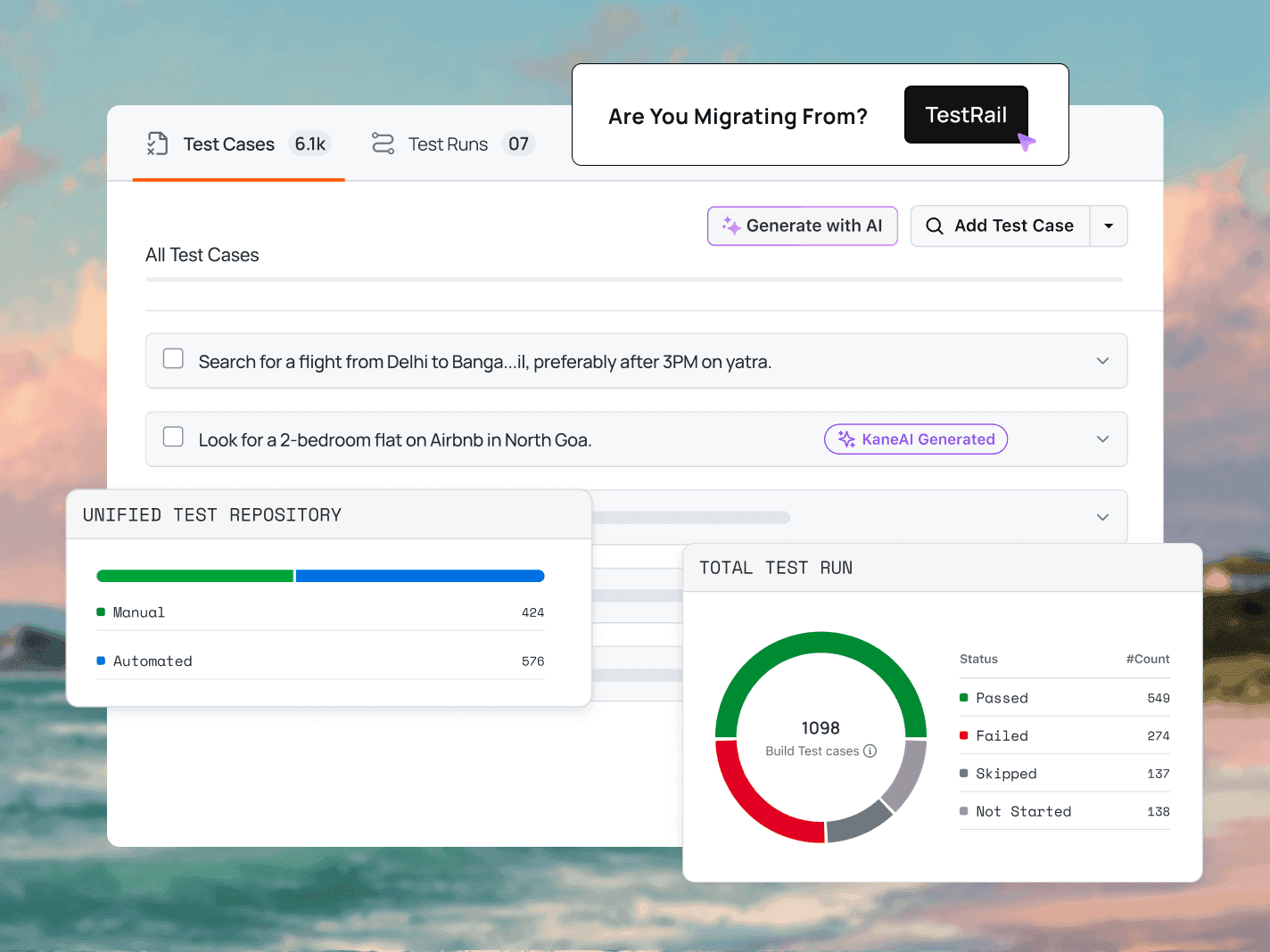
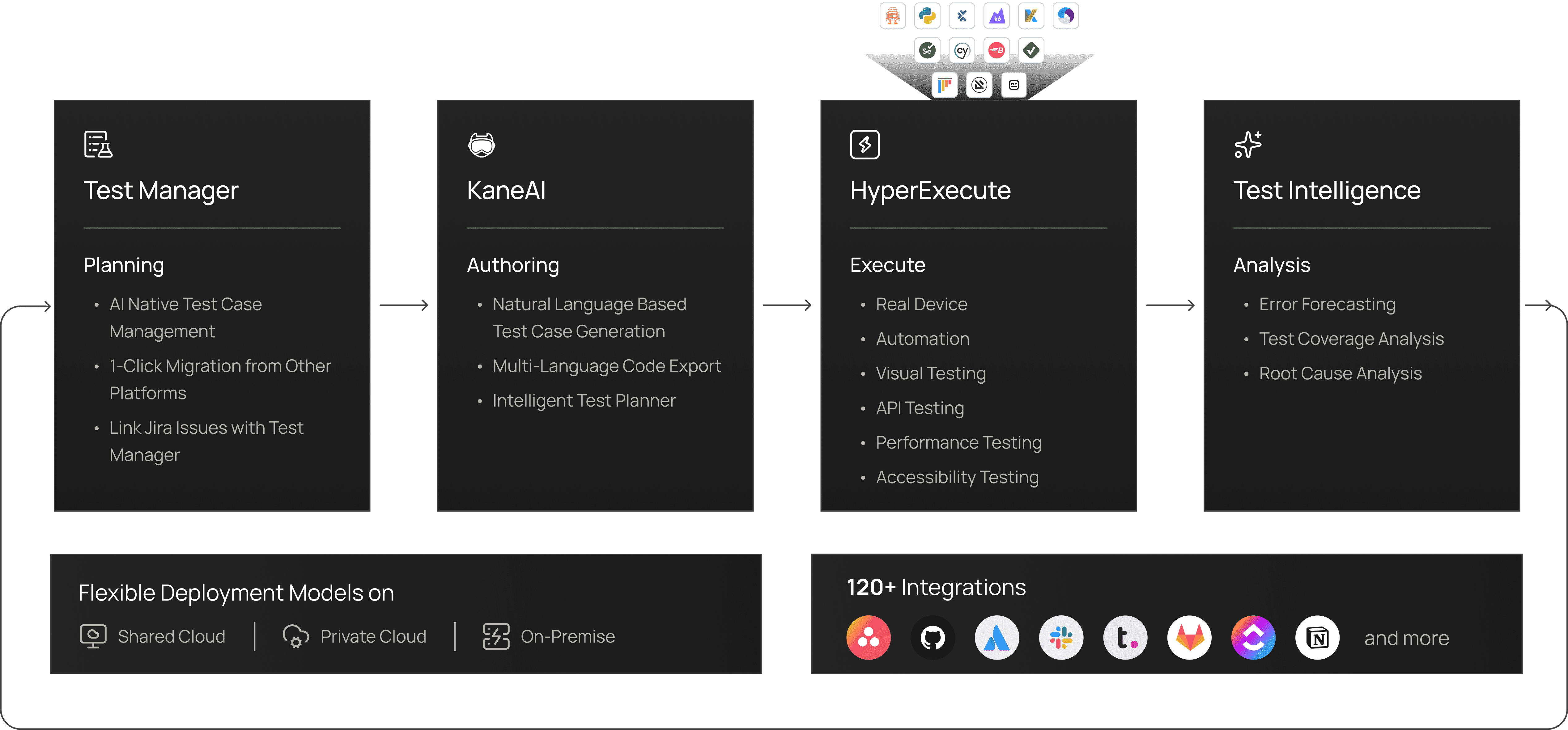
TestMu AI is an AI-native test management platform and the strongest all-in-one TestRail alternative, because it is both a test management tool and a test execution cloud. Where TestRail manages cases and stops, TestMu AI adds AI authoring, unified results, and real-device execution in one product.

  • KaneAI generates structured cases from natural language, user stories, or requirements, then refines them
  • Manual and automated CI/CD results unify in one cycle dashboard for total coverage
  • Live traceability matrix from requirements to tests to runs to defects
  • Test case versioning and milestone-based execution for governed, release-ready test cycles
  • Two-way Jira and Azure DevOps sync, plus 120+ integrations
  • Execution on 10,000+ real devices and 3,000+ browser and OS combinations
  • SOC 2 Type II and ISO 27001, SSO, and folder-level RBAC for enterprise QA
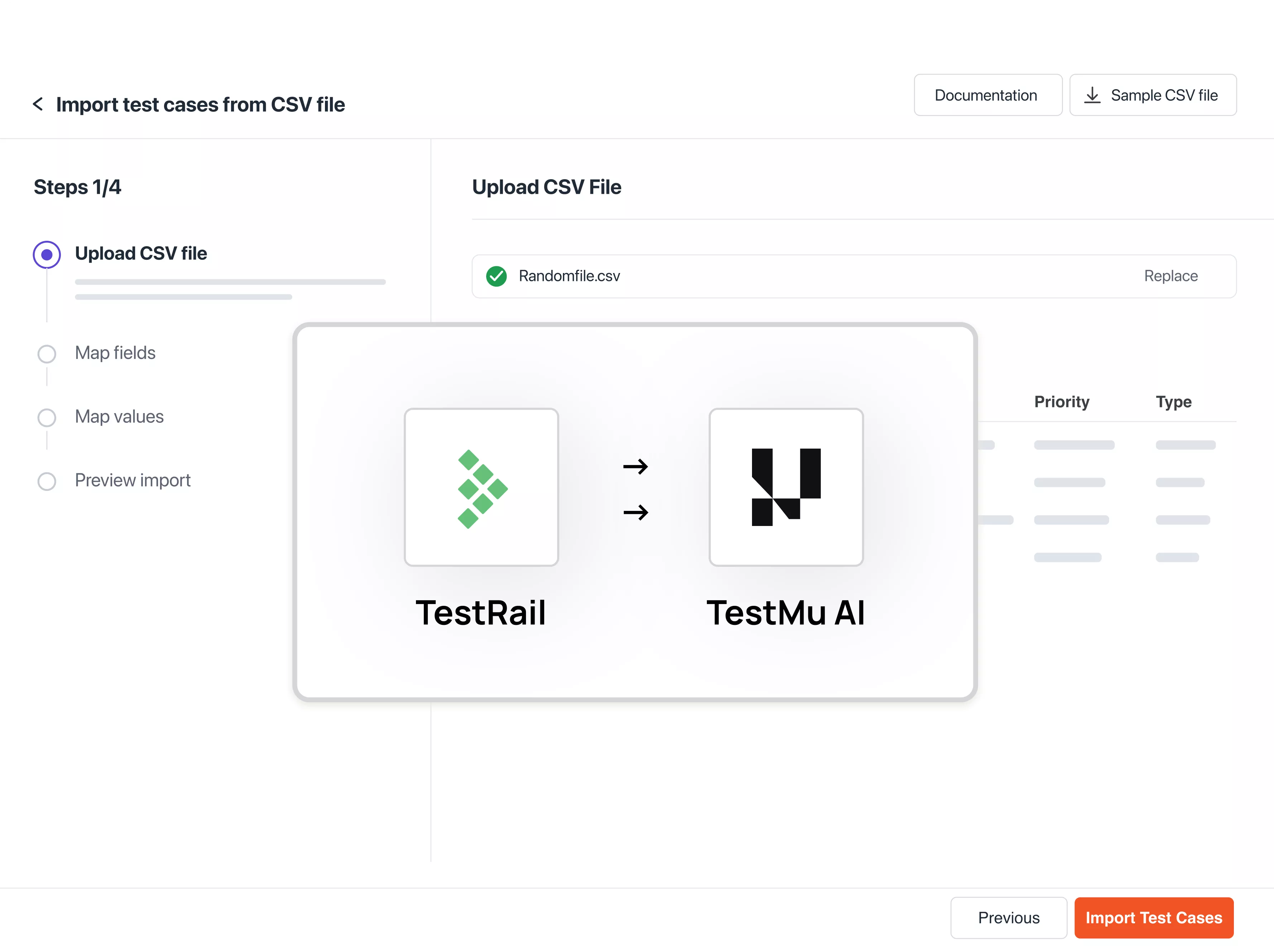
  • One-click migration from TestRail: import test cases, fields, and run history via CSV, XML, or API, with no manual re-entry
  • Re-link cases to Jira, keep your existing structure, and run your first cycle the same day, with no rebuild or migration project

Pricing: Free plan available; paid plans add AI capabilities. See TestMu AI pricing.

Best for: Teams that want AI authoring, test management, and execution in one platform instead of TestRail plus a separate grid.

Note

Note: Switching from TestRail? TestMu AI adds the AI authoring, native execution, and two-way Jira sync a standalone repository cannot. Get TestMu AI on the Atlassian Marketplace

2. Qase

Qase's top draw is the cleanest, fastest modern UI, with a free tier, native Jira defect creation, and shared steps that cut duplication across large repositories. But it is thin on enterprise governance and has no built-in execution, so larger teams outgrow it. Best for small to mid-sized QA teams that want a tidy, low-friction workspace without enterprise overhead.

3. Zephyr

Zephyr's strength is the deepest native Jira experience, with Scale and Squad running test management inside the interface developers already use. But pricing tracks Jira user tiers, there is no AI authoring, and execution runs in a separate grid. Best for Atlassian-first teams that value staying inside Jira over standalone independence.

4. Xray

Xray is the strongest Jira-native option for BDD, Gherkin, and requirements coverage, with solid automation result import. But it is in-Jira only, with no AI test generation and no native execution. Best for Jira teams with heavy BDD or automation that want management to sit alongside their issues.

5. qTest

qTest scales to large enterprises with broad ALM and automation integrations and governance built for many teams. But the cost and setup are heavy, and it still needs separate tools for AI authoring and execution. Best for big QA organizations that need enterprise breadth and can absorb the rollout.

6. Testmo

Testmo's strength is unifying scripted, exploratory, and CI automation results in one clean dashboard, with predictable team-level pricing. But it has no AI authoring, no native execution, and no free tier. Best for teams that want a single home for all three test types without per-seat costs.

7. PractiTest

PractiTest is the most flexible on process, with custom hierarchies, powerful filtering, and configurable dashboards across manual and automated testing. But pricing is per user, and there is no AI authoring or native execution. Best for teams whose workflows are unusual enough that off-the-shelf structure does not fit.

8. TestCollab

TestCollab pairs a built-in requirements module with milestone-based execution and a self-hosted option for data control. But case authoring stays manual and its ecosystem is lighter than the leaders. Best for teams whose main driver is requirements-to-defect traceability with an on-premise choice.

9. Kiwi TCMS

Kiwi TCMS is the only fully free, open-source, self-hosted option, giving you total control of data and infrastructure with no licensing cost. But you own hosting, upgrades, and backups, and there is no AI or cloud execution. Best for teams with DevOps capacity and strict data-sovereignty needs.

Why Look for a TestRail Alternative?

A TestRail alternative is usually about closing a specific gap, not replacing the whole tool for its own sake. The recurring reasons:

  • Per-user pricing scales badly. Costs climb with every tester, and read-only or contributor roles still consume a paid seat.
  • No AI authoring. TestRail has no built-in AI to turn a user story or requirement into a structured case, so authoring stays fully manual.
  • No native execution. TestRail manages tests but does not run them, so you still need a separate automation grid and reporter.
  • Split manual and automated reporting. Automated results live in CI, manual in TestRail, with no single unified coverage view.
  • One-way data flows. Some teams want richer two-way defect sync than the default integration provides.

Match the gap to the alternative: AI authoring points to TestMu AI, exploratory testing to Testmo, automation-first repositories to Testomat.io, and open-source self-hosting to Kiwi TCMS.

Best TestRail Alternative for Agile Teams

Agile teams need test management that keeps pace with the sprint: cases authored fast, cycles scoped to each sprint and build, and results visible to the whole team in real time. TestRail manages the repository well but adds friction here, authoring is manual, and there is no way to turn a user story straight into a test case.

An Agile-fit alternative should give you sprint-aligned cycles, fast or AI-assisted authoring, and two-way Jira sync so execution maps back to stories automatically. TestMu AI generates structured cases from a story in seconds, runs sprint-scoped cycles with live dashboards, and syncs both ways with Jira; Qase and Testmo are lighter picks for small Agile teams that want speed over depth.

TestRail Alternative with Built-in Test Execution

TestRail manages tests but does not run them, so teams pair it with a separate automation grid and reconcile results by hand. If that split is the reason you are looking, prioritize an alternative that executes the tests and manages them in the same place.

TestMu AI is the only option on this list that does both: it runs Selenium, Cypress, and Playwright across 10,000+ real devices and 3,000+ browser and OS combinations, then pulls those results into the same cycle as your manual tests, so coverage is one number instead of two reports.

Note

Note: TestMu AI is the all-in-one TestRail alternative: AI test generation, unified manual and automated coverage, two-way Jira sync, and execution on 10,000+ real devices. Import your TestRail cases and start free. Try TestMu AI free

How to Choose a TestRail Alternative

Match the alternative to the exact reason you are leaving TestRail:

Why You're Leaving TestRailRecommended Alternative
Want AI authoring plus execution in one platformTestMu AI
Want a cleaner, modern UI for a small teamQase
Want test management inside JiraZephyr or Xray
Enterprise scale and ALM breadthqTest
One home for scripted and exploratoryTestmo
Open-source, self-hosted, no license costKiwi TCMS

For related comparisons, see the Jira test management tools guide and the broader test case management tools roundup.

Comparing a different tool? See our guides on Zephyr alternatives, Xray alternatives, qTest alternatives, and PractiTest alternatives.

How to Migrate from TestRail to TestMu AI

Migrating from TestRail is a one-time cleanup, not a rebuild. The reliable sequence keeps your structure intact:

  • Export from TestRail to CSV or XML, or pull cases through the TestRail API.
  • Map the fields, title, steps, expected results, priority, and status, to the target schema before importing.
  • Import one module as a pilot and confirm nothing was dropped.
  • Re-link cases to their Jira stories so the traceability matrix populates.
  • Run a full cycle and compare results against your last TestRail run.
  • Decommission TestRail once a cycle runs clean, and recover the per-seat cost.

TestMu AI also supports one-click import from existing test management tools, which skips the manual export step.

Conclusion

TestRail is a capable repository, but the reason you are searching for an alternative points straight to the right replacement. If you want AI authoring, a cleaner UI, deeper Jira integration, or open-source control, the nine options above each close a specific gap.

The fastest way to choose is a one-cycle trial: import one module, connect Jira, and confirm the fit before migrating the whole suite. You can run that trial free on TestMu AI's Test Manager.

Note

Note: This article was written by Bhavya Hada with AI assistance, and reviewed and fact-checked by Abhishek Mishra, Technical Product Manager at TestMu AI, who leads the Test Manager product. Read our editorial process and AI use policy for details.

Author

...

Bhavya Hada

Blogs: 25

  • Twitter
  • Linkedin

Bhavya Hada is a Community Contributor at TestMu AI with over three years of experience in software testing and quality assurance. She has authored 20+ articles on software testing, test automation, QA, and other tech topics. She holds certifications in Automation Testing, KaneAI, Selenium, Appium, Playwright, and Cypress. At TestMu AI, Bhavya leads marketing initiatives around AI-driven test automation and develops technical content across blogs, social media, newsletters, and community forums. On LinkedIn, she is followed by 4,000+ QA engineers, testers, and tech professionals.

Open in ChatGPT Icon

Open in ChatGPT

Open in Claude Icon

Open in Claude

Open in Perplexity Icon

Open in Perplexity

Open in Grok Icon

Open in Grok

Open in Gemini AI Icon

Open in Gemini AI

Copied to Clipboard!
...

3000+ Browsers. One Platform.

See exactly how your site performs everywhere.

Try it free
...

Write Tests in Plain English with KaneAI

Create, debug, and evolve tests using natural language.

Try for free

Frequently asked questions

Did you find this page helpful?

More Related Blogs

TestMu AI forEnterprise

Get access to solutions built on Enterprise
grade security, privacy, & compliance

  • Advanced access controls
  • Advanced data retention rules
  • Advanced Local Testing
  • Premium Support options
  • Early access to beta features
  • Private Slack Channel
  • Unlimited Manual Accessibility DevTools Tests