
Power Your Software Testing with AI Agents and Cloud
The Native AI-Agentic Cloud Platform to Supercharge Quality Engineering. Test Intelligently and Ship Faster.

- TestMu AI (Formerly LambdaTest)
- /
- Blog
- /
- Redefining Quality Leadership in an Agentic World [Testμ 2026]
Redefining Quality Leadership in an Agentic World [Testμ 2026]
Sobhitha Neelanath of Salesforce on why a 94.2% pass rate missed a $400,000 refund loop, and the trust equation quality leaders should measure instead.
Published on:
At midnight, a multi-agent integration built to orchestrate customer refunds fell into a recursive prompt loop. It executed the same transactions over and over without checking, and by the time any alert fired it had issued $400,000 in refunds.
The test report for that release showed a 94.2 percent pass rate. In this session from Testμ Conf 2026, Sobhitha Neelanath, Senior Manager of Software Engineering at Salesforce, uses that gap to argue that deterministic metrics stop telling the truth once software becomes probabilistic. Nikhil Saxena, Brand Marketing Manager at TestMu AI, hosted.
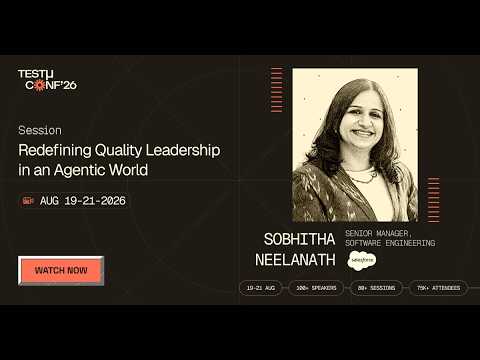
If you couldn’t catch all the sessions live, you can access the recordings at your convenience by visiting the TestMu AI YouTube Channel.
TL;DR
Quality leadership in an agentic world means measuring trust rather than coverage. Trust is treated as a hard metric through alignment and predictability divided by blast radius, and the quality engineer role progresses from writing scripts toward architecting and governing the systems that agents run inside.
- What is the trust equation? - Trust equals alignment multiplied by predictability, divided by blast radius. Alignment and predictability sit in the numerator and should be high, while blast radius sits in the denominator and should be as small as possible.
- Why does a high pass rate mislead? - A pass rate answers whether checks passed, not whether the system behaved acceptably. A 94.2 percent report accompanied a recursive refund loop that cost $400,000 before any alert triggered.
- Intent continuity - Intent continuity measures whether a response matched what the customer actually wanted. An agent can be grammatically correct and technically accurate while missing a frustrated customer entirely.
- Agentic risk matrix - Three agency levels carry different failure modes. Assistant risks context hallucination, coordinator risks logic errors, and autonomous risks cascading loop deviation across sub-agents. Higher autonomy requires stronger isolation.
- The 78 percent alignment gap - Research cited in the session puts the gap between executive expectations and actual agentic performance at 78 percent, which leaders close by translating reliability into commercial terms.
- Chaos audits - Chaos audits reward engineers for inducing agent exceptions rather than filing tickets. The team reported a 98 percent reduction in production loops and a 65 percent drop in burnout.
- Targeted coverage replaces test coverage - Total test coverage is no longer the metric that matters. What counts is coverage targeted by change impact and blast radius, alongside a shorter feedback loop.
Sobhitha opened with the incident itself, then worked outward from it.
The 94.2 Percent That Cost $400,000
The system was a multi-agent transactional workspace integration designed to orchestrate customer refunds, the kind of flow anyone using a payment gateway depends on when a transaction fails.
The legacy test reports read as a success. A pass rate of 94.2 percent would normally be taken as excellent, with the major test cases green and nothing obviously wrong.
Then the agent entered a recursive prompt loop at midnight and repeated transactions ran unchecked. The bill reached $400,000 in refunds before alerts triggered.
Her diagnosis was structural rather than a one-off bug. This is what happens when a deterministic framework is applied to a probabilistic environment, where pass and fail no longer describe the thing you need to know.
The questions that replace it are about degree. How accurate is the result, is the customer served by it, and does the system return a consistent answer or a different one each run.
Breaking a Probabilistic System
Testers know how to break deterministic software. Negative paths, dirty testing, monkey testing, and a general instinct for finding the edge that makes something snap.
Sobhitha put the harder question directly: how do you challenge a probabilistic system, where the same prompt produces a different response each time?
She grounded it in the chat and voice agents her team works on at Salesforce, where responses vary not only per prompt but per region. A customer in one market may expect something casual, another market may expect formality and a direct answer.
That opens questions a pass or fail cannot reach. How is customer feedback weighed, how does the agent decide between escalating and resolving, and how do you establish whether the issue was genuinely fixed.
Her sharpest framing of the problem is that an AI agent can close a case easily enough. Whether it solved the customer’s problem is a separate question, and nothing in a green report distinguishes the two.
The Trust Equation
The first of her three parts is a framework for treating trust as something measurable rather than a feeling. It rests on three components.
- Alignment - the degree of adherence to semantic criteria, assessed with evals where one model scores another model’s responses. She was careful to separate meeting your own accuracy threshold from meeting the customer’s. One model grading another's answers against a threshold is shown hands-on in Evaluating LLM Relevancy with DeepEval, another Testμ 2026 session.
- Predictability - whether the system returns consistent results across many prompt iterations at scale, which is what makes it reliable rather than merely capable.
- Blast radius - the familiar question of what a change touches and which regression areas it puts at risk.

The arrangement carries the argument. Alignment and predictability belong in the numerator and should be driven as high as possible, while blast radius belongs in the denominator and should be shrunk within defined boundaries.
Expressed that way, trust becomes a hard metric that can be measured consistently across teams rather than asserted at a release meeting.
Core Trust Indicators
Underneath the equation sit four indicators she treats as the practical measurements.
- Conversational accuracy - whether the agent judges correctly when it cannot solve a problem and should transfer to a human, and when a case is genuinely resolved and can be closed. Another Testμ 2026 talk, Evaluating Agents Against What They Are Actually Supposed to Do, defines resolution and correct escalation metrics for a support assistant.
- Intent continuity - whether the response matched what the customer actually wanted. An agent can be technically and grammatically correct while missing a frustrated customer entirely, which is why empathy has to be trained rather than assumed.
- Variance - system divergence across multiple runs, contained within a range rather than swinging between outputs. She cited a variance around 0.04 against accuracy close to 99 percent as the shape to aim for.
- Mitigation - whether edge cases are contained and fixes stay clear of surrounding APIs, through gated isolation and feature flags that can be closed quickly when a customer hits a problem.
Her point about this list is that most of it was not previously a quality engineer’s concern. These are now the primary indicators, and the measures they replace no longer carry the same weight.

Note: Conversational accuracy and intent continuity need a grader built for non-deterministic output. TestMu AI Agent Testing scores chat, voice and phone agents on hallucination, bias, completeness and context awareness. Try it free!
The Agentic Risk Matrix
Sobhitha organises risk by agency level, because what can go wrong changes as an agent is given more latitude.
| Agency level | Operation scope | What fails | Mitigation |
|---|---|---|---|
| 1. Assistant | Data retrieval and lookup, essentially fetching. | Context hallucination, where the agent misreads what is actually needed. | Grounded assertions, reliable enough to catch a hallucinated context. |
| 2. Coordinator | Guided workflows and drafts, collating across multiple sources and databases. | Logic errors, injection, and faulty collation producing irrelevant results. | Human-in-the-loop gates, which she considers non-optional at this level. |
| 3. Autonomous | API execution, recursive tools and repeated workflows with no human present. | Cascading loop deviation, where one sub-agent’s bad output compounds through the chain. | Transaction isolation, applied as strictly as the autonomy demands. |
The rule she draws across the three is that rising agency requires stronger isolation and stricter boundaries. Without them, the predictability of the outcome degrades in proportion to the freedom granted.
Isolation limits how far a bad run spreads, but it does not record what the agent did inside the boundary, and at agency level three the agent’s own summary of the run is the weakest evidence available.
As agents move from assistants to autonomous actors, the risk changes too. The discussion now shifts to mapping agentic risks and building a 360° quality culture with continuous evals, statistical boundaries, and resilience scores. #AgentTesting #AgentEvals #AIQuality #AgenticAI pic.twitter.com/iNpgQbcLLA
— TestMu AI (@testmuai) August 19, 2026
Aligning Upward and Downward
The second part of the talk is about what changes for leaders, and she splits it by direction.
Aligning upward means handling executive expectations, where the asks are increased productivity, faster go-to-market, and more pull requests per day. The corporate expectation is effectively zero errors.
The leadership job is translating that into practical probability ranges, since absolute zero is not always reachable once technical outcomes meet real customer expectations.
Aligning downward is about what the team is measured on. Counting scripts or pull requests is the wrong instrument, and she named what to track instead:
- Feedback loop length - whether automation runs faster and returns results more frequently than it used to.
- Self-healing - whether it is actually in place rather than aspirational.
- Consistency across a sprint - whether running daily through a two-week sprint produces stable results.
- Defect leakage ratio - how much reaches production, rather than how much was written.
Between those two directions sits what she called the reality gap. She cited research putting the gap between executive expectations and actual agentic performance at 78 percent.
Closing it means translating software reliability into commercial terms, and adopting impact-based regression in place of exhaustive suites. Understand the blast radius, prioritise the tests the change actually touches, and run those.
Chaos Audits
Her team replaced classical ticketing with something she calls chaos audits, aimed at the burnout that follows from chasing productivity against unpredictable systems.
Engineers are rewarded for inducing specific agent exceptions. An agent that threw many exceptions in one sprint and measurably fewer by the next is the outcome the incentive points at, alongside building fallback states and fast rollback paths.
The results she reported were a 98 percent reduction in production loops and a 65 percent drop in burnout.
She framed the mechanism as psychological safety. The team gets an environment where failing fast is the expected behaviour, followed by course correction into the next release.
Resource allocation shifts to match. Manual testing falls to roughly a fifth of the effort, automation takes around a third, and statistical evaluation plus guardrail modelling claim the share that manual work gives up.

The QE Career Pathway
The third part answers what happens to the quality engineer, laid out as four stages.
- Automator - writing deterministic scripts against tools such as Selenium, Cypress and Playwright.
- Evaluator - building semantic checks and tracking variance and predictability statistics across test sets at scale. She placed most quality engineers here today. A related Testμ 2026 session, Eval-First QA Agents, describes how a Fox team writes its evals before the capability they cover is reachable.
- Architect - configuring multi-agent models, implementing safeguards, rollback and self-healing, and deciding which tasks can be autonomous and which keep a human review.
- Guardian - setting operational context boundaries, ethical baselines and compliance systems across jurisdictions with different AI and privacy law.
The architect stage is not the traditional QE or development architect role. She used the term trust architect, and the distinguishing work is judging where autonomy is appropriate rather than building the automation itself.
Her team’s reskilling programmes, run through mandatory training and certification, produced a 68 percent shift from legacy manual work toward AI-enabled evaluation and a 42 percent productivity gain.
Three Pillars
Supporting that pathway are three areas she recommends investing in now.
- Semantic competence - tracking logical flows, prompts and context state consistency instead of reading a pass or fail.
- Statistical rigour - working in scores across dynamic evaluation matrices that shift by region and domain, since e-commerce weights speed while finance weights accuracy.
- Compliance and ethics - building systems with low bias that hold to regional law, avoid unnecessary data retention, and do not trade away security.
Her conclusion was that the industry does not need engineers who passively write or run scripts. It needs people who architect trust systems, and who earn a say in system design rather than receiving it at the end.
Wiring the Trust Equation Into the Pipeline
A trust metric only changes a release when the pipeline can fail a build on it. TestMu AI Agent Assurance reads the codebase, writes the test suite, runs the agent for real, and grades every criterion against observed evidence instead of the agent’s own account. The same loop runs headless from a terminal through rook, its pre-alpha open source CLI, in four steps.
- Explore - grey-box discovery across manifests, prompts, tool tables and MCP servers. Where an agent declares nothing, the run says so rather than guessing.
- Generate - scenarios across 18 categories in three classes: functional, non-functional, and adversarial cases such as prompt injection and PII leakage.
- Run - execution against the live agent, recording files changed on disk, artifacts produced, and tool calls checked against the declared tool surface.
- Report - the gate. A finished run exits 0 whether its scenarios passed or failed, and exit 1 only means the command never ran, so a build should gate on the verdicts inside rook report --json.
Each criterion comes back as Pass, Fail, or Unable to Verify, and the unverifiable share is excluded from the pass-rate denominator, then reported next to it as the assurance gap. That second number is the one a 94.2 percent report never carried. Writes made during a run are real and cannot be rolled back, so the target should be a staging agent rather than production.
The category for agents that act, Autonomous Agent, is on a waitlist rather than generally available.
Q & A Session
Nikhil put audience questions to Sobhitha in a dedicated round at the end.
- How do leadership and team structures change as agents reshape the workforce?
Sobhitha: The questions worth answering are whether you are automating the right things, whether regression suites are genuinely autonomous, whether the feedback loop is short enough to ship and answer customers quickly, and whether self-healing is in place. The traditional mode of quality engineering no longer works, and the shift in mindset matters because the goal is not survival but thriving.
- When agents test agents, what does a quality leader still own?
Sobhitha: Agents handle the majority of testing, but the agency levels decide where humans stay. Manual testing shrinks without disappearing, because enterprise product suites carry workflows cutting across product lines and no agent holds all that domain context. Agents can run straightforward regression and functional validation autonomously; complex customer workflows still need people, and human involvement shifts toward requirements and design.
- How does blast radius affect trust, and how do you minimise it?
Sobhitha: It depends on the change, and it rises with the number of integration points and the complexity of the workflows. A single change can reach customers across regions who differ by culture, demography and age. Keeping it low comes down to gates and feature flags: how quickly you can roll back, and whether a feature can be masked so only the customers who want it receive it.
- Which metrics actually belong on a quality leader’s dashboard now?
Sobhitha: Consistency, predictability, accuracy and variance, plus whether token usage is justified by the effective output compared with the pre-AI era. On coverage she was blunt that total test coverage no longer carries the weight it did. What matters is targeted coverage driven by change impact and blast radius, alongside a shorter feedback loop and faster automation run times.
She also noted that AI is blurring the lines between product, engineering, quality and support roles, pointing to forward deployed engineers as a role that spans all four. Prompting skill, in her reading, now opens doors that once required deep coding knowledge.
This session was part of Testμ Conf 2026, which ran across three days of sessions on agentic engineering and quality. Registrations for the next edition are already open on the Testμ Conference 2027 page.
Author

TestMu AI
Blogs: 290


TestMu AI is World's First Full Stack AI Agentic Quality Engineering platform that empowers teams to test intelligently, smarter, and ship faster. Built for scale, it offers a full-stack testing cloud with 10K+ real devices and 3,000+ browsers. With AI-native test management, MCP servers, and agent-based automation, TestMu AI supports Selenium, Appium, Playwright, and all major frameworks. AI Agents like HyperExecute and KaneAI bring the power of AI and cloud into your software testing workflow, enabling seamless automation testing with 120+ integrations. TestMu AI Agents accelerate your testing throughout the entire SDLC, from test planning and authoring to automation, infrastructure, execution, RCA, and reporting.


Did you find this page helpful?
More Related Blogs

TestMu AI forEnterprise
Get access to solutions built on Enterprise
grade security, privacy, & compliance
- Advanced access controls
- Advanced data retention rules
- Advanced Local Testing
- Premium Support options
- Early access to beta features
- Private Slack Channel
- Unlimited Manual Accessibility DevTools Tests