
Power Your Software Testing with AI Agents and Cloud
The Native AI-Agentic Cloud Platform to Supercharge Quality Engineering. Test Intelligently and Ship Faster.


- TestMu AI (Formerly LambdaTest)
- /
- Blog
- /
- Open Source Device Farm Explained: Definition, Benefits, Tools
Open Source Device Farm Explained: Definition, Benefits, Tools
Learn what an open source device farm is, how it enables automated parallel testing, key frameworks involved, and top benefits versus managed solutions.
Last Updated on:
On This Page
- Defining an open source device farm
- Core technologies behind open source device farms
- Advantages of using an open source device farm
- Challenges and trade-offs of self-hosted device farms
- Emerging trends shaping open source device farms
- Best practices for building and maintaining an open source device farm
An open source device farm is a self-hosted or community-driven platform that enables teams to remotely access and centrally manage real or emulated devices for automated testing. Instead of relying on proprietary clouds, it employs openly licensed software to scale parallel tests across a device matrix, covering various models, OS versions, and browsers, while maintaining control over data and infrastructure. In practical terms, it allows you to run fast, concurrent checks on the same build across many devices without shipping hardware around or blocking other testers.
Compared to commercial services, the trade-off is autonomy and customization for operational responsibility. This concept mirrors how a managed device cloud works but shifts ownership and privacy to your team, as outlined in the comprehensive Tricentis device farm guide.
Defining an open source device farm
At its core, an open source device farm is a testing infrastructure you own and operate, built with community-developed components. It provides remote access to real devices, emulators, and simulators, schedules and routes tests, and records results across a defined device matrix. That matrix is the living inventory of hardware models, OS versions, and browsers that reflect your users’ environment.
The difference from commercial device clouds lies in autonomy and economics. You avoid vendor lock-in, gain data locality, and can tailor the system to your workflows and security posture. For teams that prefer a managed option alongside internal labs, the TestMu AI online device farm offers a complementary, scalable real device cloud.
Core technologies behind open source device farms
Most farms share a common stack: a physical device pool, an orchestration layer for scheduling and queuing, automation adapters, and CI/CD integrations. Popular frameworks include Appium for cross-platform mobile, Selenium Grid for cross-browser automation, and Playwright for modern browser and mobile emulation. Many teams also run Espresso and XCUITest for native, on-device checks.
A typical stack at a glance:
| Layer | Role | Common open source options |
|---|---|---|
| Device pool & access | USB hubs, power control, remote streaming | VNC/WebRTC-based streaming, ADB/Xcode tooling |
| Orchestration | Reservation, queuing, routing, concurrency limits | Custom schedulers, Kubernetes jobs, message queues |
| Automation adapters | Execute tests on devices/emulators | Appium, Selenium Grid, Playwright, Espresso, XCUITest |
| CI/CD integration | Trigger, gate, and report tests | Jenkins, GitLab CI, GitHub Actions |
Teams typically integrate the farm into pipelines so every commit runs targeted suites and publishes artifacts. For a broader overview of how farms are assembled and used, see this concise guide to device farms from GetPanto. If you’re starting with mobile automation, our Appium with TestNG tutorial walks through setup patterns that translate well to farm environments.
Advantages of using an open source device farm
- Total cost of ownership: You eliminate recurring licensing fees and can align spending with actual hardware and infrastructure usage, an appealing model for privacy-sensitive or regulated organizations highlighted by The New Stack’s build-vs-buy analysis.
- Control and security: You retain data on your network, audit every component, and determine how logs, videos, and builds are retained. Centralized access also enhances governance, a benefit echoed in Qyrus’s overview of device farm value.
- Deep integration: With control over the stack, you can implement bespoke workflows, observability, and risk analytics that are challenging to achieve in closed systems.
- Flexibility and future-proofing: You can swap frameworks, upgrade OS images, or support new form factors on your schedule, without waiting on a vendor roadmap.
- Community momentum: Open ecosystems move quickly; fixes and features land promptly, and you can contribute improvements back.
For perspective on managed alternatives and hybrid setups, see our primer on real device cloud testing.
Challenges and trade-offs of self-hosted device farms
Running the farm entails owning procurement, inventory, OS upgrades, flakiness triage, and uptime. USB hubs fail, batteries swell, and new OS releases can disrupt stable pipelines. RobotQA’s survey of mobile device farm management identifies reliability, network tuning, and physical security as common pain points.
Two significant trade-offs stand out:
- “Free isn’t free”: While licenses may be low-cost or free, teams often encounter hidden expenses in engineering time, integration complexity, and ongoing maintenance, as detailed in mabl’s analysis of open source economics.
- Control vs. operational risk: Greater autonomy brings on-call responsibilities. Without disciplined SRE practices, a farm can become a bottleneck instead of a force multiplier.
Expect to consider device fragmentation (new models, foldables, wearables), Wi‑Fi and USB stability, and a sustainable lifecycle plan for hardware rotation and OS patching.
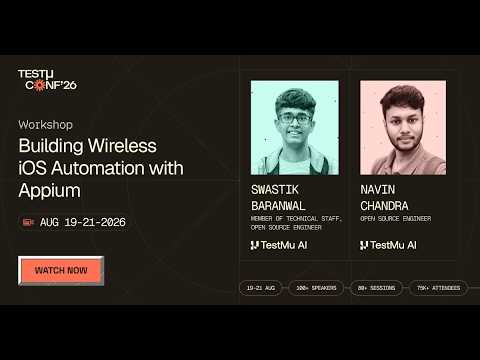
Swastik Baranwal and Navin Chandra walk through these same lab-scale pain points, cable management, unstable USB connections, limited observability, and host constraints, in the TestMu Conf 2026 workshop Engineering RemoteXPC: Building Wireless iOS Automation with Appium.
Emerging trends shaping open source device farms
- Generative AI and agentic testing: Self-healing locators, test generation from specs, and autonomous agents are reducing maintenance toil and surfacing risk-based priorities earlier in the cycle.
- Deeper framework alignment: Tighter integrations with Appium, Espresso, and XCUITest streamline capabilities (biometrics, geolocation, camera), while Playwright continues to expand reliable mobile emulation.
- Modular architectures for fragmentation: Pluggable device drivers and per-capability schedulers assist teams in accommodating new OSs, foldables, and wearables without overhauling the farm.
- CI/CD-first design: Farms are increasingly seen as pipeline-native resources, with ephemeral environments, environment-as-code, and policy gates.
- Edge and 5G scenarios: Low-latency networks enable real-time testing for streaming, gaming, and geodistributed experiences.
Best practices for building and maintaining an open source device farm
- Define your device matrix based on real user analytics. Prioritize hardware/OS combinations that each cover at least 5% of active users, then expand to long-tail segments.
- Start small and iterate. Establish a minimum viable farm, validate critical smoke and checkout flows, and only then scale hardware and concurrency.
- Choose modular, well-documented components. Opt for projects with active communities and clear upgrade paths to minimize integration debt.
- Automate updates and health checks. Script OS patches, app installations, battery checks, and reboots; enforce golden images and automatic device quarantine upon failure.
- Integrate early with CI/CD. Gate merges based on targeted suites, shard tests for parallelism, and publish artifacts for rapid triage.
- Instrument for insights. Capture device logs, network traces, and video; route telemetry into your observability stack to differentiate flaky tests from flaky devices.
If you later decide to complement your lab with burst capacity, a managed real device cloud like TestMu AI can offload peak demand while keeping critical tests in-house.
Author

Bhawana
Blogs: 75


Bhawana is a Community Evangelist at TestMu AI with over 3 years of experience creating technically accurate, strategy-driven content in software testing. She has authored 50+ blogs on test automation, cross-browser testing, mobile testing, and real device testing. She also serves as Product Marketing Manager for Kane CLI, the command-line tool that runs browser automation from the terminal using natural-language flows in a real Chrome browser. Bhawana is certified in KaneAI, Selenium, Appium, Playwright, and Cypress, reflecting her hands-on knowledge of modern automation practices. On LinkedIn, she is followed by 6000+ QA engineers, testers, AI automation testers, and tech leaders.


Frequently asked questions
Did you find this page helpful?
More Related Blogs
TestMu AI forEnterprise
Get access to solutions built on Enterprise
grade security, privacy, & compliance
- Advanced access controls
- Advanced data retention rules
- Advanced Local Testing
- Premium Support options
- Early access to beta features
- Private Slack Channel
- Unlimited Manual Accessibility DevTools Tests