

Next-Gen App & Browser Testing Cloud
Trusted by 2 Mn+ QAs & Devs to accelerate their release cycles


On This Page
- What is Monolithic Architecture?
- Characteristics Of Monolithic Architecture
- Advantages of Monolithic Architecture
- Disadvantages of Monolithic Architecture
- What is Microservices Architecture?
- Characteristics Of Microservices Architecture
- Advantages of Microservices Architecture
- Disadvantages of Microservices Architecture
- Monolithic vs Microservices: Key Differences
- Monolithic vs Microservices Architecture: Which One To Choose?
- Tips to Migrate from Monolithic to Microservices Architecture
- Conclusion

Monolithic vs Microservices Architecture: Advantages, Disadvantages, And Differences
Explore the key differences between Monolithic and Microservices Architecture to make informed decisions for business and optimize efficiency.

Akash Nagpal
December 22, 2025
While building a new software product, developers often need help with an initial dilemma: “Whether to start with a monolithic approach or embrace microservices?” While both approaches promise robust applications catering to diverse needs, the choice here isn’t just about how the code is structured; it’s a strategic move that can impact a software’s scalability, efficiency, and adaptability. Take, for example, the tech titan Uber, whose migration from a monolithic structure to a microservices architecture showcased such a transition’s immense potential and benefits.
In 2011, Uber, with UberBLACK as its sole product in San Francisco, ran on a monolithic architecture. As Uber’s services expanded globally, they started facing integration and scalability challenges in their codebase. By 2015, these complexities prompted Uber to follow tech giants like Amazon, Netflix, SoundCloud, and Twitter, transitioning from Monolithic to Microservices Architecture.
This migration involved creating over 500 distinct services, incorporating Apache Thrift IDL, crafting stable service libraries, and implementing numerous other modifications.
We will look at what Monolithic and Microservices Architecture are in detail, along with the advantages, disadvantages, and key differences.
What is Monolithic Architecture?
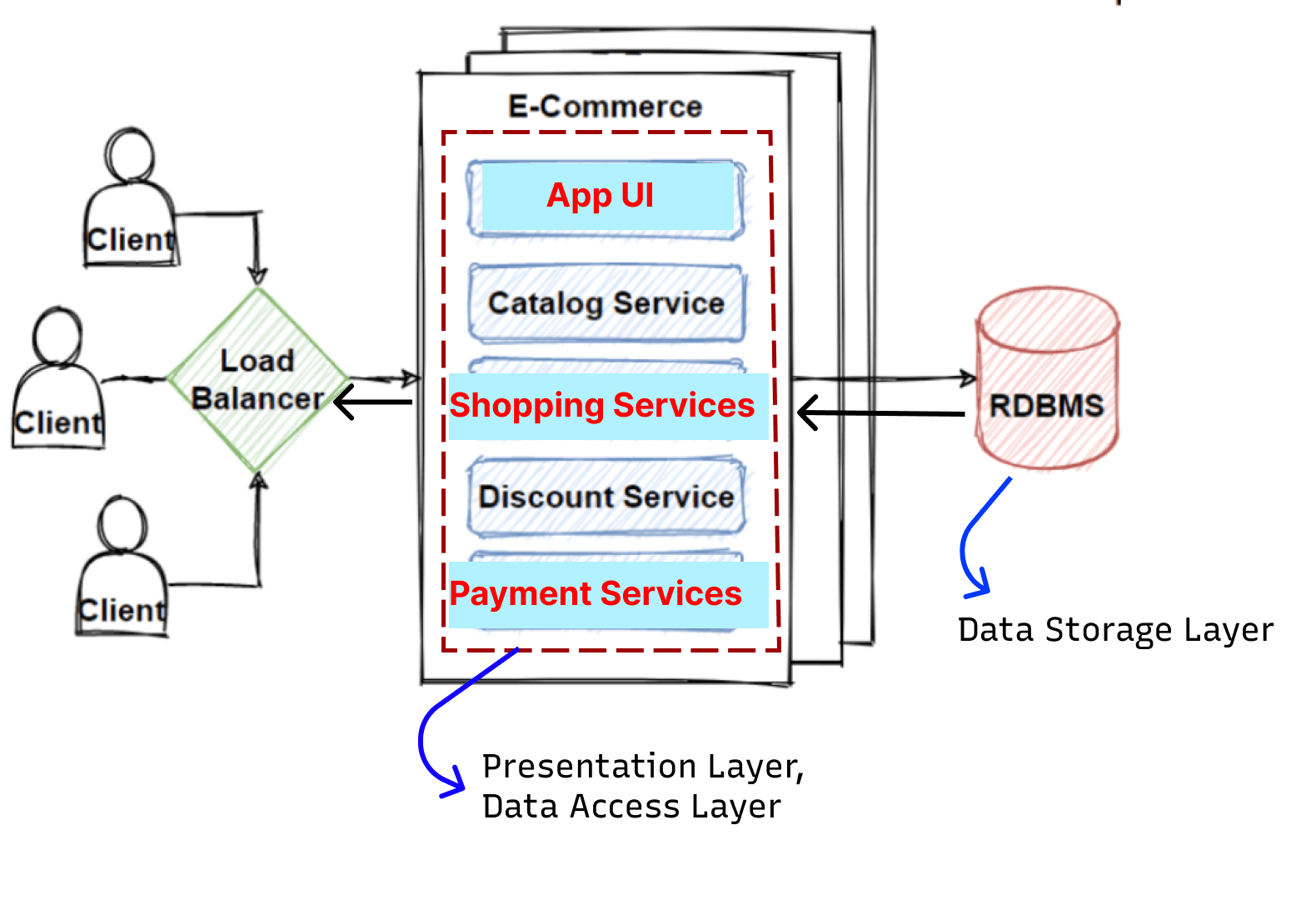
Monolithic architecture is a conventional approach to building software where an application is developed as one complete and self-contained entity. It gathers all parts and features of the application in one coding hub, creating a closely connected and centralized system.
A Monolithic application operates as a single unit, where all the components are tightly integrated and interdependent, which helps the software to be self-contained. The components include:
- User interface (Presentation Layer): The UI is the front-end component of the code that presents the application to the user and allows interaction with the app.
- Data access layer (Business Logic Layer): The data access layer communicates with the database or any other data storage mechanism to read, write, update, and delete (CRUD Operations) data.
- Datastore (Data Storage Layer): The Datastore(database) is where all the application’s data is stored and managed.
Characteristics Of Monolithic Architecture
Let us understand various characteristics of Monolithic Architecture:
- Single Unit of Deployment: The entire application is deployed as a single, indivisible unit. Any upgrades, improvements, or modifications require the deployment of the complete application, including all of its components.
- Centralized Flow of Control: A central module or primary function oversees the control flow within the application, orchestrating the sequential execution progression from one component to the next.
- Tight Coupling: The components and modules within the application are highly interconnected and dependent on each other.
- Shared Memory: All the software components have direct access to the memory resources, promoting close integration. However, this setup can also result in resource conflicts and difficulty scaling the application.
- Single Technology Stack: The whole application uses a single technology stack, which means it uses the same programming language, frameworks, libraries, and databases throughout. This is because all components are part of a unified codebase.
Advantages of Monolithic Architecture
Monolithic architecture offers several advantages that have contributed to its widespread use. Here are the key benefits of monolithic architecture:
- Robust Development: In small to mid-sized applications, building an app with monolithic architecture is easier and faster. The development team can work more effectively with a uniform codebase without setting up and managing communication between services.
- Easy Deployment: Deployment of a monolithic architecture involves deploying a single unit, which is less complex and requires fewer configurational directories than distributed systems.
- Simplified Testing and Debugging: It is easier to test a monolithic app. Due to the tight integration of all components, unit testing and integration testing can be conducted within the single codebase, simplifying the testing process.
- Versatile Scalability: Monolithic architecture provides adequate scalability by replicating the whole application for small to medium-sized applications.
- Reduced Overhead: In a monolithic architecture, all source code resides in a unified deployment unit, reducing overhead significantly. This consolidation minimizes network communication, serialization, and data validation tasks, leading to quicker application response times.
Disadvantages of Monolithic Architecture
While monolithic architecture stood conventional in software development, it’s essential to recognize its disadvantages, driving the rise of alternatives like microservices. Here are the key disadvantages:
- Large Codebase: Over time, as the application grows in size and complexity, more features are developed, and thus, the codebase becomes bulky.
- Limited Scaling: Scaling a monolithic application involves replicating the entire application, even if only specific components need updation.
- Technology Constraint: Incorporating new technology may require rebuilding the whole application, which is costly and time-consuming.
- Longer Development Timelines: Developers encounter difficulties when working on different components simultaneously, as changes in one part of the application may impact others, potentially resulting in longer development timelines.
- Testing Complexity: End-to-end testing for the whole app must verify that changes in one small application component do not disrupt other components.

What is Microservices Architecture?
Microservice architecture is a software architectural approach in which a large application is developed as a collection of small, separate services that communicate with one another via APIs and message brokers.
The architectural framework is built on the concept that each service should perform a specified task and have a well-defined interface that allows it to interact with other services in the application. These services operate with unique business logic and dedicated databases, serving a particular objective. Each service undergoes update cycles, testing strategies, deployment, and scaling.
Microservices architecture follows the fundamental software development principle of “Divide and Conquer” to solve a complex problem and improve the efficiency of a product. This principle aims to divide a larger problem into smaller problems and then conquer the results to solve the entire problem.
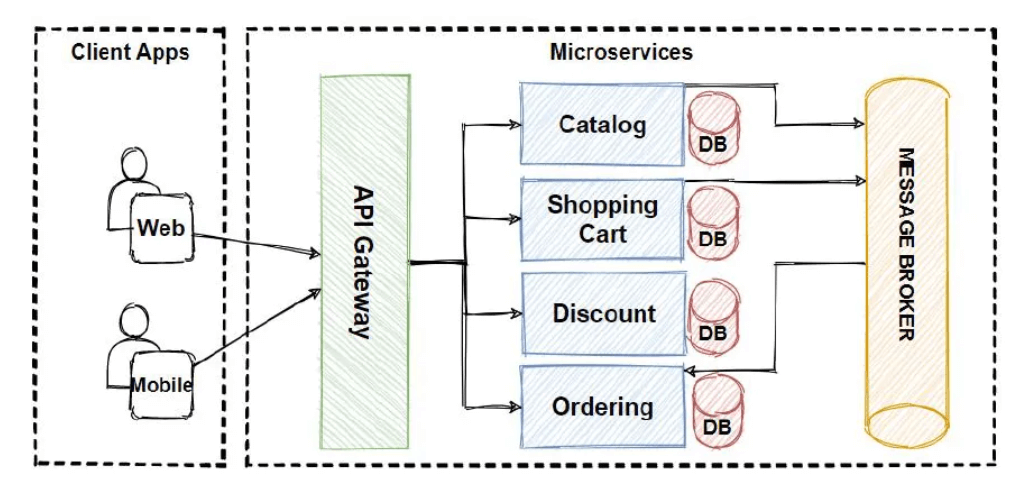
Microservices communicate with each other by exchanging data, and message brokers play a crucial role in seamlessly connecting these services. In technical terms, a message broker is a middleware component that facilitates communication between microservices while providing security, automated management, and high performance. Finally, an API gateway displays the generated response on the client’s apps.
Consider checking out the microservices tutorial to gain a complete understanding of microservices.
Characteristics Of Microservices Architecture
Let us understand various characteristics of Microservices Architecture:
- Modularity: Services are modular, allowing for easier development, maintenance, and scalability, as each service controls a specific function or feature.
- Robustness: Microservices increase the overall robustness of the system as errors in one service do not affect the entire application, ensuring fault tolerance and system reliability.
- Interoperability: Different Microservices communicate through well-defined APIs, ensuring seamless service integration and interaction.
- Parallel Development: Separate development teams can work on different microservices simultaneously, making development and features faster.
- Adaptability to Flexible Technologies: Different microservices can be built using various technologies, allowing for the use of the most effective tools for each allocated function/feature.
Advantages of Microservices Architecture
Let’s explore the key advantages of adopting a microservices-based approach for app development:
- Scalability: Microservices allow for independent scaling of different services based on their demand, optimizing resource usage and ensuring efficient performance even during traffic spikes.
- Continuous Development and Deployment: Microservices enable parallel development by different teams, leading to faster feature development and quicker deployment.
- Flexibility and Technology Heterogeneity: Each microservice can be developed using the most suitable technology stack for its specific function, promoting flexibility and adaptability to diverse technologies within the same application.
- Enhanced Debugging and Maintenance: Teams can test new features and roll back the service if needed, streamlining updates and speeding up the release of new functionalities. Additionally, pinpointing and resolving faults and errors in individual services is straightforward.
- Enhanced Security: Microservices facilitate data separation. Each service has its database, making it difficult for hackers to attempt to breach the application.
Disadvantages of Microservices Architecture
While microservices architecture offers many benefits, it has some disadvantages regarding software development. Understanding these limitations is crucial for making informed decisions when adopting this architectural approach:
- Development and Deployment Challenges: The need for clear communication rules between the different services leads to a heavier workload in the early stages of development. This requires strong coordination between different teams. In addition, managing the deployment of multiple services and coordinating their releases can be complex, adding to the overall challenges of this architecture.
- Challenges in Inter-Service Communication: Microservices use communication protocols like HTTP or message brokers for inter-service communication. Implementing and maintaining a reliable and efficient communication infrastructure for multiple services can be challenging and sometimes lead to problems like network latency, service discovery, message formats, and handling different failure scenarios.
- Increased Operational Overhead: Deploying and maintaining more services might be more complicated since it requires handling multiple deployment units, scaling services independently, and coordinating service dependencies.
- Distributed Debugging and Tracing: Since services are built and deployed independently, integration testing is critical to ensure that all perform properly together. Therefore, due to the growing number of services, creating complete testing environments and assuring end-to-end testing might be challenging.
Find out everything about Microservices Testing and ensure the smooth operation of your next application.
Monolithic vs Microservices: Key Differences
Let us have a side-by-side comparison between Monolithic and Microservices architecture:
| Attributes | Monolithic Architecture | Microservices Architecture |
|---|---|---|
| Code Structure | Single large codebase | Multiple smaller services |
| Deployment | All components deployed together | Individual service deployment |
| Scaling | The whole application needs to be scaled | Individual services can be scaled |
| Development | Sequential and centralized | Parallel and decentralized |
| Memory Management | Memory allocated to the whole app | Efficient memory usage per service |
| Flexibility and Technology Stack | Limited technology stack and updates | Mixed technology stack and updates |
| Error Isolation | An error affects the entire application | Errors isolated to specific services |
| Testing | Comprehensive and time-consuming | Focused testing on specific services. |
| Testing and Debugging tools | Common testing tools for Monolithic applications are JUnit, Selenium, Cypress, TestNG, etc. | Sometimes, microservices testing is time-consuming due to integration testing. |
| Maintenance | Complex and time-consuming updates | Common testing tools for Microservices applications are JUnit, TestNG, Cucumber, RestAssured, etc. |
| Examples | Trello, IMDb, etc | Easier and quicker updates because of individual services. |

Note: Automate your tests using Selenium Cloud Grid and test over 3000+ of browsers, and operating system combinations. Try TestMu AI Today!
Monolithic vs Microservices Architecture: Which One To Choose?
Distinctive business needs and goals of your project influence the decision between monolithic and microservices architecture. Let’s have a look at these factors:
| Aspect | Monolithic Architecture | Microservices Architecture |
|---|---|---|
| Development Team | Smaller, closely-knit development team | Larger teams or multiple distributed teams |
| Technology Stack | Works on projects with a single technology stack | Allows different teams to work on different services with different technology stacks |
| Scalability | Rapid scalability isn't a critical concern | Rapid scalability is required due to frequent updates in the software codebase |
| Project Size and Complexity | Small to medium-sized projects with simpler functionalities | Large, complex projects with multiple functionalities and features |
| Testing and Debugging | Lean towards simpler and integrated methods for testing and debugging | More focused and isolated testing and debugging for individual services |
| Deployment and Maintenance | Prefer straightforward deployment and easy maintenance | Want the flexibility of deploying and maintaining individual services independently |
Tips to Migrate from Monolithic to Microservices Architecture
Migrating from a monolithic to a microservices architecture requires thorough research, careful planning, and execution. Here are some tips to facilitate a smooth transition:
Strategic Planning:
- Analyze the existing monolithic application, its elements, and interconnections.
- Identify features suitable for separation and migration to microservices.
Systematic Migration:
- Start with less critical components for the initial migration.
- Incrementally decompose the monolithic into microservices, one functionality at a time.
API Design and Data Management:
- Define clear API standards and communication protocols for seamless service interaction.
- Establish a logical strategy for data management and consistency across microservices.
Ensure your APIs function seamlessly with effective API Testing strategies.
Testing, Monitoring, and Automation:
- Create a comprehensive strategy for testing, including checking components and combining them using TestMu AI’s automation testing.
- Implement effective monitoring and automated deployment processes.
Improving Scalability:
- Ensure scalability and load-balancing mechanisms for varying loads on microservices.
Handling Operational Changes and Enhancements:
- Offer sufficient training and strategies to manage changes for the team.
- Regularly check, improve, and make the microservices structure more effective.
Conclusion
The choice between Monolithic and Microservices is a key crossroads in the changing world of software development. The Monolithic approach provides a unified, simpler structure that simplifies development and deployment.
However, as the project grows, it might become less adaptable and difficult to scale efficiently. On the other hand, Microservices provide a modular, flexible structure that allows for autonomous scalability and speedier deployment of certain functionalities. Still, this strategy requires strict planning along with effective inter-service communication management.
As you embark on your software project, equipped with a deep understanding of the characteristics, benefits, and limitations of both Monolithic and Microservices Architecture through this blog, weigh these pros and cons carefully. A well-suited architecture is the bedrock of a successful project; choose wisely and let your software thrive.


Frequently asked questions
Did you find this page helpful?
More Related Hubs
TestMu AI forEnterprise
Get access to solutions built on Enterprise
grade security, privacy, & compliance
- Advanced access controls
- Advanced data retention rules
- Advanced Local Testing
- Premium Support options
- Early access to beta features
- Private Slack Channel
- Unlimited Manual Accessibility DevTools Tests