

Power Your Software Testing with AI Agents and Cloud
The Native AI-Agentic Cloud Platform to Supercharge Quality Engineering. Test Intelligently and Ship Faster.


- TestMu AI (Formerly LambdaTest)
- /
- Blog
- /
- AI Agents for QA: What Changes for You
Engineering teams are moving past AI hype and figuring out how to integrate AI agents into the QA lifecycle in practical, repeatable ways. The role of the QA engineer is not disappearing, it is moving up the stack.
The State of the Art: Real AI Integrations in QA
Practitioners are standardizing on repeatable patterns: using agents to draft detailed test cases from user specs, leveraging models to triage complex failure logs, and configuring self-correcting regression steps in CI. The architectural warning is to keep clear, human-driven guardrails around tasks that need deep conceptual judgment.
Unmasking the False Confidence Trap of Self-Healing Tests
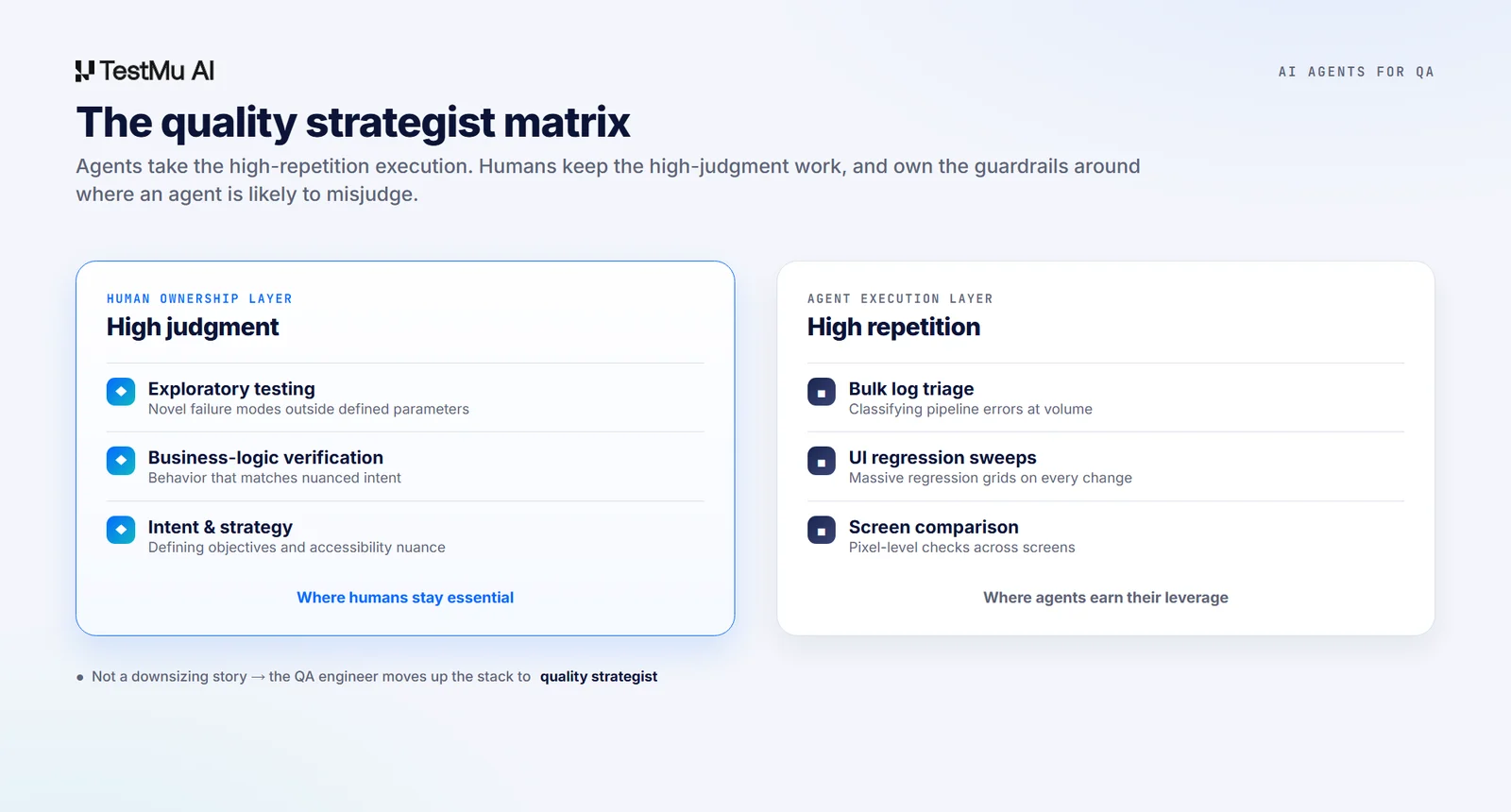
AI agents excel at high-volume, pattern-based tasks: large regression grids, pixel-level screen comparisons, and classifying bulk pipeline errors. But full reliance introduces a systemic risk.
Traditional automation scripts are fragile: a small selector change breaks the script and needs maintenance. Many tools solve this with self-healing, where the model updates the testing criteria on the fly to keep the run green.

Note: The False Confidence Trap: a self-healing run can mask a genuine product defect. If an unexpected UI change is a critical layout regression rather than an intentional update, the self-healing engine quietly modifies its assertions to match the broken state, green-lighting a faulty deployment.
This is why a deterministic, external verification signal matters, and where TestMu AI Kane CLI fits, it returns a real pass or fail against a live browser instead of rewriting the assertion to stay green. It is the same external check teams rely on when verifying vibe-coded changes before they ship.
Shifting Roles: From Script Maintainer to Quality Strategist
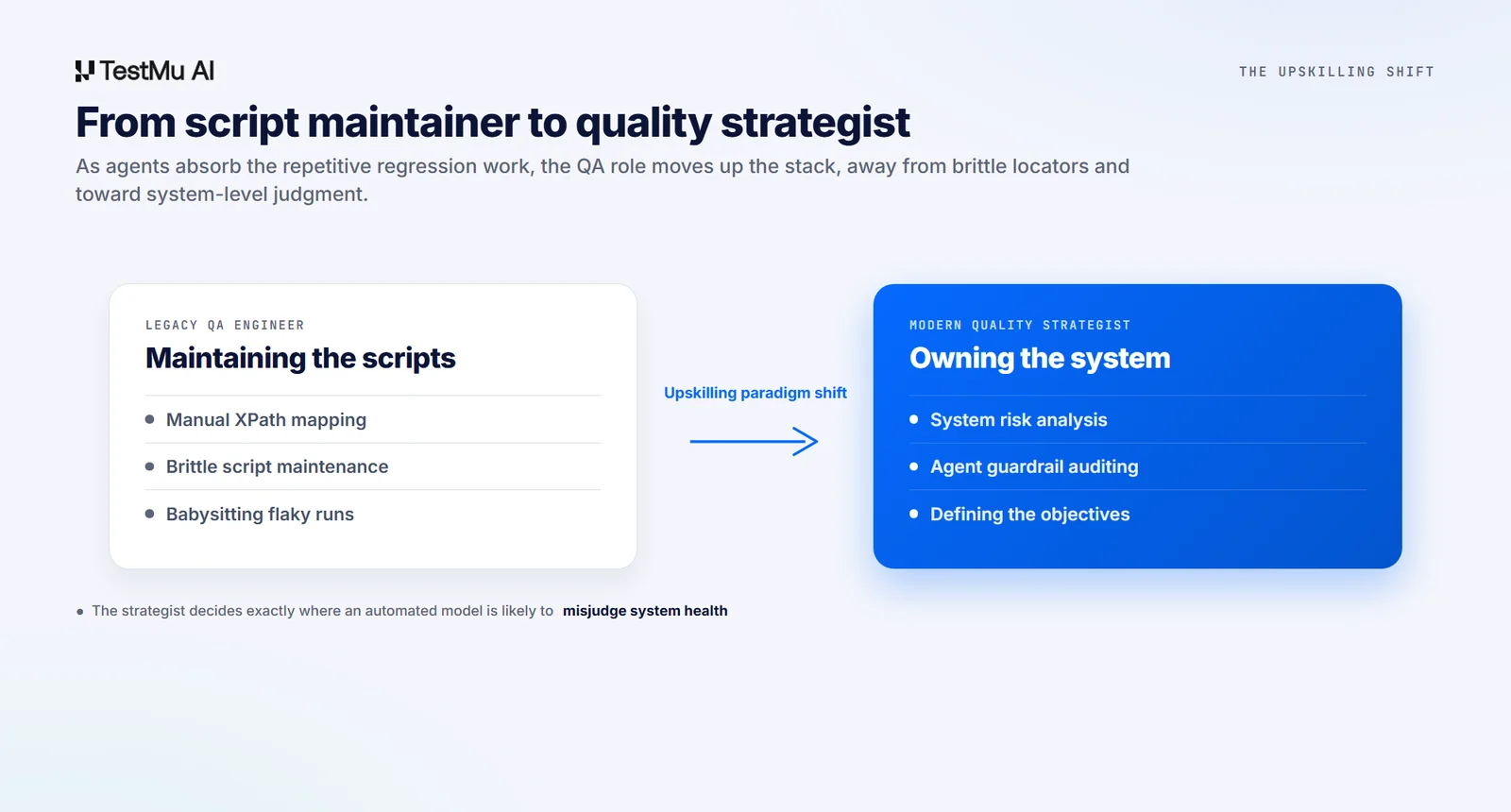
AI integration is an upskilling opportunity, not a downsizing story. The QA engineer moves away from writing brittle locators and babysitting flaky runs toward becoming a quality strategist.
There is judgment-heavy work that humans still own:
- Exploratory testing: uncovering novel failure modes outside defined parameters.
- Business-logic verification: confirming behavior matches nuanced intent.
- Nuanced accessibility auditing: evaluating real user experience, not a checklist.
The strategist defines the objectives, audits agent execution logs, and decides where an automated model is likely to misjudge system health.
Note: Give your agents a real browser and a deterministic pass or fail. Start free. Try Kane CLI
A Pragmatic Framework to Get Started
You do not need to hand over the whole lifecycle overnight. A staged rollout keeps humans in control while agents take on the repetitive load:
- Isolate high-value journeys: identify the top revenue-generating user paths that cause immediate damage if they break.
- Draft plain-English objectives: write those journeys as clear declarative objectives so Kane CLI runs them in a real Chrome browser.
- Embed as mandatory CI gates: integrate these checks as non-negotiable gates for incoming pull requests.
- Empower your coding agents: equip development and coding agents with Kane CLI skills so they run real browser verification on their own code before human review.
Note: Want the agent mode and skill setup behind this workflow? Read the Kane CLI docs. Read the docs
If you are weighing whether this fits your team, see who Kane CLI is for and how it slots into an agent-driven QA practice. Because it drives a real Chrome instance, it is also a fast route to local browser testing on your own machine.
If you would rather learn it in a structured format and come away with something to show for it, the free Kane CLI certification walks through the same workflow end to end, from writing plain-English objectives to wiring the pass or fail signal into CI, and issues a shareable credential once you pass.
Turning a One-Off Agent Grade Into a Regression Signal
The false confidence problem does not stop at self-healing scripts. When the thing under test is an AI agent your team ships, its own run summary is not the verdict. TestMu AI Agent Assurance reads your codebase, writes the scenarios, runs that agent for real, grades every criterion against observed evidence, and reports what moved since the last run:
- Newly failing: criteria that passed last run and fail now, which is the regression a green run would otherwise hide.
- Newly fixed: criteria that flipped back to pass, separating a real repair from a lucky run.
- Flaky: scenarios that changed verdict with no matching change in the agent, the ones to chase before the team learns to ignore red.
- Unable to Verify: criteria the run could not check, reported beside the pass rate as the assurance gap and kept out of the denominator.
Evidence here means files changed on disk, artifacts produced, and tool calls checked against the agent's own declared tool surface. The same grading runs headless from the terminal through rook, where a finished run exits 0 whether scenarios passed or failed, so your CI gate reads the verdicts in the JSON report rather than the exit code. The Autonomous category, for agents that act, is on a waitlist today.
Author

Shravan Mahajan
Blogs: 10

Shravan Mahajan is a Software Engineer at TestMu AI building Kane CLI, the command-line tool that runs browser automation from the terminal, describing flows in natural language that execute in a real Chrome browser and return pass or fail with shareable proof. He has an experience of 6 years in the Technical industry. His top skills are JavaScript, React.js, and full-stack development. At Fractal he built automated data pipelines with T-SQL, SSIS, Python, and Azure. He is also a Microsoft Certified Azure Data Engineer Associate.


Frequently asked questions
Did you find this page helpful?
More Related Blogs
TestMu AI forEnterprise
Get access to solutions built on Enterprise
grade security, privacy, & compliance
- Advanced access controls
- Advanced data retention rules
- Advanced Local Testing
- Premium Support options
- Early access to beta features
- Private Slack Channel
- Unlimited Manual Accessibility DevTools Tests