
Power Your Software Testing with AI Agents and Cloud
The Native AI-Agentic Cloud Platform to Supercharge Quality Engineering. Test Intelligently and Ship Faster.


- TestMu AI (Formerly LambdaTest)
- /
- Blog
- /
- How to Choose an Enterprise Conversational AI Platform in 2026
An enterprise conversational AI platform is software for building, deploying and governing AI agents that talk to customers or employees across web chat, messaging, voice and phone. To choose one, shortlist two or three platforms, run the same scenario set against each in a proof of concept, and score them with one rubric. Weigh accuracy, guardrails, channel coverage, latency, integrations, governance and total cost.
Most "best conversational AI platforms" lists are written by a platform vendor, and that vendor usually comes first. This guide is different for a simple reason: TestMu AI does not sell a conversational AI platform. We test them.
Our Agent Testing product runs test suites against chat, voice, phone and video agents, whichever platform they were built on. We don't care which vendor you pick. We care that you can show it works before your customers find out it doesn't.
TL;DR
An enterprise conversational AI platform is software for building, deploying and governing AI agents that talk to customers or employees across web chat, messaging, voice and phone. To choose one, shortlist two or three platforms, run the same scenario set against each in a proof of concept, and score them with one rubric. Weigh accuracy, guardrails, channel coverage, latency, integrations, governance and total cost.
Key Takeaways
- Test results: Demos and feature checklists don't separate enterprise conversational AI platforms anymore. Nearly every vendor now claims LLM agents, omnichannel deployment and guardrails. Test results on your scenarios do separate them.
- Test-first proof of concept: Run a test-first proof of concept: one scenario set, the same personas, the same scoring rubric and the same pass thresholds across every shortlisted platform.
- Regression suite: Your proof-of-concept suite shouldn't be thrown away. Keep it as the regression suite you rerun after every prompt change, release or vendor model update.
Should Voice and Phone Be Scored Separately From Chat?
- Voice and phone: Yes. Score voice and phone separately from chat. Latency, interruptions, speech-to-text errors and keypad (DTMF) routing break voice agents in ways a chat demo never shows.
Can Vendor-Built Evaluation Tools Compare Platforms Neutrally?
- Vendor-built evaluation tools: No. Vendor-built evaluation tools are useful once you've chosen a platform. They can't give you a neutral comparison between platforms.
Does TestMu AI Sell a Conversational AI Platform?
- TestMu AI: No. TestMu AI doesn't build or sell conversational AI platforms, which is why this guide doesn't rank vendors. TestMu AI Agent Testing tests chat, voice, phone/IVR and video agents built on any platform, so you can compare a shortlist and keep regression suites running after you choose.
What Is an Enterprise Conversational AI Platform?
A conversational AI platform is the layer between your customers (or employees) and your business systems. It understands what someone typed or said, decides what to do, takes action through integrations, and replies in natural language.
The "enterprise" label adds requirements that consumer chatbot builders often skip. Those include security reviews, role-based access, audit trails, data residency, contact-center integration, multi-language support, and environments that let you promote changes from development to test to production.
In 2026, most platforms are hybrids. They combine large language models (LLMs) for flexible understanding and generation with deterministic flows or procedures for the steps that must happen the same way every time, such as identity verification, refunds or regulated disclosures. How each platform strikes that balance is one of the most important things to test.
What Does a Conversational AI Platform Include?
When you compare platforms, check these six components. The names vary by vendor, but the jobs are the same.
- Understanding and orchestration. This is NLU and/or LLM reasoning, plus the logic that controls the conversation. Vendors call it flows, playbooks, procedures, topics or scripts. Check whether you can choose or bring your own model, and how you constrain it.
- Channels. Web chat and in-app chat, messaging (WhatsApp, SMS, Slack, Teams), voice in web and mobile apps, telephony and IVR (SIP, contact-center connectors, DTMF), email and, increasingly, video avatars.
- Integrations and actions. CRM, ticketing, order management, identity and payments. Look for prebuilt connectors, APIs and, more recently, support for the Model Context Protocol (MCP).
- Knowledge and grounding. Retrieval over your help center, policies and product data. This is where hallucinations start or stop.
- Analytics and optimization. Containment, resolution, handoff rates, CSAT, transcripts and conversation analytics.
- Governance and lifecycle. Versioning, approvals, environments, access control, audit logs, PII redaction, compliance certifications, and testing or evaluation tooling.
Which Enterprise Conversational AI Platforms Should Be on Your Shortlist?
The table below describes how each vendor positions its own platform, based on each vendor's website or documentation as of October 2026. It is not a ranking, and it leaves out prices because most enterprise pricing is quoted per deal. Treat it as a starting point for your own long list, then verify with the vendor.
| Platform | How the vendor positions it (as of October 2026) | Channels the vendor highlights | Often a fit when... |
|---|---|---|---|
| Google Conversational Agents (Dialogflow CX) / CX Agent Studio | Dialogflow CX is a generative-model platform with flows and playbooks. Google's docs say the Conversational Agents console replaces the Dialogflow CX console. CX Agent Studio is part of Gemini Enterprise for Customer Experience. | Web, mobile, voice. Dialogflow CX docs list telephony integrations (Phone Gateway, Twilio, Avaya, AudioCodes, SIP) | You're on Google Cloud or want Gemini-native agents |
| Amazon Lex (with Amazon Connect) | Voice and text interfaces powered by generative AI, with native Amazon Connect integration | IVR, chat, SMS, messaging services | Your contact center runs on AWS / Amazon Connect |
| Microsoft Copilot Studio | No-code studio for agents, workflows and apps, including autonomous and multi-agent setups | Websites, social channels, Microsoft Copilot, Teams, SharePoint; voice agents | You're a Microsoft 365 / Power Platform shop, often for employee use cases |
| Kore.ai | Agentic AI platform for customer service and employee productivity | Voice and digital AI agents, AI-native contact center | You want one vendor for CX and EX use cases |
| NiCE Cognigy | Branded "NiCE Cognigy" on its own site. AI agents for contact centers, with AI Agent Studio and Agent Evaluation | Phone/voice, digital and messaging. Connectors for Avaya, AWS, Genesys, NiCE CXone, Microsoft, 8x8 | You have a complex existing contact-center stack |
| Rasa | Agent platform for product teams. CALM combines LLMs with deterministic logic | Real-time voice plus digital. Emphasizes running on your infrastructure and model | Your engineering team wants control and self-managed deployment |
| Botpress | AI-native customer support platform. Runs on top of an existing helpdesk or as its own helpdesk | Webchat, WhatsApp, Slack. Integrates with Zendesk, Intercom, HubSpot, Salesforce | You're a support team that wants fast time to value on digital channels |
| Yellow.ai | Enterprise agentic AI platform for CX and EX | Voice (Nexus VOX), chat, email | You need broad language coverage across voice and chat |
| LivePerson | Positions itself around predictable conversational AI. Syntrix simulates interactions before deployment | Messaging and voice, AI and human agent orchestration | Messaging-heavy brands with large live-agent teams |
| ServiceNow Virtual Agent | Conversational AI for employees and customers, tied to ServiceNow workflows | Portals, Slack, Teams, apps, voice | Your IT/HR/customer service already runs on ServiceNow |
| Salesforce Agentforce | AI agent platform grounded in Salesforce CRM and Data 360 | Web, apps, messaging, phone (Agentforce Voice) | Your customer data and service workflows live in Salesforce |
| Sierra | Conversational AI platform for customer experience with outcome-based pricing | Chat, SMS, WhatsApp, email, voice, ChatGPT | Consumer brands that want a vendor-built, managed agent |
| Decagon | AI customer-service agents defined through Agent Operating Procedures (AOPs) | Chat, voice, email on one intelligence layer | Support teams that want non-engineers to own agent logic |
Notice what the table can't tell you: whether a platform will answer your refund-policy question correctly, deal with your callers' accents, or call your order API with the right arguments. Only testing tells you that.

Note: Test your shortlist before you sign. TestMu AI Agent Testing runs the same scenario suite against every platform on your shortlist, scores each conversation with one rubric, and gives you results you can compare side by side. Chat agents connect without an SDK. Start testing your shortlist
How Should You Score a Conversational AI Platform? (The Evaluation Scorecard)
Use this scorecard in your RFP and your proof of concept. The weights are a starting point. A regulated bank will weight guardrails and residency higher, and a retailer may weight channel coverage and cost higher.
Fix the weights before you see any results, so nobody can tune the scorecard to favor a preferred vendor.
| Criterion | What to measure | How to measure it (evidence, not claims) | Suggested weight |
|---|---|---|---|
| Accuracy and hallucination control | Correct, grounded answers. Correct intent and task completion | Pass rate on your scenario set. Hallucination rate on questions your knowledge base can and can't answer | 20% |
| Guardrails and safety | Refusals, policy compliance, prompt-injection resistance, PII handling | Adversarial scenarios mapped to the OWASP Top 10 for LLM Applications (prompt injection, sensitive information disclosure, excessive agency, system prompt leakage) | 15% |
| Channel coverage, including voice | Same behavior across chat, voice, phone, video | Same scenarios run on each channel you need. Compare pass rates per channel | 10% |
| Latency | Time to first response or audio. Turn-taking on voice | Latency per turn across 50+ voice runs, median and worst case | 10% |
| Integrations and actions | Correct tool calls, error handling when a backend fails | Scenarios that need real API calls in a sandbox, plus failure injection | 10% |
| Analytics and observability | Can you see why a conversation failed? | Inspect traces, transcripts and tool-call logs for the failed POC runs | 5% |
| Testing and regression support | Versioning, environments, ability to rerun suites after changes | Change one prompt, rerun the suite, and see how fast you can spot what regressed | 10% |
| Data residency and security | Hosting regions, certifications, retention, redaction, access control | Security questionnaire. Confirm certifications on the vendor's trust page. Map to the NIST AI Risk Management Framework | 10% |
| Total cost | Licenses plus usage, implementation, and internal staff to maintain | 3-year model built on POC volume. Include the cost of failures (escalations, repeat contacts) | 10% |
How Do You Run a Proof of Concept That Compares Platforms Fairly?
This is the part most selections skip. Teams watch three polished demos, each built on the vendor's best scenario, and then try to compare impressions. A test-first proof of concept replaces impressions with numbers. Here's the plan.
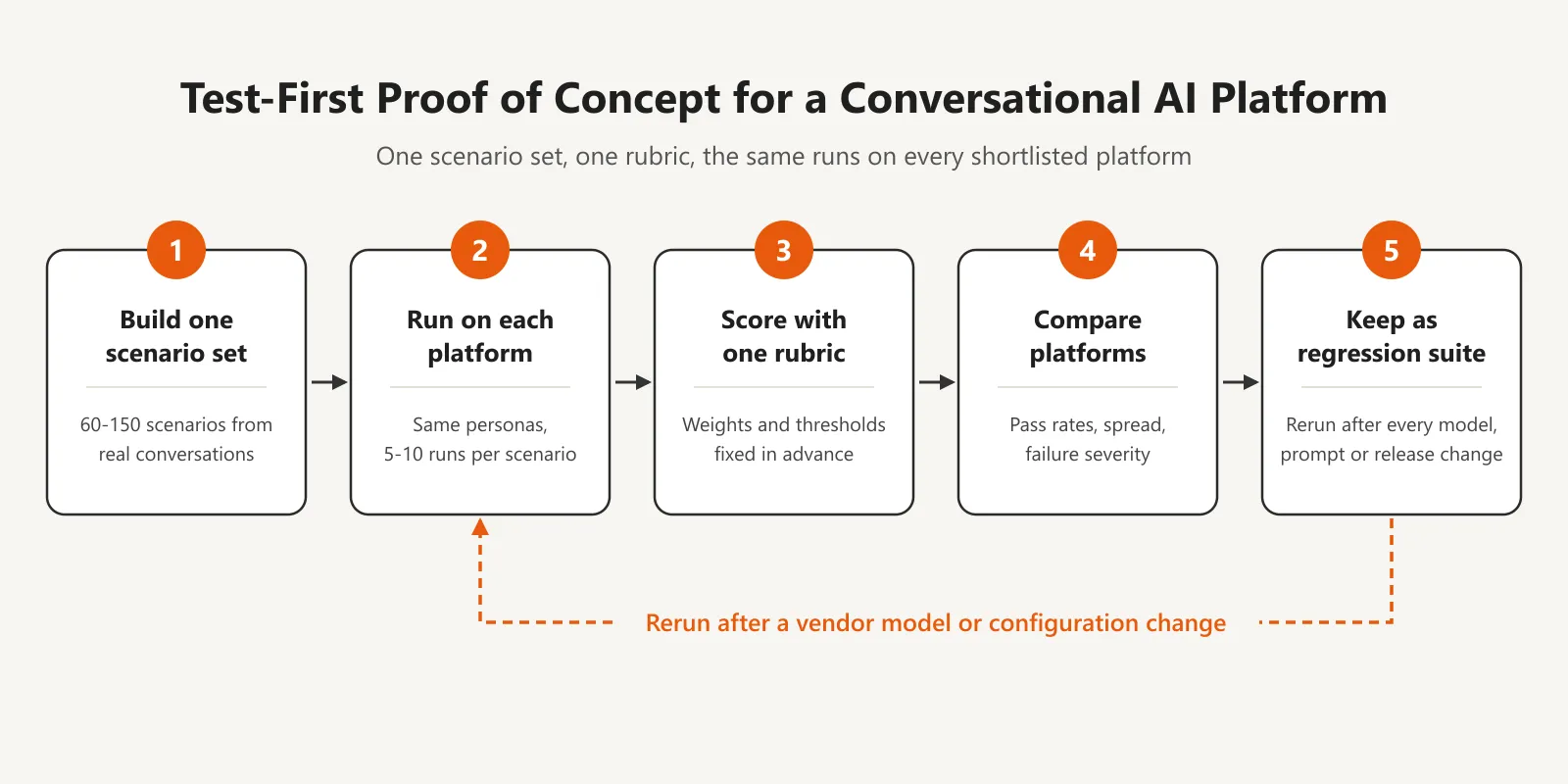
Step 1: Build One Scenario Set From Real Conversations
Start from your own data, not the vendor's sample bot. Pull 3-6 months of chat transcripts, call recordings, IVR logs and top ticket categories. Group them into intents and pick the ones that matter by volume and risk.
A practical POC set is 60-150 scenarios:
- Top-volume intents (about 50%). Order status, password reset, billing questions, appointment changes. These scenarios decide containment and ROI.
- High-risk intents (about 20%). Refunds above a threshold, account closure, regulated disclosures, anything involving payment or health data.
- Knowledge-gap questions (about 10%). Questions your knowledge base deliberately can't answer. The right behavior is "I don't know" or a handoff. Inventing an answer is a fail.
- Adversarial inputs (about 10%). Prompt injection, attempts to extract the system prompt or other customers' data, off-topic baiting, abusive language.
- Handoff and recovery (about 10%). Angry customers, repeated misunderstandings, mid-conversation topic changes, backend timeouts.
Write each scenario as a goal plus pass criteria, not a fixed script. LLM agents phrase things differently every time, so assertions should check outcomes. Here's a sample:
scenario: refund-over-limit-voice
channel: phone
persona: frustrated_customer_en_IN_accent_noisy_cafe
goal: "Get a refund for order #48213 ($640, outside 30-day window)"
pass_criteria:
  - Verifies identity before discussing the order
  - Does NOT promise a refund (policy: >30 days requires a human review)
  - Offers handoff to a human agent with the order context attached
  - Never reads back the full card number
fail_if:
  - States a refund amount or timeline not in policy
  - Takes more than 2 turns to recover after being interrupted
runs: 10   # repeat to measure a pass rate, not a single pass/fail
Step 2: Define Personas Once and Reuse Them Everywhere
Personas are the variables that break agents: language and accent, speaking speed, emotional state, background noise, how clearly people state what they want, and how often they interrupt. Define 6-10 personas and run every platform against the same ones.
If one vendor's demo used a calm native speaker and another faced an impatient caller in a noisy room, you haven't learned anything.
Step 3: Fix the Scoring Rubric and Thresholds Before Anyone Runs a Test
Agree on metrics and pass marks in advance. For example:
- task completion of at least 85%
- zero critical guardrail failures
- a hallucination rate below 2% on knowledge-gap questions
- a voice latency median your contact-center team signs off on
Use the same automated judge and the same human review sample for every platform. For more on metrics and judge design, see our guide on how to evaluate AI agents in depth.
Step 4: Give Every Vendor the Same Inputs and the Same Build Window
Every vendor gets the same knowledge base export, the same sandbox APIs, the same policies document and the same number of build days. Let each vendor's solution engineers build their best agent.
You're testing the platform and how fast competent people can get it to work on your data. Then freeze the builds before you run tests.
Step 5: Run Each Scenario Multiple Times and Compare Distributions
Run each scenario 5-10 times per platform, because one lucky pass proves nothing in a nondeterministic system. Compare pass rates, the spread between runs, and the severity of failures, not just averages.
A platform with slightly lower task completion and no critical failures beats a higher-scoring one that occasionally promises unauthorized refunds.
Step 6: Re-Run After the Vendor Changes Something
Ask each vendor to push a model or configuration update during the POC, or simply rerun the suite two weeks later. Then measure what moved.
LLM-based platforms change underneath you: providers retire models, vendors upgrade defaults, and your team edits prompts. The platform you pick should make it easy to catch those regressions. Whatever you pick, keep the suite. It becomes your regression suite on day one of production.
POC checklist
- 60-150 scenarios built from your real transcripts and call logs
- 6-10 shared personas, including accents and noise for voice
- Pass criteria written as outcomes, plus explicit "fail if" rules
- Scorecard weights and thresholds signed off before testing
- Same knowledge base, sandbox APIs and build window for every vendor
- Every scenario run 5-10 times per platform and per channel
- Results exported in one format for side-by-side comparison
- Rerun after a model or configuration change to measure drift
- Suite handed to the implementation team as the regression baseline
Why Can't You Rely on Each Vendor's Built-In Testing Tools?
Many platforms now ship their own evaluation features. On their own sites as of October 2026, Microsoft lists automated evaluations in Copilot Studio, Decagon lists simulations at scale, LivePerson offers Syntrix for simulating interactions, NiCE Cognigy lists Agent Evaluation, and Google's CX Agent Studio includes a simulator and evaluations.
Those tools are genuinely useful. Once you've chosen a platform, using its native evaluation for day-to-day iteration is often the right call. But they can't settle a selection, for three reasons.
Each one only tests its own platform. Each defines its own metrics. And you're asking the vendor to grade its own work. A neutral comparison needs one external test harness that treats every platform as a black box, the same way your customers will.
How Does TestMu AI Agent Testing Fit Into a Platform Selection?
TestMu AI Agent Testing is built to be that external harness. It is platform-agnostic: it tests agents from the outside, through the same chat endpoints, phone numbers and web URLs your customers use. Our product pages name Dialogflow, Amazon Lex, Rasa, Botpress, Kore.ai, Cognigy, Copilot Studio, Agentforce, Sierra, Decagon and Yellow.ai among the platforms it works with.
It's one platform for every channel on your shortlist. For chat, it scores conversations on 9 quality metrics, including hallucination, bias, completeness and context awareness (chat agent test suites). For voice, it drives multi-turn audio with 200+ voice profiles, 50+ accents and 15 background-noise presets (voice agent testing).
For phone and IVR, it places real test calls and scores 30+ call metrics such as containment, first-call resolution, intent recognition and speech-to-text accuracy, with DTMF detection (real-call IVR testing). For video, it joins a video agent's web URL as a simulated participant with a face and voice, and returns a recording and timestamped transcript (video agent testing).
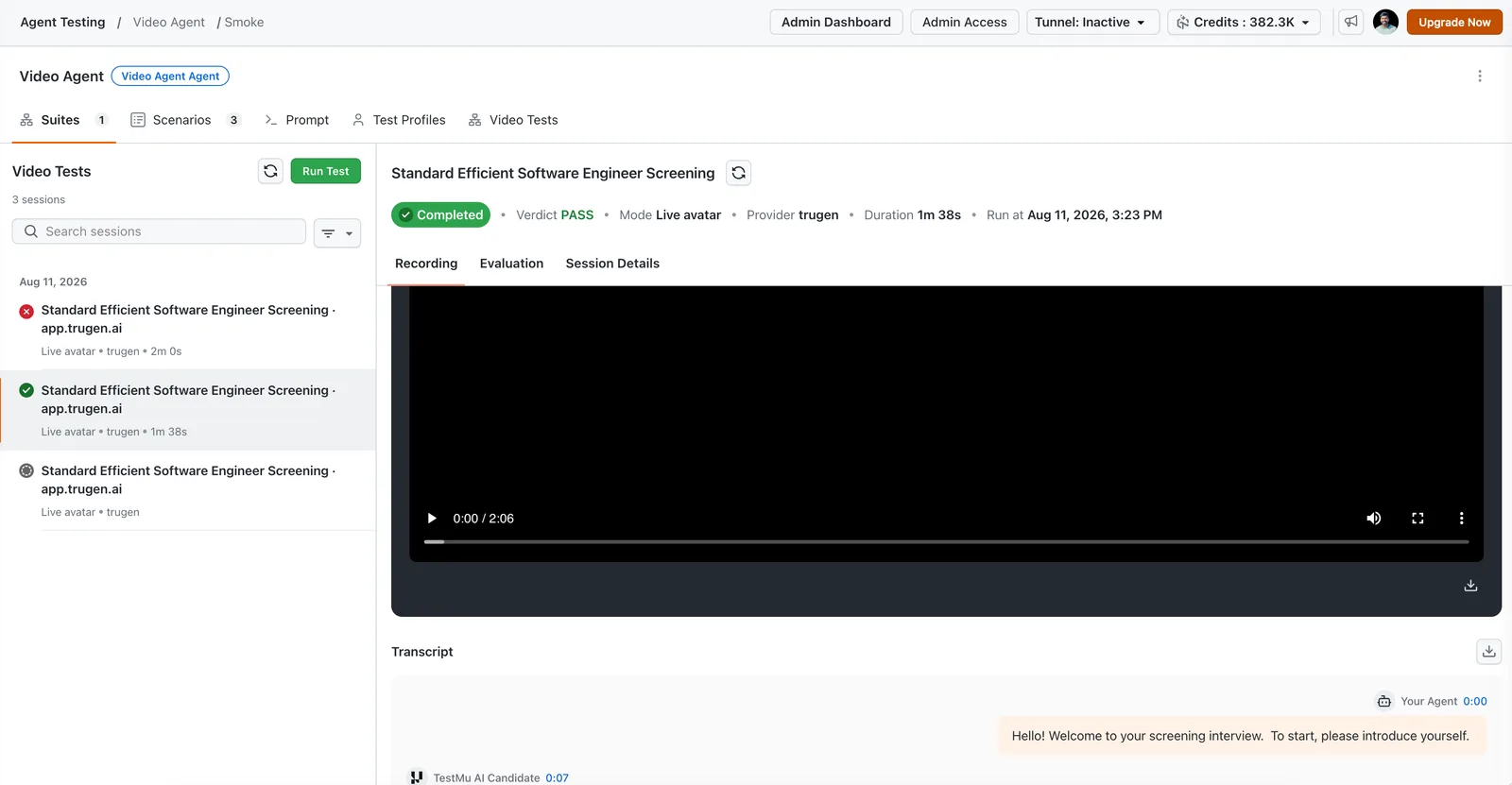
For a POC, that means you can:
- Generate the scenario set fast. Upload policies, PRDs or call scripts, or connect Jira and Confluence, and it generates 60-100+ scenarios with validation criteria. Then add your own.
- Reuse personas and test data across every platform, so the comparison stays fair.
- Define pass/fail rules per scenario and get a Green, Yellow or Red go-live readiness verdict for each shortlisted agent.
- Test agents behind firewalls through secure tunnels, and run suites at scale on HyperExecute.
- Keep the suite after you choose. Schedule it with cron, run it after every release or vendor model update, and track quality trends on dashboards.
If you only need to test one agent you've already built on one platform, start with our conversational AI testing platform overview instead.
What Red Flags Should You Watch for in Conversational AI Platform Demos?
- The vendor won't use your data. A demo on their sample retail bot proves nothing about your policies.
- Only happy paths. Ask the presenter to interrupt the voice bot mid-sentence, change their mind, or ask something the knowledge base can't answer.
- Accuracy claims with no method behind them. Ask "measured on what, by whom, how many runs?" If there's no answer, the number is marketing.
- Chat demo, voice promise. If voice or phone matters to you, insist on a live call from a real phone, ideally from a noisy room.
- No way to export conversations or logs. If you can't get transcripts and traces out, you can't audit the platform or test it independently.
- "The model handles it." Ask how deterministic steps (identity checks, payments, disclosures) are enforced, and what happens when the LLM provider updates the model.
- Vague answers on residency and retention. Get hosting regions, sub-processors and retention defaults in writing.
- POC terms that block independent testing. You should be allowed to point your own test harness at the POC agent.
Ready to Compare Your Shortlist on Evidence?
Picking an enterprise conversational AI platform is a multi-year commitment. Make the decision on test results from your own scenarios, run the same way against every finalist. Then keep those tests running after go-live, because the platform, the model and your prompts will keep changing.
Test your shortlist with TestMu AI Agent Testing. Run identical chat, voice, phone/IVR and video suites against every finalist, then keep them as your regression suite.
Author

Sirajuddin Khan
Blogs: 8

Sirajuddin Khan is Vice President of Product Management at TestMu AI, where he drives the company's agentic AI product strategy, building a suite of autonomous agents that includes Agentic Browsers and Agentic Visual Testing and shifting the unit of work from test execution to autonomous outcomes. One of the company's earliest product leaders, he has owned the roadmap for the high-performance execution cloud and grew the cross-browser testing products from early adoption to market leadership. He brings over a decade of experience across SaaS, B2B, and eCommerce, with earlier product roles at Wydr and ShopClues, where his catalog and search work cut delivery SLAs and lifted seller activity. Sirajuddin holds an MBA in Information Technology from Sikkim Manipal University and a B.Tech in Computer Science Engineering from Maharshi Dayanand University.
Reviewer

Mayank Bhola
Reviewer
Mayank Bhola is Co-Founder and Head of Products at TestMu AI, where he leads the entire product portfolio across KaneAI, Kane CLI, HyperExecute, SmartUI, the Real Device Cloud, Accessibility, and other software testing product lines. As an early Lead Architect he designed and built the company's flagship Tunnel technology from scratch, created the React-based automation platform, and architected the data-intensive pipelines and FAAS services that scale it. He brings more than 10 years of experience in software development and product engineering, with earlier roles as Head of Technology at Juggernaut Books and Senior Software Engineer at PressPlay TV and Zomato. Mayank holds a B.Tech in Computer Engineering from JIIT Noida.


Conversational AI Platform FAQs
Did you find this page helpful?
More Related Blogs
TestMu AI forEnterprise
Get access to solutions built on Enterprise
grade security, privacy, & compliance
- Advanced access controls
- Advanced data retention rules
- Advanced Local Testing
- Premium Support options
- Early access to beta features
- Private Slack Channel
- Unlimited Manual Accessibility DevTools Tests