
Power Your Software Testing with AI Agents and Cloud
The Native AI-Agentic Cloud Platform to Supercharge Quality Engineering. Test Intelligently and Ship Faster.

- TestMu AI (Formerly LambdaTest)
- /
- Blog
- /
- The Bionic Workforce: Where Humans and AI Co-exist [Testμ 2026]
The Bionic Workforce: Where Humans and AI Co-exist [Testμ 2026]
Lisha Rakesh of Capgemini on the assisted, augmented and autonomous modes of AI in QE, why autonomous is not unsupervised, and the 80/20 shift to strategy.
Published on:
A question Lisha Rakesh hears from organisations adopting AI is how to get from 100 testers to 50 in the next 30 days. Her answer is that the question skips three stages of maturity, and skipping them is why the adoption is not working.
In this session from Testμ Conf 2026, Lisha Rakesh, Senior Director and Head of Insurance Testing at Capgemini, maps those stages as assisted, augmented and autonomous, and sets out how to tell which one you are actually in.
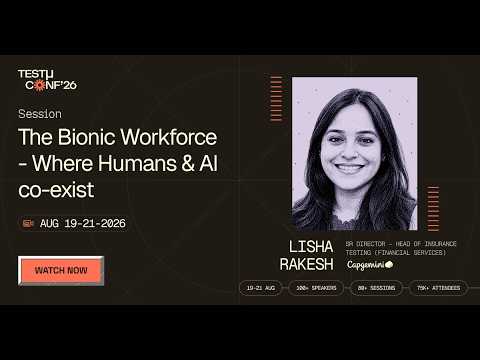
If you couldn’t catch all the sessions live, you can access the recordings at your convenience by visiting the TestMu AI YouTube Channel.
TL;DR
A bionic workforce is one where humans and AI collaborate at a defined level of maturity rather than an undefined one. The three levels are assisted, where AI advises and humans act; augmented, where the workload is genuinely shared; and autonomous, where agents execute and humans govern.
- What does assisted mode look like? - AI analyses requirements, summarises defects, reads logs and proposes root causes, while every decision stays with the tester. AI shortens the path to the decision rather than making it.
- What changes in augmented mode? - The workload is shared. AI generates the initial test scenarios including edge and negative cases, and the tester reviews, refines and prioritises, which Lisha Rakesh calls human-guided, AI-accelerated testing rather than AI-generated testing.
- Does autonomous mean unsupervised? - No. An aircraft flies largely on autopilot and still carries experienced pilots, because governance, exception handling and accountability do not transfer to the system.
- How do you tell which bionic workforce mode you are in? - By where the testers’ time goes. Execution against strategy runs roughly 80/20 in assisted mode, 50/50 in augmented, and 20/80 in autonomous, so testers still doing repetitive work all day place the organisation in assisted.
- What is the trust index? - The trust index measures how confidently people rely on AI in critical decisions, visible when teams act on recommendations without second-guessing and accept generated artefacts with minimal modification.
- Is the biggest blocker technical? - No. Access to AI and implementing use cases are not the constraint; trust is, through reliability, explainability and governance concerns that bite hardest in regulated industries.
- What replaces headcount as the planning unit? - Capability density. The question moves from how many testers to what combination of human expertise and AI capability produces the best outcome.
- Will AI replace testers? - No. AI removes work that never needed human attention, such as rerunning regression suites, maintaining scripts and writing repetitive reports, which Lisha Rakesh describes as elevating testers rather than replacing them.
She began two decades earlier, with a story she tells against herself.
Two Weeks, Fifteen Minutes
She started as an automation engineer 20 years ago, when test automation was a shiny new concept that plenty of organisations still found faintly mysterious. Everyone sensed the potential and nobody quite understood it.
Her example from those days is exact. The team spent nearly two weeks building an automation script for a process a human tester could run manually in under 15 minutes.
When it finally ran successfully everyone was thrilled, and nobody paused to ask about the return. Getting a script to pass felt like a major victory, because each success stood for progress toward a new way of working.
Her point in telling it is that the career came full circle. She once spent her time convincing people automation would transform testing, and finds herself in the same argument about AI, at a scale she says is far greater than anything imaginable then.
The Adoption Numbers
She cited recent industry research to size the shift, and the figures she put on screen were these.
- Around 90 percent - of organisations are actively piloting or deploying generative AI augmented quality engineering workflows.
- 68 percent - are already using generative AI to improve tester and developer productivity.
- 72 percent - report faster test execution outcomes through AI-enabled approaches.
Her framing of those numbers matters more than the numbers. Fifteen to eighteen months ago the industry was still debating whether AI could have a meaningful impact on testing, and whether testing would exist at all in two years.
That question has closed. The open one is how quickly an organisation can adapt.
Three Trends
From the research and her own conversations, she pulled out three movements happening at once.
- AI is becoming a participant, not a tool - fifteen months ago it helped write test cases and scripts. Today agents analyse requirements, generate the cases, build the scripts, execute them, investigate the failures and recommend corrective action. She noted Gartner naming agentic AI among the most strategic technology trends, on the basis that these systems plan, reason and act against a defined goal.
- The tester’s role is moving up the value chain - testing has always been measured by activity counts, meaning cases created, scripts generated, defects found. As AI absorbs the repetitive and analytical work, the human moves toward intent, business context, customer impact, risk and decision-making.
- Trust is the blocker, not technology - the constraint is not access to AI or the difficulty of implementing use cases. It is reliability, explainability, governance, integration complexity and data privacy, and it bites hardest in regulated industries such as insurance, banking and capital markets.

Trust has always been the currency quality engineering trades in with its customers. What has changed is that it now has to extend past the human workforce to the machine.
Defining the Bionic Workforce
Her definition is deliberately plain: a workforce where humans and AI collaborate at different levels of maturity. The reason she insists on the levels is the question she keeps being asked about cutting a hundred testers to fifty in a month.
Her analogy for the progression is driving, which has moved from an entirely human-controlled activity to an increasingly independent one without ever removing the driver’s responsibility in a single step.
Assisted Mode
The assisted stage is a modern car with GPS, blind-spot monitoring, parking sensors and collision warnings. You are fully in control and driving; the technology feeds you insight that makes the driving easier.
In testing that means humans perform the work and AI supplies intelligence. Requirement analysis that flags gaps up front, test case recommendations, defect summarisation, root cause analysis and log analysis.
Her worked example is a production defect. Traditionally that means hours through logs and historical data, re-reading requirements and talking to twenty stakeholders before you can explain what happened.
AI reads thousands of log entries in seconds, summarises the probable root causes, identifies the impacted areas and names the red zones to plan around. The decision still belongs to the tester, and what has changed is the length of the path to it.

Note: Decision velocity is only measurable if the signals are in one place. TestMu AI Test Intelligence surfaces failure patterns, flakiness and trends across builds, so root cause analysis starts from evidence rather than a log search. Try it free!
Augmented Mode
The next stage is a highway with cruise control and lane centering engaged. You are still behind the wheel and still responsible, and the vehicle is now actively helping to drive rather than only advising.
The division of labour is what makes it work. Humans bring context, prioritisation, business understanding and ethical judgment; AI brings scale, speed, pattern recognition and generation.
Instead of a tester writing 50 scenarios by hand, AI generates the initial set covering edge cases, negative scenarios, accessibility, non-functional considerations and integration risk. The tester reviews, refines, prioritises and enriches it.
Her insurance example sharpens the split. Rolling out a new underwriting model traditionally means a tester writing a few hundred scenarios and still missing coverage, where AI can generate thousands across age, geography, risk profile and claims history, and find combinations a person would overlook.
The questions humans then ask are the ones AI cannot. Is this fair, is regulatory compliance met, could it create bias in certain situations, would a customer trust this decision, and can the output be explained to them clearly.
Which is why she resists framing augmentation as a productivity story. It is about increasing human capability, coverage and the quality of what ships.
Autonomous Mode
The third stage is the self-driving car. You enter a destination, and the vehicle plans the route, navigates the traffic and changes lanes while you remain accountable for the trip.
Agents at this stage provision environments, generate cases and scripts, trigger regression suites, analyse failures, self-heal broken scripts, open defects and sometimes start the remediation workflow.
Her picture of it is a Friday evening release. Overnight the quality agent provisions environments, executes thousands of regression cases, detects anomalies, identifies root causes, classifies the failures, raises defect tickets, reruns the impacted tests, and has a release readiness report waiting before anyone logs in.
The caveat is the part she wanted remembered. Autonomous is not unsupervised.
Four Measures of Progress
Buying an AI platform does not make an organisation bionic, so she offered four dimensions to measure against. The familiar metrics of automation percentage, defect count, leakage and execution volume still matter and no longer tell the whole story.
- Decision velocity - how fast you move from information to action. Defect analysis, root cause work and report generation dropping from days to hours or minutes is a strong signal, and she noted that AI return is often not mapped to headcount at all.
- Human effort reallocation - not reduction. Where the people spend their time, and whether the best testers are still doing repetitive execution all day.
- Agent autonomy - how much work completes without intervention, judged on outcomes rather than content generated. How many workflows are agent-supported, how many agent-executed, and where human involvement is genuinely required.
- Trust index - how confidently people rely on AI in critical decisions. The signs are teams acting on recommendations without second-guessing them, generated cases and reports accepted with minimal modification, and triage happening autonomously.
Her summary of the third measure is the one to quote at a steering committee. The metric has moved from AI usage to AI responsibility.
In bionic workforce model, the measurement of success is a little different. The 4 key dimensions that define success are: The decision velocity, the human effort reallocation, the agent autonomy, and the trust index. pic.twitter.com/TyFXDHjHmy
— TestMu AI (@testmuai) August 19, 2026

The 80/20 Reversal
The second measure comes with numbers precise enough to audit yourself against, expressed as the split between execution and strategy.
- Assisted - roughly 80 percent execution, 20 percent strategy.
- Augmented - about 50/50.
- Autonomous - 20 percent execution, 80 percent strategy and orchestration.
The diagnostic follows immediately. If your best testers still spend most of the day on repetitive work, the organisation has not moved past assisted, whatever the tooling suggests.
That led her to reframe the question everyone gets asked. Rather than whether AI will replace testers, she asks which part of testing should never have required human attention in the first place.
Nobody entered the profession because they loved rerunning regression suites, maintaining scripts, building duplicate test data or writing repetitive reports. Removing those is not replacing testers; it is elevating them.
Four Leadership Shifts
Her view is that leadership, not technology, is the harder problem. Most organisations have AI tools and very few have redesigned the operating model, the skills or the culture around them.
- Headcount to capability density - the question moves from how many testers to what combination of human expertise and AI capability delivers the outcome. A team of 20 AI-enabled engineers may deliver what 50 or 60 once did, and she was emphatic that this raises the demand for expertise rather than lowering it, because speed multiplies the cost of poor judgment.
- Managing resources to orchestrating ecosystems - managers used to explain work, estimate it and report on it. The next generation manages people alongside agent frameworks, platforms and workflows, which makes technical literacy a management requirement rather than a nice-to-have.
- New skills for the tester of tomorrow - AI literacy, prompt engineering, data interpretation and multi-agent orchestration, alongside articulation, communication, the ability to re-pivot quickly, and genuine domain understanding.
- Trust-centric governance - answering which decisions AI may make, which can be relied on, which need human approval, and how transparency, accountability and customer risk are maintained.
She returned to the aircraft to close the governance point. Nobody trusts a plane because it has autopilot; they trust it because there are systems, controls, governance and trained professionals around the autopilot.
Before the Coffee
Her picture of the future state starts with a quality engineer opening a command centre in the morning. Overnight one agent analysed the latest user stories and flagged risks and gaps, another created the scenarios and cases, a third read production telemetry and identified patterns needing more testing.
Several hours of analysis are complete before the first sip, which she noted may be the first time in the industry’s history that the test cases are ready before the coffee hits.
The engineer’s value in that picture is not the count of cases written. It is the quality of the questions: are we testing the right customer journey, what are the ethical implications, what business risks might the AI not understand, are we solving the right problem.
At release time the agents have consolidated status, coverage, production risk, failure patterns, security concerns, performance metrics and customer impact. The engineer reviews the recommendations, challenges the assumptions and makes the call, not on the grounds of knowing more than the AI but of understanding context, human consequences and business priorities.
What survives the transformation is the part she wanted to leave people with. Curiosity, critical thinking, creativity, judgment, empathy toward the customer and the ability to ask questions do not become less valuable when the execution is automated.
Q & A Session
Two audience questions were taken before time ran out.
- If AI lets engineers produce 10x more code, how do we know we are creating 10x more value rather than 10x more maintenance?
Lisha Rakesh: Picture that car again, this time driven at very high speed with no brakes. Volume is not the objective, business value is, which is exactly why I argue for moving away from metrics that only count things. Is 100 percent test coverage or 100 percent automation coverage still required? Probably not. Applying something closer to an 80/20 principle and building what is genuinely needed beats generating thousands of scripts that twenty other people then maintain. Part of a practitioner’s job is coaching the people asking for volume to justify the value alongside it.
- How do you measure human and AI team productivity without vanity metrics?
Lisha Rakesh: By starting with decision speed rather than the age-old activity counts. If the AI systems are producing accurate outcomes and have been given the right context about your domain and business, the proof is straightforward: better decisions, faster decisions, and releases qualified on time or sooner than before. One more indicator rarely appears on a dashboard, and that is a happier workforce, because the time goes somewhere people would rather spend it.
Her closing line put the timeline where she thinks it belongs. The bionic workforce is not coming, it is already here, and the question is whether you are ready to lead it.
This session was part of Testμ Conf 2026, which ran across three days of sessions on agentic engineering and quality. Registrations for the next edition are already open on the Testμ Conference 2027 page.
Author

TestMu AI
Blogs: 290


TestMu AI is World's First Full Stack AI Agentic Quality Engineering platform that empowers teams to test intelligently, smarter, and ship faster. Built for scale, it offers a full-stack testing cloud with 10K+ real devices and 3,000+ browsers. With AI-native test management, MCP servers, and agent-based automation, TestMu AI supports Selenium, Appium, Playwright, and all major frameworks. AI Agents like HyperExecute and KaneAI bring the power of AI and cloud into your software testing workflow, enabling seamless automation testing with 120+ integrations. TestMu AI Agents accelerate your testing throughout the entire SDLC, from test planning and authoring to automation, infrastructure, execution, RCA, and reporting.


Did you find this page helpful?
More Related Blogs

TestMu AI forEnterprise
Get access to solutions built on Enterprise
grade security, privacy, & compliance
- Advanced access controls
- Advanced data retention rules
- Advanced Local Testing
- Premium Support options
- Early access to beta features
- Private Slack Channel
- Unlimited Manual Accessibility DevTools Tests