

Next-Gen App & Browser Testing Cloud
Trusted by 2 Mn+ QAs & Devs to accelerate their release cycles


On This Page
- What is Scala?
- Why use Scala language?
- Top Features of Scala
- Advantages of Scala
- Disadvantages of Scala
- Prerequisites before learning Scala
- Useful Scala frameworks
- Functions and Methods in Scala
- Differences: Scala vs. Java
- Importance of testing Scala applications
- Who performs Scala testing?
- Why choose TestMu AI for Scala testing?
- How to perform Scala testing using the TestMu AI platform?

What is Scala Testing: A Detailed Guide with Examples
A detailed guide covering the basics of Scala Testing, and how it helps test websites. Enhance your testing processes and deliver high-quality software with ease.

Irshad Ahamed
January 12, 2026
Before we discuss Scala testing, let us understand the fundamentals of Scala and how this programming language is a preferred choice for your development requirements.The popularity and usage of Scala are rapidly rising, evident by the ever-increasing open positions for Scala developers.
By using Scala, developers were able to overcome some of the limitations they faced while using Java. Scala powers the data engineering infrastructure requirements in various organizations.
You can quickly learn Scala if you have a solid understanding of Java. Software developers and data engineers mostly use this language to manage complex data. But you can still be proficient in Scala from a developer background.
In this guide, learn everything you need to know about Scala testing.
What is Scala?
Scala is a general-purpose programming language that supports object-oriented and functional programming. It was created by Martin Odersky and is compiled to run on Java Virtual Machine (JVM). Many organizations that depend on Java for their critical business requirements are shifting their focus to Scala for better development output, application scalability, and reliability.
You can use Scala for diverse requirements that include: data processing, distributed computing, and web development. One can install Scala on any UNIX or Windows. You must have Java 1.8 or greater installed on your computer before installing Scala on your local machine.
Here are some of the everyday use cases that use Scala.
- Microservices
- Big data projects
- Information processing in real-time
- Data processing
- Data pipelines
Why use Scala language?
Scala is flexible enough to let you define abstractions. The Scala IDE helps you explore its features in a better way as you can connect it to the Eclipse Java tools with Scala. Further, Scala can also inter-operate with JRE (Java Runtime Environment) and the .NET Framework.
In addition, Scala makes code easier to test and reuse. Parallelization becomes straightforward, and there are minimal bugs in the entire program. Scala follows a top-down approach, breaking each program into multiple modules or chunks that you can process in parallel, ramping up the process and improving efficiency.
Top Features of Scala
Scala provides the following features that include:
- Seamless integration with Java: One of the great features of Scala language is its interoperability with Java. We can use Java libraries in our Scala code, with Scala libraries being supported in Java code.
- Type inference: In Scala, you are not required to mention the data type and function return type explicitly. Scala is designed in such a way that it is intelligent enough to determine the data type. The function return type is determined from the type of the last expression present in the function.
- Use of singleton objects: There are no static variables or methods that are used in Scala. It uses the concept of the singleton object, which is a class that contains a single object in the source file.
- Lazy computation: In Scala, the computation is lazy by default. The expressions are evaluated only when they are needed. You can delete a lazy variable by using the lazy keyword, but it helps to improve performance considerably.
- Rich set of collections: Scala provides a rich set of collection libraries containing classes and traits to collect data. You can use the Scala.collection.mutable package for all the mutable collections. You can also add, remove, and update data while using this package.
Scala is case-sensitive, which means that Hello and hello have different meanings in Scala. The class names should follow a standard naming convention. The first letter should always be in upper case, for example, class MyFirstScalaClass.
The method names should start with a lowercase for better readability and clarity. It becomes vital for the development teams to define and follow coding standards to bring consistency to the development process.
Advantages of Scala
Here are some of the advantages that make Scala an excellent development option for your coding requirements:
- Its syntax is similar to Java. If you are familiar with object-oriented programming concepts, it becomes easier to pick up the key concepts and functionalities related to Scala. There is less coding involved in Scala compared to Java.
- Scala provides great Integrated Development Environment (IDE) support in the form of IntelliJ IDEA, Scala IDE, EMACS, and ATOM.
- Scalability is one of the significant advantages offered by Scala. You can quickly build highly concurrent and fault-tolerant systems, which are great from a scalability perspective.
- It is a perfect choice for data analytics, supporting tools like Apache Spark.
- Scala is highly functional, so you can easily manage the coding requirements.
- Working with Scala as a developer can be fun and challenging at the same time
- It provides better code quality. You end up with fewer lines of code and lesser bugs as well.
Understanding these concepts is crucial for acing oops interview questions, as they often explore how these principles apply across different programming languages, including Scala and Java.
Disadvantages of Scala
Let us understand some of the disadvantages of using Scala, which you should be aware of:
- Scala provides a limited developer community where it is easier to find Java developers, but only some Java developers are well equipped with coding efficiently in Scala.
- It offers a combined capability of functional and object-oriented, so it becomes challenging at times to understand the current information.
- Scala is backward incompatible, so coding becomes problematic when supporting multiple previous versions.
- Learning new concepts can be a problem when unfamiliar with Scala.
We discussed the pros and cons of using Scala as a reliable programming language for diverse development requirements. If you are new to Scala, it is recommended to download the available version and get hands-on with the features that Scala has to offer.

Prerequisites before learning Scala
Below are some prerequisites to help you learn Scala to get started with your development requirements.
- Good hands-on experience with object-oriented and functional programming concepts.
- Basic understanding related to Java.
- A curious mindset to learn and experiment with new concepts.
- Any prior experience in a programming language will be a great value add.
Proficiency in Scala is attributed to the mix of factors – OOPs concepts, programming knowledge, and the right intent to learn new tools and technologies.
It can be challenging to learn all the fundamentals at once, but it is crucial to build a learning plan to help you understand the basic concepts quickly. You can still learn Scala if you have yet to gain prior programming knowledge and understanding.
Useful Scala frameworks
It is essential to choose the correct Scala framework for your project requirements. Here are some of the prominent frameworks used in Scala.
- ScalaTest: ScalaTest is an open-source testing framework for Scala, Java, and other JVM languages. It is a hybrid functional/behavioral testing framework wherein each test method may be written in either style.
- Play: It helps you to build highly scalable web applications written in Scala. The framework follows Model-View-Controller (MVC) architecture pattern assisting the developers in improving their productivity in the long run. This framework provides excellent documentation, making it easier for Scala developers to implement concepts in real-world scenarios.
- Akka: This is a swift and concurrent framework for building distributed applications. It helps Scala developers write systems that heal independently and stay responsive to failures. The AKKA ecosystem is huge and provides a wide range of tools such as Akka Streams, Akka HTTP, etc.
- Spray: Written on top of Akka, these open-source lightweight Scala libraries provide support for client and server-side REST/HTTP support. The APIs are entirely asynchronous, and all dependencies are managed carefully. The components are structured so that you can efficiently perform testing.
Functions and Methods in Scala
The functions and methods provide different functionalities when you use them. A process allows you to perform a specific functionality where you can execute one or more statements and return a value, list of values, or no value.
The following are the functions supported in Scala:
- Anonymous function: This function is without a name or an explicit handle.
- Named function: You can assign a function to a value in a named function.
- Closure: This function return value depends on some state outside its context.
Methods can be overridden and follow a different syntax. Scala does not allow you to define an anonymous method. The supported modes are:
- Nested: The method is tightly coupled with the context of another method, which results in the code being more organized and accessible.
- Parameterization: You can parameterize a method by its type in Scala. You can create a generic method with reusable code.
- Extension: You can provide additional functionality to any existing type.
- By-name parameters: Any parameter inside the function or method is evaluated before the value can be accessed.
Differences: Scala vs. Java
In this section of the Scala testing guide, let us try and compare the popular programming languages taking into consideration different parameters:
- Scala is a mix of both object-oriented and functional programming, but Java is a general-purpose, object-oriented language
- Java is a better language from a readability perspective.
- The process of compiling source code into byte code is faster in Java than Scala.
- Scala supports operator overloading, and lazy evaluation, which is not the case with Java
- Java is backward compatible, meaning any code written in the new version is supported in the previous versions.
- You can use Scala for executing your Java code as well.
Scala and Java are the two most used programming languages in the world. When we compare these two, Scala is relatively new, a machine-compiled language, but Java works on the concept of OOP. You save a significant amount of coding effort when you are working with Scala.
Importance of testing Scala applications
It is essential to perform comprehensive Scala testing of websites and apps to deliver the correct business value to the end users and customers. You can test the apps and websites on different supported browsers, devices, and platforms for better quality and performance in the long run.
These are some of the benefits when you perform Scala testing.
- It helps you to ensure that the system dependencies are compatible with Scala applications.
- The required tests that are defined during testing are validated. In other words, it is all about validating the testing scope.
- It helps you to tackle non-functional requirements related to your app or website. This means that you can address performance and scalability-related issues.
- The customer focussed features and enhancements can be validated to ensure that it meets the required expectations.
You can perform Scala testing using specialized frameworks or tools to execute your testing requirements faster.
Who performs Scala testing?
Different teams work in close collaboration when performing Scala testing. The development and QA teams are primarily focused on covering the testing aspects of Scala websites and apps. The developers can perform code testing to ensure they follow the industry standard coding practices. Once the code is thoroughly tested, the testing team can perform different levels of testing.
These are the following testing types:
It’s important to note that the Scala testing of websites and apps can also depend on the organization’s testing goals and objectives. It is crucial to perform unit testing to improve your code quality.
As soon as development requirements are written, you should write unit tests to ensure the system’s behavior. With the help of test-driven development, unit tests are written before the code. In this scenario, unit tests can help to tackle design documentation and functional specifications.
You can also rely on specialized tools for Scala testing for better output in the long run.
However, when it comes to Scala testing, devs and testers face the significant challenge of building an in-house Scala testing infrastructure which is a tedious and expensive task. And even if you buy devices, browsers, and operating systems and set them up in-house, you would still need to manage OS updates periodically, which would take ample time from your IT or DevOps team.
So, what’s the solution here?
Use cloud-based testing platforms like TestMu AI that help you perform manual and automated Scala testing on an online device farm of 3000+ real browsers, devices, and OS combinations.
Subscribe to TestMu AI YouTube Channel, and stay up to date with the latest tutorials around Selenium automation testing, Playwright browser testing, and more.
In the next section of this guide, we’ll discuss how TestMu AI can help you with Scala testing.

Note: Test your Scala-designed apps across 3000+ browser environments. Try TestMu AI Now!
Why choose TestMu AI for Scala testing?
When we talk about Scala testing, there are two different methodologies you can adopt for your software development:
- Waterfall approach
- Agile approach
We have seen how software development has evolved over the past few years. From a structured approach, we have shifted our focus to an iterative and incremental process, which is a lot more challenging from a delivery perspective. More and more customers want to be a part of the software development approach, so they are well aware of the long-term strategy and roadmap.
This ensures that you ship your product requirements within stipulated timelines, which helps you to get timely feedback from your customers. It is crucial to involve your customers from the beginning so that you can develop the product as per their expectations and address their key pain points.
And this is where a continuous quality cloud platform like TestMu AI simplifies the customers’ requirements from the testing perspective.
TestMu AI provides much-needed flexibility as it supports cloud infrastructure where you are not required to spend additional amounts on configuring your test systems. The configurations and deployments are handled using the cloud infrastructure only. With a proficient in-house team and dedicated support, customers can explore various testing options and map them according to their project requirements.
Let’s look at some of the features of the TestMu AI platform that you can leverage for Scala testing.
- Live-interactive and automated testing of web and mobile apps using frameworks like Selenium, Cypress, Playwright, Appium, Espresso, etc.
- Parallel test execution to accelerate release cycles by multiple folds.
- Third-party integrations with tools for project management, bug tracking, codeless automation, and more.
- HyperExecute – an end-to-end orchestration cloud for blazing-fast test automation.
How to perform Scala testing using the TestMu AI platform?
TestMu AI gives you the flexibility to perform testing of Scala websites using 3000+ different desktop and mobile browsers. You can perform end-to-end manual and automation testing of your Scala websites using a scalable and reliable CMS testing cloud.
Real-time Scala testing: To perform real-time Scala testing on the TestMu AI platform, follow the below steps.
- Register for free and login to your TestMu AI account.
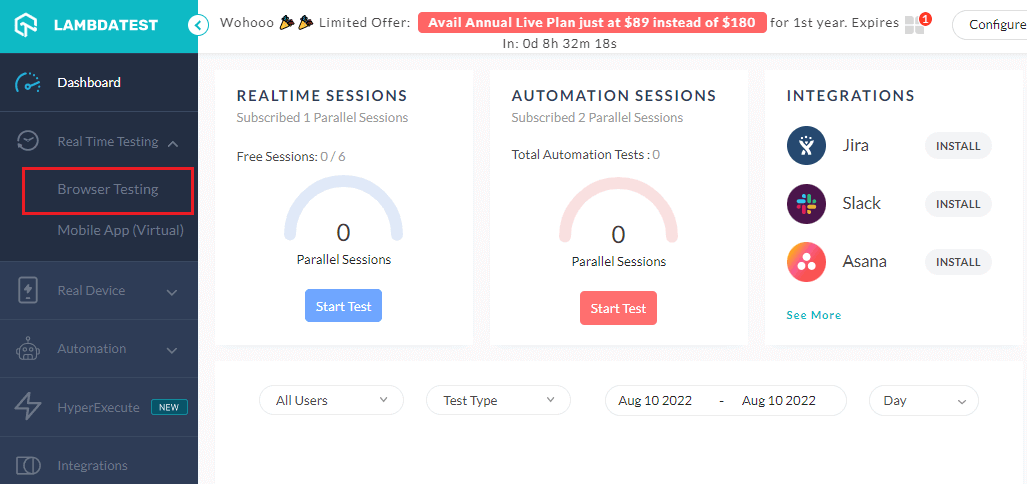
- Navigate to Real Time Testing → Browser Testing
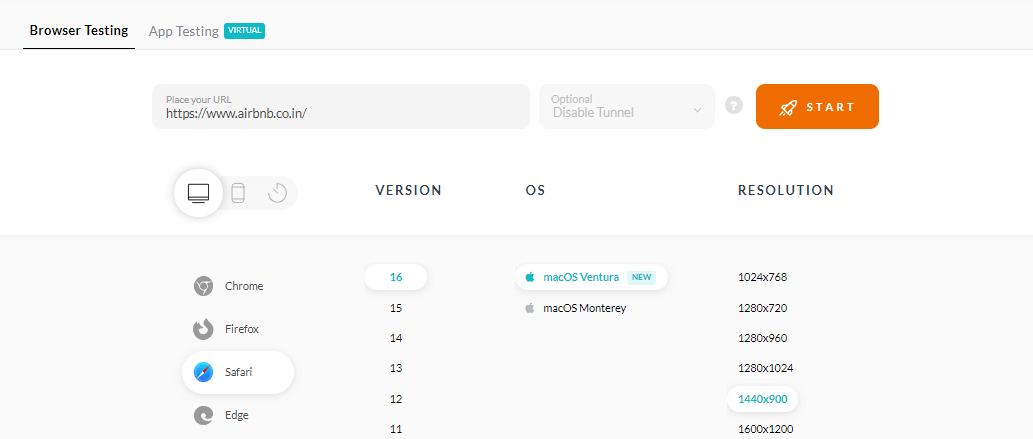
- After entering the website’s URL, select a desktop or mobile device to test it on. If you want to test on a desktop, select the RESOLUTION, OS, and VERSION of the browser. Then, click START.
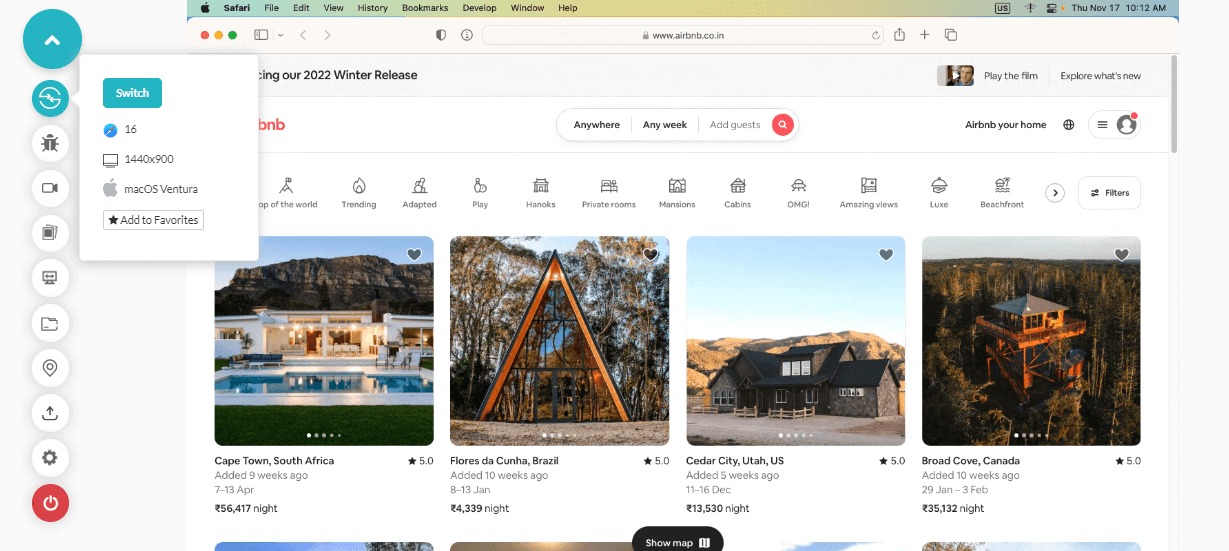
A cloud-based real operating system will launch where you can test Scala websites.
Automated Scala testing: Apart from the Real Time Testing functionality, you can perform end-to-end automation testing for your Scala websites. It is done by running automation tests at scale on your Scala website on the test automation cloud, which is highly reliable and scalable. You can run Selenium, Cypress, and JavaScript-based tests on the most reliable automation cloud.
Following are the steps to run automated tests on the TestMu AI platform.
- Login to your TestMu AI account.
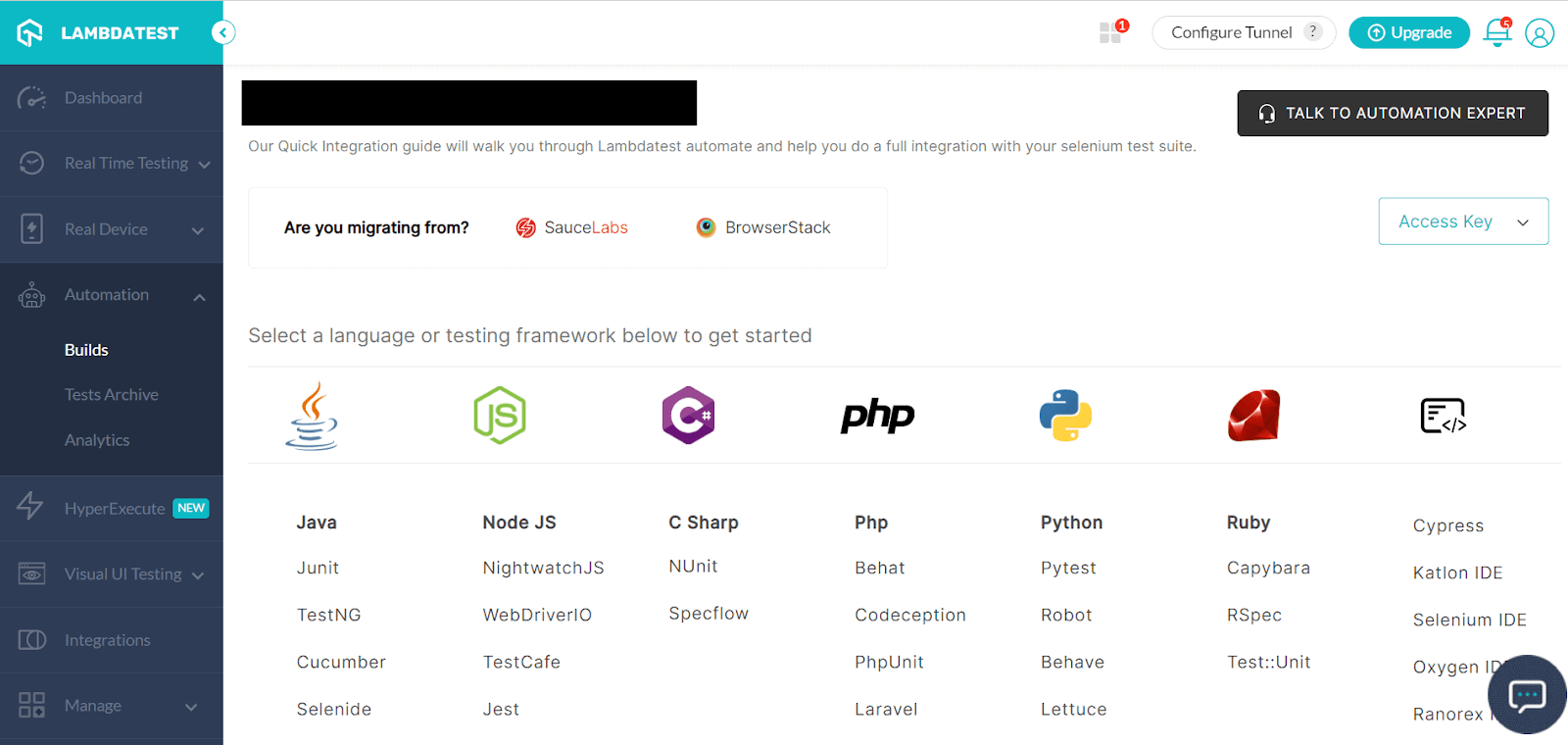
- From the left sidebar, go to Automation > Builds.
- Select your preferred testing framework to kick-start your Scala test automation.
Summing up
Apart from providing some excellent features to customers, Scala is one of the most widely supported programming languages for accomplishing your development requirements. It will be interesting to see what the future holds for Scala in the coming years. The usage is growing steadily, and the overall experience of using this language has been improving rapidly. The requirement for Scala developers has increased recently, which is a great sign. It is up to the community to ensure that you can use Scala in different domains.


Frequently asked questions
Did you find this page helpful?
More Related Hubs
TestMu AI forEnterprise
Get access to solutions built on Enterprise
grade security, privacy, & compliance
- Advanced access controls
- Advanced data retention rules
- Advanced Local Testing
- Premium Support options
- Early access to beta features
- Private Slack Channel
- Unlimited Manual Accessibility DevTools Tests